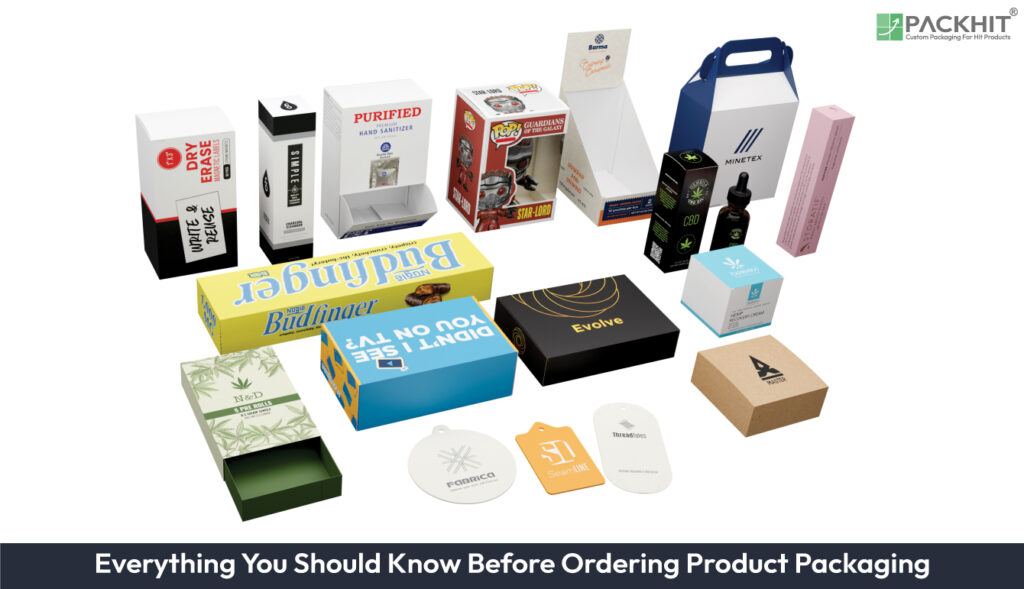
Packaging is essential for product presentation, protection, and branding, playing a vital role in the food, cosmetics, retail, and pharmaceutical industries. Product packaging serves multiple functions, including protecting products, enhancing brand identity, helping with transport and storage, and conveying important information through labeling. Packaging has evolved from natural materials like leaves and clay to modern, eco-friendly designs, meeting the needs of businesses and consumers.
Packaging types are categorized by material (paper, plastic, glass, metal, wood), usage (custom, sustainable, flexible, retail, luxury, e-commerce, bulk), and function (primary, secondary, and tertiary). Packaging can be either custom or stock, depending on the specific needs of a brand, product, or business. Custom packaging is designed specifically for a product or brand, allowing for unique sizes, shapes, materials, and branding elements like logos, colors, and custom prints, while stock (pre-made) packaging offers a practical solution for general use at lower costs.
The packaging development process includes material selection, design refinement, durability testing, and supplier collaboration to ensure functionality and cost efficiency. Ordering custom packaging requires understanding your product’s needs, setting a budget, choosing suitable materials, designing the packaging, and selecting a reliable supplier.
- What is Packaging?
- Types of Packaging
- What is Custom Packaging?
- Process of Packaging Development
- How Much Does Packaging Cost?
- How Can Packaging Improve Product Marketing and Brand Awareness?
- Why is Packaging Design Important for Products?
- What are Packaging Design Trends?
- Role of a Packaging Designer in Packaging
- How does the Packaging Engineer Create Structural Packaging?
- Which Packaging Companies Provide Packaging for Products?
- How to Order Custom Packaging for Your Products?
- 1. Understand Your Packaging Needs
- 2. Estimate Your Packaging Budget
- 3. Select the Type of Packaging
- 4. Measure the Box
- 5. Choose the Right Material
- 6. Consider Sustainable Materials
- 7. Select the Box Style
- 8. Create the Packaging Design
- 9. Choose a Printing Method
- 10. Select the Add-ons and Finishes
- 11. Choose a Packaging Supplier for Your Quantity, Timeline, and Budget
- How to Choose Packaging for Different Products?
What is Packaging?
Packaging is the science, art, and technology of containing, protecting, and presenting items for marketing, storage, shipping, and use. Packaging is made of various materials such as paper, cardboard, plastic, glass, metal, or biodegradable substances, chosen based on the product’s specific requirements. Packaging is widely used across industries such as food, pharmaceuticals, electronics, and retail to enhance brand identity, protect products, preserve them, facilitate transportation and storage, and communicate essential information through labeling.
The History of Packaging
The history of packaging mirrors the progression of human civilization, from using simple natural materials like leaves, animal skins, and gourds in ancient societies to the development of clay pots, woven baskets, and glassmaking techniques in subsequent eras. By the Middle Ages, advancements such as wooden barrels, parchment, and crates facilitated trade and storage, while the Industrial Revolution introduced transformative innovations like tin cans, paperboard, and corrugated cardboard, driven by mechanization and the need for mass production. The 20th century ushered in plastics, vacuum-sealing, and recyclable materials, revolutionizing packaging while addressing the growing demands of industrialization and environmental concerns.
Today, packaging integrates advanced materials, smart technologies, and sustainable solutions, with a focus on balancing functionality, consumer appeal, and ecological responsibility. Looking ahead, nanotechnology, IoT-enabled smart packaging, and circular economy principles are expected to shape the future, underscoring packaging’s role as a vital interface between products, consumers, and the environment.
Purpose of Packaging
Packaging serves multiple purposes, including marketing, branding, protecting, containing, preserving, transporting, and communicating, all while playing a vital role in the product’s usability and market appeal.
- Branding: Packaging establishes and communicates the product’s identity through the use of logos, colors, and designs. It also promotes brand recognition and loyalty by creating a distinct and memorable presence for consumers.
- Marketing: Packaging is used to attract buyers with visually appealing designs, effective messaging, and unique features. It influences purchase decisions and helps products stand out from competitors in a crowded market.
- Protection: Packaging protects the product from damage, contamination, and external factors like moisture, light, and temperature changes during storage, transportation, and handling.
- Containment: Packaging is used to hold the product, especially liquids, powders, and small items, for safe storage and shipping.
- Preservation: Packaging keeps the product fresh, safe, and intact throughout its shelf life by preventing spoilage or degradation.
- Shipping: Packaging ensures the safe and efficient transportation of products by protecting them from damage and keeping them organized for smooth handling during transit.
- Information Transmission: Packaging provides essential details like ingredients, usage instructions, safety warnings, expiration dates, and recycling guidelines, helping consumers make informed decisions.
- Convenience: Packaging simplifies handling, transport, and storage for both businesses and customers, making the product easy to use.
Packaging protects, contains, preserves, transports, and informs products; its specific role depends on the product and distribution needs described above.
What is Labeling in Packaging?
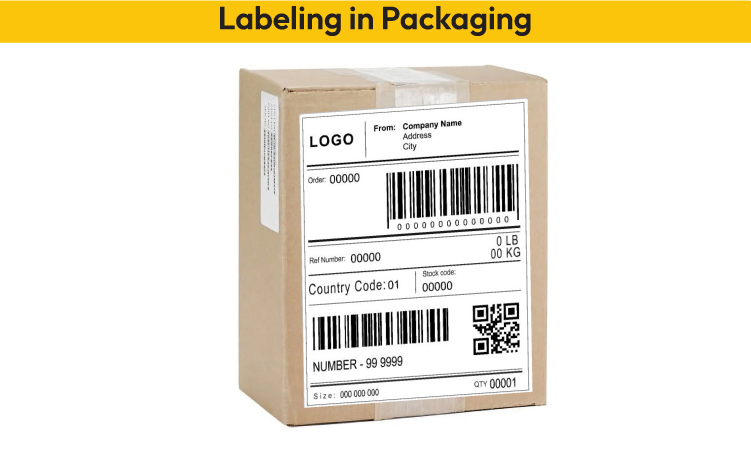
Labeling in packaging involves providing printed or graphic information on a container or article to communicate essential details about the product. Package labeling serves multiple purposes, including identifying the product, informing customers, and ensuring compliance with legal requirements. Package labels include details such as the product name, brand, ingredients, usage instructions, safety warnings, and expiration dates. These labels also feature barcodes, lot numbers, and recycling or handling symbols. Clear and accurate package labeling helps consumers make informed decisions, builds trust, and reinforces the brand’s identity. Labels play a vital role in packaging by enhancing functionality and appeal.
Types of Packaging
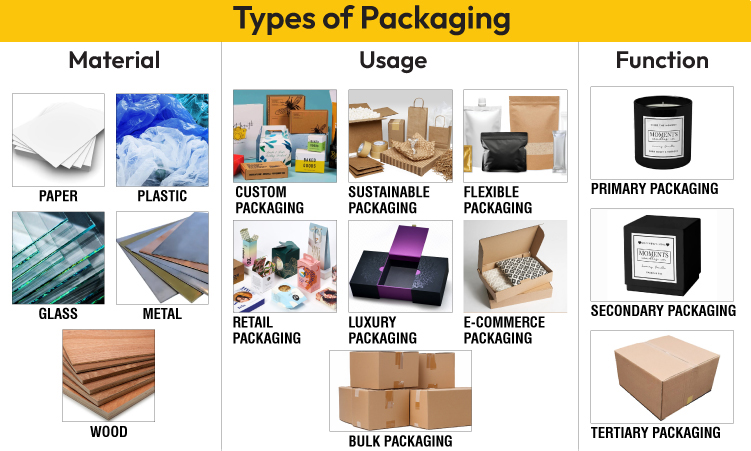
Packaging types are divided into three categories based on material, usage, and function.
Packaging Types by Material
Common packaging materials include paper, plastic, glass, metal, and wood.
Paper-based packaging, including cardboard, paperboard, kraft paper, card stock, and corrugated fiberboard, is widely used in food, retail, and e-commerce. Paper-based materials are often recyclable and can be customized for branding and product presentation.
Plastic packaging is lightweight and versatile and is commonly used for bottles, containers, pouches, and wraps. Glass offers strong barrier properties and a premium appearance, making it common for beverages, cosmetics, and perfumes. Metal provides durability and protection and is widely used for cans and tins. Wood is primarily used for shipping applications such as crates and pallets.
Packaging Types by Usage
Packaging can also be classified by its intended use, including custom, sustainable, flexible, retail, luxury, e-commerce, bulk, and product packaging.
Custom packaging is designed for a specific product or brand. Sustainable packaging incorporates materials or design approaches intended to reduce environmental impact, such as recycled, recyclable, reusable, or biodegradable components.
Flexible packaging is lightweight and adaptable and is frequently used for food and consumer products. Retail packaging is designed for presentation and sale in stores, while luxury packaging typically uses premium materials, finishes, and construction to create a high-end appearance.
E-commerce packaging is designed to protect products during shipping while supporting an effective unboxing experience. Bulk packaging is used to transport or store large quantities of goods. Product packaging refers to the container, wrapping, or other packaging used to enclose and protect a product while supporting usability and presentation.
Packaging Types by Function
Packaging is commonly divided into three functional levels: primary, secondary, and tertiary packaging.
What are Primary, Secondary, and Tertiary Packaging?
Primary, secondary, and tertiary packaging are three layers of packaging based on their function to contain, protect, store, display, and transport products.
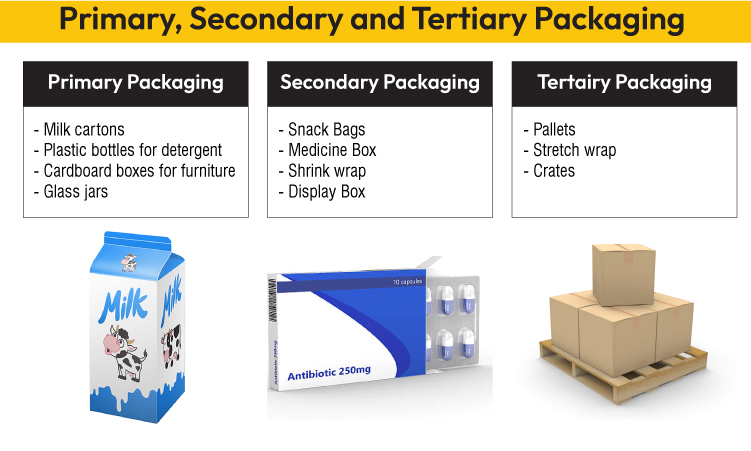
- Primary Packaging: Primary packagingdirectly holds and protects the product, ensuring safety and usability. Examples of primary packaging include bottles, cans, jars, pouches, tubes, wrappers, and blister packs.
- Secondary Packaging: Secondary packaging is used to group primary packages to facilitate handling, storage, distribution, or display. Secondary packaging includes cardboard boxes, shrink wrap, and mailing bags.
- Tertiary Packaging: Tertiary packagingis used for bulk handling, warehouse storage, and shipping to ensure safe and efficient transportation. Examples of tertiary packaginginclude pallets, stretch wraps, and shipping containers.
What is Custom Packaging?
Custom packaging is a type of packaging that is produced in the desired design, shape, material, and style to safely pack, store, and ship products like food, cosmetics, and candles while promoting the brand.
Custom vs. Stock Packaging
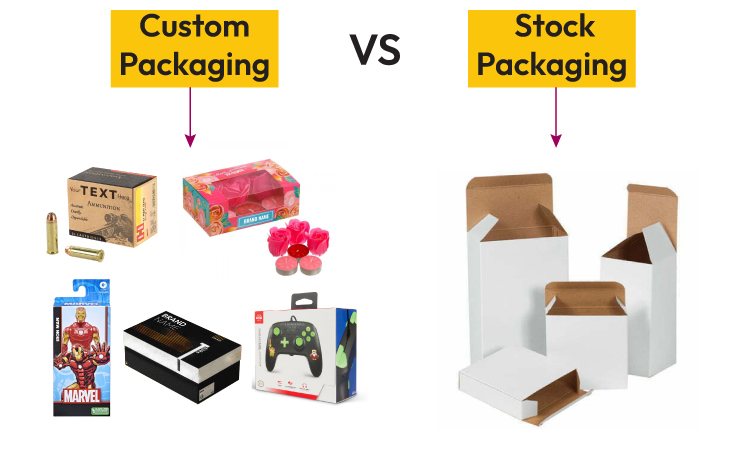
The main differences between custom and stock packaging lie in their level of personalization, cost, and purpose. Stock packaging is pre-made, generic packaging that offers standard sizes, limited customization, lower costs, and quick availability, making it ideal for basic needs and quick shipping. Custom packaging is designed specifically for a product, offering custom designs, styles, materials, sizes, and branding elements like logos and colors, creating a more premium and memorable customer experience. Stock packaging is ideal for startups, test marketing, or general shipping, while custom packaging is preferable for luxury goods, unique items, or businesses prioritizing branding and customer impressions.
Process of Packaging Development
The packaging development process involves a structured approach beginning with requirement analysis, where product specifications like dimensions, weight, and regulatory compliance are identified. Next, a concept design phase incorporates structural, material, and visual elements to create an initial model. This is followed by material selection, evaluating options such as paperboard or biodegradable polymers for cost-effectiveness and sustainability. The prototyping stage then develops physical or digital models to test practicality and performance. Rigorous testing and validation ensure durability and functionality through methods like drop tests and environmental simulations. A detailed cost analysis optimizes expenses by assessing material efficiency and production workflows. Finally, the design is finalized and moved to mass production, ensuring adherence to quality standards through automated processes and detailed specifications.
The seven key steps in the packaging development process are:
- Requirement Analysis
- Concept Design
- Material Selection
- Prototyping
- Testing and Validation
- Cost Analysis and Optimization
- Finalization and Production
How Much Does Packaging Cost?
Packaging costs (typically ranging from about $0.50 per unit for a small, simple one-piece box to about $1.00 per unit for a larger, multi-piece box) vary widely by size, materials, construction, printing, finishes, order quantity, and shipping. Request a current quote based on your specific packaging requirements. The components of packaging cost include material expenses, design intricacies, printing and finishes, tooling fees, labor costs, and freight and delivery charges, all of which collectively influence the overall expenditure.
How Can Packaging Improve Product Marketing and Brand Awareness?
Packaging can support product marketing by creating a strong first impression, differentiating products, and reinforcing brand identity through consistent logos, colors, typography, and other visual elements. These choices can improve recognition and communicate brand values, while functional features such as resealable closures, easy-open designs, easy-pour spouts, or handles can improve the customer experience.
Eco-friendly packaging made from recyclable, recycled, reusable, or biodegradable materials can support sustainability goals, while interactive features such as QR codes can provide additional product information or promotional content.
The effect of packaging on brand awareness, consumer perception, engagement, and purchasing behavior depends on the product, target audience, competitive environment, and quality of execution.
Why is Packaging Design Important for Products?
Packaging design is important because it helps communicate product information and benefits, attract attention, support brand identity, and improve functional usability. Packaging design can influence how consumers perceive and evaluate a product, although its effect on purchase decisions varies by product, audience, market, and execution. Well-designed packaging can also improve the overall consumer experience by making products easier to identify, understand, handle, store, or use.
What are Packaging Design Trends?
Packaging design trends reflect changing preferences in branding, usability, materials, and product presentation. Common approaches include minimalist layouts, bold typography, distinctive color systems, sustainable material choices, reusable or refillable formats, transparent packaging elements, tactile finishes, and interactive features such as QR codes.
Each approach serves a different purpose. Minimalist packaging can help simplify product communication, while bold typography and distinctive colors can improve shelf visibility and brand recognition. Sustainable materials and reusable formats can support environmental goals, although they may involve trade-offs related to cost, durability, availability, or product protection. Transparent elements can help customers view the product before purchase, while tactile finishes can create a more premium presentation. Interactive packaging can provide additional product information, instructions, or digital brand experiences.
The suitability of any packaging design trend depends on the product, target audience, brand positioning, functional requirements, budget, and production constraints.
Role of a Packaging Designer in Packaging
Packaging designers are tasked with conceptualizing and executing designs that balance functionality, aesthetics, and brand alignment. Their responsibilities include determining the shape, size, and material of packaging, as well as incorporating graphics, typography, and finishes to create a cohesive design. Packaging designers collaborate with clients to understand business objectives, ensuring the final product meets both practical and marketing requirements. These designers also oversee the production process, approving print proofs to maintain color accuracy and consistency.
How does the Packaging Engineer Create Structural Packaging?
A packaging engineer creates structural packaging by designing and testing materials and structures to ensure product safety, usability, and cost-efficiency. Packaging engineers analyze the product’s characteristics, transportation requirements, and environmental impact to design a package structure using appropriate materials like corrugated cardboard and strategically incorporate features like folds, creases, and reinforcements.
Which Packaging Companies Provide Packaging for Products?
Packaging companies that primarily offer stock or pre-made packaging for products are listed below.
- Uline
- Amcor
- WestRock
- Ball Corporation
- Berry Global
- Sealed Air
- Crown Holdings
- Sonoco
These packaging companies provide standard packaging such as boxes, bags, wraps, and containers that are pre-made and designed to meet general requirements. However, they do not offer customization for specific branding or design needs. In contrast, Packhit specializes in custom packaging, enabling businesses to create product packaging tailored to their brand, design, material, and style requirements.
How to Order Custom Packaging for Your Products?
To order custom packaging for your products, you need to assess your product’s dimensions and requirements, set a budget by calculating material and design costs, choose suitable packaging and materials, determine box dimensions and style, design the packaging, select printing and finishing options, and partner with a reliable packaging supplier.
Follow the steps given below to order custom packaging for your products.
1. Understand Your Packaging Needs
Begin by assessing your product’s dimensions, weight, and specific requirements for storage, marketing, shipping, and protection. Identify your branding goals and the functional features needed to ensure that your packaging aligns with your target audience’s expectations.
2. Estimate Your Packaging Budget
Calculate your packaging costs by factoring in material type, design complexity, order quantity, and printing options. Determine the cost per unit to ensure it stays within your budget constraints.
3. Select the Type of Packaging
Choose the appropriate packaging type, such as boxes, pouches, tubes, or wrappers, based on your product’s size and intended use. For example, fragile products may require durable materials for protection, while retail products benefit from visually appealing options like display boxes.
4. Measure the Box
To accurately measure box dimensions for product packaging, measure the length (L), width (W), and height (H) of the box using a ruler or measuring tape, considering both internal and external dimensions. Record the measurements in L × W × H format in inches or centimeters, double-check for accuracy, and account for additional packaging needs such as protective materials, flaps, and weight restrictions. Accurate box measurements help optimize packaging fit, protection, and shipping efficiency.
5. Choose the Right Material
Select appropriate packaging materials based on durability, cost, and environmental impact. Common materials for custom packaging include cardboard, paperboard, corrugated cardboard, kraft paper, card stock, and rigid board.
6. Consider Sustainable Materials
Opt for eco-friendly materials such as cardboard, recycled paper, or reusable packaging for your product packaging to support sustainability goals and attract environmentally conscious consumers.
7. Select the Box Style
Select a box style that best suits your product, such as mailer boxes, display boxes, or tuck end boxes. Ensure the chosen box style aligns with both functionality and branding to enhance product presentation and protection.
8. Create the Packaging Design
Create an eye-catching packaging design incorporating brand elements such as logos, colors, and graphics to enhance customer engagement. Work with a professional designer or submit pre-made artwork to your packaging supplier to create a custom design that reflects your brand identity.
9. Choose a Printing Method
Selecting the right printing method for your packaging depends on your budget, material, design, and production requirements. Digital printing is great for small batches and fast production, while offset printing provides high-quality images for large orders. Flexographic printing is best for high-speed printing on flexible materials, and screen printing works well for bold designs on rigid surfaces. Gravure printing is ideal for large-scale, high-quality prints. Choosing the right printing method ensures your packaging is visually appealing and functional.
10. Select the Add-ons and Finishes
Select finishes like coatings, laminations, foil stamping, embossing, debossing, and spot UV coating to enhance the visual appeal of the product packaging. Coatings such as matte, gloss, satin, or soft-touch not only improve the tactile feel but also provide a protective layer that enhances durability and resists scuffs or scratches.
Incorporate additional features such as foam inserts, cardboard dividers, die-cut handles, magnetic closures, ribbon closures, window cutouts, custom inserts, QR codes, NFC tags, security seals, and tamper-proof features to enhance functionality, security, and user experience.
11. Choose a Packaging Supplier for Your Quantity, Timeline, and Budget
Select a packaging supplier that can produce the required quantities within your timeline and budget. Review the supplier’s experience and customer reviews before making a decision.
How to Choose Packaging for Different Products?
Manufacturers should choose packaging by balancing product protection, branding, sustainability, shipping requirements, intended use, and budget. The best packaging option depends on the product’s characteristics and how it will be stored, transported, displayed, and used.
For products that are fragile, heavy, or sensitive to moisture, light, or temperature, protection should be the primary consideration. Corrugated packaging, protective inserts, barriers, or other suitable materials can be selected according to the level of protection required.
For retail products, packaging should balance protection with presentation. Custom shapes, printed graphics, colors, typography, and finishes can help communicate brand identity, while structural features should still support handling, storage, and product usability.
For e-commerce products, manufacturers should consider shipping durability, package size, protective materials, and ease of opening. Packaging that is unnecessarily large or complex can increase material use and shipping requirements, while packaging that provides insufficient protection can expose products to damage during transit.
Sustainability requirements can also influence material and structural choices. Recycled, recyclable, reusable, or biodegradable materials may support environmental goals, but manufacturers should also consider product protection, material availability, production requirements, durability, and cost.
The table below summarizes common packaging priorities and their practical implications for manufacturers:
| Packaging Priority | What Manufacturers Should Consider |
|---|---|
| Product protection | Product weight, fragility, moisture sensitivity, light exposure, storage, and transportation conditions |
| Branding | Logo placement, colors, typography, graphics, structure, finishes, and consistency across products |
| Sustainability | Material use, recyclability, recycled content, reuse potential, durability, and production requirements |
| Shipping | Package dimensions, weight, protective space, handling conditions, and transport efficiency |
| Retail presentation | Shelf visibility, product information, display requirements, and customer interaction |
| Usability | Opening, closing, dispensing, carrying, storage, and disposal or reuse |
| Cost | Materials, printing, finishes, tooling, order quantity, labor, and freight |
Manufacturers should evaluate these factors together rather than selecting packaging based on appearance, material, or cost alone. A packaging choice that performs well for one product or sales channel may not be suitable for another, so the final design should reflect the product’s functional requirements, brand objectives, distribution method, and production constraints.
