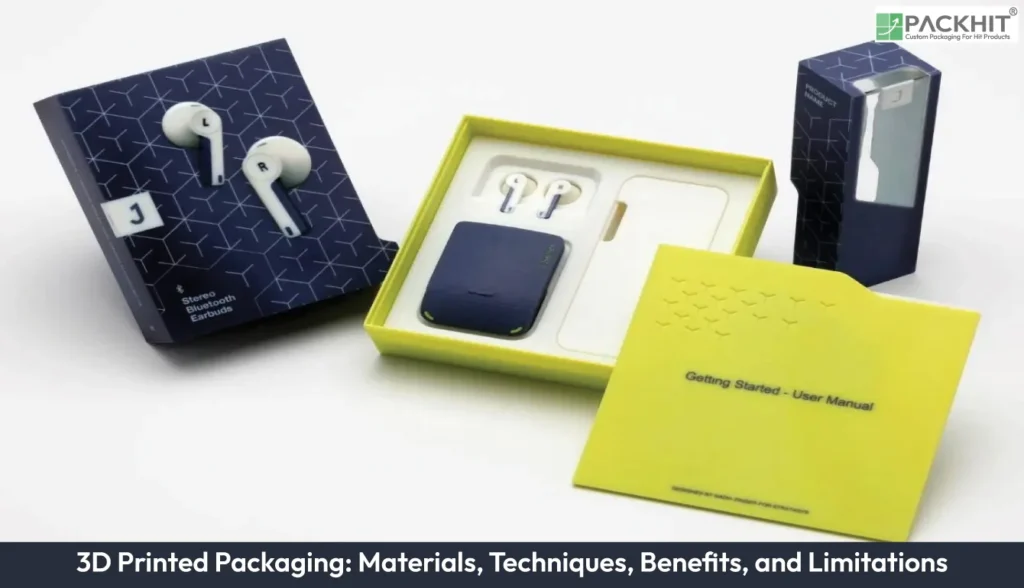
3D printed packaging is an additive manufacturing approach that creates packaging components layer by layer from digital designs. It enables customized structures, rapid prototyping, and complex geometries that are difficult to achieve with conventional manufacturing methods. The materials used in 3D printed packaging include plastics, bioplastics, metals, and composite materials, each offering different properties for strength, flexibility, sustainability, and specialized packaging applications. Common 3D printing techniques include Fused Deposition Modeling (FDM), Stereolithography (SLA), Selective Laser Sintering (SLS), and Multi-Jet Fusion (MJF), with each process suited to different production requirements, material compatibility, and design complexity. The benefits of 3D printed packaging include customization, reduced tooling requirements for certain applications, improved design flexibility, faster product development, and potential support for sustainable packaging goals when suitable materials and processes are selected. However, its adoption is influenced by limitations such as material constraints, slower production speeds for high-volume manufacturing, higher initial equipment costs, and regulatory requirements for certain packaging applications.
- What is 3D Printed Packaging?
- What Materials are Used in 3D Printed Packaging?
- Techniques Used in 3D Printed Packaging
- Fused Deposition Modeling (FDM)
- Stereolithography (SLA)
- Selective Laser Sintering (SLS)
- Multi-Jet Fusion (MJF)
- Benefits of 3D Printed Packaging
- Limitations of 3D Printed Packaging
- Main Industries That Use 3D Printed Packaging
- What are the Future Trends in 3D Printed Packaging?
What is 3D Printed Packaging?
3D printed packaging refers to packaging components or prototypes produced through additive manufacturing, where objects are created layer by layer from a digital design file. Compared with traditional packaging methods such as die-cutting, molding, or printing-based production, 3D printing can support rapid design iterations, complex geometries, and customized structures.
The suitability of 3D-printed packaging depends on factors such as production volume, material requirements, product regulations, required strength, surface finish expectations, and the intended application. For many manufacturers, 3D printing is most commonly evaluated for prototypes, limited production runs, specialized components, and designs that are difficult to produce using conventional methods.
What Materials are Used in 3D Printed Packaging?
The materials used in 3D-printed packaging vary depending on the required strength, flexibility, appearance, production method, and intended application. Common material categories include:
Composite Materials
Composite materials combine the properties of multiple substances to achieve specific performance characteristics. For example, composites that combine polymers with carbon fiber can improve stiffness, strength, or dimensional stability while maintaining compatibility with certain additive manufacturing processes. These materials may be considered for specialized packaging components where durability and structural performance are important.
Plastics
Thermoplastics such as PLA (Polylactic Acid) and ABS (Acrylonitrile Butadiene Styrene) are commonly used in additive manufacturing because they are available in printable formats and offer different combinations of strength, flexibility, and processing characteristics. PLA is often marketed for applications where renewable-source materials are preferred, although its environmental performance depends on factors such as industrial composting availability, product design, and disposal conditions.
Bioplastics
Bioplastics made from renewable sources, including some plant-derived feedstocks, may be considered for packaging applications where sustainability goals are a priority. Manufacturers should evaluate factors such as durability, barrier requirements, processing conditions, and end-of-life options before selecting these materials.
Metals
Metal powders, including aluminum or stainless steel in suitable additive manufacturing processes, may be used for specialized packaging components that require higher strength, heat resistance, or durability. These materials are generally considered for industrial or specialized applications where their performance justifies higher production complexity and cost.
Techniques Used in 3D Printed Packaging
Different 3D-printing techniques provide different combinations of detail, speed, material options, and production suitability. The appropriate method depends on factors such as design complexity, required strength, surface finish, production volume, and cost considerations.
Fused Deposition Modeling (FDM)
FDM is one of the most widely used additive manufacturing techniques. It creates parts by melting and extruding thermoplastic filament layer by layer. The process is commonly used for packaging prototypes, concept models, and small-scale production because it offers relatively low material costs and allows rapid design adjustments.
Stereolithography (SLA)
SLA uses light to cure liquid resin into solid layers. It can produce detailed prototypes with smooth surfaces, making it useful when appearance and fine design features are important. Final suitability depends on the selected resin properties and intended use.
Selective Laser Sintering (SLS)
SLS uses a laser to fuse powdered materials into solid parts. It may be suitable for functional prototypes or components requiring greater mechanical performance than some basic prototype methods.
Multi-Jet Fusion (MJF)
MJF uses a powder-based process where agents and heat are applied to form parts. It can support efficient production of detailed components, depending on material selection, equipment capability, and production requirements.
Benefits of 3D Printed Packaging
3D printed packaging reduces turnaround time for packaging prototypes and supports SKU-level customization for fit, branding, and structural features.
- Faster prototyping enables iterative design review with printed samples instead of waiting for tooling.
- Low-volume production supports short runs for launches, seasonal packaging, and replacement parts without batch-size penalties.
- Design-for-assembly prints features such as snap fits, alignment ribs, and fold guides to reduce packing labor and damage risk.
- Brand fidelity adds fine surface textures, embossing, and raised logos while keeping graphic elements aligned to the product shape.
- Weight reduction follows topology-style thinking by removing non-structural material and using lattice or rib structures.
- Material control enables predictable mechanical behavior by selecting filament or resin choices matched to stiffness, impact resistance, and surface finish.
- Localization prints region-specific labeling areas and pack identifiers for multi-market compliance and inventory tracking.
Manufacturers commonly use 3D-printed packaging for packaging inserts, protective carriers, custom clamshell prototypes, and branded outer shells where form-fit and short lead times matter.
Limitations of 3D Printed Packaging
3D printed packaging has constraints that affect cost, throughput, and performance in distribution.
- Material limits: Many printed polymers soften under heat or creep under load, which changes fit and cushioning performance during shipping.
- Barrier performance: Printed structures do not always match film and laminate barrier properties for moisture, oxygen, or light control, which matters for sensitive goods.
- Surface finish: Layering can leave a rough surface that traps dust or reduces label adhesion, which can increase rework during branding and quality checks.
- Dimensional consistency: Warping, shrinkage, or printer calibration drift can shift tolerances, which can prevent tight fits for inserts, closures, or nested packaging.
- Mechanical variability: Strength depends on print orientation and layer bonding, so flex and impact resistance change across parts and production batches.
- Throughput constraints: Large-volume runs can be slower than injection molding or thermoforming because each packaging geometry is printed layer-by-layer.
- Tooling and setup time: Even without hard tooling, pre-print preparation, test builds, and reprints add lead time until the packaging meets fit and finish requirements.
- Cost at scale: Printing per unit can raise unit cost when demand is high, especially when supporting structures, post-processing, or waste material increases.
- Post-processing needs: Many parts require support removal, sanding, or sealing for appearance and cleanliness, which adds labor and inspection steps.
- Regulatory and compliance checks: Packaging contacting foods, cosmetics, or medical-adjacent products may require documented material safety, chemical migration data, and traceable manufacturing records.
When 3D printed packaging is chosen for customization and branding, these limits typically determine whether printed packaging stays in prototyping, small-batch production, or specific product categories.
Limitations of 3D Printed Packaging also guide design decisions for dimensional tolerances, protective performance, and production planning.
Main Industries That Use 3D Printed Packaging
Main industries that use 3D-printed packaging include consumer electronics, medical devices, cosmetics, automotive components, food and beverage, and industrial equipment. These sectors use 3D-printed outer shells, inserts, and custom-fit trays for faster packaging prototyping, tighter product protection, and brand-consistent shelf presentation.
Food and Beverage Packaging
3D printing may be explored for prototypes, custom designs, molds, or specialized packaging concepts. Any packaging intended for direct food contact requires appropriate material selection, testing, and compliance with applicable regulations.
Medical Packaging
Additive manufacturing may support the development of specialized packaging components or prototypes for medical applications. Requirements such as sterilization compatibility, material safety, and regulatory approval must be evaluated before use.
Luxury Packaging
Luxury brands may use 3D printing to explore complex shapes, decorative elements, or customized packaging concepts where design flexibility is a priority.
Industrial Packaging
Manufacturers may evaluate 3D printing for protective inserts, custom holders, or specialized packaging components designed around specific products and transportation needs.
What are the Future Trends in 3D Printed Packaging?
The future development of 3D printed packaging may be influenced by ongoing advancements in materials, printing techniques, automation, and design capabilities. Current areas of interest include:
- Integration of Smart Features: Packaging concepts may incorporate sensors or digital elements for applications such as tracking, monitoring, and product information.
- Development of Alternative Materials: Research and adoption of recyclable, renewable-source, or biodegradable materials may expand as manufacturers evaluate sustainability requirements and end-of-life considerations.
- Automation in Production: Combining additive manufacturing with automated workflows may help improve consistency and support more efficient production processes for suitable applications.
- Personalized Consumer Experiences: Digital manufacturing can support customized packaging designs for limited editions, specialized products, or customer-specific requirements.
As 3D printing technology continues to develop, manufacturers may explore new packaging applications where design flexibility, customization, and rapid development provide practical advantages.