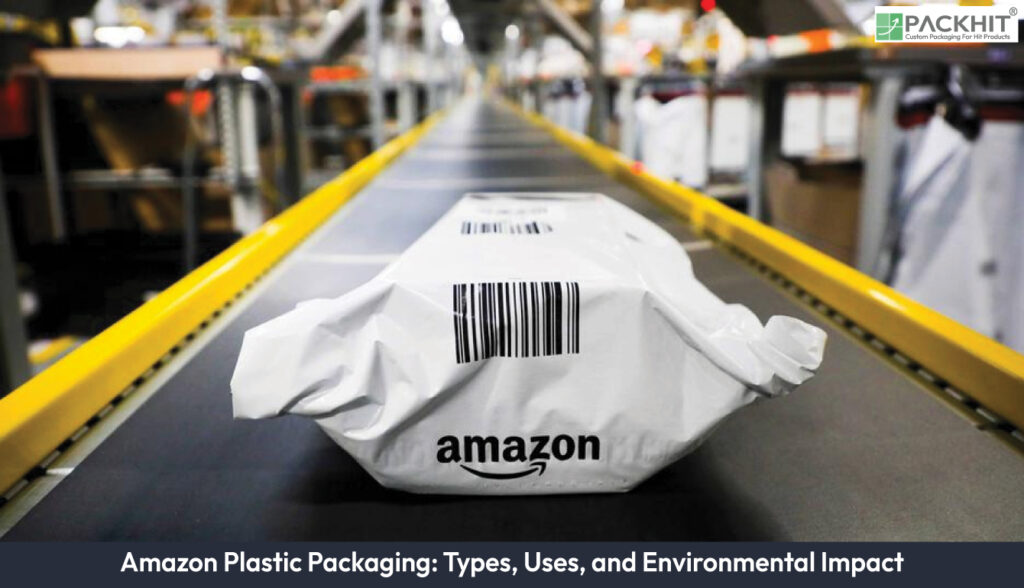
Amazon plastic packaging comprises polyethylene, polypropylene, and multi-layer films that Amazon uses to cushion and seal products, provide moisture and tamper resistance, and reduce shipping volume across its fulfillment and delivery network. Amazon’s use of plastic packaging serves critical roles in its global supply chain, balancing product protection, shipping efficiency, and customer convenience. The company employs various types, including poly mailers for non-fragile items, bubble wrap for cushioning delicate products, air pillows to stabilize shipments, shrink wrap for bundling or sealing, and plastic pouches for durable, resealable solutions. These materials are strategically selected based on product type, shipping conditions, and operational requirements. The environmental impact of such packaging is significant. Issues include waste generation from single-use plastics, recyclability challenges with multi-layered materials, carbon emissions during production, and microplastic pollution from improper disposal. While these solutions optimize logistical efficiency, they also highlight the need for sustainable alternatives to mitigate ecological harm.
- What is Amazon Plastic Packaging?
- What Types of Plastic Packaging Does Amazon Use?
- How are Plastic Packaging Types Used in Amazon’s Supply Chain?
- Direct-to-Consumer Shipments
- Warehouse Operations
- Retail-Ready Packaging
- Balancing Performance and Cost
- Environmental Impacts of Amazon’s Plastic Packaging
- How Can Manufacturers Evaluate Plastic Packaging for Amazon Shipments?
- How Does Amazon Plastic Packaging Balance Performance and Environmental Impact?
What is Amazon Plastic Packaging?
Amazon plastic packaging consists of polymer-based materials used to contain, protect, seal, group, or ship products through an e-commerce fulfillment network. Common materials include polyethylene (PE), polypropylene (PP), low-density polyethylene (LDPE), and multi-layer films. Depending on the format, plastic packaging can add cushioning, moisture resistance, tamper evidence, abrasion resistance, and low package weight during handling.
The packaging examples in this section were identified from the material descriptions and stated functions of common e-commerce shipping formats: mailers for outer shipment, cushioning for fragile goods, void fill for movement inside boxes, film for grouping or sealing, and pouches for flexible product containment. This method describes packaging functions rather than documenting every Amazon facility or product category. Packaging choices can vary by seller, fulfillment center, item dimensions, product fragility, shipping route, and current operating practice.
For a US manufacturer, the relevant comparison starts with the product rather than the shipping label. Record the product mass, dimensions, fragility, moisture sensitivity, required seal, expected shipping environment, and available end-of-life route before selecting a plastic format. A package that protects a product with less material can reduce damage-related waste, but the result depends on actual package performance and disposal conditions.
What Types of Plastic Packaging Does Amazon Use?
Amazon uses several types of plastic packaging, including:
Poly Mailers
Poly mailers are lightweight polyethylene envelopes for compressible, non-fragile products. Clothing, books, and accessories can fit this format when the contents do not require rigid walls. Polyethylene film resists moisture and tearing while adding little shipping weight. A self-sealing adhesive strip closes the envelope without separate tape or fasteners. The selected film gauge, seam construction, and mailer size depend on the item’s shape, compression tolerance, closure requirements, and exposure to abrasion.
Bubble Wrap
Bubble wrap is a protective plastic material with air-filled pockets that cushion fragile items during transit. The article classifies it as a cushioning material for products such as electronics, glassware, and ceramics, where impact and vibration present handling risks. Bubble wrap commonly uses low-density polyethylene (LDPE), with film thickness, bubble diameter, and wrap layers selected according to the required level of cushioning. Air pockets lose protective capacity when crushed, so the wrap must be sized for the product and handling conditions. This description does not establish how frequently Amazon uses each thickness or format.
Air Pillows
Air pillows are inflatable plastic cushions that fill open space inside shipping boxes and limit item movement. They can separate products from box walls and reduce contact between multiple items. Air pillows occupy less storage volume before inflation than preformed void-fill materials, although their protective performance depends on seal quality, inflation pressure, placement, and the load inside the box. Use can differ according to box size, item geometry, and the packing equipment available at a facility; this section does not claim that one void-fill material is used in every shipment.
Shrink Wrap
Shrink wrap is a plastic film that contracts around a product or group of products after heating. The close fit can keep bundled items together and reduce exposure to dust or moisture during storage and movement. The article identifies polyethylene and polyvinyl chloride (PVC) as possible film materials. Film selection also depends on seal temperature, puncture resistance, clarity, and the shape of the load. Recyclability depends on the polymer, additives, contamination, film thickness, and collection system, so a general recycling result cannot be assigned to every shrink-wrap format.
Plastic Pouches
Plastic pouches are flexible containers for products such as food items, cosmetics, and small electronics. A pouch can combine polyethylene, polypropylene, or other polymer layers to add seal strength and barriers against moisture, oxygen, or grease. Resealable closures support repeated opening and closing. Multi-layer construction can improve package performance while making material separation and recycling more difficult. The specific layer structure, seal type, barrier requirement, and end-of-life route require product-level information that is not supplied here.
How are Plastic Packaging Types Used in Amazon’s Supply Chain?
Plastic packaging can support product protection, order consolidation, storage, and parcel transport. The examples below connect each format with a stated packaging function. They do not document a universal Amazon procedure, fixed material allocation, or current practice at every fulfillment location.
Direct-to-Consumer Shipments
Direct-to-consumer shipments can use poly mailers for compressible, non-fragile items such as clothing and books. Bubble wrap can cushion electronics, glassware, and ceramics against contact, vibration, and impact. The selected format depends on the product’s fragility, dimensions, closure requirements, and outer-package specification. A rigid box remains relevant when the item can be crushed or punctured in a flexible mailer.
Warehouse Operations
Air pillows can fill voids in shipping boxes and restrict movement during handling. Shrink wrap can group multiple items or shield a product from dust and moisture during storage or bulk movement. These are functional examples, not evidence that every warehouse uses both materials in the same way. Package trials can measure movement, compression, seal failure, and product damage before a format is adopted.
Retail-Ready Packaging
Plastic pouches can contain food items, cosmetics, and small electronics when flexible walls, a seal, or a resealable closure meet the product’s packaging requirements. Barrier layers can protect contents during storage, but the pouch’s actual retail or fulfillment role depends on the product and seller packaging specification. Food and cosmetic products also require material compatibility checks for the contents, seal, and expected storage conditions.
Balancing Performance and Cost
Packaging selection involves trade-offs among product protection, material weight, package volume, labor, and end-of-life handling. A poly mailer can reduce outer-package material and dimensional weight for a non-fragile item, while bubble wrap or air pillows can add protection where movement creates damage risk. No supplied data establishes a single cost, damage-rate, or carbon result for each format. A manufacturer can compare package mass, packed dimensions, material composition, packing time, damage records, and local recovery access for each candidate design.
Environmental Impacts of Amazon’s Plastic Packaging
Amazon’s plastic packaging can contribute to waste generation, recyclability challenges, carbon emissions, and microplastic pollution.
Waste Generation
Single-use poly mailers, bubble wrap, and air pillows can become packaging waste after one delivery. The quantity depends on package size, material thickness, reuse, and disposal behavior. A package can also create additional waste if damage causes the product or replacement shipment to be discarded. This article identifies a waste-generation pathway; it does not supply a measured share of municipal solid waste attributable to Amazon plastic packaging.
Recyclability Challenges
Polyethylene-based films can be technically recyclable, but collection, sorting, contamination, and local processing determine whether recovery occurs. Multi-layer pouches and some shrink films contain bonded polymers or additives that complicate separation. Adhesive labels, food residue, and mixed-material closures can further affect processing. A recycling label alone does not establish access to a collection program or successful reprocessing in a particular US location.
Carbon Footprint
Plastic packaging carries emissions from polymer production, conversion, transport, and disposal. Low package weight can reduce transport-related energy use, while polymer production still has an upstream emissions burden. The net result requires a defined life-cycle comparison with package weights, shipping distances, energy sources, and end-of-life assumptions. Those measurements are not supplied for Amazon’s full packaging system here.
Microplastic Pollution
Discarded plastic packaging can fragment into smaller particles through sunlight, abrasion, and weathering. Particle release depends on the polymer, additives, exposure conditions, film thickness, and disposal pathway. Particles can move through soil, stormwater, waterways, and waste-handling environments, but this section does not quantify release from Amazon packaging or establish a measured contribution to food, air, soil, water, or drinking-water contamination. The potential effects of microplastic exposure on wildlife and human health remain an area of ongoing study, and no unsupported industry or study estimate is applied here.
How Can Manufacturers Evaluate Plastic Packaging for Amazon Shipments?
Manufacturers can evaluate an Amazon-oriented package by testing protection, material composition, pack-out efficiency, and disposal access together. Start with the smallest package that protects the product through expected handling, then document the polymer type, film or wall thickness, additives, adhesive, closure, and any bonded layers. Test compression, puncture, vibration, drop exposure, seal integrity, and moisture resistance according to the product’s shipping risk. Record the package weight and packed dimensions beside product damage results.
- Protection: Check whether the format limits impact, abrasion, compression, vibration, moisture, or product movement.
- Composition: Identify PE, PP, PVC, multi-layer film, adhesive components, closures, and labels.
- Operations: Measure sealing time, equipment requirements, storage volume, labor steps, and pack-out consistency.
- Recovery: Confirm whether the intended US disposal route accepts the complete package, including residue, labels, closures, and bonded layers.
This evaluation keeps the environmental question tied to the actual package specification. A generic statement about plastic packaging cannot replace measurements for a particular product, shipment profile, and local waste system.
How Does Amazon Plastic Packaging Balance Performance and Environmental Impact?
Amazon plastic packaging balances performance and environmental impact by using lightweight plastic materials for specific protection, sealing, cushioning, and shipping requirements while considering material use and end-of-life recovery. Poly mailers can reduce package weight and space requirements, while bubble wrap and air pillows provide cushioning for products that need additional protection. However, the environmental impact varies by material, construction, quantity used, and disposal or recycling options.
Key considerations include:
- Product Protection: Plastic films and cushioning materials can provide resistance to moisture, abrasion, impact, and contamination where these properties are needed.
- Material Efficiency: Lightweight films and inflatable cushioning can provide packaging volume or protection with relatively little material, although excessive packaging can increase waste.
- Recyclability: Some single-material plastic formats may be recyclable where suitable collection and processing systems exist, while multilayer films and certain flexible formats can be more difficult to recover.
- Shipping Efficiency: Lightweight plastic packaging can reduce package weight and storage volume, but the overall environmental effect also depends on material production, transportation, reuse, and disposal.
- Alternative Materials: Paper-based or other packaging materials may be considered where they can provide the required protection and have suitable recovery options.
Plastic packaging can provide useful protection and shipping efficiency, but its environmental performance depends on the specific material and application. The appropriate choice should consider product protection, material quantity, shipping requirements, recyclability, and available end-of-life infrastructure.