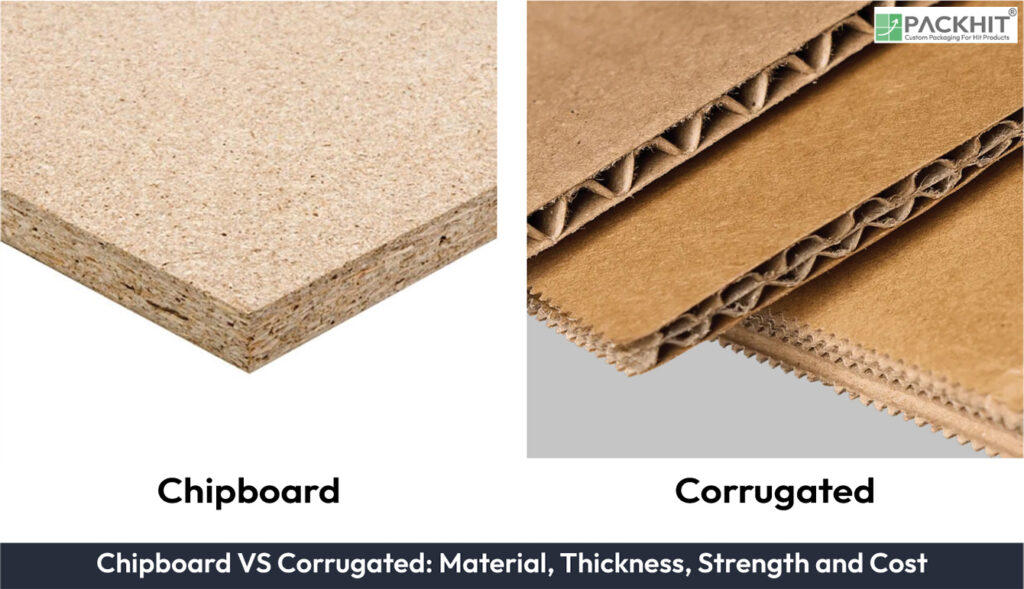
Chipboard and corrugated cardboard differ based on material composition, thickness, strength, and cost. Chipboard is commonly selected for lightweight retail packaging where print quality and cost efficiency are important, while corrugated cardboard is preferred for shipping and protective applications that require cushioning and compression strength. The choice between these materials depends on factors such as product weight, handling conditions, branding requirements, transportation needs, and sustainability goals.
- What is the Difference Between Chipboard and Corrugated Cardboard?
- What are the Uses of Chipboard and Corrugated Cardboard in Packaging?
- What are the Environmental Impacts of Chipboard and Corrugated Cardboard?
- Key Differences Between Chipboard vs. Corrugated Cardboard
- Quick Selection Checklist for Chipboard vs. Corrugated Boxes
- Which material is better for shipping products?
- Which material is better for retail packaging?
- How does moisture affect chipboard and corrugated cardboard?
- What specifications should manufacturers confirm with suppliers?
- Can corrugated cardboard replace chipboard in every application?
- How to Choose Between Chipboard and Corrugated Cardboard for Packaging?
What is the Difference Between Chipboard and Corrugated Cardboard?
The difference between chipboard and corrugated cardboard is based on material composition, thickness, strength, and cost.
1. Material
The primary material difference between chipboard and corrugated cardboard is their construction. Chipboard uses compressed paper fibers to create a flat, uniform sheet, while corrugated cardboard combines linerboards with a fluted medium to create a layered structure. These differences influence factors such as stiffness, cushioning ability, printing performance, and suitability for different packaging environments.
Purpose and Function
Chipboard primarily provides a printable, rigid substrate for lightweight retail packaging where appearance, folding performance, and cost efficiency are more important than shipping protection. Corrugated cardboard primarily protects products during storage and transportation by combining linerboards with a fluted medium that improves compression resistance and impact absorption.
Manufacturing Process
Chipboard is produced by compressing recycled or virgin paper fibers into dense sheets that are dried, calendered, and cut into the required thickness. Corrugated cardboard is manufactured by forming paper into flutes, bonding the fluted medium between linerboards with adhesive, and converting the finished board into the required wall construction and flute profile.
Handling Considerations
Chipboard performs best when stored in clean, dry environments because prolonged moisture exposure can reduce stiffness and increase the likelihood of bending or surface deformation. Corrugated cardboard should also be protected from excessive moisture because water absorption can reduce compression strength and stacking performance. Packaging that shows crushed corners, permanent creases, delamination, or moisture damage should be evaluated before reuse or shipment.
2. Thickness
Chipboard thickness is commonly specified within a range that varies by grade, manufacturer, and intended application. For example, some chipboard grades may fall around 0.015 inches to 0.125 inches, with thinner grades used for folding cartons and thicker grades used for backing boards or retail displays. Actual thickness should always be confirmed using the supplier’s specification sheet for the selected grade.
For corrugated constructions, thickness depends on the selected flute profile and wall construction. Single-wall boards commonly measure approximately 0.125 to 0.25 inches, whereas double-wall and triple-wall constructions can exceed 0.5 inches.
For example, products stored in humid warehouses or transported through multiple distribution centers may require a corrugated board grade with sufficient compression performance under expected storage conditions. Reviewing the specified flute profile, board grade, and any moisture-resistant treatments helps determine whether the selected board matches the intended shipping environment.
3. Strength
Chipboard offers moderate strength, sufficient for lightweight packaging and applications where structural integrity is not critical. It is more susceptible to bending and tearing under heavier loads, making it less suitable for shipping fragile or bulky products. However, its smooth surface and rigidity make it well suited for retail packaging, folding cartons, and point-of-sale displays.
In contrast, corrugated cardboard is designed to provide structural support and cushioning across a wide range of packaging applications. The fluted medium helps absorb impacts and distribute compression forces during handling and transportation.
Manufacturers commonly report Edge Crush Test (ECT) and burst strength values as standardized comparison indicators for specific corrugated board grades. These measurements are primarily used when selecting between corrugated constructions with different flute profiles, wall configurations, and paper grades. Chipboard selection is evaluated differently because it is generally chosen for lightweight applications where sheet rigidity, thickness, folding performance, print quality, and resistance to bending during normal handling are more relevant than shipping compression ratings.
ECT and burst values are comparable only when the corrugated board grade, flute profile, wall construction, testing standard, and test conditions are equivalent. They should not be interpreted as guaranteed performance for every packaging application. Actual performance depends on board construction, manufacturing quality, storage environment, handling conditions, and expected load requirements. For project-specific decisions, verify the supplier specification sheet for the exact corrugated grade, reported ECT or burst values, and the testing conditions used.
Common Failure Modes
Chipboard may bend, crease, or tear when exposed to heavy stacking loads, repeated handling, or excessive moisture because it lacks a fluted support structure. Corrugated cardboard can lose compression strength if it absorbs moisture, is overloaded beyond its board grade, or uses an unsuitable flute profile for the intended shipping conditions.
4. Cost
Chipboard is generally more cost-effective because its flat-sheet construction uses fewer material layers and a simpler manufacturing process. Corrugated cardboard generally costs more because its linerboards, fluted medium, and adhesive lamination increase material use and production complexity. Although corrugated board has a higher initial material cost, its additional cushioning and compression strength may reduce shipping damage for products that require transport protection. Manufacturers should compare chipboard and corrugated cardboard according to the product’s protection requirements, transportation conditions, and total packaging cost rather than material price alone.
What are the Uses of Chipboard and Corrugated Cardboard in Packaging?
Chipboard is best suited for lightweight and visually appealing packaging like food boxes, stationery, and cosmetic containers, whereas corrugated cardboard is ideal for heavy-duty applications such as shipping, storage, and custom protective inserts.
Uses of Chipboard in Packaging
Chipboard is commonly used for lightweight retail applications such as food boxes, cosmetic cartons, stationery packaging, and product sleeves. Its smooth surface supports high-quality printing and branding, making it suitable where shelf appearance is important. However, its limited structural strength means it is generally better suited for products that do not require heavy stacking or impact protection.
Uses of Corrugated Cardboard in Packaging
Corrugated cardboard is commonly used for shipping boxes, storage containers, protective inserts, and industrial packaging. Its layered construction provides cushioning and compression resistance, making it suitable for fragile products, heavier items, and applications involving repeated handling. Industry test methods such as Edge Crush Test (ECT) and burst strength ratings are commonly referenced when comparing corrugated board grades. Manufacturers should verify supplier specifications and select a board grade appropriate for the expected shipping conditions, stacking requirements, and product weight rather than relying on test values alone.
What are the Environmental Impacts of Chipboard and Corrugated Cardboard?
Chipboard and corrugated cardboard can both support sustainable packaging goals, but their environmental performance depends on factors such as recycled content, material sourcing, manufacturing processes, coatings, and end-of-life handling. Corrugated cardboard is widely recycled and often incorporates recovered fibers, although additional materials such as coatings or adhesives may affect recycling pathways. Chipboard can also be recyclable when it is free from incompatible coatings or laminations, but its lower structural durability may limit reuse opportunities compared with stronger corrugated formats.
Chipboard, commonly used for folding cartons, backing materials, and lightweight packaging applications, can also support sustainable packaging goals because it is typically fiber-based and recyclable where appropriate recycling systems exist. Its lower weight can reduce material usage and shipping impacts in certain applications, though coatings, laminations, adhesives, or contamination may affect recyclability.
The overall environmental performance of either material depends on factors such as recycled content, fiber sourcing, manufacturing efficiency, durability requirements, and local recycling infrastructure. Selecting the most suitable option requires balancing material efficiency, product protection, and the ability to recover or recycle the packaging after use.
Key Differences Between Chipboard vs. Corrugated Cardboard
Chipboard and corrugated cardboard are both widely used paper-based packaging materials, but they serve different purposes based on structure, strength, cost, and application requirements. Chipboard is generally preferred for lightweight retail packaging that requires a smooth surface and high-quality printing, while corrugated cardboard is designed for shipping and protective applications where cushioning, stacking strength, and durability are essential. The table below compares these materials across key performance and selection factors.
| Attribute | Chipboard | Corrugated Cardboard |
|---|---|---|
| Material Structure | Flat sheet made from compressed paper fibers; provides rigidity and a smooth printable surface | Layered construction using linerboards and a fluted medium; provides cushioning and structural support |
| Typical Thickness Consideration | Thickness varies by grade and application; commonly used for folding cartons, sleeves, backing boards, and retail displays where sheet rigidity is sufficient | Thickness depends on flute profile and wall construction; selected based on shipping loads, stacking requirements, and protection needs |
| Strength Characteristics | Best suited for lightweight products requiring stiffness, folding performance, and appearance; more vulnerable to bending, tearing, and deformation under heavy loads | Designed for compression resistance, cushioning, and impact protection; performance depends on board grade, flute profile, paper grade, and construction |
| Strength Verification | Review thickness, stiffness, folding performance, and expected handling conditions | Review board grade, flute profile, ECT or burst values where applicable, and testing conditions |
| Cost Factors | Generally lower cost due to simpler flat-sheet construction; efficient for lightweight retail packaging | Often higher material cost due to layered construction but may reduce damage-related costs in demanding shipping environments |
| Best Use Environment | Dry, controlled environments with limited stacking and handling stress | Distribution environments involving shipping, palletization, repeated handling, or heavier loads |
| Main Trade-Off | Better print quality and lightweight efficiency but provides less protection during transport | Better protection and cushioning but may require more material and higher cost |
Quick Selection Checklist for Chipboard vs. Corrugated Boxes
Selecting the right material depends on balancing appearance, protection, cost, and performance requirements. Chipboard provides an efficient solution for retail-focused packaging, while corrugated cardboard offers enhanced durability for transportation and heavy-duty applications. A careful evaluation of product needs and supply chain conditions helps ensure the selected packaging performs effectively throughout its lifecycle.
Choose chipboard when:
- Shelf appearance, printing quality, and branding are major priorities.
- Products are lightweight and require basic structural support.
- Packaging will be stored in controlled conditions with limited handling stress.
Choose corrugated cardboard when:
- Products require shipping protection, cushioning, and compression resistance.
- Packages will face pallet loads, long-distance transportation, vibration, or repeated handling.
- Risks such as crushing, corner damage, or product movement need to be minimized.
Before selecting a supplier, confirm:
- Expected product weight and distribution conditions.
- Required stacking load and transportation duration.
- Moisture exposure risks and storage environment.
- Required chipboard thickness and stiffness or corrugated board grade and flute profile.
- Available supplier testing data, including ECT or burst values for corrugated grades when applicable.
Which material is better for shipping products?
Corrugated cardboard is generally better suited for shipping because its fluted structure provides cushioning and compression resistance during transportation. Chipboard is typically better for lightweight retail packaging where appearance and print quality are more important than heavy-duty protection.
Which material is better for retail packaging?
Chipboard is often preferred for retail packaging because its smooth surface supports high-quality printing, folding cartons, and branded displays. Corrugated cardboard may be selected when retail packaging also requires stronger protection during distribution.
How does moisture affect chipboard and corrugated cardboard?
Both materials can lose performance when exposed to moisture. Chipboard may lose stiffness and become more prone to bending or deformation, while corrugated cardboard may experience reduced compression strength and stacking performance. Moisture-resistant treatments or suitable storage conditions may be required depending on the application.
What specifications should manufacturers confirm with suppliers?
For chipboard, manufacturers should confirm thickness, stiffness, surface requirements, and compatibility with printing or finishing processes. For corrugated cardboard, manufacturers should confirm board grade, flute profile, wall construction, ECT or burst values where applicable, and the testing conditions used for those measurements.
Can corrugated cardboard replace chipboard in every application?
Not always. Corrugated cardboard provides greater transport protection but may add unnecessary material, cost, or thickness for products that only require lightweight presentation packaging. The correct choice depends on whether the primary requirement is appearance and efficiency or protection during handling and shipping.
How to Choose Between Chipboard and Corrugated Cardboard for Packaging?
The correct choice depends on which packaging attribute has the greatest impact on the application. Choose chipboard when lightweight construction, smooth printing surfaces, folding performance, and retail presentation are priorities, and the package will experience limited stacking, short handling cycles, and controlled dry environments. Choose corrugated cardboard when the package must withstand shipping, palletization, repeated handling, vibration, heavier loads, or longer distribution routes where compression resistance and cushioning are more important than minimal material cost.
Manufacturers should use failure risks as escalation triggers during material selection. If bending, panel deformation, crushed corners, product movement, moisture exposure, or repeated stacking loads could affect product protection, corrugated board with an appropriate flute profile and board grade should be evaluated. If the primary concern is shelf appearance, branding, or lightweight product presentation and the package is not exposed to demanding transport conditions, chipboard may provide a more efficient solution.
Before finalizing a material choice, verify:
- Handling conditions: expected stacking height, pallet loads, transport distance, vibration, and frequency of handling.
- Protection requirements: risk of bending, crushing, impact damage, moisture exposure, or product movement.
- Chipboard specifications: thickness, stiffness, folding performance, surface finish, and compatibility with required printing or coatings.
- Corrugated specifications: board grade, flute profile, wall construction, ECT or burst values where applicable, and moisture-resistance requirements.
- Total packaging cost: material price, shipping protection needs, potential damage reduction, and end-of-life considerations.
The best choice is not always the strongest material or the lowest-cost option. Chipboard is typically favored when presentation and lightweight efficiency matter most, while corrugated cardboard is preferred when transportation protection and load resistance determine packaging success.