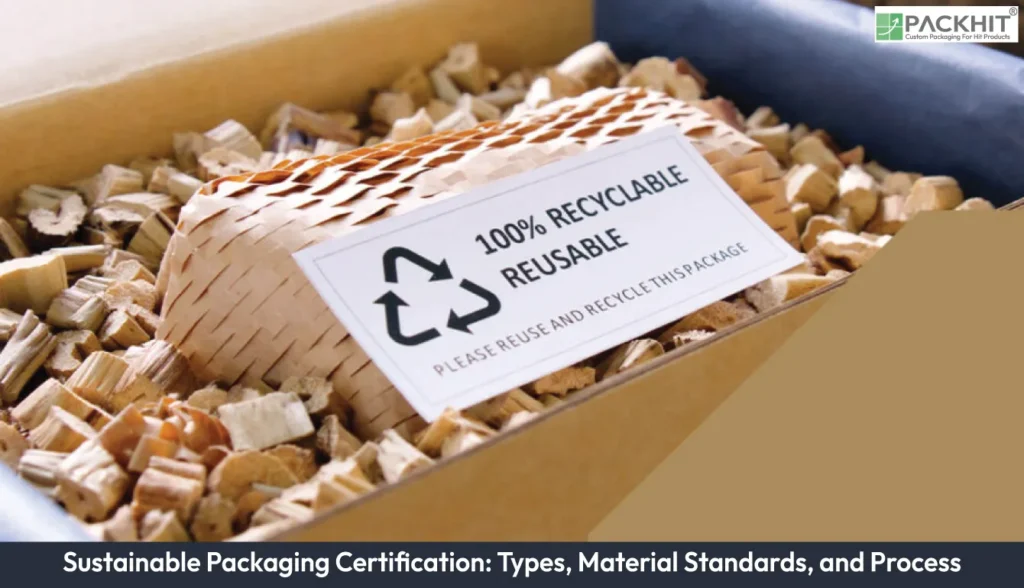
Sustainable packaging certification is a formal process that verifies whether packaging materials meet defined sustainability standards, focusing on environmental impact reduction, resource efficiency, and safety. There are various types of certifications, like FSC, PEFC, Cradle to Cradle, and BPI, that assess attributes such as responsible sourcing, recyclability, compostability, and material health. These certifications support sustainability by minimizing ecological impact, promoting renewable resources, and ensuring packaging is safe for both people and the planet. Material standards play a key role by evaluating the lifecycle, composition, and recyclability or compostability of packaging, while food safety certifications ensure packaging for consumables meets strict health standards without compromising environmental goals.
The certification process includes selecting the right certification, submitting documentation, undergoing testing and audits, and maintaining ongoing compliance through periodic reviews. For manufacturers, achieving sustainable packaging certification not only enhances brand credibility and consumer trust but also ensures regulatory compliance, promotes operational efficiency, and contributes to global sustainability and circular economy efforts.
- Types of Sustainable Packaging Certification
- 1. FSC (Forest Stewardship Council)
- 2. PEFC (Programme for the Endorsement of Forest Certification)
- 3. Cradle to Cradle
- 4. BPI (Biodegradable Products Institute)
- Material Standards for Sustainable Packaging
- How to Obtain Sustainable Packaging Certification?
- Step 1: Scope and Certification Selection
- Step 2: Documentation and Application
- Step 3: Testing and Verification
- Step 4: Extended Assessments for Multi-attribute Schemes
- Step 5: Approval, Labelling, and Ongoing Compliance
- How Does Food Safety Certification Intersect with Sustainability?
- Why is Sustainable Packaging Certification Important for Manufacturers?
Types of Sustainable Packaging Certification
Sustainable packaging certification types typically include environmental standards, material sourcing and recycling certifications, and food-safety and migration testing for items like paper-based packaging, liners, and coatings.
The four most common types of sustainable packaging certification are listed below:
1. FSC (Forest Stewardship Council)
FSC certifies paper and wood-based packaging from responsibly managed forests and requires chain-of-custody tracing from harvest through production to the finished product. It issues labels such as FSC 100%, FSC Mix, and FSC Recycled to indicate content origin and recycled content, improving traceability for buyers and supply-chain partners. Audits include on-site forest inspections, supplier verification, and annual surveillance to maintain certification and prevent illegal or high-conservation-impact sourcing.
2. PEFC (Programme for the Endorsement of Forest Certification)
PEFC endorses national forest certification systems and confirms that sourced paper meets sustainable harvest limits and legal sourcing requirements. It emphasizes landscape-level forest management and support for small forest owners, for example, community-run woodlots and family forests. Chain-of-custody audits and product labeling under PEFC allow manufacturers to document origin and claim certified content to downstream customers.
3. Cradle to Cradle
Cradle to Cradle assesses five categories such as material health, material reutilization, renewable energy use, water stewardship, and social fairness, and awards certification levels from Basic to Platinum. Certification requires material screening for hazardous substances and documented plans for reuse or recycling of each material component in the product. Scoring across the categories determines level; manufacturers submit lab reports, energy and water metrics, and supplier social responsibility records for assessment.
4. BPI (Biodegradable Products Institute)
BPI certifies industrial compostability in the U.S., requiring verified biodegradation rates, disintegration performance, and ecotoxicity to be assessed through testing to evaluate safety for intended composting conditions. Tests evaluate biodegradation under controlled composting conditions and confirm that packaging fragments and organic matter meet specified timelines and safety limits. Certified products display the BPI logo, so waste managers and consumers can identify items suitable for industrial compost facilities, reducing contamination of recycling streams.
Material Standards for Sustainable Packaging
Material standards in sustainable packaging certification assess the composition, sourcing, and lifecycle performance of packaging materials. These standards prioritize the use of renewable, recycled, or recyclable materials while discouraging the use of hazardous substances. For instance, the FSC certification ensures that paper-based packaging is derived from sustainably managed forests, while certifications like SFI (Sustainable Forestry Initiative) provide additional assurances of responsible forestry practices.
Recyclability certifications, such as those provided by How2Recycle, evaluate whether packaging can be effectively processed through existing recycling systems. These certifications consider factors like material purity, the presence of contaminants, and the availability of recycling infrastructure. Packaging that meets these criteria is labeled with standardized recycling instructions, improving consumer participation in recycling programs.
For manufacturers seeking to incorporate bioplastics or other innovative materials, certifications like OK Compost and ASTM D6400 validate the compostability of these materials. These certifications require that the materials meet specific degradation rates and safety thresholds, ensuring that they do not release harmful chemicals during decomposition.
How to Obtain Sustainable Packaging Certification?
To obtain sustainable packaging certification, select a scheme that matches the packaging material, intended application, and environmental claim. Compile material specifications, chain-of-custody records, supplier declarations, and safety data sheets, complete the required laboratory tests, pass a third-party audit, and maintain ongoing surveillance and renewal requirements.
Food-contact compliance, such as compliance with applicable FDA requirements in the United States, should be assessed separately because it is a regulatory requirement rather than a sustainability certification.
Step 1: Scope and Certification Selection
Obtaining sustainable packaging certification involves material assessment, compliance verification, laboratory testing, and third-party auditing.
Manufacturers must first identify the certifications relevant to their packaging materials and intended applications. Paper- and wood-based packaging may require FSC or PEFC certification to verify responsible sourcing and chain of custody. Packaging intended for industrial composting may require BPI or OK Compost certification. Cradle to Cradle may be appropriate when the manufacturer wants the packaging assessed across multiple sustainability attributes, including material health, circularity, renewable energy, water management, and social responsibility.
The selected certification should also reflect where the packaging will be sold, how it will be disposed of, and whether it will come into contact with food.
Certification Decision Checklist
Before applying, manufacturers should check:
- Material and application: Select a scheme that covers the packaging material, intended use, disposal route, and environmental claim.
- Testing requirements: Confirm whether migration, extractables, compostability, biodegradation, disintegration, recyclability, or material-health testing is required.
- Documentation burden: Determine which supplier declarations, chain-of-custody records, material specifications, production records, and traceability documents must be maintained.
- Ongoing obligations: Plan for surveillance audits, supplier monitoring, renewal, retesting, and recertification.
- Certification limitations: Confirm which claims the certification supports, as one scheme may not cover sourcing, recyclability, compostability, food-contact compliance, and overall environmental performance at the same time.
Manufacturers should consult an accredited certification body, qualified laboratory, regulatory specialist, or material supplier when packaging contains multiple materials, coatings, inks, adhesives, or additives; when the appropriate certification scope is unclear; or when test results and audit findings are disputed or inconclusive.
Step 2: Documentation and Application
The certification process typically begins with a detailed application covering material specifications, sourcing practices, production methods, and quality-control procedures.
Prepare the following core documents:
- Material specifications, including composition and recycled-content percentage.
- Chain-of-custody and traceability records.
- Supplier declarations and certificates.
- Safety data sheets.
- Manufacturing process flowcharts.
- Laboratory reports or previous test data, where available.
- Details of the personnel responsible for traceability, compliance, and quality control.
Documentation must remain consistent across suppliers, materials, production records, and certification claims.
Step 3: Testing and Verification
Laboratory testing and on-site audits are used to verify compliance with the selected certification standard.
Common assessments include migration and extractables testing for food-contact materials, biodegradation and disintegration testing for compostable claims, and recyclability assessments for paper-based or multi-material packaging. Auditors may also examine chain-of-custody controls, contamination prevention, material segregation, supplier records, and production traceability.
Testing requirements vary by certification and packaging structure. A certification body or qualified laboratory should confirm the applicable test methods before samples are submitted.
Step 4: Extended Assessments for Multi-attribute Schemes
Multi-attribute schemes such as Cradle to Cradle may require additional assessments covering material health, material circularity, renewable energy, water stewardship, and social responsibility.
Manufacturers may need to provide evidence such as:
- Material-health screening results.
- Material reutilisation or circularity plans.
- Renewable-energy data.
- Water-management metrics.
- Supplier social-responsibility records.
The packaging and associated manufacturing practices may be assessed across several categories and assigned a certification level according to the applicable version of the standard.
Step 5: Approval, Labelling, and Ongoing Compliance
Once certification is granted, manufacturers may use the certification label only within the approved scope and according to the scheme’s labelling rules.
Manufacturers must maintain the documented compliance system, retain supporting test records, monitor suppliers, control material and process changes, and complete required surveillance audits or renewals. Any change to the material composition, coating, adhesive, ink, supplier, production method, or packaging structure should be reviewed before the certified claim continues to be used.
Certification periods and surveillance schedules vary by scheme. Manufacturers should confirm the applicable renewal and recertification requirements directly with the certification body rather than assuming that all schemes follow the same cycle.
Common Nonconformities and Corrective Actions
Typical certification failures or nonconformities include:
- Missing, outdated, or inconsistent documentation.
- Breaks in chain-of-custody or traceability records.
- Use of unapproved suppliers or materials.
- Undocumented changes to coatings, inks, adhesives, additives, or production processes.
- Failed migration, extractables, biodegradation, disintegration, compostability, or recyclability tests.
- Incorrect use of certification labels or environmental claims.
- Missed surveillance audits, renewals, or supplier-verification requirements.
When a nonconformity appears, manufacturers should first verify the certification scope and applicable standard. They should then review supplier declarations, material specifications, test reports, production records, and traceability documents to identify the source of the issue.
Affected materials or production batches should be isolated where necessary. The manufacturer should document the root cause, implement corrective actions, update records or processes, and arrange retesting or submit revised evidence before continuing to use the certification label or claim.
How Does Food Safety Certification Intersect with Sustainability?
Food safety certification in sustainable packaging helps confirm that materials intended for direct food contact meet applicable health and safety requirements while supporting environmental goals. Food-contact regulations primarily address risks such as chemical migration, contamination, and changes to food quality, whereas sustainability certifications evaluate attributes such as material safety, recyclability, compostability, or responsible sourcing.
Manufacturers may need to provide material-specific migration test reports, laboratory analysis, or a declaration of compliance showing that the packaging is suitable for its intended food type, contact duration, and temperature conditions. This regulatory evidence is separate from certification criteria; receiving a sustainability certification, such as Cradle to Cradle or BPI, does not automatically establish compliance with all food-contact requirements.
Requirements vary by jurisdiction, packaging material, and intended application. Manufacturers should therefore confirm the regulations applicable to their target market and use qualified laboratories or certification bodies to verify both food safety and sustainability claims.
Why is Sustainable Packaging Certification Important for Manufacturers?
Sustainable packaging certification provides manufacturers with a competitive advantage by demonstrating their commitment to environmental and social responsibility. Certified packaging aligns with consumer preferences for eco-friendly products, enhancing brand reputation and marketability. Additionally, certifications help manufacturers comply with regulatory requirements, reducing the risk of legal penalties and supply chain disruptions.
From an operational perspective, certifications encourage the adoption of sustainable practices, such as waste reduction, energy efficiency, and the use of renewable materials. These practices can lead to cost savings and improved resource management over time. Furthermore, certifications provide a standardized framework for evaluating and improving packaging sustainability, enabling manufacturers to set measurable goals and track progress.
In a broader context, sustainable packaging certification contributes to global sustainability goals by promoting the use of environmentally responsible materials and practices. By obtaining certification, manufacturers play a vital role in reducing the environmental footprint of packaging and advancing the transition to a circular economy.