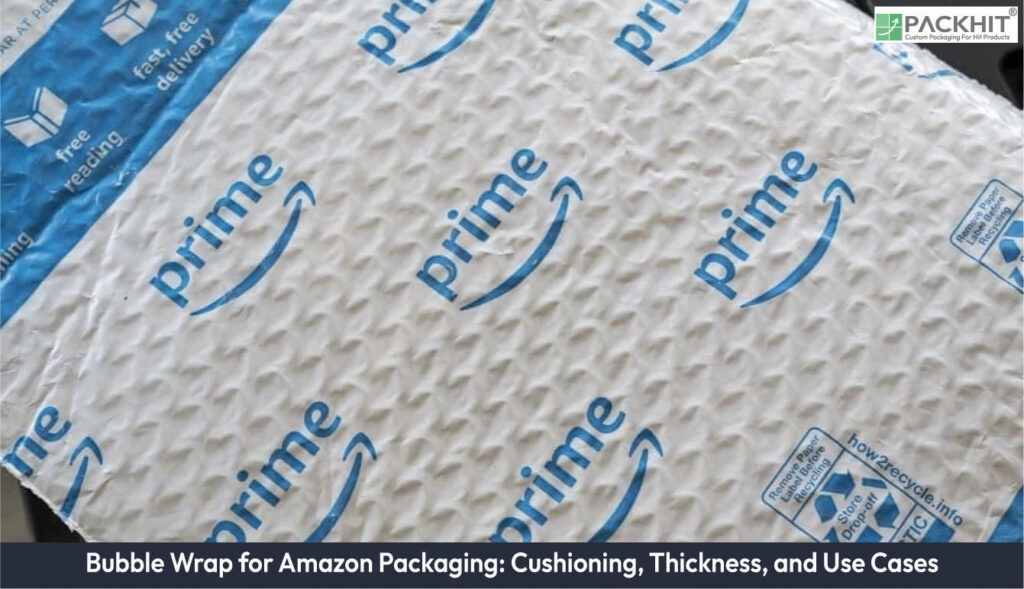
Bubble wrap is a protective cushioning material used in Amazon packaging to reduce shocks, impacts, abrasion, and movement during transit. Its core function lies in safeguarding products from mechanical stresses such as shocks, impacts, and compressive forces during transit. Defined by its distinct bubble-sealed air pockets, bubble wrap’s variable thicknesses and cushioning profiles make it adaptable for a broad spectrum of products, from fragile glassware to robust electronics. When aligned with Amazon’s packaging standards, bubble wrap offers utility in void filling, product stabilization, and damage prevention mechanisms. Its application range is influenced by factors such as bubble size, structural integrity, and material composition.
- What is Bubble Wrap for Amazon Packaging?
- How Does Bubble Wrap Cushion Products in Amazon Packaging?
- Structure and Function
- Anti-static Variants for Electronics
- Thermal Insulation for Temperature-Sensitive Items
- Enhanced Puncture Resistance
- Customization for Diverse Packaging Needs
- How Does Bubble Wrap’s Thickness Affect its Performance?
- Impact Absorption Based on Thickness
- Performance in High-Pressure Environments
- Optimization for Packaging Efficiency
- Thermal and Specialty Applications
- Uses of Bubble Wrap in Amazon Packaging
- Cushioning for Fragile Items
- Void-Filling Material
- Surface Protection
- Specialized Packaging Formats
- Applications in Automation
- Sustainability in Protective Packaging
- How Should Manufacturers Select Bubble Wrap for Amazon Packaging?
What is Bubble Wrap for Amazon Packaging?
Bubble wrap is a polyethylene cushioning material with sealed air pockets that helps separate products from carton walls and nearby items. Manufacturers should select it based on product weight, shape, surface sensitivity, carton size, and applicable Amazon fulfillment requirements.
Performance depends on bubble size, film thickness, layer count, overlap, product mass, and empty space inside the carton. Bubble wrap can reduce abrasion and handling damage, but it does not replace correct carton sizing, dividers, edge protection, or package testing.
Small bubbles suit compact or scuff-sensitive items, medium bubbles provide general cushioning, and large bubbles create more separation around heavier or fragile products. Specialized grades, such as anti-static or reflective films, should be selected only where their documented properties match the application.
How Does Bubble Wrap Cushion Products in Amazon Packaging?
Bubble wrap cushions products by creating separation, compressing under impact, and distributing force across its film. The required construction depends on product weight, geometry, surface finish, and expected handling conditions.
Structure and Function
Bubble wrap has a flat film layer bonded to a layer of sealed air pockets. During an impact, the pockets compress before the product contacts the carton or another item. The film spreads the load across a wider area, while the air volume limits direct force transfer. Wrap the product with enough overlap to cover corners and faces. Avoid excessive compression that flattens the pockets before shipment.
Anti-static Variants for Electronics
Anti-static bubble wrap uses a film formulation or surface treatment that reduces static-charge accumulation. It can reduce handling risk around circuit boards, sensors, and other exposed electronic components. It does not replace an electrostatic-discharge control program, conductive packaging, or a product-specific electrical requirement.
Thermal Insulation for Temperature-Sensitive Items
Reflective or metallic-coated bubble wrap reduces radiant heat transfer when it faces an air space. It does not maintain a fixed product temperature by itself. Temperature-sensitive shipments may also require insulation thickness, a thermal liner, refrigerant, time limits, and validated shipping conditions.
Enhanced Puncture Resistance
Laminated and multi-layer bubble wrap resists puncture better than a single light film when the product has corners, threads, or sharp edges. Add a smooth inner wrap, edge guard, or corrugated divider if the product can pierce the film. A puncture-resistant grade still requires a fit check around the finished product.
Customization for Diverse Packaging Needs
Select the wrap format from product dimensions and handling risk. Sheets suit flat parts; rolls suit repeated wrapping; bags enclose small items; perforated rolls reduce cutting time at a packing station. Match bubble size and layer structure to the failure risk. For example, wrap a painted metal housing first in small-bubble film with the smooth film side against the finish to limit scuffing, then add a large-bubble outer layer if the housing requires stand-off distance from the carton wall. A circuit board requires an anti-static grade, while a machined part with exposed threads requires a laminated grade, a smooth inner layer, or an edge guard. For a ceramic component with projecting corners, wrap the corners separately before applying the outer layer so the concentrated load does not flatten one section of the film. Confirm width, bubble diameter, film gauge, overlap, and closure method with a fit check and package test before ordering production quantities.
How Does Bubble Wrap’s Thickness Affect its Performance?
Bubble wrap thickness affects cushioning, compression resistance, puncture resistance, carton volume, and material consumption. Bubble height and film gauge describe different properties, so specify both when comparing materials.
Impact Absorption Based on Thickness
Larger air pockets create more compressible space around a product, while thicker film resists tearing. Large-bubble grades can cushion heavier glassware, ceramics, or machinery parts, but they also increase the packed item’s outside dimensions. Small-bubble film fits lightweight, compact products and protects finished surfaces from abrasion. Test the actual product and wrap combination because product mass and corner geometry affect impact results.
Performance in High-Pressure Environments
Compression from stacking can flatten air pockets over time. A thicker film or larger construction can retain separation longer than a light grade, although neither material carries a specified load unless the supplier provides test data. Use a carton, divider, or insert to carry stacking loads if the product or package is heavy.
Optimization for Packaging Efficiency
Choose the thinnest bubble-wrap grade that passes the required drop, vibration, compression, and appearance checks. A smaller packed volume can reduce dimensional-weight charges and leave less space, but under-sizing the wrap can increase product movement and damage. Bubble wrap can support Amazon packaging workflows when its dimensions, format, and closure method match the equipment, and the finished configuration meets applicable requirements. Assess material quantity, recycled content, and local film-recycling access separately; an automated packing process does not establish a sustainability claim. Verify current material and fulfillment requirements instead of assuming that a particular bubble-wrap type complies.
Thermal and Specialty Applications
Additional layers increase the distance between the product and the outside environment, while reflective films reduce radiant heat transfer across an air gap. These effects do not establish a temperature rating. For perishable or heat-sensitive goods, use a validated pack-out specification covering temperature range, transit duration, seasonal conditions, and monitoring method.
Uses of Bubble Wrap in Amazon Packaging
Manufacturers use bubble wrap in four main ways: product cushioning, void reduction, surface protection, and format-specific wrapping. The selected use depends on product construction, carton geometry, handling risk, and applicable fulfillment requirements.
Cushioning for Fragile Items
Bubble wrap surrounds fragile products such as glassware, ceramics, lamps, and small electronics. The pockets absorb part of an impact and keep the product away from carton walls. Wrap corners and projecting features separately if they create concentrated loads.
Void-Filling Material
Bubble wrap reduces movement in a carton when limited space remains around the packed item. It is not a substitute for a structural insert when the product is heavy, or the carton contains multiple items. Place enough material around the item to stop movement without forcing the carton closed.
Surface Protection
Bubble wrap separates polished, painted, coated, and transparent surfaces from abrasive carton fibers or adjacent products. Use the smooth film side against finishes if the supplier specifies that orientation, and add a non-abrasive sleeve when surface marking or pressure transfer presents a risk.
Specialized Packaging Formats
Three common formats support different packing tasks:
- Bubble bags: Preformed pouches enclose small products such as jewelry, accessories, fittings, or cosmetic containers.
- Adhesive-backed sheets: Fixed sheets stay against irregular surfaces when a removable adhesive is compatible with the product finish.
- Perforated rolls: Tear-off sections support repeated wrapping in high-volume packing areas and reduce manual measuring.
Applications in Automation
Perforated rolls, preset sheet sizes, and consistent film widths can support repeatable packing steps. Compatibility depends on the machine’s feed path, sealing method, roll dimensions, sensor settings, and package design. Confirm those parameters through a line trial before adopting automated handling.
Sustainability in Protective Packaging
Bubble wrap’s environmental impact depends on resin content, recycled content, material quantity, contamination, and local film-recycling access. Polyethylene bubble wrap can enter recycling streams only where the local collection system accepts the film and a processing facility is available. Recycled-content and recyclable options exist, but the claim and percentage require confirmation from the supplier and may not apply to every grade. Biodegradability cannot be assumed from a recyclable claim.
Reduce material use by selecting the minimum validated wrap quantity, avoiding unnecessary layers, and matching bubble size to the product’s actual cushioning requirement. Check disposal instructions for the finished package. Amazon-related sustainability expectations, packaging options, and fulfillment requirements vary by product and program, so verify current applicable requirements before finalizing the material specification.
How Should Manufacturers Select Bubble Wrap for Amazon Packaging?
Manufacturers can select bubble wrap by matching the material to the product’s mass, dimensions, surface, edge profile, and shipping risk. Record the bubble size, film gauge, roll or sheet dimensions, closure method, and any anti-static or thermal specifications in the packaging drawing.
- Product assessment: Measure weight, dimensions, corners, protrusions, surface finish, and sensitivity to static, moisture, or temperature.
- Material selection: Compare bubble height, film gauge, layer count, puncture resistance, and packed volume against the required protection.
- Package testing: Check movement, abrasion, drop performance, vibration response, compression behavior, and carton closure with the finished pack.
- Requirement verification: Confirm current packaging, labeling, safety, recyclability, and fulfillment requirements for the specific product and programme before production release.
