Amazon FBA package delivery covers how manufacturers send goods to fulfillment centers and how those shipments reach customers. The main considerations include delivery timelines, package-handling requirements, shipment preparation, and carrier selection. Requirements and service levels can vary by product, shipment type, destination, and fulfillment program. Delivery time ranges should therefore be treated as general planning estimates rather than guarantees. Before shipping, manufacturers should confirm the current Amazon instructions and applicable carrier terms for the specific shipment.
What are the Delivery Timelines for Amazon FBA Packages?
Delivery timelines depend on shipment-specific logistics. Amazon FBA delivery timelines depend on the shipment route, transport mode, carrier, appointment process, fulfillment-center workload, destination, and applicable program. Amazon does not provide one universal timeline for every inbound or customer shipment. Any period used for production or freight planning remains an estimate unless the current shipment workflow or carrier service terms state otherwise.
For inbound inventory, separate the schedule into pickup, line-haul transit, destination handling, delivery appointment, fulfillment-center receiving, and inventory reconciliation. Standard freight and expedited freight use different service commitments, but the applicable transit period depends on the origin, destination, booked service, carton or pallet count, and carrier capacity. International shipments also require export documents, customs processing, duties, port or airport handling, and final delivery to the assigned facility.
Receiving starts after the shipment reaches the assigned destination, not necessarily when the carrier records delivery. Amazon processing time varies by fulfillment center and shipment condition. Carton-count differences, damaged packaging, missing labels, incorrect quantities, and preparation errors can delay the point at which units become available for sale. Check the shipment workflow, receiving events, and inventory status instead of treating a carrier delivery scan as a promise of sellable inventory.
Outbound delivery time depends on the customer address, selected service, inventory location, order timing, and eligibility shown for that order. The delivery date displayed at checkout controls the customer-facing estimate. Weather, holiday volume, address corrections, carrier capacity, and inventory transfers can change that estimate. Manufacturers planning replenishment must therefore add production, inspection, pack-out, freight, receiving, and inventory buffers to the required availability date.
How Does Amazon Handle Delays in Delivery Timelines?
Amazon and its carriers record shipment events, revise estimated dates, and investigate exceptions according to the shipment type, program terms, transport responsibility, and delay event. The available response can differ for a late pickup, a missed appointment, a customs hold, a damaged carton, or a receiving discrepancy. Manufacturers can review tracking scans, appointment records, carton counts, shipment notifications, and inventory status before opening a support or carrier case.
For paper-based custom packaging, place production, printing, finishing, pack-out, inspection, and freight buffers before the planned FBA check-in date. Keep the purchase order or shipment identifier, carton quantity, tracking numbers, carrier, ship date, planned receiving date, and photographs of sealed cartons and labels. These records distinguish a manufacturing delay from a carrier delay or an Amazon receiving exception.
What are the Handling Requirements for Amazon FBA Packages?
Amazon FBA handling requirements vary by shipment and product. Requirements depend on the product, packaging type, fulfillment program, destination, shipment configuration, and current Amazon instructions. Relevant requirements can address carton dimensions, weight, packaging condition, shipment identification, product labels, barcode placement, and preparation. A carton-weight limit or labeling rule from one shipment does not establish a universal rule for every product or destination. Confirm the instructions generated for the assigned shipment before pack-out.
Use a carton that protects the product while limiting empty space and loose components. Fragile products can require bubble wrap, foam inserts, molded paper, or corrugated partitions. Paper-based custom packaging must resist crushing, scuffing, moisture exposure, and seam failure during pallet movement and parcel sorting. Test the packed unit and the master carton, including drop, compression, vibration, and handling conditions that match the planned distribution route.
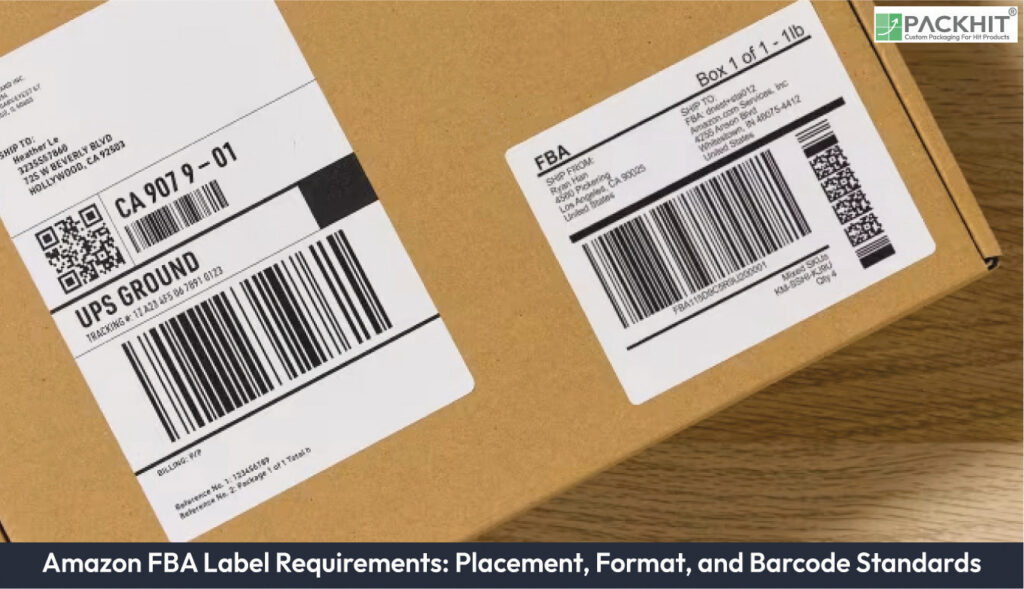
Apply the required product and shipment labels where scanners can read them. Keep barcodes flat, unobstructed, and away from carton seams, corners, tape, and curved surfaces. Match each carton to the shipment record, then verify the SKU, quantity, destination, and carton count before carrier pickup. Missing or unreadable labels can create receiving exceptions, relabeling charges, delayed availability, or shipment rejection under the applicable terms.
How are Packages Inspected Upon Arrival at Amazon Fulfillment Centers?
Amazon fulfillment centers compare inbound cartons with shipment information and receiving requirements. Checks can include label readability, carton condition, quantity, product identity, preparation, and visible damage. The sequence and depth of inspection are not uniform across every facility, product category, or shipment type.
A mismatch can place cartons or units into an investigation. Examples include an unexpected SKU, a short carton count, a damaged box, an unreadable barcode, or missing preparation. Keep packing lists, carton-level records, photographs, carrier scans, and purchase-order details available for an investigation or carrier claim. Record the carton condition before pickup, if the packaging process permits it.
Which Carriers are Used for Amazon FBA Package Delivery?
Amazon FBA shipments use different carrier types. Carrier selection depends on shipment origin, destination, service level, cost, capacity, and program eligibility. Providers can include UPS, FedEx, DHL, regional parcel carriers, less-than-truckload carriers, ocean carriers, and air-freight providers. The carrier assigned to one shipment does not establish a permanent assignment.
For inbound shipments, compare an Amazon-partnered transportation option with a self-arranged carrier under the terms shown in the active shipment workflow. A partnered option can connect shipment creation, applicable pricing, and tracking within its stated conditions. A self-arranged shipment gives the manufacturer more control over carrier selection, but it remains subject to Amazon’s routing, appointment, labeling, tracking, and delivery rules. Availability, rates, eligibility, and service conditions depend on the origin, destination, shipment size, and booking date. Confirm the current terms before booking freight.
International shipments add export documents, import clearance, duties, destination handling, and possible port or airport delays. Select the transport mode after checking carton dimensions, product value, required arrival date, customs responsibilities, and receiving destination. Compare the full landed cost, including freight, brokerage, duties, storage, handling, and delay exposure, rather than comparing freight rates alone.
What is the Criteria for Carrier Performance?
Carrier performance is measured against shipment requirements and service terms. Useful measures include on-time arrival, scan completeness, damage frequency, appointment compliance, claim handling, and delivery coverage. A 95% on-time rate appears in some shipping requirements or operational guidance, but it is not a universal Amazon FBA standard for every carrier, route, or program. Confirm the applicable threshold, definition of on-time performance, measurement period, and shipment scope in the current terms instead of applying that percentage generally.
Review carrier records by route, service level, carton type, and season. Compare the scheduled pickup date with the first scan, the applicable arrival commitment with the actual receipt, and the delivered carton count with the shipment record. Repeated damage or late scans can support a packaging test, carrier review, service-level change, or larger inventory buffer. Treat internal performance results as route-specific evidence, not as a claim about every Amazon shipment.
Verify current Amazon FBA requirements before sending inventory. Delivery windows, carton limits, labeling rules, partnered-carrier terms, rates, fees, and performance requirements can change by program, destination, product, and shipment condition. Retain the shipment instructions and verification date with the manufacturing and freight records.
How Can Manufacturers Plan Amazon FBA Package Delivery?
Manufacturers can plan Amazon FBA package delivery by assigning time to five intervals: packaging production, product pack-out, carrier transit, fulfillment-center receiving, and inventory availability. The required availability date must include each interval, plus time for inspection, shipment corrections, carrier exceptions, and receiving discrepancies. Amazon does not control every interval, so a carrier delivery date does not equal the date when units become available for sale.
- Requirement check: Confirm the current carton limits, preparation rules, barcode standards, shipment labels, routing instructions, destination requirements, and carrier appointment terms before production starts. Apply the rules to the finished packed carton, not only to the empty packaging. Check whether the product requires additional preparation, such as poly-bagging, suffocation warnings, expiration-date marking, or unit-level labeling.
- Packaging test: Inspect barcode placement, seal strength, cushioning, compression resistance, carton dimensions, and packed weight. Test representative cartons after filling them because the product can change the carton’s shape, label position, and stack strength. Record the test condition, including the product count, paperboard grade, closure method, and measured packed weight.
- Production release: Approve the packaging specification before the full run. Record the paper grade, board thickness, internal fit, closure method, print artwork, barcode location, and carton dimensions so the production lot matches the tested sample. Hold nonconforming cartons apart from approved inventory if a production change affects any of these attributes.
- Shipment record: Reconcile SKUs, quantities, carton counts, weights, dimensions, tracking numbers, shipment IDs, and appointment details. Keep the carton-level record with the packing list and product batch information. Photograph pallet labels and retain the final carton specification when the shipment contains multiple SKUs or production lots.
- Transit monitor: Review pickup scans, movement events, exceptions, estimated arrival dates, and proof of delivery. Contact the carrier if a pickup scan is missing or a delivery exception changes the planned receiving date. Separate carrier delay from Amazon receiving delay in the shipment log.
- Receiving review: Compare Amazon receiving records with the shipped quantity and inspect for shortages, damage, or labeling discrepancies. Investigate differences promptly while the shipment record, carrier details, and production batch remain available. Match each discrepancy to the affected SKU, carton, quantity, and tracking record.
- Inventory check: Confirm that received units appear as available inventory before allocating stock to customer orders. Reserve additional time if the product launch depends on a specific receiving date or seasonal sales period. Treat units marked as received but unavailable as a separate status until the inventory record changes.
Use the shipment workflow and inventory status to set the required availability date. Proper labeling and accurate dimensions reduce delay and fee risks, while carton strength and closure quality reduce damage during handling. Carrier selection affects transit cost, pickup reliability, and delivery speed; fulfillment-center receiving adds a separate interval that the carrier cannot control.
These steps support planning but do not replace the current Amazon Seller Central or carrier instructions for a specific shipment. Requirements and service levels can change, so confirm them again after a product, packaging format, carrier, destination, or fulfillment program changes.