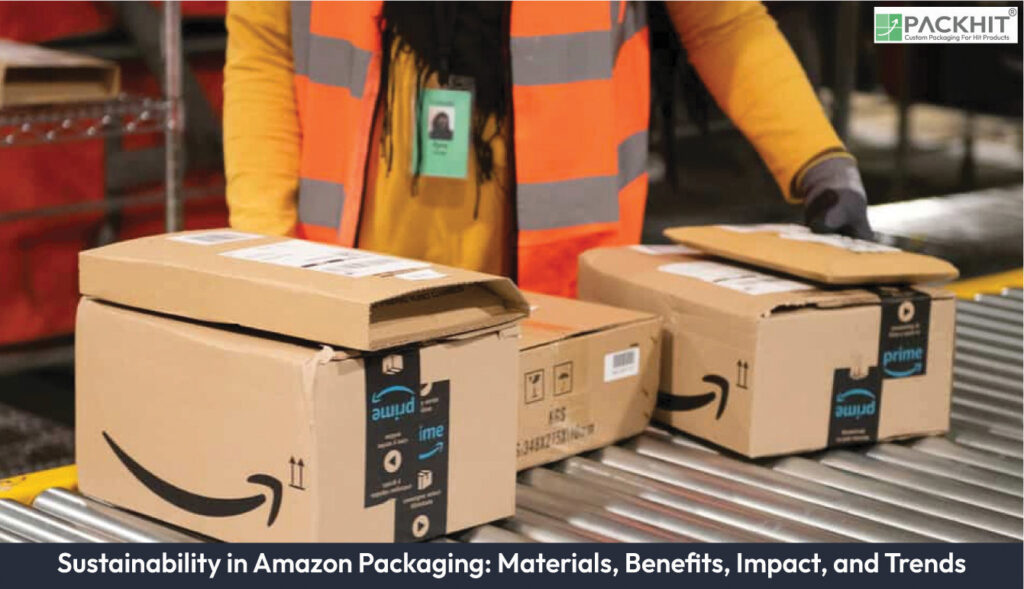
Amazon’s sustainable packaging initiatives represent a comprehensive approach to reducing environmental impact while maintaining operational efficiency and enhancing consumer experience. Amazon’s sustainable packaging uses materials such as corrugated cardboard, kraft paper, paper-based tape, and plant-based polymers. Its effects depend on package design, product protection, shipping conditions, local recovery systems, and measured environmental outcomes. These efforts align with global sustainability trends, such as circular economy integration and advanced material innovation, positioning Amazon as a leader in eco-conscious practices. Manufacturers can draw inspiration from these principles by adopting sustainable materials, optimizing packaging design, leveraging technology, and engaging consumers to meet the growing demand for environmentally responsible products.
- Materials Used in Sustainable Amazon Packaging
- Benefits of Sustainable Amazon Packaging
- How Does Amazon’s Sustainable Packaging Impact the Environment?
- What Trends are Shaping Sustainable Amazon Packaging?
- Advanced Material Innovation
- Circular Economy Integration
- Digital Printing Technologies
- AI-Driven Optimization
- Consumer-Centric Design
- How to Recycle Amazon Packaging?
- How Can Manufacturers Apply Amazon’s Sustainable Packaging Principles?
Materials Used in Sustainable Amazon Packaging
Amazon sustainable packaging commonly uses corrugated cardboard, kraft paper, paper-based tape, molded fiber, and reduced-material formats. Material selection depends on product weight, breakage risk, moisture exposure, recycling access, package dimensions, and shipping conditions. A US manufacturer’s package specification records fiber content, recycled content, coatings, adhesive type, board grade, dimensions, closure method, and disposal instructions. These details connect material selection with package testing, shipping performance, and customer disposal.
Corrugated Cardboard
Corrugated cardboard places fluted paper between liner sheets. Recycled fiber can reduce the demand for virgin pulp, while the layered structure resists compression, puncture, and impact during handling. Corrugated boxes enter paper-recycling systems in many US communities, but acceptance depends on local collection rules, contamination, coatings, wet fibers, and the capacity of the receiving mill. The material is therefore recyclable in a defined recovery system, not unconditionally recyclable in every location.
Manufacturers reduce material use by selecting the smallest box that maintains compression strength and by matching board grade to the product load. Common specification checks include edge-crush strength, burst or puncture resistance, box compression, seam quality, stacking performance, and behavior after humidity exposure. Flute profile, liner basis weight, joint style, and interior clearance also affect package performance. A lighter board enters production only after the revised package passes the same distribution tests as the baseline.
Kraft Paper
Kraft paper comes from wood pulp processed through the kraft method. Amazon packaging uses it for wrapping, void fill, and selected cushioning applications. It contains no plastic film by default, but inks, coatings, labels, and wet-strength additives can affect recycling or composting. Recycled content, fiber certification, basis weight, tear resistance, and disposal instructions belong in the package specification.
Crumpled sheets, honeycomb structures, and folded paper inserts restrain products in different ways. The specification therefore identifies the paper format, basis weight, fold pattern, and placement rather than listing kraft paper as a complete performance description. Testing covers product movement, abrasion, compression, vibration, and humidity exposure.
Paper-Based Tape
Water-activated paper tape closes corrugated boxes without adding a plastic film layer. Tape that is compatible with corrugated recycling can remain with the box during pulping, subject to local mill requirements. Tensile strength, adhesive coverage, box weight, storage conditions, and humidity determine seal performance.
A packaging trial tests seal failure, manual opening, abrasion during parcel handling, humidity exposure, and compatibility with automated sealing equipment. Roll width, application temperature, storage time, and reinforced fibers also belong in the specification. Reinforced paper tape can change strength and pulping behavior, so its construction appears in the material declaration.
Plant-Based Polymers
Plant-based polymers use biological feedstocks such as corn starch or sugarcane. Bio-based content does not automatically indicate biodegradability or compostability. A compostable package requires the applicable certification, collection route, and processing conditions. The material declaration distinguishes bio-based content from recycled content and compostability.
These polymers remain relevant where paper does not provide the required moisture barrier, sealability, or flexible-film performance. Additives, laminates, inks, and barrier layers can determine whether the package enters a recycling or composting stream. Disposal instructions identify the actual route available to the customer rather than relying on the feedstock description.
Minimalist Packaging
Amazon’s Frustration-Free Packaging approach removes unnecessary components, reduces package size, and limits materials such as plastic clamshells and wire ties. Fewer parts can reduce assembly time and disposal volume, but the package still requires testing for drops, compression, vibration, and product damage. A smaller package also changes pallet density and carrier dimensional-weight charges.
Manufacturers compare baseline and revised formats by recording package mass, empty volume, units per pallet, packing labor, damage claims, and replacement shipments. Product protection remains part of the calculation because a damaged product creates additional material, transport, and return impacts. Material reduction alone does not establish a lower environmental impact.
These formats are assessed against protection, material mass, recycled content, manufacturing requirements, shipping density, cost, and local recovery systems. A paper-based package remains a packaging specification, not an environmental result, until production, distribution, use, and recovery conditions are measured.
Benefits of Sustainable Amazon Packaging
Sustainable Amazon packaging can produce three measurable benefit areas: lower packaging material use, more efficient transport, and simpler disposal. Results vary by product, package format, facility, and market. Manufacturers compare one protected product delivered to a US customer, using the same protection requirement, shipment route, and reporting period for both the baseline and revised packages.
Environmental Benefits
Paper-based packaging can reduce plastic content and place more package material within established fiber-recycling streams. The result depends on recycled content, forest management, production energy, transport distance, contamination, and the percentage of material recovered. A comparison reports package mass, material composition, recycled content, recovery assumptions, and damage-related replacement shipments.
Operational Efficiency
Right-sized packaging reduces empty space and can increase the number of parcels or cases loaded onto a pallet or vehicle. The effect depends on product dimensions, box inventory, fulfillment-center equipment, carrier rules, and damage rates. Manufacturers measure package volume, material mass per shipment, units per pallet, damage claims, transport miles, line speed, pack-out time, changeover frequency, and rejected packages.
Consumer Experience
Frustration-Free Packaging reduces opening steps and excess material in comparison with some conventional retail packs. Customers can sort paper-based packaging more easily if their local program accepts the material. Clear material identification and accurate disposal guidance reduce sorting errors. Opening time, access to the product, sharp edges, fasteners, household-tool requirements, damage rates, and returns provide practical design measures.
These benefits support packaging decisions when the measured change includes protection, distribution, customer handling, and end-of-life conditions.
How Does Amazon’s Sustainable Packaging Impact the Environment?
The environmental effect is assessed through waste mass, material sourcing, package dimensions, transport requirements, product damage, and end-of-life recovery. No single packaging material determines the result. A defensible assessment defines the baseline package, product group, shipment route, reporting period, functional unit, and life-cycle boundary. It separates packaging effects from impacts caused by the product and its delivery service.
Amazon Packaging Waste Reduction
Amazon packaging waste reduction describes efforts to remove excess components and replace selected formats with recyclable paper-based materials. The effect varies by packaging format, product, fulfillment process, and shipping route. Claims about eliminated boxes, plastic tonnage, or reduced waste require a defined baseline, reporting period, package boundary, and calculation method.
For manufacturers, relevant measures include grams of packaging per shipped unit, recycled content, production scrap, rejected material, customer-discarded material, damage-related replacement shipments, and the share of packaging accepted by local recycling programs. Waste accounting separates these streams instead of combining them into one total.
Carbon Emissions
Lightweight and smaller packages can reduce transport emissions if they lower shipment mass or increase vehicle loading. A carbon estimate also includes paper production, recycled-fiber processing, adhesives, manufacturing energy, warehouse handling, transport mode, and end-of-life treatment. The result varies by package format, product, fulfillment site, carrier, and route.
A package-level comparison reports the functional unit, such as one protected product delivered to a customer, and separates packaging emissions from product and delivery emissions. It also identifies the baseline package, facilities, reporting period, product categories, and life-cycle boundary. If a smaller package raises breakage or return rates, the additional shipments belong in the comparison. No fixed percentage reduction applies to every sustainable packaging format without supporting measurement and attribution.
Resource Conservation
Recycled paper can reduce demand for virgin fiber, while responsible fiber sourcing addresses forest-resource concerns. Paper production still uses water, energy, chemicals, and transport, and recycled fiber does not replace virgin fiber for every performance requirement. Plant-based polymers change the feedstock but do not automatically reduce total emissions or waste.
A credible comparison states the recycled or bio-based percentage, material mass, sourcing boundary, production location, and disposal assumption. Fiber loss during collection and pulping affects the amount of material that returns to paper production.
What Trends are Shaping Sustainable Amazon Packaging?
Packaging work commonly addresses material testing, package right-sizing, circular recovery, digital production, and data-based design. Adoption depends on technical performance, cost, equipment, regulations, and local waste infrastructure. A practice becomes a package specification after manufacturers verify performance, production constraints, and end-of-life handling.
Advanced Material Innovation
Researchers are testing mycelium-based cushioning, molded fiber, and nanocellulose. Their commercial use depends on moisture resistance, shelf life, food-contact rules where relevant, manufacturing throughput, cost, and verified disposal routes. A new material requires performance and life-cycle testing rather than a sustainability claim based only on biological origin. Test plans commonly include compression, impact, vibration, humidity, odor transfer, storage stability, and disposal conditions.
Circular Economy Integration
Circular packaging systems keep materials in use through reuse, collection, sorting, pulping, or reprocessing. Corrugated cardboard can re-enter fiber production when it remains clean and reaches a suitable recovery facility. Closed-loop claims require a defined collection area, recovery rate, processing partner, material loss rate, and number of reuse or recycling cycles. A national outcome cannot be inferred from a pilot program in one facility or region.
Digital Printing Technologies
Digital printing can remove printing plates and reduce setup waste for short runs or variable graphics. Its environmental effect depends on ink chemistry, substrate coating, print coverage, equipment energy, run length, and recyclability. Manufacturers compare ink mass, setup waste, energy per printed package, and rejected units against the conventional process using the same substrate, coverage, color count, and production volume.
AI-Driven Optimization
Packaging software compares product dimensions, box inventories, handling constraints, and shipment data to select a package size. The calculation can reduce void space and package mass if the input data includes product fragility, orientation, cushioning, and damage outcomes. Reported gains require a baseline period, tested product group, fulfillment sites, and measurement units. A model recommendation does not establish an environmental result until the resulting packages are produced, shipped, and measured. Human review remains necessary for irregular geometry, hazardous contents, temperature sensitivity, or incomplete damage records.
Consumer-Centric Design
Packaging teams are reducing opening steps, mixed materials, and components that complicate sorting. Paper-based formats can simplify disposal if local systems accept them, while coatings, labels, adhesives, and contamination can change the result. Design reviews combine opening time, injury risk, product damage, return rates, material mass, and disposal instructions. The final package specification identifies each material component and gives disposal guidance that matches the customer’s collection system.
How to Recycle Amazon Packaging?
Recycling Amazon packaging involves specific steps tailored to the materials used, ensuring they are processed correctly and contribute to a circular economy. Here’s how you can recycle different types of Amazon packaging:
- Corrugated Cardboard Boxes: Flatten the boxes to save space and place them in your curbside recycling bin. Ensure they are free of any non-recyclable materials, such as plastic labels or excessive tape.
- Kraft Paper Mailers and Padded Paper Envelopes: These materials are widely accepted in municipal recycling programs. Remove any stickers or adhesives before recycling to avoid contamination.
- Paper-Based Tapes: Fully recyclable alongside cardboard, paper-based tapes do not need to be removed from boxes, simplifying the recycling process.
- Plastic Films: Films, including bubble wrap and air pillows, are not typically accepted in curbside programs. Collect these items and drop them off at designated recycling facilities, often found at grocery or retail stores.
- Plant-Based Polymers: Used in niche applications, these materials require industrial composting facilities for proper disposal. Check with your local composting services for availability.
To maximize recyclability, always clean and dry materials before placing them in recycling bins. Packaging with Amazon’s “Frustration-Free” label is designed for easy separation of recyclable components, streamlining the process for consumers. Recycling capabilities vary regionally as urban areas are generally equipped to handle a broader range of materials, while rural zones may have limitations. Refer to your local recycling guidelines for specific instructions. By following these steps, you can contribute to reducing landfill waste and supporting eco-friendly practices, aligning with Amazon’s broader sustainability goals.
How Can Manufacturers Apply Amazon’s Sustainable Packaging Principles?
Manufacturers can apply Amazon’s sustainable packaging principles by reducing material use, selecting recyclable or renewable inputs, and checking the package through production, shipping, and disposal.
- Material Selection: Prioritize recyclable, biodegradable, and renewable materials, such as paper-based components and plant-based polymers, when they meet the product’s protection requirements.
- Design Optimization: Reduce package dimensions, empty space, and unnecessary layers to lower material use, package weight, and shipping volume.
- Technology Integration: Apply AI and data analytics to compare package dimensions, material quantities, and shipping configurations before production.
- Supplier Collaboration: Work with material suppliers on plant-based polymers, recyclable substrates, and adhesives that support the selected package structure.
- Consumer Communication: Label the package with clear disposal information and describe the materials used, so customers can sort the package correctly.
These practices give manufacturers specific ways to reduce packaging material, package weight, and shipping volume while keeping sustainability information visible at the point of disposal.