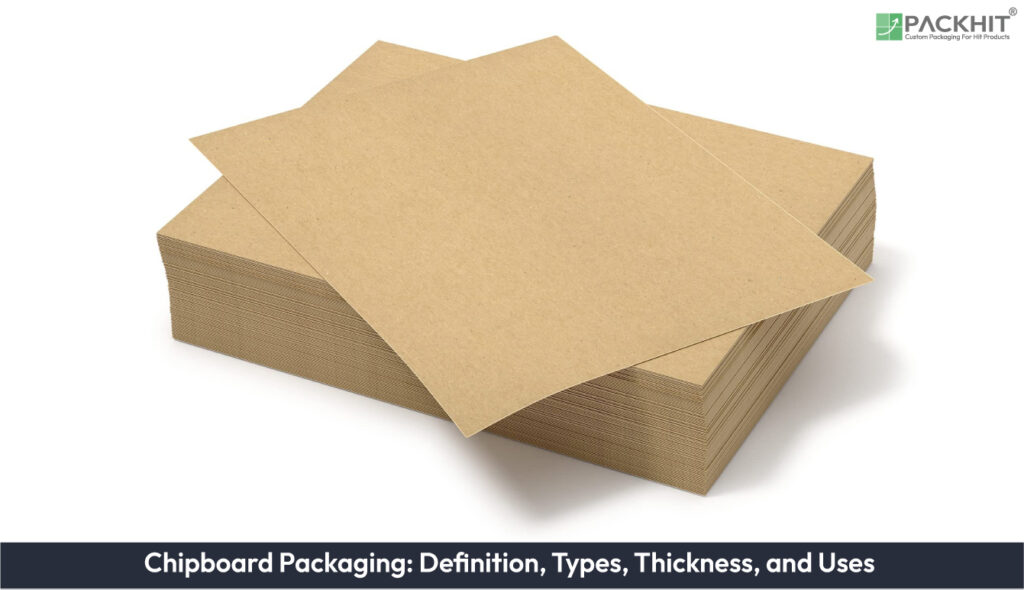
Chipboard packaging is a lightweight, dense material made primarily from recycled paper fibers, valued for its affordability, recyclability, compact structure, and smooth, print-friendly surface that can be easily cut, folded, and customized for boxes, cartons, and other packaging formats. Common types include Solid Bleached Sulfate (SBS) for premium packaging, Coated Recycled Board (CRB) for economical food and household packaging, uncoated chipboard for inner packaging and structural layers, and specialty chipboards with enhanced finishes for customized designs. Its thickness determines its strength and application, with lightweight grades used for stationery and food items, medium-weight grades for retail products such as cereals and toys, and heavy-duty grades for book covers, industrial products, and heavier items requiring greater protection. Chipboard packaging is used across food and beverage, retail, cosmetics, apparel, and industrial sectors, while its low cost, design flexibility, high-quality printing capabilities, and reduced reliance on plastic make it a practical option for both functional packaging and branding requirements.
What is Chipboard Packaging?
Chipboard packaging refers to packaging materials made from chipboard, a dense, paper-based product composed of recycled paper fibers. It is characterized by its smooth surface, lightweight structure, and ability to be easily cut, folded, and printed. Chipboard is often used for creating boxes, cartons, and other packaging solutions for products ranging from food items to electronics.
Different Types of Chipboard Packaging
Chipboard packaging is available in various types, each suited for specific applications. Below are the primary types:
- Solid Bleached Sulfate (SBS) Chipboard: SBS chipboard is a premium-grade material made from virgin fibers. It is white on both sides, known for good printability and a clean appearance. SBS chipboard is often used for high-end packaging, such as cosmetics, pharmaceuticals, and luxury goods.
- Coated Recycled Board (CRB): CRB chipboard is made from recycled fibers and features a coated surface for improved durability and printability. It is an economical choice for packaging products like food, beverages, and household items.
- Uncoated Chipboard: Uncoated chipboard is a basic, untreated material often used for inner packaging or structural components. It is less expensive but lacks moisture resistance and aesthetic appeal.
- Specialty Chipboard: Specialty chipboard includes variations with unique finishes, such as metallic coatings, textured surfaces, or laminated layers. These are used for custom packaging designs that require enhanced visual appeal or functionality.
How Does Chipboard Thickness Impact Packaging Applications?
Chipboard thickness is a critical attribute that influences its strength, durability, and application. Manufacturers can choose from a range of thicknesses based on their packaging requirements:
Lightweight Chipboard (20–40 pt)
Lightweight chipboard is ideal for packaging lightweight products such as stationery, small electronics, or food items. It is easy to fold and cut, making it suitable for intricate designs.
Medium-Weight Chipboard (50–80 pt)
Medium-weight chipboard offers a balance between strength and flexibility. It is often used for retail packaging, such as cereal boxes, toy packaging, and gift boxes.
Heavy-Duty Chipboard (90–100+ pt)
Heavy-duty grades can provide higher durability for heavier/fragile items and are used for industrial packaging, book covers, and rigid boxes. Its thickness ensures protection for heavier or fragile items.
Common Uses of Chipboard Packaging
Chipboard packaging is versatile and finds applications across various industries. Below are some common uses:
Food and Beverage Packaging
Food and beverage packaging is often made from chipboard due to its printability and ability to be coated for moisture resistance. Examples include cereal boxes, frozen food cartons, and beverage carriers.
Retail Packaging
Retail products such as toys, cosmetics, and clothing often use chipboard packaging for branding and protection. Its smooth surface allows for vibrant printing and attractive designs.
Industrial Applications
Heavy-duty chipboard is used in industrial applications, such as packaging for machinery parts, tools, and electronics. Its strength ensures the safe transport of heavy or delicate items.
Eco-Friendly Packaging
Chipboard is a sustainable choice for eco-conscious manufacturers. Its recyclability and use of recycled fibers make it an environmentally friendly alternative to plastic packaging.
What are the Benefits of Chipboard Packaging?
Chipboard packaging reduces material cost for rigid paper-based cartons because manufacturers can source standard board formats for low-volume and high-volume runs.
- Cost Efficiency: Chipboard is affordable, which supports large-scale packaging needs such as 12–24 unit multipacks for shelf-ready retail displays.
- Customizability: Chipboard accepts die-cut shapes, enabling custom window inserts or insert trays for products that need defined placement.
- Sustainability: Chipboard is recyclable and commonly produced from recycled fiber, so end users can return empty cartons to paper recycling streams.
- Print Quality: Its smooth surface supports high-resolution artwork, including small barcode and SKU text, when coated boards are paired with offset or flexographic printing.
What are the Limitations of Chipboard Packaging?
Chipboard packaging works best when product loads stay within board strength and moisture conditions, since uncoated paperboard changes dimension and stiffness after prolonged humidity exposure.
- Moisture Sensitivity: Uncoated chipboard absorbs humidity faster, so packaging for beverages, damp storage areas, or outdoor transit often requires a barrier coating or laminated wrap.
- Limited Strength: Lightweight chipboard lacks performance under puncture and edge crush, so heavy, sharp-edged, or irregular items require inserts or a thicker board grade.
- Environmental Impact: Chipboard is recyclable, but production still consumes energy and creates processing waste, so zero-waste targets depend on local recycling rates and fiber sourcing.
Selecting chipboard by thickness, coating type, and structural layout helps manufacturers match packaging performance to product handling, storage temperature, and transit time.
Selection Factors for Chipboard Thickness
This table lists the selection factors used to choose chipboard thickness for custom cartons and shippers. Use each decision rule to match board grade to performance needs such as load stacking, edge protection, moisture exposure, printing, internal structure, and transportation distance.
Read across the columns to find common mm thickness ranges and the typical product or packaging application that corresponds to each factor.
| Selection factor | Decision rule | Common chipboard thickness | Typical use case |
|---|---|---|---|
| Load and stacking | Choose higher thickness if the carton supports pallet stacking or causes box-to-box pressure. | 6–10 mm for heavier stacking loads (example: boxed electronics accessories). | Warehouse storage cartons and retail shippers. |
| Edge protection | Choose thicker chipboard if the product has sharp corners or the carton receives impact during transport. | 6–12 mm for higher edge impact (example: home hardware parts). | Corner guards, rigid inserts, and protective shippers. |
| Product weight | Use thicker material for heavier units, if the carton walls flex during handling. | 4–8 mm for medium weight (example: small appliances). | Primary packaging around rigid product groups. |
| Moisture risk | Choose moisture-resistant coatings if humidity exposure is likely; use thinner grades only if transit stays dry. | 3–6 mm with moisture coating (example: seasonal shipments). | Outdoor or seasonal distribution where condensation occurs. |
| Branding finish | Match board surface quality to print requirement, if the artwork needs sharp text and consistent color. | 4–6 mm for standard high-definition printing (example: cosmetic retail boxes). | Printed shippers and presentation cartons. |
| Internal structure | Increase thickness if you need rigid internal partitions, if inserts resist product rattle. | 5–10 mm for partition panels (example: split compartments for components). | Trays, dividers, and molded-style internal supports. |
| Transportation distance | Choose thicker chipboard if the shipment includes long-haul vibration, if the carton shows seam or corner wear. | 6–12 mm for long-haul protection (example: heavy-duty appliance packs). | Freight shipments and multi-carrier routes. |
| Environmental and disposal goals | Select chipboard grade if recycling and waste targets matter, if the process allows single-material packaging. | 4–8 mm for recyclable retail cartons (example: consumer subscription shipments). | Single-material packing for US distribution. |
Which Chipboard Thickness Should You Choose for Custom Packaging?
Chipboard thickness choice depends on package size, product weight, and handling conditions. For light inserts, choose thinner boards; for heavier items and stacked shipments, choose thicker boards.