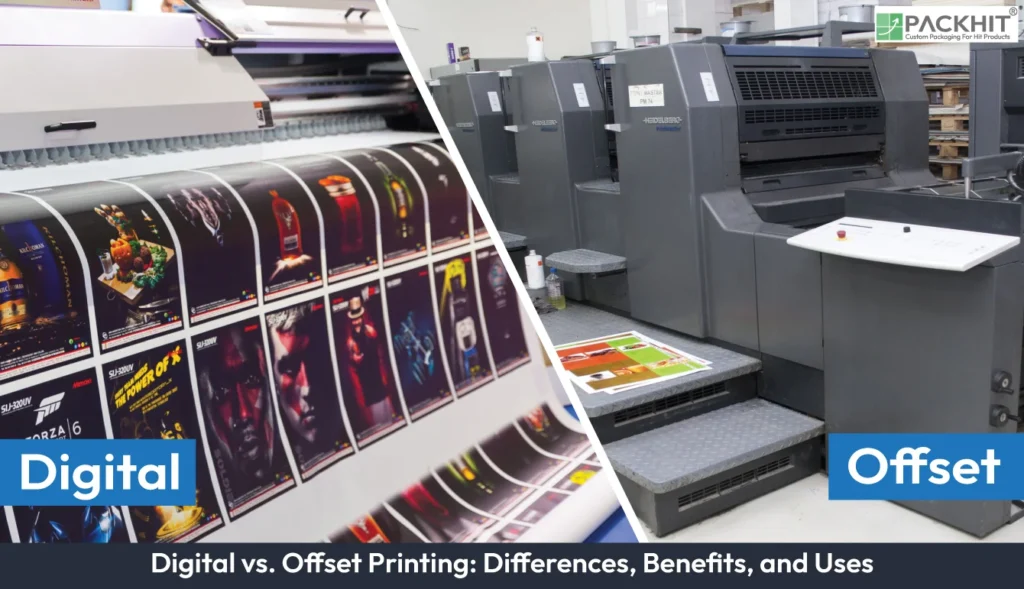
Digital printing and offset printing are two widely used commercial printing methods that differ in their printing technology, setup requirements, production costs, print consistency, turnaround time, and suitability for different production volumes. Digital printing offers benefits such as minimal setup, rapid turnaround, variable printing, reduced material waste, and cost-effective short-run production, whereas offset printing provides superior color consistency, lower unit costs, substrate compatibility, and support for specialty inks and premium finishing techniques. Digital printing is commonly used for personalized packaging, prototypes, limited-edition products, and short production runs, while offset printing is preferred for large-scale packaging, catalogs, brochures, promotional materials, and other high-volume printing projects requiring consistent print quality and accurate brand color reproduction.
- Differences Between Digital Printing and Offset Printing
- 1. Printing Mechanism and Technology
- 2. Print Quality and Color Fidelity
- 3. Cost Considerations
- 4. Turnaround Time and Production Flexibility
- 5. Environmental Impact
- Benefits of Digital Printing and Offset Printing
- Applications of Digital Printing and Offset Printing
- Which Printing Method is Better for Custom Packaging?
- When Should Manufacturers Choose Offset Printing?
- Can Digital Printing Match Pantone Colors?
- Which Printing Method Provides Faster Turnaround?
- Can Both Printing Methods be Used on Packaging Materials?
- How Can Manufacturers Choose Between Digital and Offset Printing?
Differences Between Digital Printing and Offset Printing
Digital printing and offset printing are two widely used printing methods with different technologies, cost structures, quality levels, turnaround times, and environmental impacts. Offset printing is generally preferred for high-volume projects requiring precise color reproduction and consistency, while digital printing is suitable for short runs, customization, and faster production. The key differences between these methods are discussed below.
1. Printing Mechanism and Technology
Digital printing transfers images directly from digital files onto substrates using inkjet or laser technology. Since it does not require printing plates, it allows faster setup and reduces preparation time. Digital printing also supports variable data printing, enabling customized designs, text, and images for individual packages or products.
Offset printing uses a plate-based process where ink is transferred from metal plates to a rubber blanket and then applied to the final substrate. This indirect transfer method provides precise image reproduction and consistent results, making it suitable for large-scale printing projects. Offset printing supports CMYK and Pantone color systems, allowing accurate color matching for branding and professional applications.
2. Print Quality and Color Fidelity
Digital printing delivers high-resolution images with strong color quality for short and medium runs. However, exact Pantone spot-color matching and highly consistent solid-color reproduction may vary depending on the digital press, color management settings, ink configuration, and substrate being printed.
Offset printing supports CMYK process colors and Pantone spot colors, making it well suited for consistent brand color reproduction. Actual color accuracy depends on factors such as substrate, ink formulation, and press calibration.
For packaging applications such as folding cartons, cosmetic boxes, rigid boxes, and retail packaging, consistent color reproduction becomes particularly important when multiple production batches must maintain the same brand appearance.
3. Cost Considerations
Digital printing eliminates plate-making costs and requires minimal setup, making it economical for small and medium production runs. Although it has lower upfront costs, the per-unit cost is generally higher compared with offset printing for large-volume production.
Offset printing requires higher initial setup costs due to plate creation, press preparation, and calibration. However, these costs decrease per unit when production volumes increase, making offset printing cost-effective for bulk packaging, marketing materials, and large-scale manufacturing.
For example, seasonal packaging campaigns or product launches often benefit from digital printing, while long-running retail packaging programs typically become more economical with offset printing.
4. Turnaround Time and Production Flexibility
Digital printing provides quick turnaround because files can be printed directly without additional setup processes. It is ideal for time-sensitive projects, personalized packaging, prototypes, and limited-edition designs. Offset printing requires more preparation time, including plate production, ink setup, and machine calibration. Once the setup is complete, it delivers fast and consistent output for high-volume projects.
5. Environmental Impact
Digital printing produces less waste because it does not require plates or extensive setup materials. However, factors such as toner cartridges, electronic components, and equipment energy consumption can influence its overall environmental performance. Offset printing can generate more waste during setup due to test prints, excess ink, and plate preparation. However, materials such as paper and aluminum plates can often be recycled, and improvements such as eco-friendly inks and waterless printing help reduce environmental impact.
Benefits of Digital Printing and Offset Printing
Digital printing and offset printing provide different advantages depending on production requirements, including volume, customization, quality, cost efficiency, and turnaround time.
Benefits of Digital Printing
The benefits of digital printing are given below:
- Low Setup Requirements: Eliminates plate creation, reducing preparation time and upfront costs.
- Customization Flexibility: Allows personalized packaging, variable data printing, and unique designs for different customer segments.
- Fast Turnaround: Enables quick production cycles, making it suitable for urgent orders and market-responsive packaging.
- Cost-Effective for Short Runs: Provides economical solutions for small-batch production and prototypes.
- Reduced Material Waste: Produces less setup waste because printing begins directly from digital files without requiring plates.
Benefits of Offset Printing
The benefits of offset packaging are given below:
- High-Volume Cost Efficiency: Becomes more economical for large production runs due to lower per-unit costs after initial setup.
- Superior Print Consistency: Delivers uniform color, sharp details, and consistent quality across thousands of printed pieces.
- Accurate Color Matching: Supports CMYK, Pantone, and specialty inks for precise brand color reproduction.
- Wide Material Compatibility: Can print on various substrates, including paper, cardboard, and specialty materials.
- Premium Finish Options: Supports advanced finishing techniques such as coatings, embossing, foil stamping, and specialty effects. Available finishing options depend on the selected substrate, press configuration, and production workflow.
Applications of Digital Printing and Offset Printing
Digital printing and offset printing are used for different packaging and printing requirements based on production volume, customization needs, quality expectations, and turnaround time.
| Printing Method | Applications |
|---|---|
| Digital Printing | • Ideal for short-run projects, personalized packaging, prototypes, and limited-edition products. • Enables variable designs, customized text, and targeted packaging solutions. • Requires minimal setup, allowing faster production and quick design changes. • Suitable for businesses that need flexibility, rapid turnaround, and smaller production quantities. |
| Offset Printing | • Best suited for large-scale production requiring consistent quality and uniform output. • Commonly used for product packaging, catalogs, brochures, and promotional materials. • Supports specialty inks, multiple substrates, and advanced finishing options for premium branding applications. • Provides reliable color accuracy and image consistency across long print runs. |
Which Printing Method is Better for Custom Packaging?
Digital printing is generally better for custom packaging, prototypes, and personalized packaging because it supports short production runs, rapid artwork updates, and variable data printing without requiring printing plates.
When Should Manufacturers Choose Offset Printing?
Offset printing is generally preferred for large production volumes where consistent color reproduction, repeatability, and lower long-run unit costs are more important than setup speed.
Can Digital Printing Match Pantone Colors?
Some digital printing systems can reproduce Pantone colors accurately, but exact color matching depends on the digital press, color management system, substrate, and ink configuration. Manufacturers should confirm color requirements before production when precise brand color consistency is critical.
Which Printing Method Provides Faster Turnaround?
Digital printing typically provides faster turnaround because it prints directly from digital files without requiring plate production or extensive press setup.
Can Both Printing Methods be Used on Packaging Materials?
Yes. Both digital and offset printing can be used on a variety of packaging substrates. However, substrate compatibility, material thickness, surface characteristics, and finishing requirements should be verified before production to ensure the selected printing process meets project requirements.
How Can Manufacturers Choose Between Digital and Offset Printing?
Manufacturers should evaluate production requirements before selecting a printing method.
- Choose digital printing for prototypes, short production runs, personalized packaging, QR codes, seasonal campaigns, or projects requiring frequent artwork changes.
- Choose offset printing for large production volumes where lower long-term unit costs and consistent color reproduction are priorities.
- If exact Pantone spot-color matching is required, offset printing is generally the preferred option. Digital printing can achieve excellent color quality, but results depend on printer calibration, substrate, and color management.
- If premium finishes such as foil stamping, embossing, or specialty coatings are required, manufacturers should verify compatibility with the selected printing process before production.
Rather than selecting one method as universally better, manufacturers should compare production volume, turnaround time, customization requirements, substrate compatibility, finishing needs, and overall production costs before making a decision.
