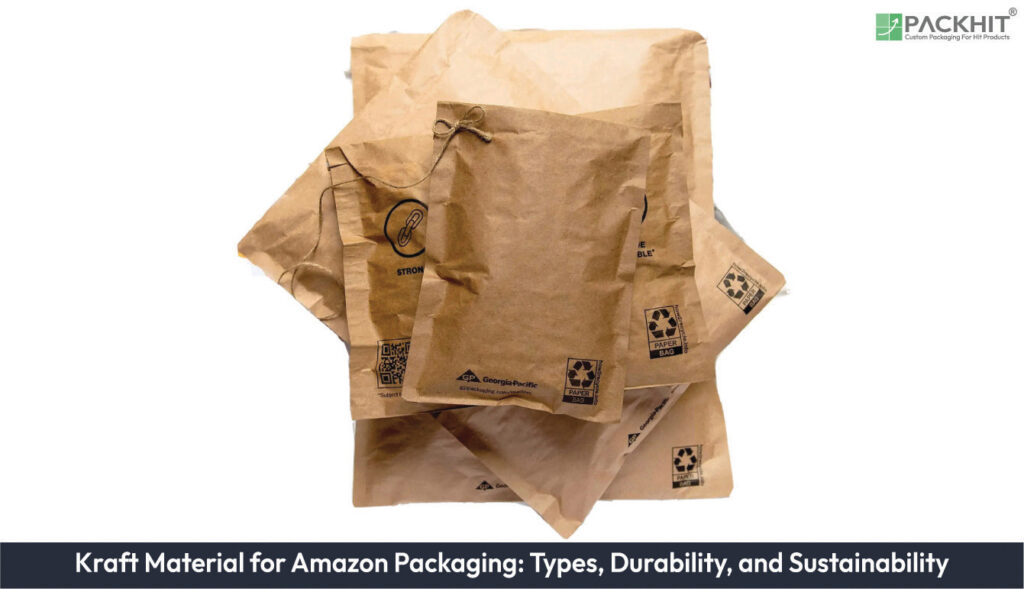
Kraft material is used in Amazon packaging because it combines strength, cost-effectiveness, and environmental benefits. This paper-based material is produced through the kraft process and includes natural kraft, bleached kraft, and recycled kraft paper, each suited to different packaging requirements. Its durability comes from properties such as tensile strength and tear resistance. These characteristics support applications such as shipping boxes, padded mailers, and wrapping paper, with performance depending on factors such as moisture, compression, material grade, and package design. Kraft material also supports sustainability considerations through renewable fiber sourcing, recyclability, and biodegradability, although coatings and other treatments can affect its end-of-life recovery.
- What is Kraft Material for Amazon Packaging?
- Types of Kraft Material Used in Amazon Packaging
- How Durable is Kraft Material in Amazon Packaging?
- Tensile Strength and Tear Resistance
- Moisture Resistance
- Performance Under Compression
- Testing Kraft Packaging Before Production
- How Sustainable is Kraft Material in Amazon Packaging?
- How to Select Kraft Material for an Amazon Packaging Format?
- How Does Kraft Material Contribute to Amazon Packaging Efficiency?
What is Kraft Material for Amazon Packaging?
Kraft material for Amazon packaging is a paper-based material made from wood pulp or recovered paper fibers. The kraft pulping process separates lignin from cellulose fibers, then forms and dries those fibers into paper or paperboard. The resulting sheet combines low weight with useful tensile strength, tear resistance, foldability, and printability. Kraft-based materials can be used in shipping boxes, mailers, wrapping paper, void fill, dividers, and protective inserts. The selected grade depends on package format, product weight, stacking load, handling conditions, and moisture exposure. Kraft material is used in Amazon-related packaging applications, but the final choice depends on the package design and its performance specification rather than on the sales channel alone.
For manufacturers, the material specification usually includes basis weight, thickness, fiber source, moisture resistance, coating type, recycled content, and print requirements. A single kraft grade does not perform the same way in every package. A heavier paper can resist puncture and tearing, while corrugated board converts paper strength into stacking performance through its fluted structure. Package dimensions, score lines, seams, closures, and internal supports also affect product protection during fulfillment and parcel transport.
Types of Kraft Material Used in Amazon Packaging
Three common kraft categories are natural kraft, bleached kraft, and recycled kraft. They differ in fiber source, color, surface finish, strength retention, and environmental profile. Packaging suppliers can combine these papers with corrugation, adhesive systems, coatings, or liners to meet a defined shipping requirement. Paper bags, corrugated cases, padded mailers, wrapping sheets, and protective inserts are examples of formats that use different kraft constructions.
Natural Kraft Paper
Natural kraft paper is an unbleached brown paper made mainly from virgin wood fibers. Its long cellulose fibers support tensile strength and tear resistance, while the brown color masks minor scuffs and reduces the need for bleaching chemicals. Common uses include corrugated shipping cases, paper bags, padded mailers, wrapping sheets, and protective sleeves. Lightweight grades serve wrapping and mailer functions; heavier grades are used when puncture resistance or load-bearing capacity matters. The correct basis weight depends on product mass, panel dimensions, closure method, and required package tests.
Natural kraft also accepts flexographic printing, although its brown surface can change ink color and contrast. Manufacturers can specify a white outer liner when brand graphics require a lighter print surface while retaining kraft-based layers elsewhere in the board. Ink coverage, barcode contrast, scuffing, and rub resistance belong in the print specification.
Bleached Kraft Paper
Bleached kraft paper is processed to create a white or lighter surface. The surface supports clearer color reproduction, product information, barcodes, and branded graphics than unbleached brown paper. It appears in printed mailers, cartons, labels, envelopes, and gift-wrap components. Bleaching adds processing steps and can change fiber characteristics, so the specification must balance appearance with burst strength, tear resistance, and the package’s end-of-life requirements. A white outer liner can be combined with brown inner liners when the exterior requires print contrast but the complete board does not require bleached fiber.
Recycled Kraft Paper
Recycled kraft paper contains post-consumer or post-industrial recovered fibers. Fiber length decreases during repeated pulping cycles, which can reduce tensile strength, stiffness, and resistance to wet conditions. Modern mills compensate through fiber blending, refining, sheet formation, and higher basis weight. Recycled grades appear in corrugated liners, lightweight mailers, paper filler, dividers, and secondary packaging components. Manufacturers can request a stated recycled-content percentage and test the finished package rather than relying on fiber source alone. Performance and recyclability depend on grade, fiber condition, coatings, adhesives, and local paper-processing conditions.
How Durable is Kraft Material in Amazon Packaging?
Kraft material can withstand routine parcel handling when its paper grade and package structure match the product load. Durability depends on fiber length, basis weight, thickness, moisture content, flute profile, board construction, seam strength, and internal cushioning. Compression, vibration, impact, abrasion, and repeated handling each place a different demand on the package. A package test should therefore represent product mass, dimensions, stacking pattern, and expected distribution route.
Tensile Strength and Tear Resistance
Tensile strength measures the force required to pull kraft paper apart, while tear resistance measures its ability to stop a growing tear. Long softwood fibers form strong bonds during pulping and drying, but the result varies with grain direction, moisture, recycled content, and basis weight. Lightweight sheets can serve wrapping or mailer functions, whereas heavier sheets and multiwall constructions carry greater loads. Testing should examine both machine direction and cross direction because paper does not behave identically along and across the fiber orientation. A package specification must connect these paper tests to the finished mailer, box, seam, or insert.
Moisture Resistance
Uncoated kraft paper absorbs water vapor and liquid because cellulose fibers are hygroscopic. High relative humidity can soften the sheet, reduce edge-crush performance, and lower the compression strength of corrugated board. Wax, polyethylene, dispersion, or other barrier treatments reduce water contact, but each treatment changes recyclability, cost, sealing behavior, and print performance. Kraft-based material with a moisture barrier belongs in the specification only if the product or distribution conditions justify that added layer. Test the complete package after humidity exposure rather than testing dry paper alone.
Performance Under Compression
Corrugated kraft board resists stacking loads because its fluted medium separates and supports the paper liners. The liners carry tensile and compression forces, while the flutes add thickness and help maintain the distance between surfaces. Board grade, flute size, moisture level, box dimensions, openings, and pallet stacking pattern affect compression strength. A larger box with a long unsupported panel can buckle sooner than a smaller box made from the same paper grade. Edge-crush and box-compression tests help match the board to the expected load.
Testing Kraft Packaging Before Production
Test the assembled package under the hazards that it encounters during storage and parcel distribution. A basic validation sequence can include compression, drop, vibration, abrasion, seam, and humidity checks. Test filled production-intent samples because empty-board results do not show how the product, cushioning, closure, and package dimensions interact. Inspect product damage, panel collapse, seam opening, corner crush, print failure, and moisture-related deformation after each test condition.
Repeat testing after material changes, including a new recycled-content ratio, lower basis weight, different flute, altered coating, revised adhesive, or smaller box. The acceptance criteria should state the permitted product damage, package deformation, closure failure, and labeling loss. These records support a repeatable material decision without treating one paper-property value as a guarantee of shipping performance.
How Sustainable is Kraft Material in Amazon Packaging?
Kraft packaging has a favorable sustainability profile when it uses responsibly sourced fibers, limits unnecessary material, and remains recyclable after use. Its environmental impact also includes forestry, pulping energy, water use, transport weight, inks, adhesives, coatings, and recovery conditions. Amazon-related packaging claims require qualification because package formats, suppliers, regions, and product categories can differ. A manufacturer can assess the actual package by documenting fiber content, material weight, certification, barrier chemistry, recycled content, and local recycling guidance. Kraft material suits an Amazon-related packaging specification only when its complete construction meets both protection and end-of-life requirements.
Renewable Sourcing
Kraft paper uses wood fiber, a renewable feedstock when forests are managed and regenerated under applicable standards. Mills recover black-liquor byproducts from the kraft process and can burn them for process energy, reducing dependence on external fuel. Responsible-sourcing certifications, including FSC and PEFC, trace defined fiber claims through a documented chain of custody. Certification does not describe every environmental impact, so procurement reviews should also examine recycled content, mill energy sources, water management, and transportation distance.
Recyclability and Biodegradability
Clean, dry, uncoated kraft paper and corrugated board are widely accepted in paper-recycling systems, subject to local collection rules. Recovered fibers can re-enter paper production, although fiber quality declines after repeated processing and fresh fiber is added to maintain sheet performance. Kraft paper can also biodegrade under suitable biological conditions, but the rate depends on moisture, oxygen, temperature, thickness, inks, adhesives, and the disposal environment. No single recycling count or decomposition period applies to every kraft package. Remove food residue and non-paper components before recycling when local instructions require it, and confirm acceptance with the intended municipal or commercial recycling stream.
Challenges in Recycling Coated Kraft
Coated kraft becomes harder to recycle when a barrier layer, foil, plastic film, or heavy adhesive prevents normal fiber recovery. Polyethylene-lined and wax-treated papers may require specialized processing, and some facilities reject them. Water-based dispersion coatings can preserve more paper fiber than plastic laminates in certain designs, but recyclability still depends on coating weight, repulpability, and local mill equipment. Manufacturers can reduce this risk by using a mono-material paper structure where performance permits, minimizing coating coverage, identifying components clearly, and confirming acceptance with the intended recycling stream.
How to Select Kraft Material for an Amazon Packaging Format?
Select kraft material by matching paper properties to product mass, package geometry, distribution hazards, and recovery requirements. Start with the finished format: a mailer requires different tear and seam performance than a regular-slotted corrugated box, while an insert requires stiffness, clean die cutting, and dimensional stability. Record the product weight, dimensions, center of gravity, sharp edges, surface sensitivity, and expected stacking conditions before choosing basis weight or board grade.
- Basis weight: Use the paper mass per unit area to compare grades, then verify thickness, stiffness, and finished-package strength.
- Fiber content: Specify virgin fiber, post-consumer fiber, post-industrial fiber, or a stated blend when strength and sourcing records matter.
- Surface treatment: Add a coating or barrier only when liquid contact, grease, abrasion, or heat sealing requires it.
- Package construction: Check flute profile, liner arrangement, score placement, adhesive, seam, closure, and internal supports as one system.
- Recovery pathway: Confirm whether the intended paper stream accepts the complete package, including inks, labels, coatings, tapes, and adhesives.
A supplier data sheet describes the paper, not the complete shipping package. Use pilot samples and finished-package testing if a change in basis weight, recycled content, coating, board grade, or box size affects protection.
How Does Kraft Material Contribute to Amazon Packaging Efficiency?
Kraft material contributes to Amazon packaging efficiency by combining strength, relatively low weight, versatility, and recyclability. Its properties allow packaging structures to provide appropriate product protection without relying on unnecessarily heavy materials.
- Lightweight Construction: Kraft paper and kraft-based corrugated materials can provide strength while keeping package weight relatively low, supporting easier handling and transportation.
- Efficient Material Use: Different grades and basis weights can be selected according to the product’s protection requirements, helping avoid excessive material use.
- Versatile Applications: Kraft material can be used in boxes, mailers, wrapping paper, and protective components, making it adaptable to different packaging formats.
- Product Protection: Its tensile and tear resistance can help packaging withstand handling and shipping stresses, although performance depends on the material grade and package design.
- Cost Considerations: Kraft-based packaging can offer a practical balance between material performance and manufacturing cost, depending on specifications and order volume.
- Recyclability: Uncoated kraft paper is generally recyclable where appropriate collection and recycling systems are available, supporting material recovery after use.
Kraft material can improve packaging efficiency by combining functional performance with material and weight efficiency. The most suitable kraft grade depends on product weight, shipping conditions, required protection, package design, and end-of-life considerations.