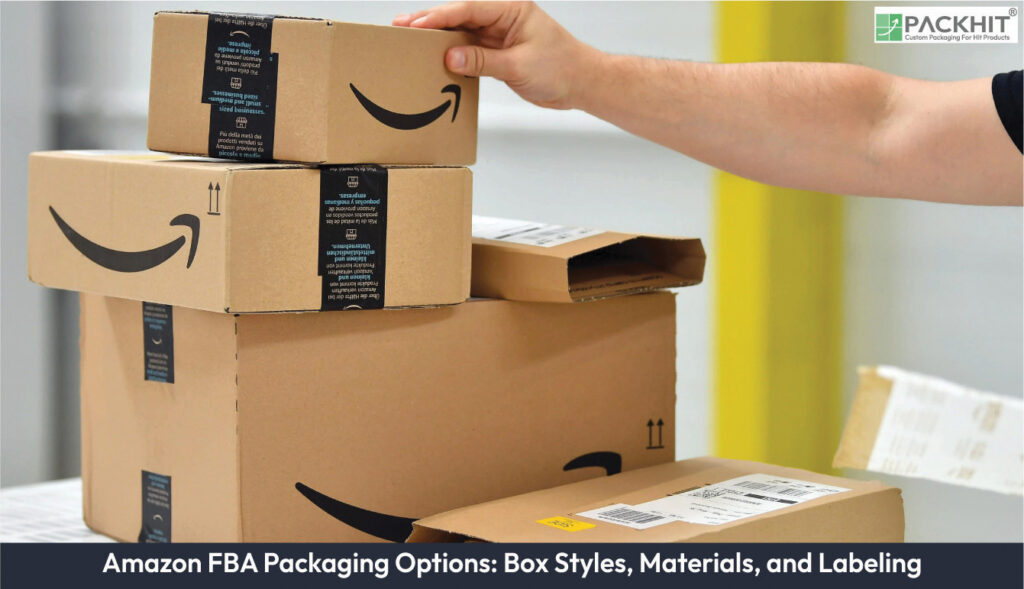
Amazon FBA packaging involves selecting box styles, materials, and labeling formats according to the product, package design, and applicable fulfillment requirements. Common packaging formats include Regular Slotted Containers (RSC), Full Overlap Containers (FOL), die-cut boxes, and double-wall boxes, while material selection may include corrugated cardboard, polyethylene bags with required warnings, and other eligible packaging materials. Strength grades and material specifications can vary by product and fulfillment program, so current Amazon requirements should be verified before production or shipment. Following applicable, verified specifications can help reduce compliance risk, but does not by itself guarantee compliance. Requirements for labels, dimensions, weight, materials, warnings, and testing may also vary, and incorrect packaging or labeling can lead to rework, delays, additional charges, or other operational consequences.
- Approved Box Styles for Amazon FBA Packaging
- Regular Slotted Containers (RSC)
- Full Overlap Containers (FOL)
- Die-Cut Boxes
- Double-Walled Boxes
- Specialty Boxes
- Which Materials are Appropriate for Amazon FBA Packaging?
- Compliance Risks Associated with Amazon FBA Packaging
- How Should Labels Be Applied to Amazon FBA Packages?
- What are the Sustainability Considerations for Amazon FBA Packaging?
Approved Box Styles for Amazon FBA Packaging
Amazon FBA box selection depends on the product’s dimensions, packed weight, fragility, and shipping configuration. Common corrugated formats include regular slotted containers (RSC), full overlap containers (FOL), die-cut cartons, double-wall cartons, and specialty cartons. A box style is not automatically approved for every product or shipment. Amazon packaging and labeling requirements can change by product category, fulfillment program, destination, and time. Check the current applicable requirements before production and shipment, and record the date of verification in the packaging specification.
Regular Slotted Containers (RSC)
Regular Slotted Containers (RSC) have four top flaps and four bottom flaps with the same length. The flaps meet at the center when the carton closes. This standard construction uses corrugated board efficiently and works with common carton-sealing equipment. RSC cartons fit standard-sized products that do not require an internal fixture. Select the board grade from the packed weight, product dimensions, stacking load, and expected shipping conditions rather than from box style alone. Specify the inside length, width, and height, because outside dimensions affect shipment measurements and storage calculations. Confirm that the assembled carton leaves enough clearance for the product, cushioning, closure, and label area.
Full Overlap Containers (FOL)
Full Overlap Containers (FOL) have flaps that extend across the full width of the carton and overlap when closed. The extra board at the top and bottom adds resistance to edge crush, punctures, and concentrated loads. FOL cartons can protect heavy products or products with narrow contact points, but their added material and folding requirements affect carton cost and storage volume. Test the closed carton with the actual product and cushioning before shipment. Confirm that the overlap remains flat and that the closure method does not cover a required barcode.
Die-Cut Boxes
Die-cut boxes use a cutting die to form precise panels, tabs, slots, windows, or internal compartments. The close fit limits product movement and can reduce unused volume. Manufacturers commonly specify die-cut cartons for irregular products, electronics, cosmetics, and small components that require separation. Measure the packed product, including protective films and inserts, because a tight carton can compress the contents or prevent proper closure. Inspect each locking tab and partition after assembly; a die-cut feature that tears during packing can leave the product exposed. Include the die line, board grade, glue or locking method, and assembly sequence in the approved carton specification.
Double-Walled Boxes
Double-walled boxes contain two corrugated mediums and three liners. They resist compression and puncture better than single-wall cartons at a comparable footprint. This construction fits heavy products, bulk packs, and shipments exposed to repeated stacking. It also adds board thickness, weight, and material cost. Double-wall construction does not replace product-specific drop, compression, or transit testing, and it does not provide dependable temperature control without a separate thermal design. Record the combined board grade and test method rather than describing the carton only as double-wall.
Specialty Boxes
Specialty boxes include telescoping cartons, multi-depth cartons, and other formats with adjustable or interlocking panels. Telescoping cartons use separate pieces that slide together for variable product heights. Multi-depth cartons use score lines that allow the packer to shorten the carton. These formats reduce unused space for products with non-standard dimensions, but every fold, tab, and closure must remain secure after packing. Check the final exterior dimensions and shipping weight in each configuration. Use the largest resulting dimensions and weight when the shipment workflow requires a single carton specification.
Packaging limits and testing requirements can vary by product type, fulfillment program, destination, and shipment configuration. A commonly cited 25-inch maximum side length, 50-pound maximum weight, or 200 pounds per square inch (PSI) compression figure is not a universal requirement for every Amazon FBA carton. Do not use any of these figures as a production specification unless the current applicable Amazon guidance identifies the limit and test method for the shipment. Confirm permitted dimensions, packed weight, carton construction, and testing criteria before production. If the source does not show a last-verified date, treat its numerical limits as unverified reference information rather than current compliance instructions.
Which Materials are Appropriate for Amazon FBA Packaging?
Corrugated fiberboard is the primary paper-based material for Amazon FBA cartons. Its fluted medium and linerboard resist compression while keeping shipping weight relatively low. Board selection depends on carton size, product weight, stacking height, moisture exposure, and the distribution route. Edge Crush Test (ECT) and burst ratings describe different board properties, so the packaging specification must identify the required test method and grade. A figure such as 32 ECT is not a universal minimum for every Amazon shipment. Verify the current strength specification for the relevant product, carton, and fulfillment program before ordering board.
Kraft linerboard, recycled fiberboard, molded-pulp inserts, and crumpled kraft paper can support paper-based packaging programs. Use molded pulp or folded corrugated partitions to separate breakable items. Wax coatings, films, and laminates can limit moisture absorption, but they can also affect recycling and may not meet a particular sustainability or disposal requirement. Confirm the accepted material composition before committing to coated board. State the percentage of recycled fiber only when the supplier has documented the calculation and the applicable specification defines the measurement.
Polyethylene bags can package certain products if the applicable product and shipment rules permit them. Bag thickness, closure method, exposed-product area, and warning-label requirements vary by use. A 1.5-mil thickness figure and a suffocation warning are not universal requirements or substitutes for checking the current rule. Confirm the applicable thickness, closure, warning statement, and label specifications before finalizing the bag. A bag that covers the product completely can also affect barcode placement and inspection access.
Bubble wrap, air pillows, kraft paper, and molded pulp function as internal cushioning; they do not automatically satisfy a primary-packaging or prep requirement. Confirm whether the product requires a sealed bag, a warning statement, a scannable label on the bag, or additional carton protection. Use enough cushioning to limit movement and prevent contact between fragile product surfaces and the carton walls.
Material decisions also affect carton measurements, packed weight, barcode placement, and disposal handling. Test the complete package, including the product, inserts, bags, tape, and labels, rather than testing empty board samples alone. Recheck the material and prep requirements when the product, supplier, destination, or fulfillment program changes.
Compliance Risks Associated with Amazon FBA Packaging
Packaging non-compliance can create product rejection, receiving delays, relabeling work, inventory restrictions, additional charges, or shipment interruptions. Common causes include an incorrect carton measurement, excess packed weight, weak board, exposed product, an unreadable barcode, duplicate barcodes, or a warning label that does not meet the applicable rule. The exact consequence depends on the shipment, product, fulfillment program, and current Amazon enforcement process.
Reduce these risks with a documented packaging check before production and before shipment. Record the assembled carton dimensions, packed weight, board grade, closure method, cushioning, barcode placement, and warning-label format. Scan labels on representative cartons and inspect cartons after drop or compression testing if the applicable specification calls for those tests. Recheck the current Amazon requirements if the product, packaging supplier, destination, or fulfillment program changes. Add a last-verified date and the source of each numerical limit to the internal record.
Packaging Support and Supplier Network (APASS) resources may help manufacturers identify packaging suppliers and testing services, but supplier participation does not remove the manufacturer’s responsibility to verify the requirements for a specific shipment. Automated label printing can reduce transcription errors, while human inspection remains necessary for carton condition, placement, and scanability. Until the listed requirements have been reviewed against current Amazon instructions, use this section as a packaging checklist, not as confirmation of present compliance.
How Should Labels Be Applied to Amazon FBA Packages?
Apply each required label to a flat, visible surface that remains readable after packing and sealing. Remove or cover obsolete barcodes and shipping marks, and keep the scannable code away from seams, corners, edges, closures, and heavy graphics. A label that wraps around a carton or sits beneath tape can fail during receiving even when the printed information is correct. Keep a clear area for each barcode during the carton-design stage instead of adding labels after artwork approval.
Use the barcode, shipment identifier, carton identifier, product information, and warning text required for the applicable workflow. Print at a resolution and size that the current instructions specify, then inspect contrast, quiet zones, placement, and scan quality. Apply suffocation warnings to bags if the current rule requires them. Do not assume that one label format, print resolution, or warning statement applies to every product category. Verify the label data against the shipment record before applying it to production cartons.
Scan representative labels after printing and after application to the carton. Check the code at the angle and distance used during receiving, because glare, curvature, tape, wrinkles, and low contrast can interfere with scanning. Keep label stock, printer settings, artwork revisions, and inspection results in the packaging record. Recheck current Amazon labeling instructions before shipment if the page lacks a last-verified date or if the fulfillment workflow has changed.
What are the Sustainability Considerations for Amazon FBA Packaging?
Amazon FBA packaging sustainability depends on the material, package design, shipment, and program requirements. Amazon’s Frustration-Free Packaging (FFP) program addresses packaging design by reducing unnecessary components, such as plastic ties, clamshells, and shrink wrap, when the product can remain protected during fulfillment. Packaging for an FFP submission must also support customer opening without additional tools. Program participation does not establish that every package is recyclable or biodegradable, so manufacturers must verify material and disposal conditions for the specific design.
Amazon’s Compact by Design certification focuses on product and package efficiency. A package with fewer components, smaller dimensions, or less unused air may occupy less storage and shipping volume. Those changes can reduce material use or transportation space in some cases, but the environmental and cost effects depend on the product, protective requirements, shipment profile, and final package construction. Manufacturers can assess paperboard grade, coatings, inserts, adhesives, plastic parts, package dimensions, and opening method before selecting an FBA packaging format.
- Material: Identify whether paperboard, corrugated fiberboard, plastic, coatings, adhesives, and inserts can enter the intended recycling system.
- Protection: Confirm that the package prevents damage during handling and shipping, since replacing damaged products can add material and transport impacts.
- Size: Remove unnecessary void space while retaining the clearances and cushioning required for the product.
- Labeling: Keep FBA labels, product information, and disposal marks legible without adding components that complicate recycling.
- Verification: Check current Amazon program criteria and document the assumptions used for material, cost, and shipment comparisons.
Sustainable packaging choices may reduce material use or shipping space in some cases, but they do not create universal environmental or financial benefits. Compare the complete FBA package against the product’s protection needs, fulfillment requirements, local disposal conditions, and measured packaging cost.