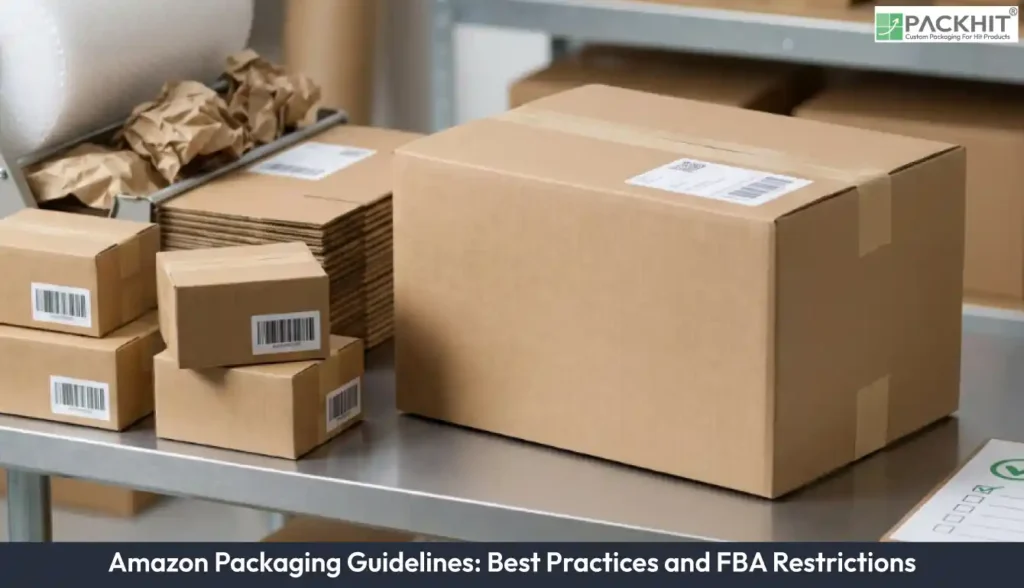
Amazon FBA (Fulfillment by Amazon) packaging preparation makes each sellable unit ready for fulfilment-centre receiving, storage, transport, and customer shipment. The correct method depends on the unit’s format and risk: secure loose components, package sets as one complete sellable unit, protect fragile goods against movement and impact, and use cut- and puncture-resistant packaging for sharp products.
After choosing the physical protection, inspect the identification points. A manufacturer or Amazon barcode must be scannable through a poly bag or appear on an outside label. Keep the bag close to the product and no more than 7.5 cm beyond its dimensions; a flat-measured opening of 5 inches or more requires a suffocation warning. Expiration-dated products need readable dates on the outer box and individual units, with the outer-box date in at least 36-point type.
Vendor packaging certification is separate from ordinary FBA preparation. Frustration-Free Packaging, Ships in Own Container, and Prep-Free Packaging use tier criteria for the product’s own package. Tier 1 includes 100% curbside-recyclable materials and removal of contents within 120 seconds; Tier 2 also specifies package forms, sealing, protection, labelling, carton marking, dimensions, and weight limits that must be checked against current programme guidance.
Before dispatch, confirm FBA product restrictions, category-specific preparation, barcode and date visibility, set configuration, box-content information, shipping labels, routing, and the shipment record. Prep-service enrollment can affect whether inadequate units are refused, returned, or repackaged, but it does not replace the need to verify the applicable guidance.
- What Does Amazon FBA Packaging Preparation Need to Achieve?
- Match the Packaging Method to the Amazon Product and Its Risks
- Contain Loose Components and Complete the Sellable Unit
- Protect Fragile and Sharp Products Before Boxing
- Right Barcodes, Warnings, and Expiry Dates for the Amazon Package
- When Do Amazon Vendor Packaging Certification and Packaging Tiers Apply?
- Tier 1: Recyclable Materials and Quick Opening
- Tier 2: Sealed, Protective Packaging
- Certification Status and Commercial Effects
- A Final Pre-Shipment Check for Compliant FBA Units
- Choose the Preparation Path Before Packaging for Amazon
- FBA Preparation Checks by Unit Condition
- What Is the First Step in Amazon FBA Packaging Preparation?
- Does a Barcode Need an Outside Label on a Poly Bag?
- How Far May a Poly Bag Extend Beyond the Product?
- When Does a Poly Bag Need a Suffocation Warning?
- Are Vendor Packaging Tiers the Same as Ordinary FBA Prep?
- What Should Be Checked Before Sending FBA Inventory?
- What Are the Four Essential Stages for a Dependable FBA Packaging Decision?
What Does Amazon FBA Packaging Preparation Need to Achieve?
Amazon FBA packaging preparation makes each sellable unit ready for transport, receiving, storage, and order fulfilment at an Amazon fulfilment centre. General rules apply to inventory entering FBA, while liquids, fragile goods, batteries, apparel, small products, and other categories can require additional preparation.
Classify the unit before packing. A loose product, boxed unit, poly-bagged unit, case-packed product, and item sold as a set create different containment and identification problems. That classification determines whether the unit needs a bag, bubble wrap, hanger removal, secure closure, set marking, or another preparation step.
Packaging has two jobs: protect the sellable unit and keep its identifier accessible. The product should not arrive damaged or with loose pieces, and the manufacturer or Amazon barcode must remain scannable or be replaced by a correctly applied outside label. Also check product size tiers, FBA barcode settings, box-content information, shipping labels, shipping and routing, product condition, and product title before dispatch.
Match the Packaging Method to the Amazon Product and Its Risks
Choose the method according to the failure that must be prevented. Liquids and granular products may escape; glass and ceramic items may break; batteries and other sensitive goods may need category-specific treatment; apparel, textiles, plush products, jewellery, and small products can have their own preparation paths. The category is a starting point, not a substitute for checking the current product-specific rule.
Contain Loose Components and Complete the Sellable Unit
Loose sleeves or pouches should be bagged or secured with a non-adhesive band or removable tape so they cannot separate during transport. Amazon must not be expected to assemble multiple pieces of a sellable unit. Pack all components together before shipment.
When several items are sold as one unit, mark the package as a set. For example, six unique toy cars sold together should be identified as one set, so receiving staff can distinguish the intended sellable unit from separate products sharing an outer carton. Confirm that the barcode or FNSKU matches the assortment and condition.
Protect Fragile and Sharp Products Before Boxing
Fragile goods need protection that limits movement and absorbs impact. Over-boxing is required when the prepared item fails a 3-foot drop test after bubble wrap has been applied or could still be damaged during shipping and handling. Bubble wrap is therefore a component of some preparation methods, not an automatic substitute for an outer box.
Sharp products must be contained in cut- and puncture-resistant packaging. Use a safety knife with a covered blade while packing so an exposed blade is not left inside a carton. Liquids, batteries, and other specialised categories should follow their applicable preparation path rather than ordinary boxed-unit practice.
Right Barcodes, Warnings, and Expiry Dates for the Amazon Package
Inspect the final prepared unit, not merely the product before bagging. A loose poly bag can affect apparent package measurements during fulfilment-centre scanning, while a hidden barcode, warning, or date can create a receiving problem.
Make the Barcode Scannable Through the Bag
If the manufacturer or Amazon barcode scans through the poly bag, an additional outside barcode label is not needed for that visibility issue. If the bag blocks the barcode, print the relevant label and place it on the outside where it can be scanned without opening the package. Different assortments and conditions can correspond to unique FNSKUs, so match the identifier to the exact sellable unit.
Keep the bag close to the product and remove excess material. The poly bag should not extend more than 7.5 cm beyond the product dimensions. Secure the opening without covering the identifier or obscuring other required product information.
Keep the Suffocation Warning and Expiry Date Visible
A poly bag with an opening of 5 inches or larger when measured flat must carry a suffocation warning. The supplied guidance also uses a 12 cm opening threshold in its polythene-bag wording; because these thresholds are not identical, verify the current marketplace guidance and use the applicable warning rule rather than assuming the measurements are interchangeable.
Expiration-dated products must show the date on the outer box and on the individual units. If additional prep is added, place the expiration-date label on the outside of that prep or packaging. When the original date format differs, a sticker in the correct format may be placed over it, provided the replacement remains legible. The outer-box expiration date must use 36-point font or larger.
Note: Ensure the suffocation warning and expiration date remain fully visible, including labeling the outside of any additional prep. Be aware that poly bag thresholds and formatting requirements vary by marketplace and can change over time. Because measurement thresholds (like 5 inches versus 12 cm) are not exactly interchangeable, you must actively verify current local compliance rules regarding warning triggers, specific text wording, and strict outer-box font sizes (such as the 36-point rule) rather than assuming past guidelines apply.
When Do Amazon Vendor Packaging Certification and Packaging Tiers Apply?
Amazon’s Ships in Product Packaging (SIPP) program, formerly known as FFP and SIOC, allows eligible products to ship without an additional Amazon overbox. Certification evaluates a product’s own packaging against specific program tiers rather than standard FBA preparation rules. Because guidelines vary by product type and region, always treat these tiers as high-level planning considerations and verify current eligibility in Seller Central before updating your packaging.
Tier 1: Recyclable Materials and Quick Opening
Tier 1 packaging criteria, such as the use of 100% curbside-recyclable materials and a 120-second opening time, are supplied guidance that may vary by product and programme; verify current requirements before relying on them. These are programme criteria, not universal replacements for category-specific FBA rules.
Tier 2: Sealed, Protective Packaging
Tier 2 packaging must be a rigid 6-sided box, rigid or padded mailer, or bag. It must be securely sealed, protect the product, and meet the stated labelling and carton-marking rules. The supplied Tier 2 measurements include minimum dimensions of 6 × 4 × 0.375 inches and for flexible packaging, maximum limits such as 18 × 14 × 6 inches, a 21-inch combined-dimension limit, a 16-inch stated item dimension, and a 7-pound item-weight limit. As these thresholds can vary, verify the applicable current requirement for your programme.
Certification Status and Commercial Effects
Certification is needed for 2018 and later model-year televisions on new-condition FBA offers. For other products, confirm eligibility and the full programme criteria before describing a package as FFP, SIOC, or Prep Free Packaging. Tiers 1 and 2 may reduce or remove Amazon Ships in Product Packaging chargebacks, shown as SIOC chargebacks in Vendor Central; tier-dependent benefits should be confirmed through the applicable vendor process.
A Final Pre-Shipment Check for Compliant FBA Units
First confirm FBA product restrictions and the shipping and routing rules for the intended fulfilment-centre shipment. Then compare each unit with the shipment record: quantity, product condition, box-content information, shipping labels, routing, and carton closure.
At unit level, confirm that sets are complete and marked, loose parts cannot escape, protective packaging remains secure, and the barcode or FNSKU is visible and scannable. For dated inventory, inspect both the outer-box date and individual-unit dates after all additional prep has been added.
Finally, confirm FBA prep-service enrollment. If a product is not enrolled and its packaging or labelling is inadequate or non-compliant, Amazon may refuse it, return it, or repackage it. Enrollment affects possible handling of a problem; it does not remove the seller’s obligation to check current product-specific guidance.
Choose the Preparation Path Before Packaging for Amazon
Begin with the product category, physical format, and selling configuration. Liquids, pellets and granular products, batteries, fragile goods, sharp products, apparel, textiles, jewellery, and small products can present different containment or protection risks. Ask what could leak, break, puncture adjacent inventory, shed loose parts, or arrive incomplete.
Then match the final inspection to the format. A boxed unit needs intact protection and an accessible identifier; a poly-bagged unit needs a close-fitting bag, visible barcode, and applicable warning; a set needs every component secured and marked as one unit. This unit-level check is separate from carton-level box-content and routing checks.
Vendor programmes should be treated as a second decision, not as a general FBA shortcut. FFP, SIOC, and Prep Free Packaging evaluate package design against tier criteria, while FBA preparation remains necessary for the individual offer. Review programme eligibility through the applicable vendor process before using a certification claim.
FBA Preparation Checks by Unit Condition
This table outlines the Amazon FBA preparation checks for each unit condition, including standard, fragile, liquid, bundled, and otherwise restricted products. Use it to identify the packaging steps that apply before shipment and reduce receiving delays caused by exposed items, missing protection, or incorrect preparation.
| Unit or Programme | What to Verify | Supported Detail |
|---|---|---|
| Fragile or breakable | Use protection appropriate to the risk and add an outer box when the prepared item could be damaged or fails the applicable drop test. | Supplied threshold: a 3-foot drop test after bubble wrap. |
| Poly-bagged | Keep the bag close, keep the barcode scannable, and add the applicable warning. | The bag should not extend more than 7.5 cm beyond the product. A flat-measured opening of 5 inches or more requires a suffocation warning; verify current guidance where alternate wording uses 12 cm. |
| Expiration-dated | Show the date on the outer box and every individual unit; place any added date label on the outside of the final prep. | Outer-box date: at least 36-point font. |
| Sold as a set | Pack all components together and mark the packaging as a set. | Example: six unique toy cars sold as one unit. |
| Sharp or loose-component | Use cut- and puncture-resistant containment and secure sleeves or pouches. | A non-adhesive band or removable tape may secure loose pieces where appropriate. |
| Vendor Tier 1 | Check recyclability, opening method, prohibited components, and removal time. | 100% curbside recyclable; contents removable within 120 seconds. |
| Vendor Tier 2 | Check package form, sealing, protection, labelling, carton marking, and current dimensional limits. | Minimum 6 × 4 × 0.375 inches; supplied flexible-package maximums include 18 × 14 × 6 inches and 7 pounds. |
| Shipment | Match units and cartons to the intended fulfilment centre. | Confirm box-content information, shipping labels, routing, quantity, and condition. |
Amazon packaging decisions depend on product risk, package format, and FBA preparation requirements. Select protection and labeling that match the product category before sending inventory to Amazon.
What Is the First Step in Amazon FBA Packaging Preparation?
Classify the product, its physical format, and its selling configuration first. That decision indicates whether the unit needs containment, impact protection, a poly bag, set marking, or category-specific preparation.
Does a Barcode Need an Outside Label on a Poly Bag?
Only when the manufacturer or Amazon barcode cannot scan through the bag. If the bag blocks it, apply the relevant barcode label to the outside where it remains visible and scannable.
How Far May a Poly Bag Extend Beyond the Product?
The supplied guidance says the bag should not extend more than 7.5 cm beyond the product dimensions. Excess material can also affect apparent package measurements, so use a close-fitting bag and verify the current marketplace rule.
When Does a Poly Bag Need a Suffocation Warning?
A bag with an opening of 5 inches or larger when measured flat needs a suffocation warning under the supplied guidance. Because the source wording also refers to a 12 cm polythene-bag threshold, check the current applicable guidance before dispatch.
Are Vendor Packaging Tiers the Same as Ordinary FBA Prep?
No. FBA prep makes an individual unit suitable for fulfilment, while FFP, SIOC, and Prep Free Packaging certification evaluates the product’s own package against programme-specific tier criteria.
What Should Be Checked Before Sending FBA Inventory?
Check product restrictions, category-specific preparation, unit completeness, set marking, barcode and expiry-date visibility, box-content information, carton labels, shipping and routing, and the shipment record. Also confirm whether prep-service enrollment applies.
What Are the Four Essential Stages for a Dependable FBA Packaging Decision?
A dependable FBA packaging decision has four stages: identify the product and programme rules, secure the unit against its specific risks, keep barcodes, warnings, and expiry dates visible, and reconcile the cartons with shipment details before dispatch. Treat vendor-tier certification as a separate qualification, and verify any conflicting measurement or current product-specific rule before sending inventory.