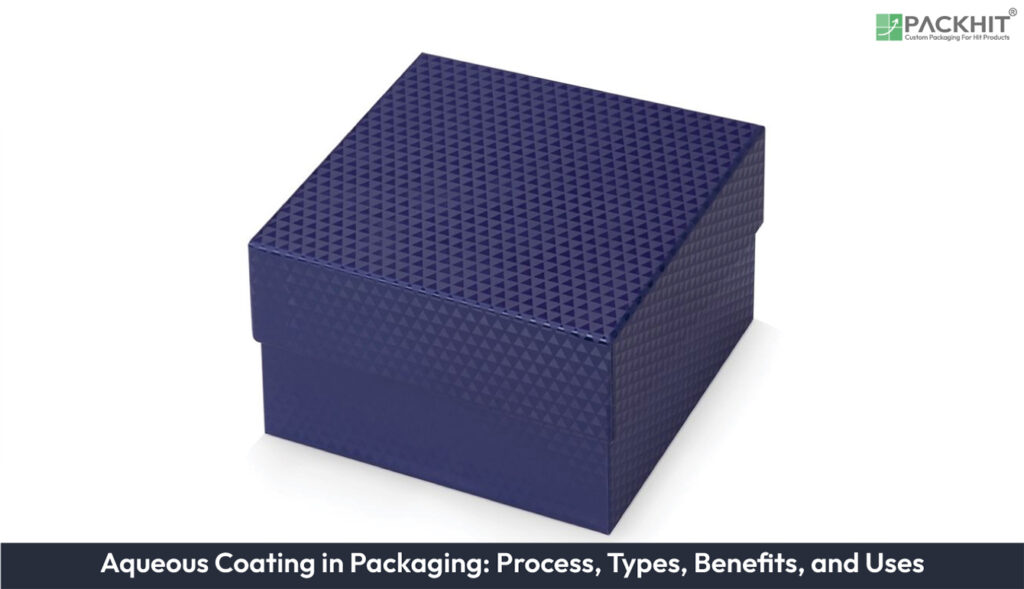
Aqueous coating is a water-based packaging finish that forms a protective surface layer while modifying the appearance of printed materials. Its application relies on controlled coating, drying, and inspection, with performance influenced by the substrate, formulation, coat weight, and dryer capacity. Its main finishes include gloss, matte, satin, and soft touch, giving manufacturers different options for reflectivity, texture, and presentation. Its benefits center on surface protection, foldability, production efficiency, and compatibility with a range of paper-based packaging applications. Aqueous coating is commonly used across food packaging, retail cartons, promotional materials, and mailing applications where print protection and finishing flexibility are important. Compared with UV coating, aqueous coating differs in surface characteristics, production requirements, and compatibility with different packaging and converting conditions.
- How is Aqueous Coating Applied?
- Common Application Methods
- Key Process Parameters
- Substrate, Ink, and Preflight Checks
- Quality Control and Common Defects
- Operational Considerations
- What is the Curing Process for Aqueous Coating?
- Different Types of Aqueous Coating
- What are the Benefits of Using Aqueous Coating in Packaging?
- What are the Uses of Aqueous Coating in Packaging?
- How Does Aqueous Coating Compare to UV Coating?
- When to Choose Aqueous Coating for Packaging?
How is Aqueous Coating Applied?
Aqueous coating is applied on press immediately after printing, using wet-on-wet or wet-on-dry workflows so the coating forms a uniform film that increases scuff resistance and reduces fingerprints.
Common Application Methods
Common application methods for aqueous coating include roll coating, spray coating, and curtain coating; each method targets controlled film thickness and uniform coverage on paper-based packaging surfaces.
- Roll (Anilox / Gravure): Metered rollers transfer a controlled film thickness. Used for high-speed sheetfed and web presses. Suitable for grammages and runs that require repeatable coat weights.
- Rod (Mayer bar): Simple metering via a wire-wound rod. Used for short runs and proofing; economical but less uniform at very high speeds.
- Curtain coater: Creates a continuous liquid curtain that impacts the substrate. Produces very smooth, even films at moderate to high speeds and for glossy finishes.
- Spray / Air-assisted: Atomizes coating across the web. Useful for spot coating and uneven surfaces; requires careful control to avoid overspray and misting.
- Air-knife / Knife-over-roll: Applies a flood coat, then meters by air pressure or blade. Used where precise thin films are required and for substrates sensitive to shear.
Key Process Parameters
Aqueous coating quality depends on resin formulation, solids content, viscosity, spray or roll pressure, line speed, droplet size, drying air temperature and airflow, reel tension, and cure time to reach target gloss, adhesion, and barrier performance.
- Resin type: Select acrylic, styrene-acrylic, or polyurethane dispersions based on required barrier and adhesion targets.
- Solids content: Control solids at the batch stage to match designed coating weight.
- Viscosity: Adjust dilution and temperature to maintain consistent spread across paper fibers.
- Application mode: Use gravure, flexo, slot-die, or curtain coating settings for uniform coverage.
- Coating weight: Target a fixed dry coat mass to stabilize scuff resistance and print compatibility.
- Substrate conditioning: Condition paper moisture before coating to reduce wrinkles and coating defects.
- Line speed: Set speed to balance coverage and wet film thickness, if drying capacity supports it.
- Spray/roll parameters: Control atomization pressure, nip gap, and doctor blade settings for edge-to-edge uniformity.
- Drying profile: Use staged hot-air zones to remove water without pinholes or blistering.
- Airflow and exhaust: Increase airflow where condensation occurs to prevent haze and uneven gloss.
- Cure temperature: Use time–temperature control to reach adhesion strength and chemical resistance.
Substrate, Ink, and Preflight Checks
Confirm substrate type and porosity before coating; for example, uncoated paperboard may absorb more coating than clay-coated stock. Verify ink dry time and tack. Run a wet-trap test, if using wet-on-wet, to check intercoat adhesion. Use adhesion and rub tests on press proofs to validate settings.
Quality Control and Common Defects
Quality control checks aqueous coating coverage, adhesion, and surface finish to prevent defects such as streaking, pinholes, blistering, and orange-peel texture on packaged paperboard.
- Streaking occurs when the coating viscosity or spray rate varies across the web, leaving lighter and darker bands.
- Pinholes form when trapped air or low solids disrupt the wet film, creating small voids that later expose the base stock.
- Blistering appears when moisture content or drying time mismatches the line conditions, causing bubbles after heat or humidity changes.
- Delamination results when adhesion fails at the paper–coating interface, often linked to insufficient drying, surface dust, or incorrect binder chemistry.
- Orange-peel texture develops when drying is uneven, producing a rough, pebbled look instead of a smooth finish.
- Cracking happens when the coated film dries too fast or becomes brittle, creating fine fissures that can spread under handling.
Defect prevention relies on line monitoring for coating solids, pH, spray pattern, wet film thickness, and cure or dry parameters, then verifying finish appearance and adhesion on finished cartons.
Operational Considerations
Operational considerations for aqueous coating include controlling water content, viscosity, drying temperature, and line speed to achieve uniform coverage while avoiding blocking, blistering, and poor adhesion; test adhesion and abrasion after curing at production conditions.
- Inline vs off-line: Inline coating saves handling and time for long runs; off-line gives more control for specialty coatings or small batches.
- Production speed: Match applicator and dryer capacity to web speed. If the dryer can’t remove moisture at that speed, exceeding dryer capacity can increase defects.
- Environmental control: Maintain stable temperature and relative humidity to prevent drying variability and blush.
- Safety and waste: Aqueous formulas have low VOCs and reduced solvent hazards; collect wash water and solids per local discharge rules.
Successful application depends on matching the method and parameters to the substrate, the ink set, and the required finish. Run short press trials and standardized tests (rub, adhesion, cold-crack) before full production to confirm coat weight, drying, and handling behavior.
What is the Curing Process for Aqueous Coating?
Aqueous coating dries as water evaporates from the applied film, typically with heat and forced airflow supporting the process. Drying performance depends on factors such as coating weight, solids content, substrate absorption, line speed, air temperature, and dryer capacity. If moisture is not removed adequately before further processing, defects such as blocking, blistering, haze, or poor adhesion can occur. Drying conditions should therefore be verified on the intended substrate and press setup before full production.
Different Types of Aqueous Coating
Aqueous coatings are available in a range of finishes commonly used to meet different functional and aesthetic requirements in packaging.
Gloss Finish
Gloss finish produces a high-shine surface that increases color saturation and specular reflection. Typical coat weight ranges 1–3 g/m2; application methods include curtain coater and anilox roll for uniform films. Common uses: brochures, folding cartons, point-of-purchase displays (examples: product inserts, retail sleeves, shelf talkers). Gloss shows fingerprints more readily and may require anti-block agents when stacking; reduce coat weight if blocking occurs.
Matte Finish
Matte finish creates a low-reflectance surface that reduces glare and improves text legibility. Use an air-knife or knife-over-roll to control thin films and minimize mottle. Common uses: luxury boxes, book covers, label stock (examples: high-end retail boxes, corporate reports, wine labels). Matte hides minor surface imperfections but can show scuff marks; increase solids or add anti-scratch additives if abrasion resistance is required.
Satin Finish
Satin finish yields a low-to-medium sheen that balances visual depth and readability. Coat weights typically fall between 0.8–2.5 g/m2; curtain or anilox application gives smooth laydown. Common uses: retail packaging and consumer electronics boxes (examples: cosmetics cartons, appliance sleeves). Satin reduces glare compared with gloss while retaining some color pop; choose satin if you need a compromise between contrast and low reflectivity.
Soft Touch Finish
Soft-touch finish creates a velvety surface that changes the tactile feel of the package. Because some formulations can be more susceptible to blocking or scuffing during stacking and handling, these properties should be evaluated on production samples before the full run.
These finishes not only enhance the visual and tactile aspects of packaging but also serve functional purposes, such as protecting the substrate from wear and tear, ensuring durability, and maintaining the material’s integrity during handling and transportation.
What are the Benefits of Using Aqueous Coating in Packaging?
Aqueous coating delivers a range of benefits, including eco-friendliness, durability, flexibility, and fast drying, that make it a preferred choice for packaging applications:
- Eco-Friendliness: Aqueous coating uses a water-based formulation with low volatile organic compounds (VOCs), reducing solvent hazards and emissions. Suitable for manufacturers, examples: food-packaging producers and retail-box converters. Minimal solvent handling lowers air permit complexity and hazardous-waste disposal needs.
- Durability: Aqueous coating increases resistance to fingerprints, scuffs, and surface rubs by forming a continuous polymer film. Validate durability with standardized rub and adhesion tests; adjust coat weight (typical range 0.5–4 g/m2) to raise abrasion resistance. Useful for printed materials, examples: brochures and point-of-purchase displays.
- Flexibility: Aqueous coating can retain flexibility at scores and fold lines when the formulation and coat weight are compatible with the substrate and converting process. Excessive coating build, unsuitable formulation, or drying conditions can increase the risk of cracking when the board is folded. Fold and cold-crack testing on production samples can be used to verify performance before the full run.
- Affordability: Material and process costs for aqueous coating are lower than for many UV systems because it uses water as a carrier and often runs inline. An inline application reduces handling and setup time, lowering per-unit cost on long runs. Favored by high-volume packagers, examples: corrugated inner-sleeves and retail cartons.
- Fast Drying: Aqueous coating cures by thermal and forced-air evaporation, enabling short drying cycles when dryer capacity matches web speed. Drying time depends on solids content (10%–35%) and coat weight; optimize staged air/temperature zones to avoid blush. Enables immediate downstream processes, examples: die-cutting and folding on the same run.
Together, these characteristics can make aqueous coating a strong finishing option when the formulation, substrate, coat weight, and drying conditions are matched to the required packaging performance.
What are the Uses of Aqueous Coating in Packaging?
Aqueous coating is extensively used in packaging across various industries, such as food, retail, and mailing application packaging. Its versatility and eco-friendly properties make it suitable for applications such as:
Food Packaging
Aqueous coating can be applied to paper-based food packaging to help protect the printed surface from soiling, scuffing, and handling wear. Coated paperboard and kraft are common substrate categories for applications such as bakery boxes, produce trays, and frozen-food sleeves. Where the coating may have direct or indirect food contact, the specific formulation and finished package should be verified for the intended use and applicable requirements.
Retail Packaging
Aqueous coating increases scratch resistance and color saturation on retail packaging while enabling selectable sheen levels (gloss, satin, matte). Common substrates: folding cartons and litho-laminated boards (examples: cosmetics cartons, apparel sleeves, electronics boxes). Adjust coat weight and dryer profile to balance scuff performance and print vibrancy.
Promotional Materials
Aqueous coating extends the handling life of promotional printed pieces by reducing fingerprints, micro-abrasion, and ink rub. Typical applications: brochures, flyers, and catalogs (examples: direct-mail inserts, event handouts). Select gloss for stronger color pop and matte for improved legibility; verify tack and drying for immediate finishing steps.
Mailing Applications
Aqueous coating protects mailed items from transit scuffs and spotting while remaining cost-effective for high-volume runs. Applicable substrates: coated offset stock and envelopes (examples: postcards, marketing mailers, subscription inserts). Use lower coat weights and anti-block additives to prevent blocking during stacking and postal handling.
How Does Aqueous Coating Compare to UV Coating?
Aqueous and UV coatings can both protect and modify printed packaging surfaces, but they differ in how they dry or cure and in the production conditions needed to achieve the required finish.
- Composition and Curing: Aqueous coatings use water as a primary carrier and dry mainly through evaporation supported by heat and airflow. UV coatings cure through exposure to ultraviolet energy using a compatible coating formulation.
- Environmental Considerations: Aqueous formulations can reduce reliance on organic solvents, although environmental performance depends on the specific formulation, drying energy, waste handling, and the complete packaging structure. UV coating should likewise be evaluated according to its formulation, curing system, and intended application rather than the curing method alone.
- Surface Durability: Both systems can provide surface protection when correctly specified and applied. Their resistance to scuffing, abrasion, or other handling conditions depends on factors such as formulation, coating weight, substrate, ink system, and drying or curing quality.
- Folding and Converting: Aqueous coatings can retain flexibility across folds when the formulation and coat weight are matched to the substrate. UV coatings also require compatibility checks where scoring, folding, gluing, or other converting operations place stress on the cured surface.
- Production Requirements: Aqueous coating requires sufficient airflow and drying capacity for the applied film at the intended press speed. UV coating instead requires a compatible UV-curing system capable of delivering the required cure under the selected production conditions.
Choosing between the two should begin with the required surface performance, substrate and ink compatibility, converting sequence, and available drying or curing setup. Neither coating should be treated as universally more durable, sustainable, flexible, or economical without evaluating the specific formulation and production conditions.
When to Choose Aqueous Coating for Packaging?
Choose aqueous coating when the package needs a water-based finish, inline application, controlled gloss or matte appearance, and sufficient flexibility for folding or converting. The process is a good fit when dryer capacity supports the intended press speed and the selected coating, ink, and substrate combination passes adhesion, rub, and fold checks during press trials. Before full production, verify the drying profile and finished-surface performance under the intended production conditions.