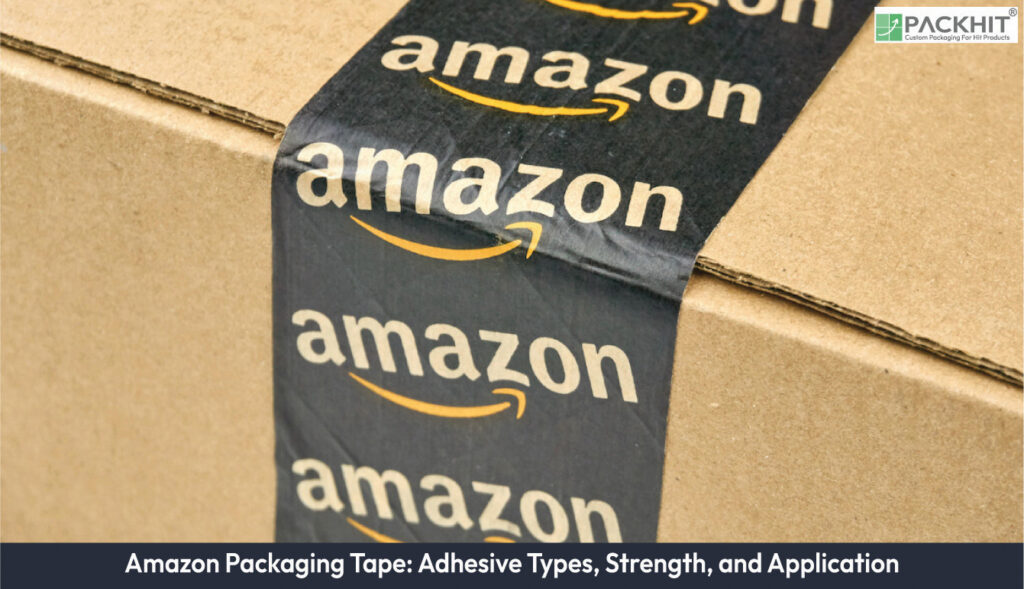
Amazon packaging tape uses different adhesive types and backing materials to seal packages across e-commerce, industrial, and refrigerated applications, with performance shaped by adhesion, tensile and peel strength, substrate, package weight, and environmental conditions. The main adhesive types include acrylic-based adhesives for long-lasting adhesion and environmental resistance, rubber-based adhesives for immediate tack and high-speed operations, and hot melt adhesives for cost-efficient performance in moderate temperature conditions. Tape selection also depends on the packaging application, from heavy-duty industrial shipments to e-commerce fulfillment and refrigerated storage, where the required strength and environmental resistance can differ.
Here, Amazon packaging tape refers to carton-sealing tape selected for packaging workflows associated with Amazon-oriented e-commerce fulfillment; the required adhesive, backing, and performance depend on the carton, application process, and shipping conditions.
What is Amazon Packaging Tape?
Amazon packaging tape is an adhesive tape used to close, reinforce, and identify shipping cartons across commercial and industrial packaging operations. It combines an adhesive layer with a backing made from materials such as polypropylene, polyester, paper, or fiberglass-reinforced film. The selected construction affects adhesion, tensile strength, tear resistance, temperature performance, and printability. Most grades adhere to corrugated cardboard, including recycled and coated board, but surface dust, moisture, board porosity, and application pressure affect the seal.
Packaging tape selection depends on carton weight, board type, sealing equipment, storage temperature, transit duration, and required opening behavior. Acrylic, rubber-based, and hot-melt adhesive systems cover 3 common carton-sealing requirements. Printed or colored tape can identify shipments or carry a handling message, but tape graphics do not replace required shipping labels, closure methods, or regulatory markings.
Types of Adhesives Used for Carton Sealing
Carton-sealing tape uses 3 common adhesive categories: acrylic-based adhesives, rubber-based adhesives, and hot-melt adhesives. Each category differs in initial tack, aging behavior, temperature range, and bonding performance on substrates such as corrugated cardboard. Product specifications depend on the complete tape construction, so the adhesive category alone does not establish performance. The main adhesive types are detailed below.
Acrylic-Based Adhesives
Acrylic adhesives maintain adhesion over extended storage periods and across changing environmental conditions. They generally resist ultraviolet (UV) light, oxidation, and temperature fluctuations better than many rubber-based formulations, although the result depends on the formulation and backing. Acrylic tape forms a consistent bond on corrugated cardboard, including some recycled boards, after the adhesive receives sufficient application pressure. Its initial tack can be lower than that of a rubber-based product, particularly on dusty, cold, or uneven surfaces. Acrylic formulations also show less yellowing during long-term storage in many applications.
Rubber-Based Adhesives
Rubber-based adhesives, including natural-rubber and synthetic-rubber formulations, provide immediate tack and contact with rough or uneven substrates. Packaging lines use this property when cartons move quickly from sealing to handling. The adhesive conforms to board irregularities and can bond when the surface has lower energy or a textured finish. Resistance to prolonged heat, UV exposure, and oxidation varies by rubber formulation and stabilizer package. Review storage conditions, shipment duration, and the manufacturer’s test data before selecting a rubber-based tape.
Hot-Melt Adhesives
Hot-melt adhesives use thermoplastic resins that produce high initial tack and fast bonding at packaging-line speeds. These tapes can bond to recycled and lightweight corrugated boards, depending on the adhesive formulation and board surface. Their performance depends on application temperature, carton surface, dwell time, and service temperature. A stated operating range, such as 40°F to 120°F, applies only to the specified product and test conditions. Cold storage, prolonged heat, or condensation can reduce bond formation, so the tape manufacturer’s technical data remains the controlling reference.
How is Tape Strength Measured?
Tape strength is measured with product-specific tests for tensile strength, peel strength, and shear resistance. Results depend on the backing, adhesive formulation, substrate, tape width, application pressure, dwell time, temperature, and test method. A high tensile value does not automatically indicate the highest carton-seal strength. Compare values only when the test conditions and specimen dimensions match the intended application.
Tensile Strength
Tensile strength is the longitudinal force required to break the tape, commonly reported in pounds per inch (lb/in) or a comparable unit. Treat the reported value as a specification for a defined tape construction rather than as a general range for all carton-sealing tape. Backing material, thickness, reinforcement, specimen width, test speed, and conditioning can change the result. Select the required tensile value from the manufacturer’s technical data, then verify the complete closure with the intended carton, tape width, number of strips, and load.
Peel Strength
Peel strength measures the force required to lift tape from a substrate and is commonly reported in ounces per inch (oz/in), newtons per centimeter, or another stated unit. The result is specific to the adhesive, backing, board grade, surface condition, dwell time, peel angle, peel rate, and test temperature. High peel resistance can reduce edge lifting during transit, while a lower peel force can support manual opening and repackaging. Use the manufacturer’s test value for the intended carton surface instead of applying an unverified typical range.
Elasticity and Shear Resistance
Elasticity describes how far the tape stretches under load, while shear resistance describes its ability to resist sliding when force acts parallel to the bonded surface. These properties vary with backing composition, adhesive formulation, temperature, load, and test duration. A tape that stretches can accommodate some carton movement, but excessive stretch or adhesive creep can affect a loaded closure during extended storage. Test the complete closure rather than judging the backing alone, because carton geometry, flap alignment, and board failure also affect package performance.
Which Packaging Applications Benefit Most from Carton-Sealing Tape?
Carton-sealing tape supports 3 common packaging applications: heavy-duty industrial packaging, e-commerce fulfillment, and refrigerated or food-grade packaging. The appropriate grade depends on carton construction, product mass, sealing speed, temperature, moisture exposure, and applicable compliance requirements.
Heavy-Duty Industrial Packaging
Heavy-duty packaging tape uses high-tensile backings or reinforced construction for cartons such as double-wall corrugated boxes. Manufacturers use these grades for machinery, automotive parts, building materials, and other dense products. Wider tape, multiple parallel strips, or cross-pattern application can distribute closure loads. The carton design and sealing method still determine the complete package strength; tape alone does not compensate for weak board or an overloaded box.
E-Commerce Fulfillment
E-commerce fulfillment commonly uses acrylic or hot-melt carton-sealing tape on lightweight and recycled corrugated boxes. Distribution centers select tape according to line speed, applicator settings, carton dimensions, and expected handling. Printed tape can identify a package or display a handling message, but it does not by itself create a tamper-evident closure. A manufacturer must test the complete carton, tape, and application process before adopting a grade at production scale.
Refrigerated and Food-Grade Applications
Food-contact suitability is product- and use-specific. Verify current manufacturer documentation and applicable requirements before selecting tape for direct food-contact packaging. The review must identify the intended contact surface, food type, contact duration, temperature, and jurisdiction. Tape used to close an outer shipping carton does not automatically qualify for contact with food or a primary food package. A food-packaging claim alone does not establish authorization for the intended use.
Before production use, obtain a current compliance review from the responsible quality, regulatory, or food-safety professional when direct contact or a regulated claim applies. Retain the product specification, lot information, compliance statement, and use conditions with the packaging approval record. Recheck the documentation if the tape formulation, supplier, packaging design, jurisdiction, or intended use changes.
Cold-chain packaging also requires a product-specific performance check. Confirm adhesion after refrigeration, condensation exposure, and the time needed for the tape to bond to the carton. Hot-melt, acrylic, and rubber-based tapes can respond differently to cold surfaces, so follow the manufacturer’s application-temperature limits and test the sealed carton under the expected storage and transit conditions. Record seal appearance, peel behavior, edge lifting, and carton failure during the test.
What Factors Determine the Best Amazon Packaging Tape?
The best packaging tape depends on package weight, carton substrate, environmental exposure, transportation conditions, application equipment, and storage duration. These factors determine the appropriate adhesive, backing strength, dimensions, and performance requirements.
- Package weight: Heavier cartons generally require stronger backing and greater tensile strength to resist stretching, splitting, and edge lift. Test tape against the actual filled and stacked carton load.
- Substrate type: Adhesion varies with smooth, recycled, rough, or dusty corrugated surfaces. Evaluate candidates on the actual carton board rather than relying only on general material compatibility.
- Adhesive type: Hot-melt, acrylic, and solvent-based adhesives differ in initial tack, temperature performance, aging behavior, and processing requirements. Select the chemistry according to the package and operating conditions.
- Environmental conditions: Temperature, humidity, dust, moisture, and sunlight can affect adhesion. Apply tape to clean, dry surfaces and validate performance under expected storage and handling conditions.
- Transportation requirements: Backing and adhesive should withstand relevant vibration, stacking, impact, shear, and handling stresses. Test the sealed carton under conditions representative of its distribution route.
- Application method: Tape width, roll length, core size, unwind characteristics, and tack should match manual dispensers or automated case sealers. Proper alignment and full flap contact help maintain consistent seals.
- Shelf life: Consider how long both unused tape and sealed cartons will be stored and under what conditions. Validate aged tape and finished seals on the intended carton stock when long-term storage is required.
Manufacturers should compare tape options using adhesion, tensile strength, seal consistency, and finished-carton testing, then select the specification that best matches the package and distribution conditions.