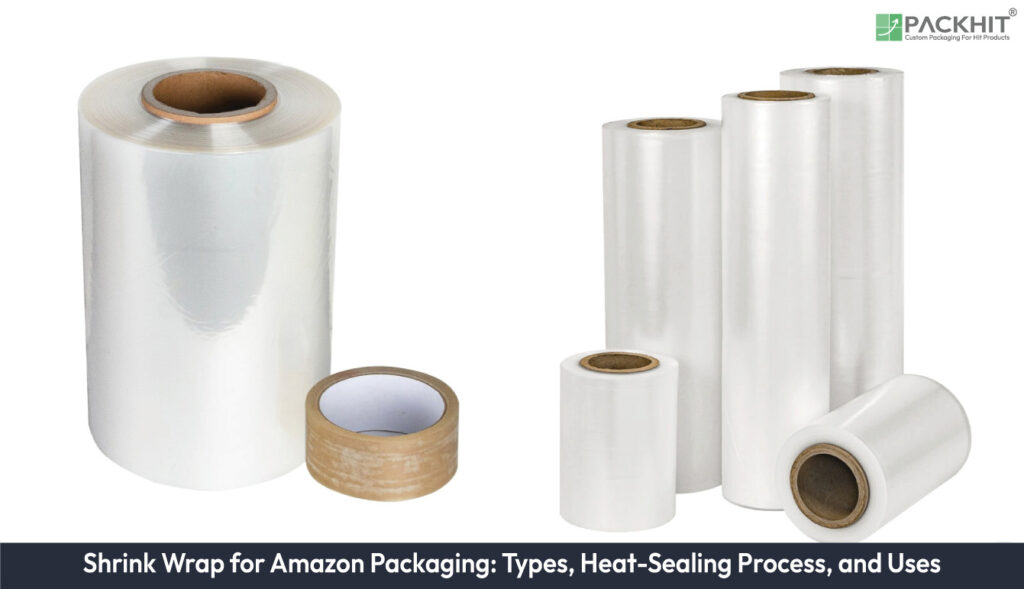
Shrink wrap, a thin polymer film that contracts under heat, can provide a protective layer around products and help secure items during handling and transit. This flexible secondary packaging solution is available in materials such as polyolefin (POF), polyvinyl chloride (PVC), and polyethylene (PE), with material selection depending on the product and packaging application. It can be used for bundling, unitizing, and protecting products, although suitability depends on factors such as film properties, product requirements, and sealing conditions. The heat-sealing process can help create a tight, durable package when the film, equipment, and settings are properly matched; it does not by itself establish compliance with applicable e-commerce or fulfillment requirements. Environmental considerations, material selection, equipment settings, and packaging performance should be evaluated alongside the specific requirements applicable to the product and fulfillment program.
What is Shrink Wrap for Amazon Packaging?
Shrink wrap is a heat-responsive polymer film that contracts around a product or group of items. In Amazon packaging, it can support unitization, surface protection, tamper indication, and barcode visibility when properly applied. It does not by itself establish fulfillment compliance, so manufacturers should verify current Amazon requirements and supplier documentation before use.
A shrink-wrapped package typically includes the film, seal, enclosed product, and any applied label or barcode. Each must perform correctly for the finished unit to handle and scan as intended.
Properties of Shrink Wrap
Shrink wrap has four primary properties that affect material selection, sealing, storage, and transit performance:
- Material composition: POF, PVC, and PE films differ in thermal, mechanical, barrier, and disposal characteristics. Select the grade based on the product, equipment, and application.
- Dimensional stability: Film should maintain predictable shrink and sealing behavior within its specified storage and operating conditions.
- Optical clarity: Transparent film can preserve product visibility and barcode readability when wrinkles, folds, and label lift are controlled.
- Water and chemical resistance: Protection varies by polymer, thickness, seal quality, and exposure conditions. Shrink film does not replace a hermetic or product-specific protective barrier.
Types of Shrink Wrap Used in Amazon Packaging
Three common shrink-wrap materials used in Amazon packaging are polyolefin (POF), polyvinyl chloride (PVC), and polyethylene (PE). Selection depends on mechanical strength, clarity, shrink temperature, seal performance, product contact, and the packaging line. The film supplier’s gauge, shrink ratio, sealing range, and storage instructions define the usable process window. Product geometry also matters. Sharp corners, projecting handles, oily surfaces, and heat-sensitive contents can change the film and equipment choice.
Polyolefin (POF) Shrink Wrap
POF shrink wrap combines clarity, puncture resistance, and balanced shrinkage for many retail-facing units. Multilayer POF structures work with manual sealers, L-sealers, and automated shrink tunnels. Some grades include documentation for direct food-contact applications in specified jurisdictions, but that status does not apply to every POF film or every use. Confirm the formulation, intended contact conditions, temperature limits, and applicable requirements with the film supplier before packaging food or other regulated products. Inspect each production sample for seal continuity, corner perforation, film splits, and barcode readability.
POF often fits products that require a clear presentation and a relatively clean seam. The film still requires a process trial because package length, film gauge, tunnel temperature, and conveyor speed affect shrink balance. A test run with the actual product exposes problems that a flat-film trial cannot show, including corner holes and label distortion.
Polyvinyl Chloride (PVC) Shrink Wrap
PVC shrink wrap has good clarity and stiffness for small products, sleeves, and promotional packages. Heating PVC can produce irritating or corrosive decomposition products if the film overheats. Exact emissions depend on the formulation, temperature, exposure time, and ventilation. Do not treat hydrogen chloride formation or any other emission as a fixed result for every process. Follow the film supplier’s temperature limits, safety data, and ventilation instructions. Stop the process if smoke, abnormal fumes, or discoloration appears.
Polyethylene (PE) Shrink Wrap
PE shrink film, including low-density polyethylene (LDPE), has greater thickness and tear resistance than many retail films. It commonly wraps heavy products, pallet loads, and multipacks. A thicker gauge generally reduces optical clarity and requires sealing equipment that matches the film’s thermal range. Confirm that the finished seam resists lifting, conveying, carton packing, and contact with the product’s edges.
Heat-Sealing Process for Shrink Wrap
Heat sealing joins overlapping film edges before or during shrinkage. The equipment applies heat for a defined dwell time, while the seal bar, wire, or band applies pressure as the polymer softens. A sound seal has continuous contact across the intended seam without open channels, burn-through, excessive wrinkles, or detached edges. Seal performance depends on film composition, film thickness, equipment calibration, pressure, and the cleanliness of the sealing surfaces.
Heat Sources
Two common heat sources are heat guns and shrink tunnels. The choice depends on package volume, film type, package geometry, and process repeatability:
- Heat Guns: Handheld devices direct heated air at selected film areas. They support prototypes, repairs, and low-volume packaging, but the operator must control distance, movement, temperature, and exposure time.
- Shrink Tunnels: Heated chambers apply circulating air as packages pass through at a set conveyor speed. They support repeated production work after the operator establishes film-specific temperature and speed settings.
Safety boundary: Use heat-sealing equipment according to the equipment and film supplier’s safety instructions. Provide ventilation, guards, emergency controls, and heat-resistant personal protective equipment where the risk assessment requires them. Stop the process if overheating, smoke, fire risk, or unexpected fumes occur. Isolate the equipment safely and consult a qualified safety or materials professional before continuing if off-gassing, unknown film composition, or abnormal material behavior is possible.
Sealing Techniques
The sealing method affects seam strength, cycle time, energy use, and film appearance. Three common methods are:
- Impulse Sealing: A heated wire or strip applies a short electrical pulse to the film seam. It suits many thin POF and PVC films when bar temperature, pulse time, and pressure match the supplier’s specifications.
- Direct Heat Sealing: Constant heat and pressure soften the film over a longer dwell period. The method supports thicker PE films and other materials that require more thermal energy to form a continuous seam.
- Continuous Band Sealing: A moving heated band closes seams as packages travel along a conveyor. The method supports repeatable throughput when film width, line speed, temperature, and pressure remain within equipment limits.
Optimizing the Heat-Sealing Process
Set temperature, dwell time, conveyor speed, pressure, and film tension from the film and equipment specifications, then verify the seal with documented inspections. Excessive heat or dwell time can cause holes, brittleness, distortion, smoke, or degraded film. Insufficient heat, pressure, or dwell time can leave channels and weak seams. Test the complete package, including corners, folds, labels, and product edges, before routine production.
Use thermal sensors, guards, and preventive maintenance where the equipment includes those controls. Keep the sealing area free of film scraps and other combustible material. PVC requires particular control because overheating can generate irritating or corrosive fumes. Stop the equipment after unexpected fumes, smoke, fire risk, or unexplained film behavior. Follow the site’s emergency procedure, use the approved ventilation system, and consult a qualified safety or materials professional before restarting.
How is Shrink Wrap Applied in Amazon Packaging?
Shrink wrap is applied by positioning the film, sealing the film, and applying controlled heat. The operator leaves enough clearance around the product, closes the film around the unit, and forms a seam with a bar, wire, band, or other specified sealing device. Heat then activates the film’s stored molecular orientation, causing contraction around the product. The result can hold a multipack together, limit abrasion, and create visible evidence of disturbance. Package dimensions, film gauge, shrink ratio, sealing temperature, dwell time, and conveyor speed determine the finished package.
- Positioning: Place the product inside the film with clearance at the ends, corners, and seam area. Remove sharp projections or protect them if they could puncture the film.
- Sealing: Close the overlapping film edges with the specified sealing method. Keep the seam free of product, folds, contamination, and trapped channels.
- Shrinking: Apply heat gradually and evenly. Concentrated heat can perforate the film, distort the product, or damage labels.
- Inspection: Check the seal, film coverage, barcode, label adhesion, package dimensions, and unit integrity before the package enters routine production.
Handheld heat guns support low-volume work, prototypes, repairs, and localized shrinkage. Shrink tunnels heat packages as they move through a controlled chamber on a conveyor. Select equipment according to the film specification, package dimensions, production rate, and required seal strength. Keep hands, combustible materials, and electrical components outside hot zones.
Inspect representative units after setup and after material, product, or equipment changes. Record the film lot, film gauge, sealing settings, tunnel settings, inspection results, and any corrective adjustments. Check seam continuity, film tension, corner coverage, punctures, wrinkles, product distortion, label adhesion, barcode scanning, and package dimensions. These checks describe process control; they do not establish compliance with current Amazon requirements.
How Does Shrink Wrap Contribute to Amazon Fulfillment Needs?
Shrink wrap can support fulfillment through unitization, tamper indication, transit protection, and controlled material use. Packaging must still meet applicable labeling, barcode, dimensional, and fulfillment requirements, which should be verified before production.
- Product unitization: Holds multiple items together as one handling unit. Film and seals should withstand lifting, conveying, packing, and normal handling without separating.
- Tamper resistance: An intact film layer can indicate whether a package has been opened or disturbed, but it does not replace certified tamper-evident, child-resistant, or other product-specific security packaging where required.
- Protection during transit: Helps limit dust, moisture contact, and surface abrasion. Film type and thickness should be validated against product weight, edge shape, temperature, and expected handling conditions.
- Sustainability alignment: Depends on polymer type, film thickness, package design, collection systems, and local recycling capacity. Reduce excess film where testing permits, and support recyclability, compostability, biodegradability, or disposal claims with appropriate documentation.
Manufacturers should verify current Amazon and local requirements for the relevant product, program, and market, and record the review date in production specifications.
What are the Limitations and Challenges of Using Shrink Wrap?
Despite its advantages, shrink wrap poses certain limitations that must be carefully managed. Environmental impact is a prominent issue; traditional materials are petroleum-based and exhibit long decomposition cycles. Furthermore, improper heat application can lead to inconsistent sealing or film warping, compromising package integrity.
Cost pressures are another consideration. While shrink wrap offers packaging efficiency, the need for specialized heat-sealing equipment introduces capital expenditures. Additionally, recycling shrink wrap remains a logistical barrier, especially for multi-layered films that complicate waste stream segregation.