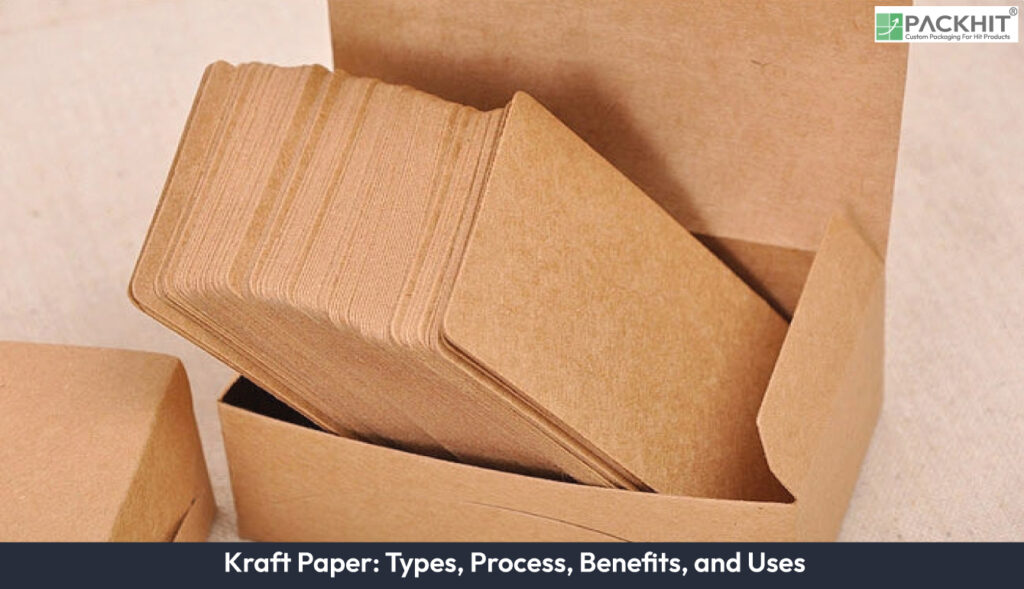
Kraft paper is a paper-based packaging material commonly selected for applications that require dependable strength, practical printability, and a natural appearance. Its performance varies across different grades, coatings, basis weights, and recycled-fiber compositions, allowing it to support both lightweight and heavy-duty packaging needs. The manufacturing process influences its strength, surface quality, color, and suitability for further treatments. These qualities make kraft paper useful for retail bags, industrial sacks, protective wrapping, food-packaging formats, and corrugated packaging, provided the selected grade is verified for its intended application.
Properties of Kraft Paper
Kraft paper has various properties, including high tensile strength, natural appearance, biodegradability, customizability, weight variability, and recyclability.
- High Tensile Strength: Kraft paper generally offers good tensile and tear resistance compared with many other paper grades.
- Natural Appearance: Its earthy brown color provides a rustic and eco-friendly aesthetic.
- Biodegradability: Kraft paper is generally biodegradable under appropriate disposal conditions.
- Customizability: It can be printed, dyed, or laminated for branding purposes.
- Weight Variability: Available in different thicknesses and weights, ranging from lightweight wrapping paper to heavy-duty industrial grades.
- Recyclability: Kraft paper is widely recyclable when free from coatings or laminates, subject to local recycling infrastructure.
Types of Kraft Paper
Kraft paper comes in various types, each tailored to specific applications. Below are the most common types:
1. Natural Brown Kraft Paper
Natural brown kraft paper is an unbleached, high-strength paper commonly supplied in grades typically between 40-160 g/m². It preserves long cellulose fibers from the kraft process, giving high tear resistance and a matte, absorbent surface suitable for many print methods such as flexography and offset. Typical uses include retail wrapping, shopping bags, corrugated facings, and interleaving.
- Surface and Printing: uncoated; accepts water-based and soy inks, and can be waxed or oil-treated for limited grease resistance.
- Weight Guidance: choose 40-80 g/m² for light wrapping, commonly 90-140 g/m² for bags, and typically 140-160 g/m² for corrugated facings.
- End-of-life: recyclable and compostable if uncoated; retains recyclability when unlaminated.
2. Bleached Kraft Paper
Bleached kraft paper is chemically whitened to provide a bright, smooth surface while retaining kraft strength. It offers higher brightness and improved print consistency compared with natural brown grades, which makes it suitable for high-visibility branding. Typical weight ranges from 50-180 g/m². Uses include premium shopping bags, cosmetic and apparel packaging, and printed wraps.
- Surface and Finishing: compatible with clay/coating layers for gloss or matte finishes and with water-based barrier coatings for food contact, if produced to applicable food-safety standards.
- Environmental Note: available in ECF (elemental chlorine-free) or TCF (totally chlorine-free) variants. Verify mill disclosures for bleaching chemistry and recycled-fiber content.
Surface and Finishing: Bleached kraft can be combined with clay coatings or water-based barrier treatments for improved appearance and functionality. For food-contact applications, the finished structure should be manufactured for that purpose and supported by appropriate documentation for the intended product, use conditions, and jurisdiction.
3. Sack Kraft Paper
Sack kraft paper is a heavy-duty grade engineered for multiwall and single-wall industrial sacks. Typical basis weights run 140-300 g/m² or higher in multi-ply constructions. It prioritizes burst strength, tear resistance, and seam integrity for bulk packaging. Uses of sack kraft paper are cement bags, flour and grain sacks, and feed and fertilizer sacks.
- Construction and Finishing: formed as single-ply or multi-ply sheets, sewn or valve-formed, and often paired with an internal polyethylene or mineral coating for moisture resistance.
- Compliance: for food-contact sacks, use designated food-grade sack kraft produced on dedicated lines, and documentation or certification may be required depending on the product and jurisdiction.
Food-Contact Considerations: Kraft sacks intended for flour, grain, or other food products may require designated food-contact grades and supporting supplier documentation. Applicable requirements depend on the packaged product, contact conditions, packaging construction, and regional regulations.
4. Coated Kraft Paper
Coated kraft paper receives a functional layer, commonly polyethylene (PE) or clay, to add moisture, grease, or print-quality properties. Two common variants exist: PE-coated for liquid or moisture barriers and clay-coated for sharper printing and bright whites. Uses may include food wrappers, moisture-resistant bags, pouches, and printed sleeves when the complete packaging structure is suitable and verified for the intended application.
- Recycling Impact: plastic or polymer coatings reduce curbside recyclability; specify recyclable or easily separable coatings if end-of-life recovery matters.
- Printability: clay-coating yields near-photographic print results with conventional CMYK processes.
5. Recycled Kraft Paper
Recycled kraft paper contains post-consumer or post-industrial fibers and is offered in 30-100% recycled-content grades depending on performance needs. Recycled content lowers brightness and, at high percentages, reduces tensile strength versus virgin kraft; manufacturers often blend recycled and virgin fibers to meet specific strength targets. Uses are secondary packaging, filler paper, eco-focused retail bags, and mailers.
- Certification and Claims: specify percentage recycled content and use labels such as “FSC Recycled” (recycled-content certifications may be available depending on the supplier) where traceability is required.
- Performance Tuning: increase ply count or add a virgin-fiber liner if recycled grades need added burst or tear resistance.
Selection guidance: choose kraft paper type by matching three parameters, such as basis weight (g/m²), surface treatment (coated/uncoated), and barrier needs (moisture/grease/food-contact). Examples: select 50-80 g/m² bleached kraft for printed retail bags; select 180-300 g/m² sack kraft for multiwall industrial sacks; avoid PE-laminated grades when curbside recycling is a priority.
How is Kraft Paper Manufactured?
Kraft paper is produced by chemically pulping wood to separate long cellulose fibers, forming wet sheets on a paper machine, then pressing, drying, and finishing; process branches (bleaching, coating, recycling, multi-ply) create the common kraft types.
The full manufacturing sequence is divided into discrete stages that determine strength, brightness, and end-use. Below are the main steps and the process choices that yield natural brown, bleached, sack, coated, and recycled kraft.
1. Wood Preparation and Pulping: Wood logs are debarked and reduced to chips sized for the digester. Chips enter the kraft digester, where an alkaline chemical pulping process is used to separate cellulose fibers from lignin that varies by mill and production process, producing brown kraft pulp with a typical yield that varies depending on wood species and manufacturing conditions of dry wood.
2. Washing, Screening, and Chemical Recovery: After cooking, the pulp is washed and screened to remove knots and oversized rejects. Black liquor (dissolved lignin and chemicals) is concentrated and burned in a recovery boiler to reclaim inorganic chemicals and generate steam for mill power.
3. Delignification and Optional Bleaching: Mills apply oxygen delignification or peroxide/bleach stages when higher brightness is required. Choose no bleaching for natural brown kraft; use elemental-chlorine-free (ECF) or totally-chlorine-free (TCF) sequences for bleached kraft to meet brightness and regulatory needs.
4. Stock Preparation and Additives: Pulp is refined to adjust fiber fibrillation and strength. Additives include sizing agents (alkyl ketene dimer or rosin) for water resistance, fillers for surface smoothness, and wet-strength resins (polyamide-epichlorohydrin) for sack kraft where seam and burst resistance matter.
5. Sheet Formation, Pressing, and Drying: The stock forms on a Fourdrinier or cylinder machine. Wet webs pass through press felts to remove water, then through drying cylinders to reach the target grammage (g/m²). Calendering even thickness and adjusts surface gloss or smoothness.
6. Surface Treatment, Coating, and Lamination: Functional coatings add properties: clay or calcium carbonate coatings improve print quality; polyethylene (PE) or bio-based films add moisture and grease barriers. Wax or oil treatments provide temporary grease resistance for food wraps. Note: polymer layers reduce curbside recyclability unless designed for separation.
7. Converting and Finishing: Converted products include single- or multi-ply sacks, rolls for corrugated facings, printed retail bags, and liners. Converting operations include ply bonding, valve forming, sewing, pleating, die-cutting, and flexographic or offset printing. Basis-weight selection follows end-use: 40-160 g/m² for retail and facings; 140-300+ g/m² for sack grades.
8. Quality control and testing: Common QC tests measure grammage, tensile strength, tear resistance, burst strength, moisture content, and porosity. Mills use these metrics to match paper grade to application and to control consistency across production runs.
What Processing Techniques Affect the Performance of Different Kraft Papers?
Processing techniques affect kraft paper performance by changing fiber refining, wet strength resin curing, and basis weight distribution, which shift tear strength, stiffness, moisture resistance, and printability across common kraft grades like kraft liner and wrapping paper.
- Natural brown kraft: skip bleaching as minimal surface treatment preserves strength and recyclability (examples: retail wraps, corrugated facings).
- Bleached kraft: add bleaching stages and surface coatings for brightness and high-quality printing (examples: premium bags, cosmetic wraps).
- Sack kraft: use heavier basis weights, wet-strength resins, and multi-ply bonding for seam integrity (examples: cement sacks, flour bags).
- Coated kraft: apply clay or PE coatings for print fidelity or barrier function (examples: food wrappers, moisture-resistant pouches).
- Recycled kraft: incorporate deinked post-consumer or post-industrial fibers with adjusted refining or ply count to recover strength (examples: filler paper, eco-branded bags).
Environmental controls like chemical recovery, closed-loop water treatment, and choice of bleaching chemistry affect a mill’s emissions and the recyclability of final products. Specify process criteria (bleaching type, recycled content, coatings) when selecting a kraft grade for your packaging.
Food-Contact Safety Note: Kraft paper should be used in direct contact with food only when the specific grade, coating, ink, adhesive, and manufacturing process have been evaluated for the intended product and conditions of use. Requirements can vary by jurisdiction, food type, temperature, contact time, and whether the packaging is intended for direct or indirect contact. Request current compliance documentation from the supplier and confirm suitability with the relevant food-safety or regulatory requirements before use.
Benefits of Kraft Paper in Packaging
Kraft paper delivers six practical benefits for packaging: strength, cost-efficiency, printability for branding, environmental performance, barrier and functional options, and converting flexibility.
- Strength: high tensile and tear resistance across basis weights (40-300+ g/m²), suitable for heavy loads and abrasion-prone handling (examples: multiwall sacks, corrugated facings, industrial wraps).
- Cost-efficiency: available as single-ply or multi-ply constructions to trade off material cost and performance, lowering per-unit packaging cost for bulk and retail runs (examples: commodity sacks, rollstock for corrugators).
- Printability and branding: accepts flexographic, offset, and water-based inks; bleached and clay-coated grades improve color fidelity and white point for graphics (examples: shopping bags, printed sleeves, gift wraps).
- Environmental performance: biodegradable and widely recyclable; offered in 30-100% recycled-content grades and certifiable via schemes like FSC Recycled (examples: eco-branded mailers, secondary packaging). Avoid PE-laminated grades if curbside recycling is a priority.
- Barrier and functional options: supports coatings and treatments, PE lamination for moisture, clay coating for print, wax/oil for grease, wet-strength resins for seam integrity, enabling a range of industrial and potential food-packaging applications, subject to verification of the complete material structure.
- Converting flexibility: compatible with pleating, valve forming, sewing, die-cutting, and ply bonding; mills can tune fiber blends and calendering to meet runnability and machinability targets (examples: sewn sacks, die-cut retail boxes, printed rollstock).
Many different types of kraft paper exist; choose by basis weight, surface treatment, and recycled content to match package strength, print needs, and end-of-life expectations. Kraft paper benefits, such as strength, printability, recyclability, functional coatings, and convertibility, cover most packaging requirements.
Uses of Kraft Paper in Packaging
Kraft paper serves five principal packaging uses: retail presentation, industrial sacks, food-contact wraps, protective cushioning/void-fill, and corrugated facings and rollstock.
- Retail packaging: shopping bags, gift boxes, and printed sleeves; use bleached or clay-coated kraft for high-fidelity graphics (50-140 g/m²) and natural brown kraft for rustic branding (40-120 g/m²). Specify surface treatment (clay, varnish) for color fidelity and handle reinforcement or multi-ply for bag load capacity.
- Industrial sacks: cement bags, flour sacks, and feed sacks; use sack kraft in single- or multi-ply constructions at 140-300+ g/m² with wet‑strength resin and sewn or valve closures. Add an internal polyethylene or mineral coating if moisture protection is required.
- Food Packaging: Kraft paper may be used for bakery wraps, takeout pouches, liners, and other food-packaging formats when the selected paper, coating, ink, and adhesive system is verified for the intended use. Grease- or moisture-resistant treatments should be selected according to the food type, temperature, contact duration, and disposal requirements. Obtain supplier documentation and confirm compliance for the relevant jurisdiction before specifying kraft paper for direct food contact.
- Protective packaging: crumple-wrap, interleaving sheets, and padded mailers; use low-to-mid basis weights (40-100 g/m²) for cushioning and void fill, and use recycled kraft for inexpensive filler paper. For fragile items, combine kraft wrap with corrugated pads or bubble layers to meet drop-test requirements.
- Corrugated facings and rollstock: linerboard, corrugator rolls, and inner facings for boxes and trays; use higher-basis kraft (80-160 g/m²) for single-face and linerboard applications. Select natural brown kraft for strength and recyclability; choose bleached or coated facing where product presentation or print contrast is prioritized.
Selection rules: match basis weight (g/m²), surface treatment (uncoated, clay, PE, wax), and recycled content to the use case. Use multi-ply or add wet‑strength resins if seam integrity or burst resistance is required. Avoid PE‑lamination if curbside recyclability is a priority.
Conversion and print notes: specify flexographic or offset printing, handle types, ply bonding, and valve/seam options during order. For eco claims, state the percentage of recycled content and any certifications (for example, “FSC Recycled 100%”), and verify that chosen coatings do not breach those claims.