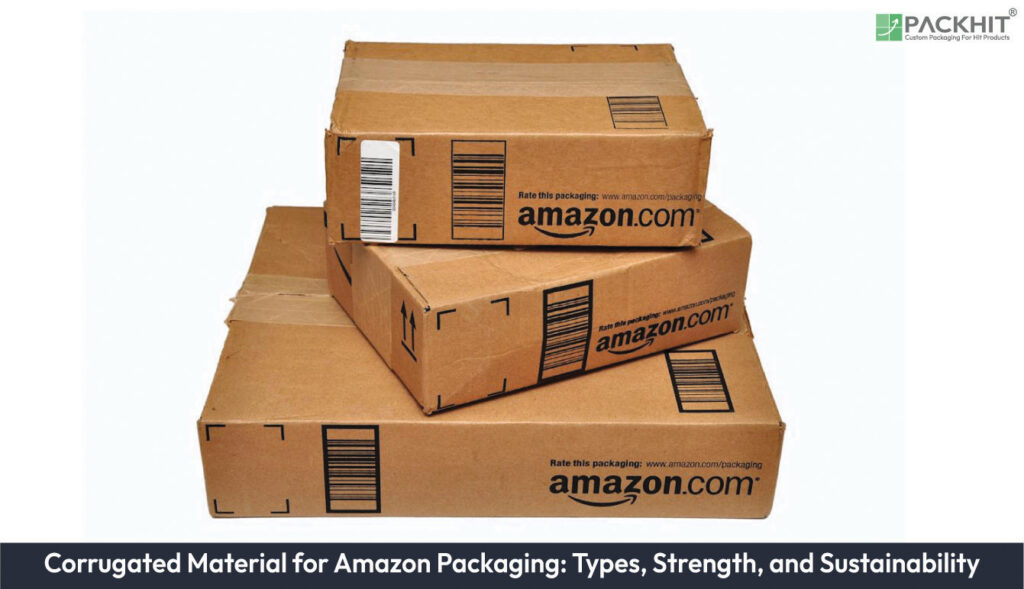
Corrugated material is the foundation of Amazon’s packaging system, balancing durability, cost-efficiency, and environmental sustainability. It encompasses three primary types, including single-wall, double-wall, and triple-wall boards, each tailored for specific product categories based on strength and structural configurations. For lightweight items like books and apparel, single-wall boards offer protection with customizable flute profiles. Double-wall boards cater to heavier or delicate products with enhanced compression strength and puncture resistance, while triple-wall boards handle industrial shipments requiring maximum robustness. The strength of corrugated material is measured through tests such as Edge Crush Test (ECT), Burst Strength, and Box Compression Test (BCT), ensuring reliable performance under mechanical stresses. Sustainability remains integral, with corrugated material being recyclable, biodegradable, and designed for reduced waste.
- What is Corrugated Material for Amazon Packaging?
- Types of Corrugated Material Used in Amazon Packaging
- How is the Strength of Corrugated Material Measured for Amazon Packaging?
- How Does Corrugated Material Align with Sustainability Goals for Amazon Packaging?
- Why is Corrugated Material Important for Amazon Packaging?
What is Corrugated Material for Amazon Packaging?
Corrugated material is a paper-based packaging board made from one or more fluted paper mediums fixed between flat linerboards. The flutes create air spaces that add cushioning and increase bending resistance. The linerboards resist abrasion, punctures, and compression. Corrugated cartons are commonly used for e-commerce shipments such as books, apparel, small electronics, appliances, and bulk goods. Product mass, dimensions, fragility, box style, flute profile, paper grade, and board construction determine the carton’s protection, weight, and material consumption. The carton also requires enough internal clearance for protective inserts without allowing excessive product movement during parcel handling.
For an Amazon shipment, corrugated material describes the board attribute of the outer carton, not a single mandatory paper specification. The correct construction depends on the product, the completed box, and the shipping route. A carton that passes a board test can still fail if its panels are too large, its flaps are poorly supported, or the product shifts inside the box.
Types of Corrugated Material Used in Amazon Packaging
Corrugated material is classified by wall construction, flute profile, and paper grade. E-commerce cartons commonly use single-wall, double-wall, or triple-wall board, although the selected construction depends on the product and distribution conditions rather than on an unsupported Amazon-wide specification. Flute profiles also change carton performance: A-flute adds thickness and cushioning, B-flute resists crushing and supports die-cut parts, C-flute balances cushioning with stacking strength, and E-flute creates a thin surface for small cartons and detailed printing. Manufacturers select the board after considering product mass, dimensions, fragility, stacking height, handling frequency, and shipping conditions. Paper grade, recycled-fiber content, moisture exposure, and the carton’s closure method also affect the result.
The three main corrugated constructions used in Amazon packaging are single-wall, double-wall, and triple-wall board. These categories describe the number of fluted mediums and linerboards. They do not, by themselves, specify ECT, burst strength, basis weight, recycled content, or finished-box performance.
Single-Wall Corrugated Board
Single-wall corrugated board contains one fluted medium between two linerboards. It is the common construction for lightweight products, including books, apparel, toys, and small electronics. A-flute gives the carton more thickness and cushioning, while E-flute reduces carton thickness and creates a flatter printing surface. B-flute can support die-cut cartons and resist crushing; C-flute balances cushioning and stacking strength. The selected flute must match the product’s weight, the carton dimensions, and the clearance between the product and carton walls. Excess clearance increases movement; insufficient clearance can transfer impact directly to the product. Single-wall board can reduce material use, but the finished carton still requires compression and drop testing for its intended shipping route.
Double-Wall Corrugated Board
Double-wall corrugated board contains two fluted mediums and three linerboards. The additional flute and liner layers raise compression strength and puncture resistance for heavier products, including kitchen appliances, tools, and grouped consumer goods. Combining flute sizes can balance cushioning with stacking performance, but the added paper increases carton weight, thickness, and material use. Carton samples require testing with the actual product because internal fit and load placement affect the result. A double-wall specification also changes crease behavior and may require adjustments to die lines, closure flaps, and pallet patterns.
Triple-Wall Corrugated Board
Triple-wall corrugated board contains three fluted mediums and four linerboards. Its compression and puncture resistance support heavy industrial shipments, including machinery, metal components, and large liquid-container loads. This construction appears less often in consumer-facing cartons because its weight and thickness increase handling and transportation requirements. It remains relevant to bulk distribution and internal supply-chain shipments where concentrated loads or repeated stacking create higher board demands. Large cartons also require attention to panel dimensions because unsupported areas can buckle even when the board grade has a high rating.
How is the Strength of Corrugated Material Measured for Amazon Packaging?
Corrugated material strength is measured with standardized tests for edge compression, bursting, and box collapse. The three common metrics are Edge Crush Test (ECT), burst strength, and Box Compression Test (BCT). Together, they describe stacking capacity, resistance to sudden board damage, and the load a completed carton carries before collapse. A material grade alone does not determine carton performance because box dimensions, seams, openings, flap design, moisture, and load placement also affect the result. Testing at the intended humidity and with production-style samples gives manufacturers a more relevant comparison.
Edge Crush Test (ECT)
The Edge Crush Test measures the force required to compress a defined strip of corrugated board on its edge. ECT ratings are reported in pounds-force per inch of edge and must be interpreted with the board specification, test method, test conditions, and packaging design. A rating such as 32 ECT is a board test classification, not a universal 32-pound box load limit. Manufacturers use ECT when cartons face stacking during storage and transport, then confirm performance with finished-box testing because carton dimensions, joints, openings, moisture, and load placement change compression behavior.
Burst Strength
Burst strength measures the pressure required to rupture corrugated board, expressed in pounds per square inch (psi). The result reflects resistance to punctures and tearing from impacts, protruding product edges, and rough handling. Burst strength does not replace ECT because a board can resist surface rupture without carrying the same vertical load. Paper basis weight, fiber composition, moisture, and liner condition affect the measured result. Select burst performance with the product’s contact points in mind, then assess the complete box rather than relying on the board value alone.
Box Compression Test (BCT)
The Box Compression Test measures the maximum vertical load that a finished corrugated box carries before it buckles or collapses. A common estimate uses the relationship BCT = k × √(ECT × thickness), where k depends on box dimensions and construction. This relationship provides an estimate rather than a universal rating. Testing a production-style carton gives a more useful result than evaluating board strength alone because seams, flaps, print cuts, openings, product fit, and moisture affect compression. The required BCT also depends on the number of cartons stacked, the duration of storage, pallet support, and the safety margin selected for handling conditions.
How Does Corrugated Material Align with Sustainability Goals for Amazon Packaging?
Corrugated material supports packaging sustainability through fiber recovery, renewable cellulose content, low material density, and reduced waste at the carton level. Its environmental performance depends on the paper grade, recycled content, coatings, adhesives, production energy, shipping distance, carton size, and access to collection and processing systems. A lighter carton is not automatically preferable if inadequate protection causes product damage and replacement shipments. Manufacturers can compare material use and protection together by recording board weight, product damage, empty space, return rates, and shipping-test results. These measures describe the package itself without assuming that every Amazon carton follows one material policy.
Recyclability and Biodegradability
Corrugated board consists mainly of cellulose fibers from wood and recovered paper, so it can enter established paper-recycling systems and biodegrade under suitable conditions. Recycling outcomes vary by local collection access, contamination limits, and processing capacity. Clean, dry boxes generally move through recycling streams more easily than cartons contaminated with food, liquids, plastic film, or heavy coatings. Repeated fiber recycling shortens fiber length, so mills also use new fiber to maintain board strength. Manufacturers can improve recovery by limiting non-paper components and separating labels or inserts that interfere with paper processing.
Lightweight Design
Lightweight corrugated design reduces paper consumption while preserving the compression and puncture resistance required for the shipment. Manufacturers can reduce empty space, select a smaller flute, or specify a lower basis weight after testing the carton with its actual product. Lower carton mass also reduces the energy used to manufacture and transport each package, although insufficient board strength can increase damage and replacement waste. A packaging trial can compare board weight, internal clearance, product damage, carton deformation, and shipping performance before production approval.
Amazon’s Frustration-Free Packaging Initiative
Amazon’s Frustration-Free Packaging program may involve requirements for protection, labeling, preparation, and certification. Manufacturers must verify the requirements that apply to the specific product and shipment because this article does not establish current program conditions. A recyclable, easy-to-open corrugated carton can reduce extra packaging layers when the completed package passes the applicable protection tests. The final material choice balances flute construction, ECT, burst resistance, BCT, carton weight, recycled fiber content, and damage risk. Corrugated board is commonly used for e-commerce packaging because its flute structure balances protection, weight, and material efficiency; recycling outcomes still depend on local collection and processing facilities.
Why is Corrugated Material Important for Amazon Packaging?
Corrugated material is important for Amazon packaging because it provides a practical balance of product protection, strength, lightweight construction, and recyclability. Its layered structure helps packages withstand common handling and shipping stresses while keeping material use relatively efficient.
Key benefits include:
- Product Protection: Fluted layers help absorb and distribute impacts, reducing the risk of damage during handling and transportation.
- Structural Strength: Single-, double-, and triple-wall boards can provide different levels of compression and stacking strength for different product weights and shipping conditions.
- Lightweight Construction: Corrugated board can provide strength without adding excessive package weight, which can support efficient handling and transportation.
- Versatile Design: It can be converted into boxes in various sizes and configurations to accommodate different products.
- Recyclability: Paper-based corrugated packaging can generally enter established recycling systems where suitable collection and processing facilities are available.
- Cost Efficiency: Its relatively low material weight and efficient manufacturing can make corrugated packaging practical for high-volume shipping.
Corrugated material is valuable for e-commerce packaging because it can combine adequate protection, structural performance, material efficiency, and end-of-life recovery in a widely used packaging format.