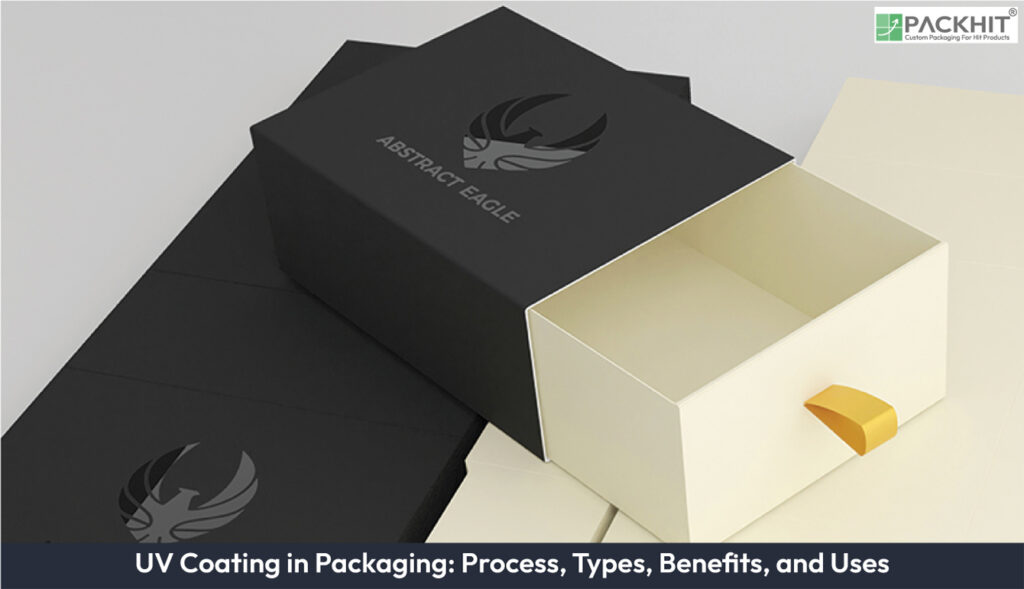
UV coating creates a cured surface finish on printed packaging using ultraviolet energy. Application, curing, and inspection stages during the UV coating process determine whether the finished layer achieves the required coverage, adhesion, and appearance on the chosen substrate. Gloss, matte, satin, and spot UV provide different levels of reflectivity and design emphasis, while the hardened coating can also add surface protection where the formulation and curing conditions are suitable. Product boxes, labels, and promotional materials commonly use these effects when handling performance or visual contrast matters. Choosing between UV, aqueous coating, and varnish requires balancing the desired finish with substrate compatibility, curing or drying requirements, converting needs, and production conditions. Current development is centered on UV-LED curing, selective digital finishing, inline process control, and newer matte surface effects.
- Stages of UV Coating Process
- What are the Types of UV Coating?
- Benefits of UV Coating in Packaging
- Durability and Scratch Resistance
- Visual Finish and Color Appearance
- Targeted Design Emphasis
- Production Profile
- Production Speed and Cost
- Applications of UV Coating in Packaging
- Comparison of UV Coating with Aqueous Coating and Varnish
- Current Trends in UV Coating
- What are the Risks and Common Failure Modes of UV Coating?
- When to Choose UV Coating Instead of Another Packaging Finish?
Stages of UV Coating Process
A successful UV finish depends on three linked stages: laying down the coating accurately, delivering enough UV energy for the formulation to cure, and checking the result before converting. Problems introduced at one stage often become visible at the next, so coating coverage, cure quality, and adhesion should be treated as connected production controls.
1. Application
For flood UV, the coating unit lays down a controlled wet film across the intended printed area. Spot UV requires closer registration because the coating must align with specific artwork such as logos, text, or graphics. Coated and uncoated stocks can hold the liquid differently, making a production sample useful for checking coverage and adhesion before the full run.
2. Curing
Once applied, the coating passes through a UV-curing unit, where ultraviolet energy initiates polymerization and forms the hardened surface. Cure quality depends on the coating formulation, film thickness, lamp output, line speed, substrate, and underlying ink. A faster line is therefore useful only when the curing system can still deliver the required result at that speed.
3. Inspection
Inspection determines whether the coated sheets are ready for die-cutting, folding, or assembly. Look for streaks, pinholes, orange peel, uneven coverage, or incomplete curing, then verify critical properties such as adhesion and gloss where required. Spot UV also needs an alignment check because even a well-cured coating can fail visually when it shifts away from the intended artwork.
What are the Types of UV Coating?
UV coating comes in various types, each suited for specific applications and aesthetic preferences. The useful distinction between UV coating types is not simply how they look, but what role the finish needs to play in the design.
Gloss UV suits artwork that depends on high reflectivity and pronounced visual contrast. Large coated areas should be checked for consistent gloss because uneven application can become especially noticeable on reflective surfaces.
For a less reflective surface, matte UV provides a more subdued appearance and can reduce glare across larger design areas. The final effect should be assessed on the actual printed stock because ink, substrate, and coating formulation influence the appearance.
Spot UV takes a different approach by limiting the coating to selected artwork. Logos, lettering, patterns, or images can be contrasted against an uncoated or differently finished background, making registration accuracy more important than with a simple flood application.
Between highly reflective gloss and subdued matte, satin UV provides a moderate sheen. It can suit packaging that needs some surface reflectivity without making gloss the dominant visual feature.
Benefits of UV Coating in Packaging
UV coating offers numerous advantages for packaging applications, such as durability, scratch resistance, and visual finish, making it a preferred choice for manufacturers. The key benefits of UV coating in packaging are mentioned below:
Durability and Scratch Resistance
Surface protection becomes useful when packaging will experience repeated handling, stacking, or transport. A properly cured UV coating can improve resistance to scuffs, scratches, and ink smearing, although the result depends on coating formulation, film build, substrate, and cure quality. Adhesion and surface condition should be checked before assuming that a harder-looking finish will perform better in use.
Visual Finish and Color Appearance
The cured surface changes how light interacts with printed artwork. Gloss formulations increase reflectivity, while matte and satin systems reduce it to different degrees. Rather than treating one finish as inherently more premium, match reflectivity to the artwork and viewing conditions the package is designed for.
Targeted Design Emphasis
Not every panel needs the same coating treatment. Spot UV can concentrate contrast on a logo, product name, pattern, or image while leaving surrounding areas visually quieter. This approach depends on accurate registration; excessive buildup or misalignment can make the effect look unintended.
Production Profile
UV curing can reduce the waiting period between coating and subsequent operations because the coating hardens through UV exposure rather than relying primarily on extended evaporative drying. That advantage depends on achieving an adequate cure at the intended line speed. VOC content, energy demand, and other environmental attributes should be evaluated from the particular formulation and production system rather than inferred from the term “UV coating.”
Production Speed and Cost
Coating price alone gives an incomplete picture of production cost. Relevant factors include coating consumption, curing equipment, energy requirements, setup time, achievable line speed, rejected sheets, and any effect on later die-cutting, folding, gluing, or assembly. Faster curing has practical value when it shortens the overall production sequence without introducing defects that require rework.
Notes on Performance Variability: The same UV coating can perform differently across substrates, ink systems, coating weights, and equipment settings. Where adhesion, gloss, surface durability, or resistance properties are critical, validate the finished coating on production samples under the intended manufacturing and converting conditions.
Applications of UV Coating in Packaging
UV coating is widely used across various industries to enhance the functionality and appeal of packaging. Common applications include:
- Product Packaging: UV coating is frequently used in product packaging to safeguard printed designs and enhance visual appeal. It is particularly favored for luxury goods, cosmetics, and electronics packaging due to its premium finish and durability.
- Marketing Materials: Brochures, business cards, and promotional items benefit from UV coating, as it provides a protective layer that ensures longevity while adding an eye-catching finish, making these materials stand out during frequent handling.
- Labels and Tags: UV coating is applied to labels and tags to improve their resistance to wear, moisture, and fading. This ensures they remain legible and visually appealing throughout the product’s lifecycle, even under challenging conditions.
- Food and Beverage Packaging: UV coatings may be used on suitable food and beverage packaging where the printed surface requires a particular finish or additional resistance to handling. Selection depends on the package structure, coating formulation, location of the coated surface, curing conditions, and applicable requirements for the intended use.
Comparison of UV Coating with Aqueous Coating and Varnish
UV coating, aqueous coating, and varnish can all modify the appearance and surface characteristics of printed packaging, but they differ in formulation, drying or curing method, finish possibilities, and production requirements. The appropriate choice depends on the substrate, desired surface effect, required performance, production setup, and end-of-life considerations.
| Feature | UV Coating | Aqueous Coating | Varnish |
|---|---|---|---|
| Drying/Curing Method | Cured using UV energy | Dries as its water-based carrier is removed | Drying or curing method depends on varnish formulation |
| Finish Options | Can include gloss, matte, satin, and selective effects | Commonly used for gloss, satin, or matte effects depending on formulation | Available in gloss, matte, satin, and other formulation-dependent finishes |
| Selective Application | Commonly used for spot or flood effects | Primarily suited to broader coverage, although capabilities depend on equipment | Can be applied selectively or across larger areas depending on the printing process |
| Production Consideration | Requires compatible UV-curing equipment and coating chemistry | Requires sufficient drying capacity and compatibility with the substrate and ink | Requirements vary according to varnish chemistry and application method |
| Environmental Consideration | Depends on formulation, curing energy, production process, and end-of-life compatibility | Depends on formulation, drying requirements, production process, and end-of-life compatibility | Depends on formulation, solvent or carrier system, drying or curing method, and end-of-life compatibility |
| Cost Consideration | Depends on coating, equipment, run size, and production requirements | Depends on coating, drying setup, run size, and production requirements | Depends on formulation, application method, run size, and production requirements |
UV coating can be particularly useful when rapid curing or pronounced spot and surface effects are priorities, while aqueous coating may suit applications where a water-based coating and broader surface coverage fit the production requirements. Varnish provides another flexible option whose characteristics vary considerably with its formulation and application method. None of the three is inherently more durable, sustainable, or cost-effective in every application; those outcomes depend on the complete coating system, substrate, production conditions, and performance requirements.
Current Trends in UV Coating
UV coating technology is currently developing around faster curing, more controlled application, and lower-resource production. Key trends include:
- UV-LED Curing: UV-LED systems are increasingly used to cure inks and coatings because they support rapid processing and can reduce reliance on conventional thermal drying in suitable applications.
- Digital and Selective UV Finishing: Greater integration with digital printing and finishing equipment is enabling more precise application of UV effects to selected graphics, textures, or package areas, supporting shorter runs and more customized finishing.
- Inline Coating Control: Automated systems that measure and adjust coating thickness during production are being introduced to improve consistency while reducing excess coating consumption and waste.
- Excimer and Ultra-Matte UV Effects: Excimer curing uses short-wavelength ultraviolet radiation to modify the surface of a UV-curable coating before or during final curing, creating microscopic surface texture that reduces gloss and produces an ultra-matte appearance. In suitable coating systems, this process can create matte or tactile surface effects without relying solely on conventional matting additives. The resulting finish depends on the coating chemistry, excimer setup, and subsequent curing process.
- Resource-Efficient UV Production: Equipment manufacturers are increasingly positioning UV-LED curing as part of broader efforts to reduce energy demand and improve production efficiency compared with more heat-intensive drying systems.
For manufacturers, these developments matter only when they translate into measurable production or finishing improvements on the intended package. UV-LED or alternative curing systems should therefore be evaluated against cure quality, line speed, substrate sensitivity, and equipment compatibility, while digital or inline coating controls should be assessed by how consistently they maintain registration, coverage, and the specified surface finish during production.
What are the Risks and Common Failure Modes of UV Coating?
UV coating performance depends on correct application, curing, and compatibility between the coating, ink, and substrate. Common problems include:
- Incomplete Curing: Insufficient UV exposure, excessive coating thickness, unsuitable line speed, or an incompatible formulation can leave the coating inadequately cured. The affected sheets should not proceed to converting until the curing conditions and coating requirements have been checked.
- Poor Adhesion: A UV coating may peel, flake, or separate when it does not bond properly with the underlying ink or substrate. Adhesion testing on production samples can identify compatibility problems before a full run.
- Cracking at Folds: A cured coating can crack along scores or folds when the coating and substrate cannot tolerate the mechanical stress of converting. Testing the finished coating through the intended cutting, creasing, and folding process helps identify this risk.
- Uneven Surface Finish: Streaking, orange peel, pinholes, or inconsistent gloss can result from coating application, surface condition, viscosity, or curing problems. Visual inspection and relevant coating measurements can help determine whether adjustment is required.
- Registration Errors: Spot UV applied out of register can shift away from logos, text, or other intended design elements. Registration should therefore be verified before and during production.
- Substrate Sensitivity: Some substrates, inks, adhesives, or previously applied finishes may respond poorly to a particular UV coating or curing setup. Production testing should confirm compatibility before the full run.
Safety Considerations: UV-curing equipment uses ultraviolet radiation and should be operated with the shielding, interlocks, ventilation, and other controls specified for the particular machine and coating system. Uncured coating materials may also require specific handling precautions. Operators should follow the equipment instructions and the coating manufacturer’s safety documentation rather than assuming that all UV-curing systems have the same handling requirements.
When to Choose UV Coating Instead of Another Packaging Finish?
Choose UV coating when the package needs a fast-cured, visually pronounced surface treatment with added resistance to handling and scuffing. Flood UV is better when you want a consistent finish across a large area, while spot UV is more suitable for emphasizing logos, text, or selected graphics. The coating should still be tested against the actual substrate, ink system, folding or gluing requirements, and curing setup before full production.