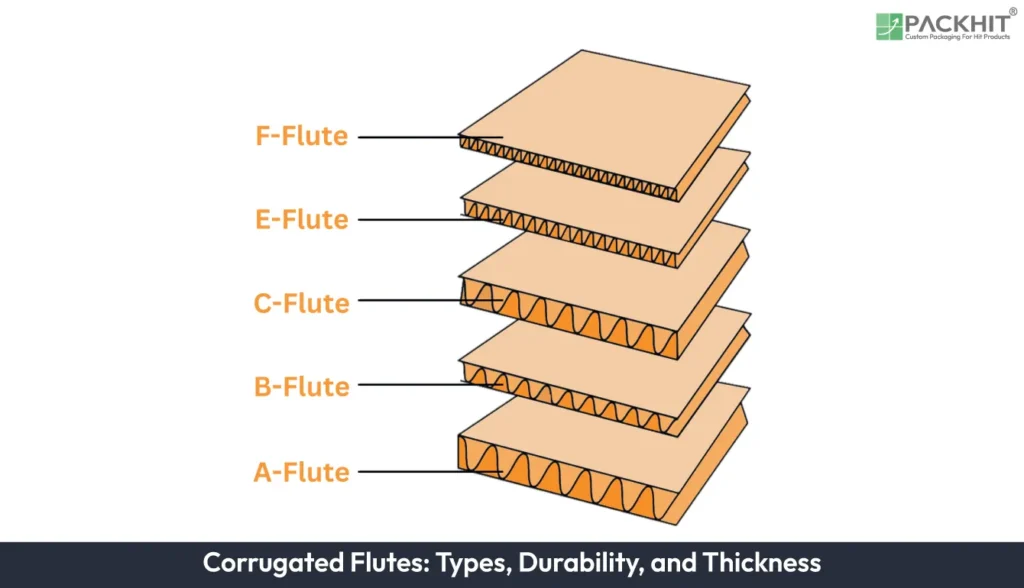
Corrugated flutes are wave-shaped paper profiles that influence the strength, cushioning, thickness, printability, and foldability of corrugated packaging. Common types include A, B, C, E, and F flutes, ranging from thicker profiles designed for cushioning and stacking to thinner profiles suited to detailed printing and compact retail boxes. Their durability depends on factors such as paper quality, adhesive strength, flute construction, manufacturing precision, and environmental exposure. Flute thickness further affects compression resistance, package dimensions, surface quality, and product protection, although overall performance also depends on the complete board structure. These characteristics make corrugated flutes suitable for industrial, retail, and food-packaging applications with different handling, display, and shipping requirements.
Different Types of Corrugated Flutes
Corrugated flutes are categorized based on their size and profile. Each type serves specific functional roles, making them suitable for different packaging applications. The most common flute types include A, B, C, E, and F flutes.
A-Flute
A-flute is one of the largest flute profiles, often produced with around 33 flutes per foot and a thickness near 4.7 mm, although dimensions vary by manufacturer and board construction. It offers strong cushioning and stacking strength, making it suitable for heavy-duty shipping boxes, fragile items, and applications requiring protection against compression and impact forces.
B-Flute
B-flute is commonly produced with around 47 flutes per foot and a thickness near 3.2 mm, though specifications vary by construction. It generally provides better crush resistance and a smoother printing surface than larger flute profiles. It is widely used for retail packaging, die-cut boxes, and applications requiring moderate structural strength and print quality.
C-Flute
C-flute is a widely used profile, often produced with around 39 flutes per foot and a thickness near 4.0 mm, depending on the manufacturer and board design. It balances cushioning and stacking strength and is suitable for general-purpose shipping boxes, food packaging, and products requiring a combination of durability and functionality.
E-Flute
E-flute is a smaller profile, commonly produced with around 90 flutes per foot and a thickness near 1.6 mm, although exact values vary. It provides a relatively smooth surface for printing and good foldability. It is commonly used in retail packaging, custom-printed boxes, and lightweight product applications where appearance and precision are important.
F-Flute
F-flute is among the smallest flute profiles, often produced with around 125 flutes per foot and a thickness near 0.8 mm, depending on board construction and supplier specifications. It supports detailed printing and intricate structural designs, making it suitable for luxury packaging, small product boxes, and point-of-purchase displays.
Choosing a flute type involves balancing cushioning, stacking strength, print quality, foldability, and package size. Larger flutes generally provide more cushioning but can create a bulkier structure and a less refined print surface, while smaller flutes support sharper graphics and tighter folds but may require stronger liners or added reinforcement for heavier products and demanding shipping conditions.
What Factors Affect the Durability of Corrugated Flutes?
Corrugated-flute durability depends on how the paper, adhesive, flute profile, production quality, and shipping environment work together. A board that performs well in dry warehouse conditions may weaken during humid storage, repeated handling, or heavy stacking.
- Material Quality: Strong liner and fluting papers help the board maintain shape under compression. Lower-strength or heavily recycled fibers may deform sooner under sustained loads, especially when the box carries dense products or remains stacked for long periods.
- Environmental Conditions: Humidity and moisture can soften paper fibers and weaken adhesive bonds. In humid shipping conditions, the first signs may be reduced seam strength or local crushing before visible warping or delamination appears.
- Adhesive Strength: Adhesive bonds hold the fluted medium to the liners so the layers act as one structure. Uneven or weak bonding can allow the liner to separate from the flutes, reducing compression strength around seams, corners, and frequently handled areas.
- Flute Profile: Larger flute profiles generally provide more space for cushioning, while smaller profiles create a denser surface that can improve crush resistance and print quality. For products that place concentrated pressure on corners or narrow contact points, local crush resistance may matter more than overall cushioning.
- Manufacturing Precision: Consistent flute height, alignment, glue coverage, and scoring help distribute loads across the board. Misaligned flutes, excessive scoring, or uneven adhesive application can create weak points that fail during folding, stacking, or transit vibration.
Manufacturers should evaluate durability under conditions that reflect the actual shipment, including product weight, stacking height, humidity, handling frequency, and transport distance.
How Does Corrugated Flute Thickness Impact Its Durability and Performance?
Flute thickness affects cushioning, compression behavior, foldability, printing, and package dimensions. Thicker profiles, such as A- and C-flute, generally provide more cushioning and stacking support for heavier or fragile products. Thinner profiles, such as E- and F-flute, usually provide a smoother print surface and tighter folds for lightweight retail packaging.
Thickness alone does not determine performance. A thick flute made from weak paper or exposed to high humidity may perform worse than a thinner, well-constructed board. Products with sharp edges, concentrated loads, or repeated handling may also require stronger liners, double-wall construction, or internal supports rather than a thicker flute alone.
Applications of Corrugated Flutes
Corrugated flutes are used across various industries for packaging and shipping. Their versatility and customizable properties make them suitable for a wide range of applications across different industries.
- Industrial Packaging: Corrugated flutes are commonly used in industrial packaging to protect heavy machinery, automotive parts, and other bulky items. A-flute and C-flute boards are preferred for their superior cushioning and stacking strength.
- Retail Packaging: Retail packaging often requires high-quality printing and aesthetic appeal. E-flute and F-flute boards are ideal for creating custom-printed boxes, point-of-purchase displays, and luxury packaging.
- Food Packaging: Corrugated flutes are widely used in food packaging due to their ability to provide insulation and protection. C-flute and B-flute boards are commonly used for pizza boxes, beverage carriers, and produce trays.
How to Choose the Right Corrugated Flute?
Selecting the right corrugated flute depends on the specific requirements of your packaging application. Consider the following factors:
- Product Weight: Heavier products require thicker flutes for better support and cushioning.
- Print Quality: Smaller flutes, such as E and F flutes, offer smoother surfaces for high-quality printing.
- Shipping Conditions: Evaluate the environmental conditions and handling requirements during transportation.
- Cost: Balance the cost of materials with the desired performance and durability.
Corrugated flutes play a vital role in the performance and functionality of corrugated fiberboard. By understanding the types, thickness, and durability of flutes, manufacturers can make informed decisions to optimize their packaging solutions.
