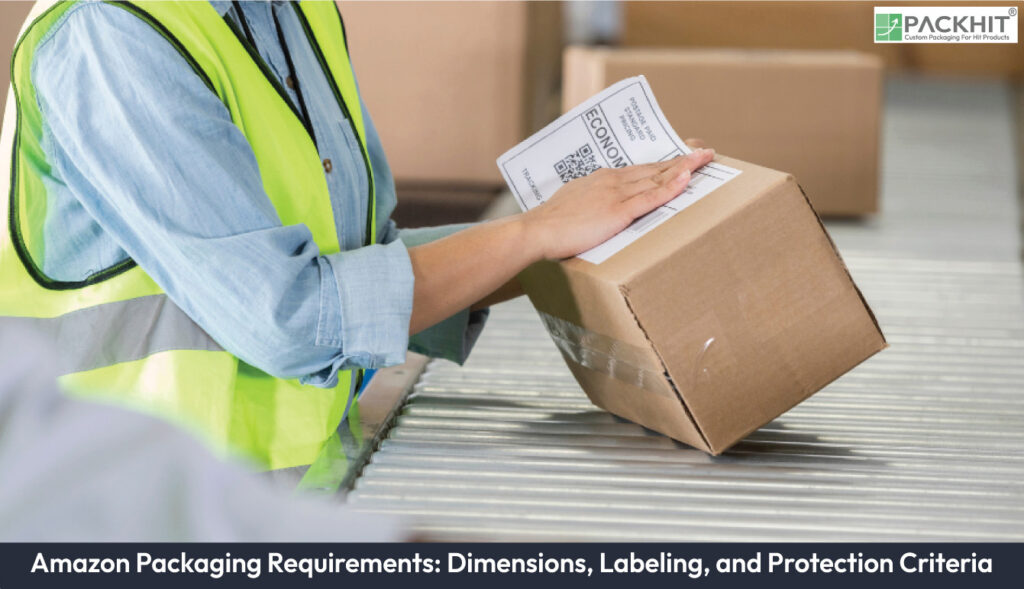
Amazon’s packaging requirements are comprehensive guidelines aimed at ensuring products are delivered in excellent condition while maximizing operational efficiency. Amazon’s dimensional requirements can help ensure compatibility with its fulfillment systems and efficient storage. Amazon packages must adhere to precise sizing rules, including a maximum of 25 inches on any side, a minimum of 6 x 4 x 0.375 inches, and weight limits of 50 pounds. Non-compliance risks additional fees, processing delays, or shipment rejection.
These requirements address three critical areas: precise dimensions for smooth conveyor transport and bin allocation, accurate labeling for seamless identification and tracking, and protective measures to safeguard items during transit. Manufacturers must adhere to these standards by implementing proper packaging designs, following Amazon’s labeling specifications, and using durable materials and sealing methods. Deviations can trigger penalties such as additional fees, shipment rejections, and damaged customer deliveries. To avoid these issues, manufacturers are encouraged to standardize their packaging processes, adopt automated labeling systems, and conduct pre-shipment durability tests. Aligning with Amazon’s criteria can help reduce packaging-related issues and support faster warehouse check-ins.
- What are Amazon Packaging Requirements?
- Dimensional Requirements for Amazon Packaging
- How Labels are Applied to Amazon Packages?
- Protection Criteria for Amazon Packaging
- Penalties for Non-Compliance with Amazon’s Packaging Requirements
- How Can Manufacturers Ensure Compliance With Amazon Packaging Requirements?
What are Amazon Packaging Requirements?
Amazon packaging requirements refer to a set of standardized guidelines designed to prevent transit damage, streamline receiving, and fit automated sorting machinery. These criteria encompass precise dimensions, accurate labeling, durable materials, and protective measures to minimize transit damage and optimize operational workflows.
Dimensional Requirements for Amazon Packaging
Amazon’s dimensional requirements can help prevent package jams on high-speed sorting belts and prevent wasted capacity across warehouse shelving units.
Packaging dimensions must be precise and adhere to the following constraints:
- Maximum Dimensions: Packages must not exceed 25 inches on any side for standard-size items. Oversized items, defined as those exceeding 18 x 14 x 8 inches or weighing more than 20 pounds, are subject to additional fees and handling protocols.
- Minimum Dimensions: Packages must measure at least 6 x 4 x 0.375 inches so that automated sensor systems and scanners can reliably process them on conveyor lines.
- Weight Limits: Standard-size packages must weigh no more than 50 pounds unless explicitly approved. For individual units, any item exceeding 50 pounds must include a “Team Lift” label.
Failure to comply with these dimensional requirements can result in additional fees, delays in processing, or rejection of inventory at Amazon’s fulfillment centers. Manufacturers are advised to use calibrated measuring tools and consider dimensional tolerances when designing packaging.
Note: Amazon packaging requirements can change and may vary by product, fulfillment route, and shipment category. Always verify current guidelines before production or shipment. Dimensions, labels, material specifications, and fees are not universal.
How Labels are Applied to Amazon Packages?
Labeling is a critical component of Amazon’s packaging requirements, as it may help in accurate identification, tracking, and routing of products within its fulfillment network. The following guidelines must be adhered to:
Label Placement
Labels must be placed on a flat surface of the package, avoiding edges, seams, or corners. For boxes, the label should be positioned on the largest flat side to maximize visibility. Polybags require the label to be affixed securely without wrinkles or obstructions.
Barcode Specifications
Each package must include a scannable barcode with specifications such as an FNSKU (Fulfillment Network Stock Keeping Unit) or ASIN (Amazon Standard Identification Number). Barcodes must meet the following criteria:
- Size: Barcodes must be at least 1 x 2 inches in size to prevent misreads by optical scanners.
- Contrast: High-contrast black ink on a white background is required for optimal readability.
- Clarity: Barcodes must be free of smudges, scratches, or distortions that could impede scanning.
Additional Labeling Requirements
Packages containing fragile items, hazardous materials, or items requiring special handling must include appropriate warning labels. For example, lithium battery shipments must comply with IATA (International Air Transport Association) labeling standards.
Protection Criteria for Amazon Packaging
Amazon’s protection criteria are designed to minimize damage during transit and prevent item returns. These criteria focus on material strength, cushioning, and sealing methods:
Material Strength
Packaging materials must have enough strength to withstand the rigors of Amazon’s fulfillment process, which includes automated sorting, stacking, and transportation. Corrugated cardboard with a minimum edge crush test (ECT) rating of 32 is recommended for most packages.
Cushioning Requirements
Products should follow cushioning requirements to prevent movement within the package. Acceptable cushioning materials include air pillows, bubble wrap, and foam inserts. Items with sharp edges or irregular shapes require additional padding to avoid puncturing the outer packaging.
Sealing Standards
Packages must be sealed securely using pressure-sensitive tape that is at least 2 inches wide. For heavier packages, reinforced tape or multiple layers of tape may be necessary. Staples and string are not permitted as sealing methods.
Note: For lithium batteries and other hazardous or special-handling shipments, treat this as general information only and confirm the current applicable requirements with the carrier or a qualified compliance professional before packaging or shipment.
Penalties for Non-Compliance with Amazon’s Packaging Requirements
Failing to meet Amazon’s packaging requirements can trigger penalties that disrupt inventory turnover, increase return rates, and inflate operating costs. These penalties include:
- Additional Fees: Amazon imposes non-compliance fees for packages that fail to meet dimensional standards, labeling accuracy, or protective criteria. These fees may escalate based on the severity of the issue, leading to increased operational costs.
- Inventory Rejection: Non-compliant shipments are subject to outright rejection at fulfillment centers, which can result in costly delays, re-routing, or the need for repackaging. This disrupts the supply chain and may slow receiving throughput.
- Customer Dissatisfaction: Poorly packaged items that arrive damaged or improperly labeled lead to negative reviews, returns, and loss of consumer trust. This can adversely affect product ratings and sales performance on the platform.
How Can Manufacturers Ensure Compliance With Amazon Packaging Requirements?
Manufacturers aiming to align their packaging operations with Amazon’s standards can adopt the following structured best practices:
1. Standardized Packaging Designs
Develop templates that consistently meet Amazon’s dimensional, labeling, and protective criteria. Incorporate precise measurements and durable materials to align with sorting machinery and protect goods against impact during transit.
2. Automated Labeling Systems
Implement automated labelling systems to generate and apply labels with consistent accuracy. This reduces errors in barcode placement and can help eliminate misread barcodes during receiving scans, reducing receiving times.
3. Pre-Shipment Testing
Conduct rigorous pre-shipment testing, including drop tests, vibration tests, and compression tests, to validate the structural integrity and protective capabilities of packaging. This minimizes the risk of damage during transit.
4. Training Programs
Train staff on Amazon’s packaging requirements to ensure adherence to dimensional standards, labeling accuracy, and protective measures. Regular workshops and updated guidelines can help maintain error-free packaging execution across operations.
5. Continuous Audits and Quality Checks
Perform continuous audits and quality checks of packaging processes to identify non-compliance issues. Use calibrated tools for measurement and ensure quality control checks for labels, materials, and sealing methods before shipment.
By implementing these practices, manufacturers can eliminate packaging-related intake delays and operational disruptions, maintaining a dependable supplier standing on Amazon’s e-commerce platform.
