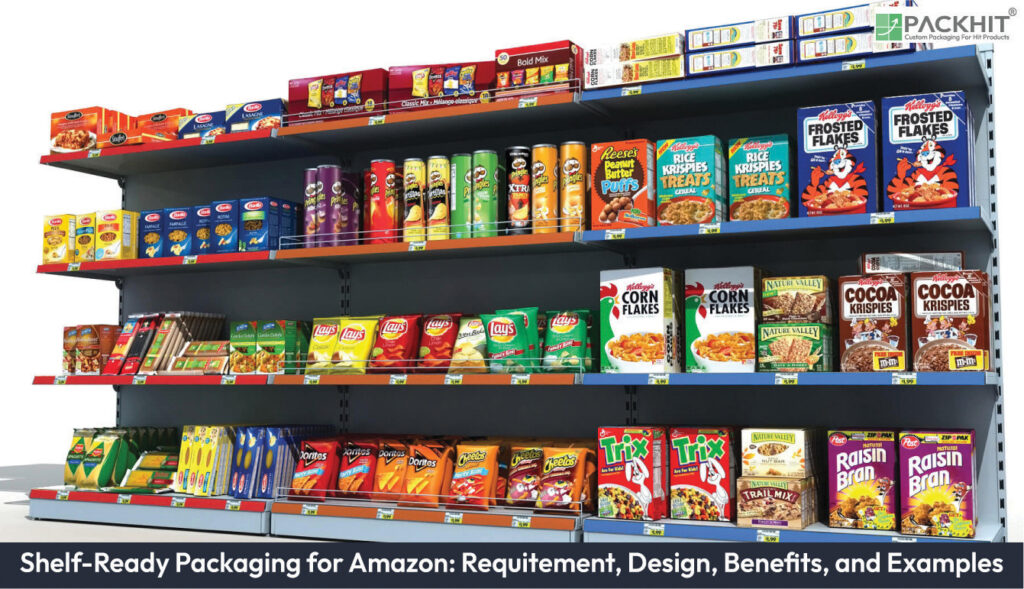
Shelf-ready packaging (SRP) for Amazon streamlines supply chain operations and enhances product presentation. Designed to meet Amazon’s Frustration-Free Packaging (FFP) standards, SRP emphasizes sustainability, ease of unboxing, and damage prevention during transit. It combines recyclable materials, structural integrity, compact designs, and clear labeling to comply with warehouse optimization protocols. Manufacturers leverage Shelf-ready packaging (SRP) to improve operational efficiency, reduce costs, and enhance customer experience, while customizable designs boost brand visibility. Real-world examples from industries like electronics, food, and personal care demonstrate innovative approaches in aligning packaging with Amazon’s requirements, contributing to higher compliance, sustainability, and customer satisfaction.
- What is Shelf‑Ready Packaging for Amazon?
- Amazon’s Requirements for Shelf‑Ready Packaging
- How is Shelf‑Ready Packaging Designed for Amazon?
- 1. Material Selection
- 2. Structural Engineering
- 3. Graphic Design and Branding
- 4. Prototyping and Testing
- Benefits of Shelf‑Ready Packaging for Amazon
- Examples of Shelf‑Ready Packaging for Amazon
- How Can Manufacturers Optimize Shelf‑Ready Packaging for Amazon?
What is Shelf‑Ready Packaging for Amazon?
Shelf-ready packaging (SRP) for Amazon is secondary packaging designed to protect products in transit while allowing easier opening, handling, or display with limited repacking. Common formats include shippers, trays, display cases, and outer cartons made from corrugated or paperboard materials with features such as perforations, tear-away panels, or inner trays.
SRP differs from primary packaging, which directly contains or protects the product, and from tertiary packaging, such as pallets used for bulk transport. Keeping these functions separate helps preserve product protection while allowing efficient handling.
Amazon does not use one SRP specification for every product. Requirements vary by program, category, packaging format, fulfillment route, destination, and current testing or labeling criteria. SRP may support a Frustration-Free Packaging submission, but the two terms are not interchangeable.
Typical SRP features include recyclable fiber materials, stable stacking surfaces, readable barcodes, reinforced corners, and controlled opening methods. These elements should be tested because features that improve opening can also weaken the package during transport if materials, perforations, or adhesives are poorly specified.
Amazon’s Requirements for Shelf‑Ready Packaging
Amazon’s packaging requirements and certification steps vary by program, product, package configuration, and fulfillment route, so this overview covers general design considerations rather than a permanent certification checklist. Verify the current material, labeling, testing, and fulfillment criteria before production or certification.
Material Composition
Select materials according to the product’s mass, fragility, moisture exposure, and shipping configuration. Recyclable paperboard, corrugated fiberboard, and molded fiber are common paper-based choices, but recyclability alone does not establish program compliance. Check fiber composition, coatings, adhesives, inks, plastic components, and local disposal requirements for the applicable program. Record board grade, flute profile, basis weight, coating type, adhesive, and recycled content in the packaging specification.
Structural Integrity
The package must retain the product and resist compression, vibration, abrasion, and impact across the planned distribution route. Structural checks can include box compression, edge-crush performance, drop sequences, seal strength, and panel deformation. Test the finished package with the actual product, inserts, closures, and print stock because a material change can alter the result. Record sample configuration, conditioning, test method, failure points, and corrective action.
Ease of Opening
An opening feature should expose the product without a knife, excessive force, or unnecessary layers, while remaining closed during handling. Tear strips, perforated panels, pull tabs, and removable lids require controlled tear strength and clear placement. Print opening instructions on the package if the structure is not self-explanatory. Inspect samples for loose fibers, sharp edges, exposed product, incomplete tears, and fragments that can enter the product area after opening.
Compact Design
Set package dimensions after measuring the loaded product, protective clearances, closure tolerances, and stacking pattern. A smaller package can reduce board use and occupied shipping volume, but insufficient clearance can increase dents, seal failures, or product damage. Record length, width, height, gross weight, case pack, and pallet pattern for the relevant fulfillment configuration. Recheck these values after changing the board, insert, closure, or unit count.
Labeling and Barcode Placement
Place required product information and machine-readable codes on clean, accessible surfaces that remain visible after the package is closed. Verify barcode size, quiet zones, contrast, orientation, substrate, and scan performance against the current instructions for the applicable Amazon program. Keep unit-level and outer-case identification distinct when both are required. Do not cover a unit barcode with a case label, tear panel, tape, seam, fold, or another graphic element.
Treat certification and fulfillment acceptance as program-specific checks rather than assumed results. Requirements can change, and a package that meets one route or product category can require a different review elsewhere. Confirm the current criteria and testing method with Amazon or a qualified professional before release. If a package fails a review, correction may involve the structure, materials, markings, measurements, or test documentation; this article does not establish a specific penalty or rejection outcome.
How is Shelf‑Ready Packaging Designed for Amazon?
Designing shelf‑ready packaging for Amazon starts with the product, fulfillment route, distribution stresses, and current program criteria. Four controlled development steps reduce avoidable changes before production.
1. Material Selection
Choose corrugated cardboard, molded fiber, or paperboard according to load, moisture, stacking, and print requirements. Specify board grade, flute profile, basis weight, coatings, adhesive, and recycled content in the packaging drawing. Test coatings and laminates for their effect on recyclability, barcode scanning, seal strength, and opening performance before approval.
2. Structural Engineering
Create a dieline that fixes panel dimensions, score lines, perforation geometry, glue areas, clearances, and closure points. Reinforced corners and internal partitions protect fragile goods, while a removable outer panel gives shelf access. Keep the opening path separate from surfaces that carry compression loads. Check the loaded structure for product movement, panel bowing, and interference between the tear feature and barcode.
3. Graphic Design and Branding
Place the product name, quantity, handling marks, instructions, and required identification on panels that remain visible in storage and after opening. Use logos, product images, and color fields without reducing barcode contrast or hiding required information. Check artwork at full production size because fine type and thin lines can lose legibility on corrugated board. Approve a printed sample, not only a screen proof.
4. Prototyping and Testing
Build prototypes with production-intent materials and the actual product. Record drop, compression, vibration, seal, opening, stacking, moisture, and barcode-scan results when those tests apply to the program and distribution route. Correct the dieline or material specification, then repeat relevant tests after each material, closure, unit-count, or print-stock change. Retain the final test report with the approved package drawing.
Before purchase-order release, compare the approved sample with the production specification in five areas: dimensions, board grade, closure method, printed artwork, and barcode position. A signed drawing does not control a package if the converter receives an older file. Assign revision numbers to the dieline, artwork, bill of materials, and test report.
Benefits of Shelf‑Ready Packaging for Amazon
A properly tested shelf‑ready package can produce five practical benefits for manufacturers and fulfillment operations. These benefits may help improve handling efficiency and customer access, but results vary by product dimensions, material specification, case pack, package testing, and fulfillment requirements. The examples below describe packaging effects, not verified marketplace performance or case-study results.
Operational Efficiency
A stable case or tray reduces repacking steps when workers sort, store, pick, or open units. Defined openings and visible codes also reduce handling ambiguity. The time saved depends on the package format, product volume, case pack, and fulfillment process. A tear-away panel can separate transport protection from the selling unit, but the remaining tray must retain product alignment during movement. Confirm opening force, tear direction, and panel removal during line and distribution testing.
Cost Reduction
Lower package volume, lower material weight, and better case packing can reduce freight and storage costs. Check these gains against board grade, tooling, testing, labor, and damage rates. A lighter package that increases product loss does not reduce total cost. Compare at least four cost inputs: packaging material, converting and assembly labor, transportation volume, and damage or replacement rates. The comparison also requires the same product quantity and shipping conditions for each package design.
Customer Convenience
A controlled tear strip or perforated panel can reduce the time and force required to reach the product. Clear opening instructions also reduce accidental damage during unboxing. Customer results depend on tear strength, product placement, and package condition at delivery. Place the opening feature away from the product if a knife or excessive force could damage the contents. Test the package after compression, vibration, and handling cycles because board creases or shifted products can change the opening result.
Sustainability
Paper-based structures can reduce plastic components if the required protection remains intact. Recyclability depends on the complete package, including coatings, labels, adhesives, inks, and mixed materials, as well as local collection rules. Specify the material mix instead of describing the package as recyclable without qualification. Record the fiber type, coating, adhesive, ink coverage, and any plastic film in the packaging specification. A reduction in material weight does not by itself establish a lower environmental impact if the change increases damage, returns, or replacement shipments.
Brand Visibility
Printed panels can identify the manufacturer, product, quantity, and opening method while the package remains closed or sits in a retail-ready position. Keep branding subordinate to required markings and scan surfaces. Consistent artwork across product sizes can help customers distinguish variants without changing the structural specification. Reserve clear areas for barcodes, product identifiers, lot or date markings when required, and handling information. Artwork revisions must preserve contrast, quiet zones, perforation visibility, and legibility after printing and distribution.
Examples of Shelf‑Ready Packaging for Amazon
The following five examples show how manufacturers can adapt paper-based SRP features to product risks. They are illustrative configurations, not evidence that a particular package meets current Amazon criteria.
- Consumer Electronics: A headphone manufacturer can use a corrugated tray, molded-fiber retention parts, and a perforated outer sleeve. The tray holds the device and cable during drops, while the sleeve carries product identification and a controlled opening panel. Barcode placement must remain scannable after the sleeve is closed and case-packed.
- Health and Wellness Products: A supplement manufacturer can pack several labeled cartons in a compact corrugated case with a removable top. The case can include a moisture-resistant paper treatment if the storage route requires it. Unit labels, lot information, expiration information, and the outer-case code require separate checks because they serve different handling and traceability functions.
- Food and Beverage Items: A snack manufacturer can use a perforated display tray that holds individual cartons upright. The tray opening exposes the front panels without cutting into the food packages. Product freshness depends on the sealed primary package, so the outer tray cannot replace the required food-contact or barrier structure.
- Home and Kitchen Products: A cookware manufacturer can use a reinforced corrugated carton with molded-fiber separators and printed unpacking steps. The separators limit contact between metal surfaces, while the outer carton carries handling marks and product identification. Compression testing must include the loaded set because nested cookware changes weight distribution.
- Personal Care Products: A skincare manufacturer can place a bottle set in a paperboard carton with internal dividers and a tear-away access panel. The dividers limit bottle movement, and the panel gives the customer a defined opening path. Check leakage, closure retention, print legibility, and barcode scanning after environmental and transit testing.
Across these five categories, effective shelf‑ready packaging combines a fit-for-purpose paper structure, controlled opening, readable identification, and documented testing. Manufacturers must verify the current Amazon requirements for the specific product and program before treating an example as a production specification.
How Can Manufacturers Optimize Shelf‑Ready Packaging for Amazon?
Manufacturers can optimize shelf‑ready packaging for Amazon by matching the paperboard structure, graphics, packing process, and shipment tests to the product and fulfillment route. The carton must protect the product, support consistent handling, and display readable product information without unnecessary material. A shelf‑ready design also requires a controlled opening method, stable stacking geometry, and a clear separation between the transport portion and the customer-facing portion.
Begin with the product profile. Record the product dimensions, mass, center of gravity, fragile components, permitted compression, and exposure to moisture or abrasion. Then define the package requirements for the selected Amazon fulfillment path, including the outer dimensions, packed weight, barcode location, case quantity, and handling orientation.
- Collaborative design: Coordinate packaging engineers, structural designers, graphic designers, production staff, and fulfillment contacts before finalizing the carton. Review opening features, tear strips, stacking strength, product fit, labels, barcodes, and panel legibility as one system. Ask operators to open trial cartons at the intended work rate, since a tear strip that works in a static inspection can still leave loose paperboard or obstruct product removal.
- Automation: Match carton dimensions, material caliper, fold geometry, adhesive points, and case-packing steps to the available equipment. Run production trials to check forming accuracy, seal placement, line speed, and repeatability before a larger order. Measure blank feeding, flap folding, glue coverage, and carton squareness across multiple trial units rather than approving a single sample.
- Material control: Select paper-based materials that meet the required compression, puncture, moisture, and print-performance needs. Specify the board grade, caliper, flute or fiber construction, coating, recycled content, and adhesive type in the packaging specification. Reduce empty space and unnecessary components, while confirming that material changes do not weaken the carton, increase panel distortion, or interfere with opening.
- Compliance review: Check the finished package against applicable Amazon program criteria, customer-facing labeling rules, product-specific requirements, and the selected fulfillment route. Confirm barcode readability, warning statements, dimensions, weights, and shipping marks before release. Verify each printed version after artwork changes, because a shifted quiet zone, altered contrast, or covered code can affect scanning even when the carton structure remains unchanged.
- Distribution testing: Test assembled packages in conditions that represent stacking, vibration, drops, compression, temperature changes, and handling. Inspect both product damage and carton failure, including crushed corners, opened seams, torn tear strips, bowed panels, and blocked barcodes. Record the test configuration, package orientation, load condition, failure point, and corrective action for each test series.
- Feedback integration: Record findings from pack-line operators, warehouse personnel, retailers, and customers. Use recurring issues, such as difficult opening, loose product fit, excessive dust, or unreadable print, to guide the next structural or graphic revision. Keep the approved drawing, material specification, artwork file, test report, and change history together so production uses the same package definition.
These practices can help manufacturers evaluate packaging compliance, control material and labor costs, and support package performance. Actual results depend on the product, paperboard specification, package design, production controls, testing method, and fulfillment requirements. Recheck the package after a change to board grade, adhesive, artwork, product configuration, case quantity, or shipping route.