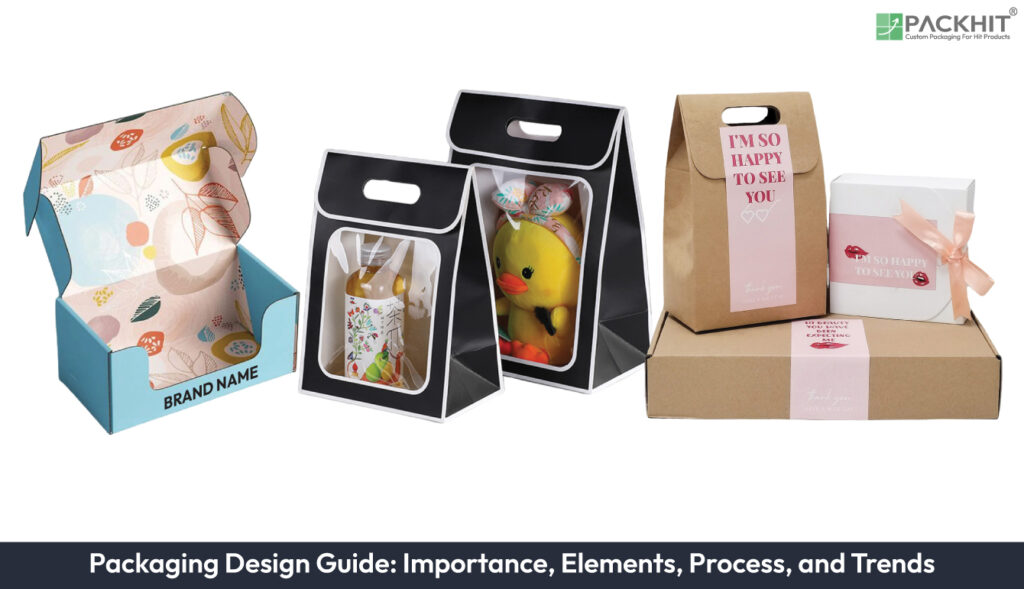
Packaging design is the process of creating a product’s exterior, including material selection, structural design, graphics, colors, typography, and labeling. It combines functional and visual elements to protect products, communicate brand identity, and support the customer experience. The process typically includes understanding project requirements, research, concept development, prototype evaluation, design refinement, and production preparation. The specific design process and requirements vary depending on the product, industry, packaging material, and manufacturing method. Depending on the product and business objectives, packaging design also involves addressing common risks and failure modes, understanding the importance of effective packaging, and incorporating emerging approaches such as sustainable, minimalist, smart, and functional packaging.
- What is Packaging Design?
- Key Elements of Packaging Design
- How to Develop an Effective Packaging Design?
- Step 1: Understanding the Brief
- Step 2: Establishing a Project Plan
- Step 3: Research and Discovery
- Step 4: Concept Development
- Step 5: Artwork Implementation and Review
- Step 6: Prepress Production
- Step 7: Testing
- Step 8: Finalization
- Emerging Packaging Design Trends
- Budget Considerations for Packaging Design
- Risks, Failure Modes, and Mitigations in Packaging Design
- What Should Manufacturers Prioritize When Choosing Packaging Materials?
- When Should a Packaging Design be Simplified?
- Are Premium Finishes Always Recommended?
- Why is Prototype Testing Important?
- What is the Impact of Packaging Design on Brand Success?
- How to Choose Between Packaging Design Options?
What is Packaging Design?
Packaging design is the practice of designing a product’s container or package to protect its contents while communicating information and supporting brand presentation. It combines structural design, visual communication, material selection, and usability considerations to create packaging that meets both functional and marketing objectives.
Effective packaging design can help protect products during storage and transportation, communicate brand identity through elements such as colors, graphics, typography, and labeling, and improve product visibility on retail shelves or digital marketplaces. The relative importance of each objective depends on the product category, distribution environment, and customer expectations.
Core Functions of Packaging Design
There are four core functions of packaging design, which are mentioned below:
- Brand Communication: Packaging design helps convey the brand’s identity, values, and messaging through visual and textual elements like color, font, and typography.
- Consumer Attraction: Packaging design captures the attention of customers on shelves and influences their purchasing decisions.
- Protection: Packaging design safeguards the product from environmental factors and falls during transportation, storage, and use.
- Usability: Packaging design also helps enhance user experience with convenient and functional designs.
Key Elements of Packaging Design
Packaging design integrates multiple elements that work together to balance product protection, usability, manufacturing requirements, and visual presentation.
- Material Selection: Material choices should balance strength, product compatibility, barrier performance, appearance, weight, cost, and recyclability. Common materials include cardboard, paperboard, plastic, glass, metal, and wood.
- Sustainability Considerations: Recyclable, renewable, recycled-content, or compostable materials should be considered when they meet product requirements, regulatory standards, and available recycling or composting systems.
- Form and Structure: Packaging structure should support product protection, storage efficiency, transportation needs, and user convenience through features such as stackability, ergonomic shapes, collapsible designs, and protective inserts.
- Graphics and Colors: Visual elements such as logos, imagery, colors, and layouts should communicate product information clearly while reinforcing brand identity. A strong visual hierarchy improves readability and helps customers quickly find important details.
- Typography: Font selection, size, spacing, and text arrangement should ensure clear communication, improve readability, and align with the overall brand style and packaging objectives.
How to Develop an Effective Packaging Design?
The packaging design process is a comprehensive, multi-stage workflow that begins with understanding the brief, analyzing client requirements to identify missing elements, and clarifying expectations. This is followed by establishing a project plan with defined timelines, budgets, and deliverables to ensure accountability. Next comes research and discovery, where consumer insights, market trends, and competitor strategies are examined to guide differentiation. Concept development follows, involving brainstorming, sketching, and exploring visual and structural ideas. Once a concept is selected, artwork is implemented and refined to align with the brand identity. The design then enters prepress production, where dielines, color targets, and special finishes are finalized for print readiness. Rigorous testing is conducted to validate durability, functionality, and consumer usability, allowing for necessary adjustments. Finally, the process concludes with design finalization, where all specifications are confirmed, compliance is ensured, and the packaging is prepared for mass production, aligning with brand goals and consumer expectations.
The packaging design process involves eight key steps, which are mentioned below:
Step 1: Understanding the Brief
Project requirements, product characteristics, target users, functional objectives, manufacturing constraints, and business goals are reviewed to establish design requirements.
Step 2: Establishing a Project Plan
Project timelines, responsibilities, deliverables, review stages, budgets, and production milestones are defined.
Step 3: Research and Discovery
Research may include competitor reviews, consumer insights, packaging benchmarks, manufacturing capabilities, distribution requirements, and material options.
Step 4: Concept Development
Multiple structural and graphic concepts are developed through sketches, digital mockups, and design exploration before preferred concepts are selected.
Step 5: Artwork Implementation and Review
Graphics, branding elements, typography, regulatory labeling, and product information are refined through stakeholder review.
Step 6: Prepress Production
Print-ready artwork, dielines, color specifications, material selections, and finishing requirements are prepared for manufacturing.
Step 7: Testing
Prototype evaluation may include assessments appropriate to the packaging application, such as handling simulations, structural performance, closure functionality, usability reviews, print quality checks, or transportation-related evaluations. The testing performed depends on the product, packaging material, distribution environment, customer requirements, and applicable industry standards.
Step 8: Finalization
After revisions are completed, final specifications are confirmed for production. Compliance reviews are conducted as applicable to the product category, packaging materials, labeling requirements, and intended markets before manufacturing begins.
Emerging Packaging Design Trends
In recent years, packaging design has commonly emphasized sustainability, simplicity, digital integration, and improved usability. The adoption of these approaches varies across industries, products, customer expectations, and regulatory environments.
Sustainable Packaging
Many organizations explore packaging solutions that reduce unnecessary material use or incorporate recyclable, recycled-content, renewable, or reusable materials where appropriate. Environmental outcomes depend on material selection, manufacturing methods, transportation, reuse practices, and available recycling or recovery systems.
Minimalist Packaging
Minimalist packaging uses simplified layouts, restrained graphics, and clear information hierarchy to improve readability while reducing unnecessary visual elements. Depending on the design, this approach may also reduce material usage or printing complexity.
Smart Packaging
Some products incorporate technologies such as QR codes, digital authentication features, RFID, NFC, or smart labels to provide product information, improve traceability, or support customer engagement. Adoption varies by industry and application.
Functional Packaging
Many packaging designs incorporate usability features such as resealable closures, easy-open mechanisms, dispensing systems, ergonomic handling, or portability improvements to support the intended user experience.
Budget Considerations for Packaging Design
Packaging design costs vary depending on factors such as package complexity, structural engineering requirements, material selection, graphic design needs, prototype development, testing, production volume, and finishing techniques.
When evaluating packaging budgets, businesses often consider how design decisions influence manufacturing efficiency, product protection, transportation, branding, and long-term operational costs. Prototype development, revisions, testing, and specialized print finishes may increase overall project costs depending on project scope.
Risks, Failure Modes, and Mitigations in Packaging Design
Packaging design decisions should be evaluated not only for appearance but also for protection, usability, manufacturing reliability, and lifecycle performance. Common failure modes and mitigation approaches include:
| Common Failure Mode | Potential Impact | Typical Mitigation |
|---|---|---|
| Material Selection | Material lacks sufficient strength, barrier properties, or compatibility with the product | Product damage, reduced shelf life, leakage, or performance issues |
| Structural Design | Package collapses, deforms, or does not stack efficiently during handling | Increased damage risk, higher shipping costs, and poor warehouse efficiency |
| Closure and Usability | Opening mechanism is difficult, inconsistent, or fails during use | Poor user experience, product accessibility issues, or package damage |
| Graphics and Printing | Color variation, poor image quality, or print misalignment | Reduced brand consistency and lower visual quality |
| Labeling and Information Design | Text is unclear, incomplete, or difficult to read | Consumer confusion, compliance risks, or reduced product understanding |
| Sustainability Design | Material choice creates recycling difficulties or excessive waste | Environmental concerns and reduced alignment with sustainability goals |
| Manufacturing Feasibility | Design requires excessive tooling, manual assembly, or unavailable production capabilities | Increased costs, longer lead times, and production delays |
Packaging design success depends on balancing visual appeal, product protection, user experience, manufacturing feasibility, and environmental responsibility. Identifying common failure modes early allows brands to address potential risks before production and avoid costly redesigns or quality issues.
What Should Manufacturers Prioritize When Choosing Packaging Materials?
Select materials based on product protection, shipping conditions, sustainability goals, and production requirements.
When Should a Packaging Design be Simplified?
Simplify when prototypes reveal structural issues, production delays, excessive assembly time, or quality problems.
Are Premium Finishes Always Recommended?
No. Finishes such as foil stamping and embossing should be used only when they improve presentation without creating unacceptable cost, durability, or production risks.
Why is Prototype Testing Important?
Prototypes help identify failures in structure, closures, printing, finishes, and manufacturing before full production.
What is the Impact of Packaging Design on Brand Success?
Packaging design can influence brand recognition, customer experience, operational efficiency, and product protection by combining structural design with visual communication.
Thoughtful packaging can strengthen brand identity through consistent use of graphics, colors, typography, labeling, and structural presentation. Appropriate material selection and package design can also improve product protection, handling efficiency, storage utilization, and transportation performance.
The overall business impact depends on factors such as product quality, pricing, market positioning, distribution strategy, customer preferences, and execution. Packaging design is one component of a broader product and brand strategy rather than the sole driver of commercial success.
How to Choose Between Packaging Design Options?
Packaging design choices should be based on the product requirements, distribution environment, customer expectations, and manufacturing constraints rather than appearance alone.
| Decision Area | Prioritize When | Recommended Approach | Trade-Off to Consider |
|---|---|---|---|
| Material Selection | Product requires strong protection, moisture resistance, or extended shelf life | Choose materials with suitable strength and barrier performance | Higher-performance materials may increase cost, weight, or environmental impact |
| Sustainability Goals | Reducing environmental impact is a major objective | Consider recyclable, recycled-content, renewable, or reduced-material solutions | Some sustainable materials may require additional testing for durability, printing, or product compatibility |
| Structural Design | Products face long-distance shipping, stacking, or rough handling | Prioritize protective structures, inserts, and efficient package dimensions | More protective designs may use additional material or increase shipping volume |
| Visual Design | Brand differentiation and shelf visibility are important | Use graphics, colors, typography, and finishes that support recognition and communication | More complex designs may increase printing steps, cost, and production requirements |
| Usability Features | Consumers interact frequently with the package | Add features such as resealable closures, ergonomic shapes, or easy-open mechanisms | Added functionality may increase structural complexity and manufacturing requirements |
| Production Constraints | Launch timing or manufacturing capacity is limited | Select available materials, standard structures, and proven processes | Reduced customization may limit visual uniqueness |
When Should a Brand Reassess or Redesign Its Packaging?
Manufacturers should consider revising the design when:
- Prototype testing shows repeated product damage, structural failure, or closure problems.
- Packaging performance does not meet transportation, storage, or usability requirements.
- Printing, labeling, or finishing quality cannot be maintained consistently during production.
- Material choices create unacceptable sustainability, recycling, or compatibility issues.
- Production requirements exceed available budget, supplier capability, or launch timelines.
A successful packaging design balances protection, communication, usability, sustainability, and manufacturability. The most suitable design depends on the product category, distribution conditions, customer expectations, and production environment.