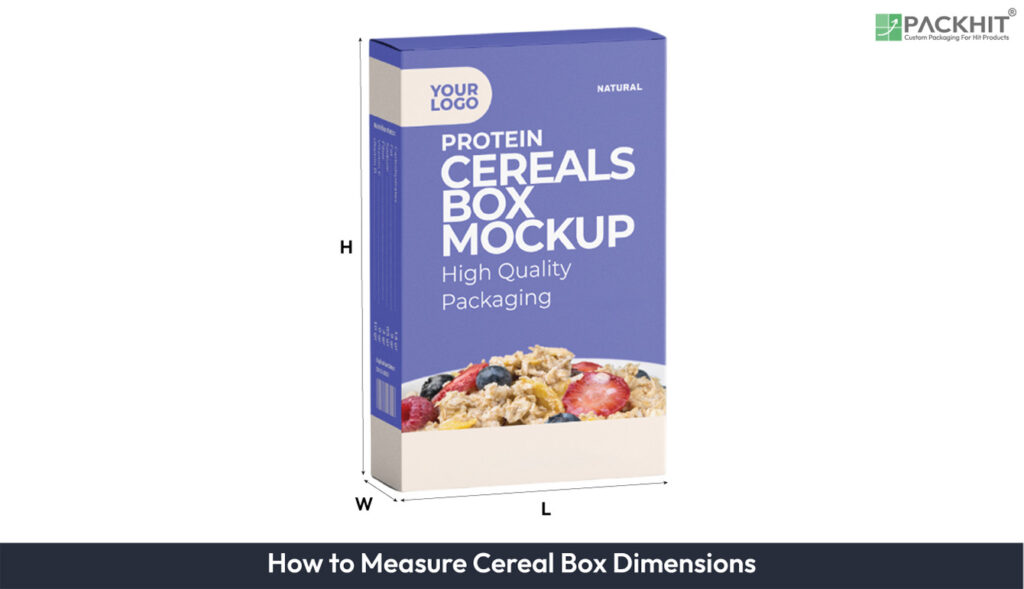
To measure the cereal box dimensions, start by gathering the measuring tools. Position the box upright on a flat surface to measure its height from base to top edge. Next, measure the width across the front face and the depth along the side edge. Record the measurements in Height x Width x Depth format, such as 12 x 8 x 2.5 inches for a standard cereal box. Custom box sizes help support branding goals, sustainability, and market trends. These dimensions are essential for optimizing storage, enhancing branding through ample design space, simplifying shipping logistics, and aligning with consumer preferences.
To measure cereal box dimensions, follow these steps:
- Step 1: Gather the Measuring Tools
- Step 2: Measure the Height
- Step 3: Measure the Width
- Step 4: Measure the Depth
- Step 5: Record Measurements
- Standard Cereal Box Dimensions
- Customization of Cereal Box Dimensions
- What are the Dimensions of a Family-Size Cereal Box?
- What are the Dimensions of a Mini Cereal Box?
- Why is it Important to Choose the Right Cereal Box Dimensions?
Step 1: Gather the Measuring Tools
Place the box on a flat surface and gather the measuring tools for each dimension. Use a tape measure, a 12-inch steel ruler, and digital calipers as primary tools, and use a carpenter square or right angle to confirm the box stands perpendicular. A right-angle check ensures the ruler aligns with the front face so height readings are vertical. For production checks, metric calipers or a metric ruler can be used.
Step 2: Measure the Height
To measure the height, start measuring from the vertical distance from the base to the top edge. Stand the box upright on a flat surface and press the base flat. Align the ruler at the box center and read at the highest point of the top edge. Measure both front and back if the top is uneven. Measure three samples and average the results to account for manufacturing variance. Ensure all samples are from the same production batch to maintain consistency.
Step 3: Measure the Width
Next, to measure the width, place the ruler across the front face and measure from one side seam to the other. Place the ruler at mid-height to avoid edge curvature. If the front panel has a recessed or embossed area, take seam-to-seam width for packaging dimensions and take the printable-panel width (the flat artwork area) for artwork layout. Record seam-to-seam width in inches and in millimeters if you use metric specifications. Seam-to-seam means measuring edge-to-edge at the panel seams, not including artwork recesses.
Step 4: Measure the Depth
To measure the depth, measure the side from the front panel to the back panel at the widest point. Measure seam-to-seam on the side panel. If the inner bag or liner reduces usable volume, measure the inside depth as a separate value. Note that a common standard box of 12 x 8 x 2.5 inches can correspond to roughly 12–18 oz, depending on formulation and internal packaging. Record dimensions as Height x Width x Depth and include the unit, for example, 12 x 8 x 2.5 in or 305 x 203 x 64 mm.
Step 5: Record Measurements
Record the measurements in the format: Height x Width x Depth. For example, a standard cereal box might be recorded as 12 x 8 x 2.5 inches.
Note: Outer panel measurements do not account for interior structural folds or tapered sides. Seam-to-seam side checks can miss bulging contents or stuffed inner liners. Inner bag reductions require a separate inside depth value for true usable capacity.
Standard Cereal Box Dimensions
The dimensions of a standard cereal box in the United States often measure 12 inches tall, 8 inches wide, and 2.5 inches deep. These measurements are designed to fit efficiently on retail shelves while providing adequate space for branding and product information. Variations exist depending on the brand, product type, and target audience. It is important to note that these figures represent static exterior dimensions; actual manufacturing tolerances, material thickness, and natural box bulging when filled can cause minor deviations in real-world shipping and shelf-space calculations.
Customization of Cereal Box Dimensions
Customizing cereal box dimensions allows brands to differentiate their products and meet specific market demands. Custom dimensions are particularly useful for the following:
- Branding: Unique box sizes can make a product stand out on retail shelves.
- Special Editions: Limited-edition products often use custom packaging to create exclusivity.
- Sustainability: Eco-friendly designs with reduced material usage are becoming increasingly popular.
What are the Dimensions of a Family-Size Cereal Box?
Dimensions of a family-size cereal box can measure around 14 inches tall, 10 inches wide, and 3 inches deep. They are larger to accommodate greater product volume, designed for households with higher consumption needs, and are often marketed as cost-effective options. Actual measurements vary significantly by brand and cereal density.
What are the Dimensions of a Mini Cereal Box?
The dimensions of a mini cereal box are usually around 6 inches tall, 4 inches wide, and 1.5 inches deep. Mini cereal boxes are compact and portable, often used for single servings or travel purposes. These boxes are popular in variety packs and promotional giveaways. The cost per ounce of a mini cereal box is drastically higher than standard or family sizes.
Why is it Important to Choose the Right Cereal Box Dimensions?
It is important to choose the right cereal box dimensions are important because they affect four practical areas: storage, branding, shipping, and consumer preference. Accurate height, width, and depth measurements (and consistent unit recording) help ensure boxes stack correctly, fit planned artwork panels, and pack efficiently.
- Optimizing Storage: Cereal boxes in standard sizes optimize storage and enhance space efficiency in warehouses, retail shelves, and home pantries by enabling consistent stacking, optimized pallet arrangements, and uniform shelf placement.
- Branding: The panel area of a cereal box defines how much space is available for logos, product graphics, nutrition facts, and promotion text; larger faces offer more layout options and room for regulatory panels.
- Facilitating Shipping: Uniform cereal box dimensions reduce wasted cubic volume in trucks and on pallets, lower handling time, and limit product movement that can cause damage during transit.
- Meeting Consumer Preferences: Different sizes of cereal boxes serve various purposes to meet consumer preferences. Family-sized cereal boxes are ideal for households with multiple members, standard boxes suit weekly consumption, and mini boxes are convenient for single servings or travel. The size of the box impacts how often consumers purchase cereal and how they perceive its value.