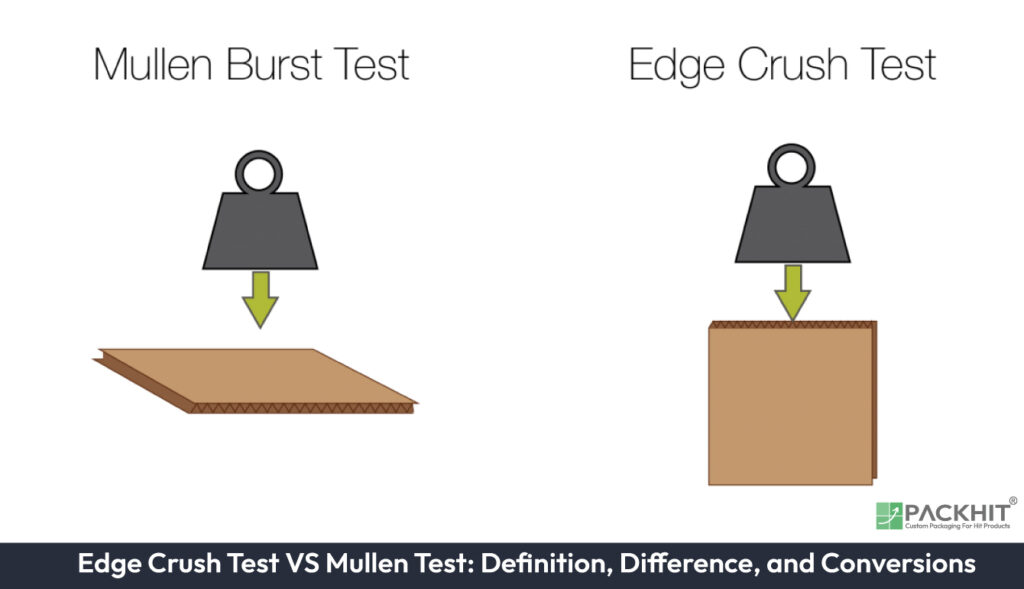
The Edge Crush Test (ECT) and Mullen Burst Test are two distinct methodologies used in the corrugated packaging industry to evaluate the strength and durability of corrugated materials. While the ECT measures the edgewise compressive strength of a corrugated board, directly correlating to its stacking performance, the Mullen Test assesses the material’s resistance to rupture under pressure, indicating its ability to withstand punctures and external forces. These tests serve different functional roles, influencing box design, material selection, and cost optimization, and using the wrong one as a proxy for the other can mean specifying a box that stacks well but fails under rough handling, or vice versa. Understanding their mechanisms, applications, and conversion metrics is essential for manufacturers aiming to select the most suitable packaging for their products.
- What is the Edge Crush Test (ECT)?
- What is the Mullen Burst Test?
- What is the Difference between Edge Crush Test (ECT) and Mullen Test?
- How Do Conversion Metrics Relate to Edge Crush Test (ECT) and Mullen Test Ratings?
- What to Confirm Before Selecting an ECT or Mullen Rating?
- What are the Industry-Specific Use Cases for ECT and Mullen Ratings?
- How to Choose Between the Edge Crush Test (ECT) and the Mullen Test?
What is the Edge Crush Test (ECT)?
The Edge Crush Test (ECT) quantifies the edgewise compressive strength of corrugated board by measuring the force required to crush a small sample of the material placed vertically between two rigid plates. The result is expressed in pounds per linear inch (lb/in) and reported as an ECT value; for example, a specific corrugated board construction tested under controlled conditions might receive an illustrative rating of 32 ECT. Actual performance can vary based on flute type, board thickness, wall construction, and manufacturing specifications. ECT is used as an indicator of stacking performance, making it a useful parameter for applications where vertical load-bearing capacity is a priority.
What is the Purpose of ECT-rated Corrugated Boards?
ECT-rated corrugated boards are designed to optimize stacking performance while minimizing material usage. They are particularly suited for lightweight packaging solutions where high stacking strength is required, such as in retail and e-commerce applications. The test is widely used for single-wall, double-wall, and triple-wall corrugated boards, with variations in flute types (A, B, C, E, F) influencing the results.
What is the Mullen Burst Test?
The Mullen Burst Test measures the force required to rupture the surface of a corrugated board under pressure. The test involves applying hydraulic pressure to the material until it bursts, with results expressed in pounds per square inch (psi); for example, a specific corrugated board construction tested under controlled laboratory conditions might receive an illustrative rating of approximately 200 psi. This value is not transferable across all boards because burst performance depends on board composition, flute profile, thickness, and testing conditions. Though actual ratings vary depending on flute profile, board thickness, and the humidity or temperature conditions the board is tested or used under, a rating measured in a controlled lab environment may not hold up identically in a humid warehouse. This test evaluates the board’s ability to resist punctures and external forces, making it ideal for applications requiring durability during rough handling.
What is the Purpose of Mullen-rated Corrugated Boards?
Mullen-rated corrugated boards are preferred for packaging where puncture resistance and overall material integrity are critical. These boards are commonly used in industries such as food and beverage, pharmaceuticals, and heavy-duty shipping, where external impacts and internal pressure are significant concerns.
What is the Difference between Edge Crush Test (ECT) and Mullen Test?
The Edge Crush Test (ECT) and Mullen Burst Test serve distinct purposes in evaluating the strength of corrugated packaging. Below is a comparative table summarizing their key differences, applications, and implications:
| Aspect | Edge Crush Test (ECT) | Mullen Test |
|---|---|---|
| Strength Measurement | Measures edgewise compressive strength, expressed in pounds per linear inch (e.g., 32 ECT). | Measures burst strength, expressed in pounds per square inch (e.g., 200 psi). |
| Ideal Applications | Best for storage and transportation scenarios requiring high stacking performance. | Suitable for environments involving rough handling or where puncture resistance is critical. |
| Material Usage | Uses less material, optimizing for lightweight and sustainable packaging solutions. | Uses thicker material, ensuring enhanced protection for fragile or heavy items. |
| Sustainability | Eco-friendlier due to reduced raw material consumption and lighter weight. | Less sustainable due to higher material usage, though more durable for specific needs. |
| Cost Implications | Generally, more economical, with lower material and shipping costs. | Higher cost due to thicker materials and superior durability, but offsets for sensitive or high-value goods. |
| Industry Examples | Commonly used in retail and e-commerce for lightweight goods requiring efficient stacking. | Preferred in industries such as pharmaceuticals and heavy machinery, where durability and puncture resistance are vital. |
This comparison highlights the distinct advantages of each test method: ECT for stacking efficiency and material savings, Mullen for puncture resistance and rough-handling durability.
How Do Conversion Metrics Relate to Edge Crush Test (ECT) and Mullen Test Ratings?
Conversion metrics help manufacturers approximate equivalencies between Edge Crush Test (ECT) and Mullen Burst Test ratings, simplifying packaging selection based on specific performance needs such as stacking strength or puncture resistance.
Understanding Conversion Charts
Conversion charts serve as a practical tool to approximate equivalencies between Edge Crush Test (ECT) and Mullen Burst Test ratings. For instance, conversion charts may suggest a rough comparison between a specific 32 ECT-rated board construction and an approximately 200 psi Mullen-rated board tested under comparable conditions. These values are not direct equivalents and should not be transferred between different board types without confirming construction details and test assumptions. Exact alignment varies by board type, flute profile, and environmental conditions. These charts simplify the selection process for manufacturers by providing a comparative framework, though actual suitability depends on specific application needs.
Why are Conversion Metrics Useful?
Conversion metrics help manufacturers balance performance requirements with cost efficiency. By understanding the relationship between stacking strength and puncture resistance, businesses can determine the most appropriate packaging standard for their product’s weight, handling conditions, and shipping environment.
Limitations of Conversion Metrics
While conversion charts are beneficial, they have limitations. Factors such as flute type, board thickness, and environmental conditions can influence packaging performance, making it essential to consider these variables when selecting between ECT and Mullen ratings. Relying solely on conversion metrics without evaluating these nuances may result in suboptimal packaging solutions.
The selection between ECT and Mullen ratings should consider multiple packaging factors beyond strength alone. The following criteria help determine which rating best matches the handling, storage, and transportation requirements of a packaging application.
| Factor | What It Indicates | When to Prioritize |
|---|---|---|
| ECT (lb/in) | Edgewise compressive strength, correlating with stacking capacity | Warehouse storage, palletized loads, and retail stacking |
| Mullen Burst (psi) | Resistance to rupture under pressure | Rough handling, drop risk, and puncture-prone shipping routes |
| Flute Type (A, B, C, E, F) | Affects both ECT and Mullen results independent of board grade | Confirm flute profile matches the rated test values before ordering |
| Board Thickness | Influences both stacking and puncture performance | Thicker boards generally increase both ratings but may add material cost |
| Environmental Conditions | Humidity and temperature can reduce both ratings from laboratory-tested values | Consider expected shipping and storage conditions rather than relying only on rated specifications |
Selecting the right rating requires balancing strength, protection, cost, and environmental factors to ensure the packaging performs effectively throughout the supply chain. Before trusting a chart’s suggested equivalency, it’s worth confirming the flute profile and board construction match what the chart assumes; a mismatch here is the most common reason a converted rating doesn’t hold up in practice.
What to Confirm Before Selecting an ECT or Mullen Rating?
Before finalizing an ECT or Mullen specification, manufacturers should evaluate how the carton will be tested, produced, and used throughout the supply chain. Key considerations include the expected shipping environment, pallet configuration, handling frequency, and whether packaging performance will be verified through supplier documentation, laboratory testing, or physical samples.
ECT-focused specifications are generally useful when the primary requirement is predictable stacking performance, such as warehouse pallet storage. Mullen-focused specifications are more relevant when cartons may experience drops, compression from handling equipment, or puncture risks during distribution. However, neither rating alone defines complete packaging performance, so manufacturers should also review board construction, flute profile, material consistency, and real-world handling conditions.
For quality assurance, test ratings should be treated as performance indicators rather than guarantees. Packaging teams should confirm that the selected board grade matches the intended application through supplier specifications, testing records, or trial shipments before implementing large-scale production.
What are the Industry-Specific Use Cases for ECT and Mullen Ratings?
ECT-rated boxes are commonly used for warehouse distribution, retail replenishment, and palletized shipments where cartons experience prolonged vertical loading. For example, a product stored several layers high in a distribution center depends more heavily on stacking strength than impact resistance.
Mullen-rated boxes are often preferred for parcel shipments, export handling, and applications where cartons may face frequent manual handling, drops, or contact with sharp surfaces. For example, an individually shipped package moving through multiple courier hubs may require stronger burst resistance than a carton transported only on a secured pallet.
Neither rating should be viewed as universally superior. The appropriate choice depends on the dominant failure risk expected during storage and transportation.
Which Rating Matters More for E-Commerce Shipping?
It depends on the shipping method; palletized bulk shipments benefit more from ECT, while individually shipped parcels handled by multiple couriers often face more puncture and impact risk, favoring Mullen.
How to Choose Between the Edge Crush Test (ECT) and the Mullen Test?
The right choice between ECT and Mullen depends on whether the primary requirement is stacking strength or resistance to external impacts. Verify the selected rating against the board construction and expected handling conditions before finalizing the specification. ECT is generally preferred for shipping applications where boxes must withstand stacking loads during storage and transportation, while Mullen testing is useful when burst strength and puncture resistance are critical. Selecting the appropriate test method helps ensure the corrugated packaging performs reliably throughout the supply chain.
Can a Box Have Both a High ECT and a High Mullen Rating?
Yes, a corrugated box can achieve both high ECT and high Mullen ratings, but this usually requires thicker or higher-grade board construction. Using stronger materials can improve stacking strength and impact resistance, but it may also increase material usage, packaging weight, and overall cost.
Do Conversion Charts Apply Across All Board Types?
No, ECT-to-Mullen conversion charts are only approximate and should not be treated as exact equivalents. Results can vary depending on flute type, board structure, paper grade, manufacturing process, and supplier specifications. These charts are best used as a general reference when comparing packaging options.
How Does Flute Type Affect ECT and Mullen Ratings?
Flute type plays an important role in determining corrugated board performance. Larger flute profiles, such as A-flute, generally provide better cushioning and impact protection, while smaller flute profiles, such as E-flute, can offer higher stiffness and improved printability in thinner structures. The appropriate flute selection depends on the required balance between protection, strength, and packaging efficiency.