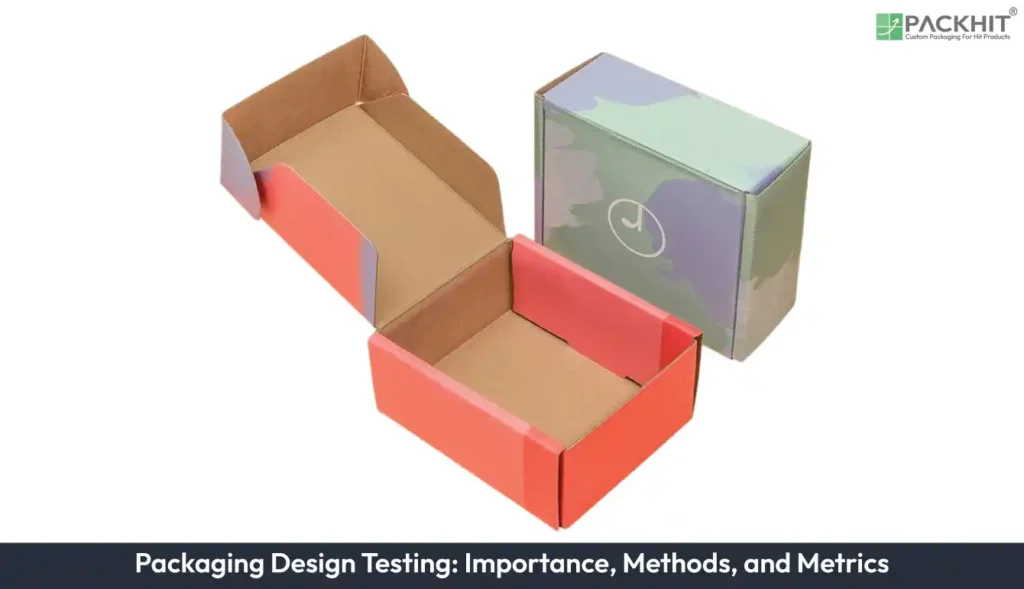
Packaging design testing typically evaluates prototypes across material, functionality, and buyer intent to help reduce transit damage, potentially lower unit cost, and quantify purchase signals. Methods often combine qualitative studies (focus groups, interviews) and quantitative tests (A/B tests, discrete-choice tasks, eye-tracking, controlled durability tests). Packaging design testing can help track performance, consumer, and compliance metrics. To conduct packaging design testing properly, it is important to define goals, then create prototypes, select testing methods, and, after conducting the tests, analyze the results and refine the design.
- Why is Packaging Design Testing Important?
- Material and Cost Outcomes
- Typography, Copy, and Legibility
- Purchase Intent and Shelf Performance
- Brand Signals and Sustainability Perception
- Concept Validation and Production Risk Reduction
- When is Packaging Design Testing Conducted?
- Methods for Packaging Design Testing
- What Metrics Does Packaging Design Testing Track?
- How to Conduct Packaging Design Testing Properly?
- 1. Define Goals
- 2. Create Prototypes
- 3. Select Methods
- 4. Conduct Tests
- 5. Analyze Results
- 6. Refine Design
- How Should Manufacturers Effectively Apply Packaging Testing?
Why is Packaging Design Testing Important?
Packaging design testing can help reduce transit damage, lower avoidable production costs, and produce measurable signals of purchase intent and brand fit.
Material and Cost Outcomes
Testing can quantify protection performance and material cost trade-offs, so you may pick the lightest, cheapest substrate that still passes performance targets. Measurable outputs often include damage rate (damaged units per 1,000 shipments), compression strength (kPa or lbs/in²), and required board grade (examples: 200-400 gsm paperboard, single-wall E-flute corrugated). Use controlled tests like drop, vibration, and compression to help set specification limits and avoid over-engineering; such over-engineering is a trade-off that may raise unit cost (for example, by a few to tens of percent) depending on how performance targets are set, if performance limits are not precisely followed.
Typography, Copy, and Legibility
Testing typically identifies the font sizes, contrast ratios, and copy length that deliver readable information in the available panel space. Run legibility checks at typical viewing distances (example: 30 cm for shelf-facing panels, consistent with ergonomic standards) and record the readable percentage and time-to-read. Compare Serif vs Sans Serif, 8-12 pt vs 10-14 pt for short panels, and high-contrast color pairs (example: 4.5:1 contrast ratio, often used as a benchmark in accessibility guidelines) to generally meet accessibility and regulatory requirements.
Purchase Intent and Shelf Performance
Testing may convert subjective attraction into numeric purchase signals using A/B choice tests, discrete-choice tasks, and simulated-shelf scans. Key metrics can include: choice share lift (percentage-point change), conversion rate (clicks or purchases per 100 exposures), and first-fixation time (seconds). Use sample sizes matched to the method (examples: n≥100 for online A/B, n=200+ for discrete-choice experiments; these are commonly recommended minimums to ensure statistical power), and randomize stimuli to help detect statistically significant lifts (often assessed at common significance thresholds, such as p<0.05, depending on protocol for research significance).
Brand Signals and Sustainability Perception
Testing can help verify whether packaging communicates intended brand attributes such as eco-friendliness, premium quality, or technical reliability. Measure brand alignment with attribute ratings and forced-choice tasks. Test material finishes (matte kraft vs glossy white), messaging, and iconography to typically confirm that the packaging maps to brand guidelines and consumer expectations.
Concept Validation and Production Risk Reduction
Concept testing generally validates design choices before mass production, often reducing rework, scrap, and time-to-market errors. Adopt three fidelity levels, like mockup, functional sample, pilot run, and test at each stage. Run concept tests on 3 designs, select top 1-2 for pilot production, and track cost delta per unit (examples: tooling rework cost, change-order scrap rate). Document test protocols and decision criteria so each design change may tie to a measured KPI.
When is Packaging Design Testing Conducted?
Packaging design testing is typically conducted during the product development lifecycle, from initial concept to pre-launch stages. It may also be performed periodically for existing products to adapt to market trends or address performance issues.
Key Stages of Packaging Design Testing
Packaging design testing often involves multiple stages, each aimed at ensuring the packaging meets functional, aesthetic, and regulatory requirements. These stages can guide manufacturers from concept development to post-launch evaluations.
- Prototype Testing: Evaluating early designs for feasibility and functionality.
- Pre-Market Testing: Assessing consumer reactions and refining designs before mass production.
- Post-Launch Testing: Monitoring performance and gathering feedback for continuous improvement.
Methods for Packaging Design Testing
Various methods are typically employed to test packaging designs, ranging from qualitative assessments to quantitative analyses. These methods can ensure comprehensive evaluation across multiple dimensions.
The two methods of packaging design testing are detailed below:
1. Qualitative Methods
Qualitative methods may focus on understanding consumer perceptions, preferences, and emotional responses to packaging designs. These approaches rely on direct feedback and interaction, generally offering insights into subjective elements of design evaluation.
- Focus Groups: Gathering consumer opinions on design elements such as color, typography, and usability.
- Interviews: Conducting one-on-one discussions to understand individual preferences and pain points.
2. Quantitative Methods
Quantitative methods use measurable data to evaluate packaging design performance, providing objective insights into its potential effectiveness. These methods are especially valuable for assessing functionality, durability, and consumer engagement under real-world conditions.
- A/B Testing: Comparing two or more design variations to determine the most effective option.
- Eye-Tracking Studies: Measuring visual engagement with packaging designs.
- Durability Tests: Assessing material strength under simulated conditions such as compression, vibration, and drop tests. Drop testing parameters (often ranging from 0.5 to 1.2 meters depending on package weight and shipping environment) typically follow established ISTA/ASTM test protocols.
What Metrics Does Packaging Design Testing Track?
Packaging design testing can track a variety of metrics to evaluate performance, consumer appeal, and compliance. These metrics generally provide actionable insights for design optimization.
The three packaging design testing tracks’ metrics are as follows:
Performance Metrics
Performance metrics in packaging design testing are critical for assessing how well packaging may perform under real-world conditions. They focus on durability, usability, and product protection to help ensure optimal functionality and reliability.
- Material Strength: Resistance to tearing, puncturing, and environmental factors.
- Functionality: Ease of opening, resealing, and handling.
Consumer Metrics
Consumer metrics can play an essential role in assessing how packaging designs resonate with target audiences. These metrics focus on the visual, emotional, and practical aspects of packaging that often influence purchasing decisions and brand perception.
- Visual Appeal: Measures the attractiveness of the design, including color schemes, typography, and overall layout, to ensure alignment with brand identity.
- Perceived Value: Evaluates how consumers perceive the quality of the product based on its packaging, helping justify pricing strategies and enhance customer trust.
- Purchase Intent: Analyzes how effectively the packaging design drives consumer interest and encourages conversion at the point of sale.
Compliance Metrics
Compliance metrics in packaging design testing can ensure that packaging adheres to legal, environmental, and industry-specific requirements. These metrics are typically essential for maintaining brand reputation, avoiding legal penalties, and meeting consumer expectations for sustainability and safety.
Neglecting performance metrics testing and compliance metrics testing creates significant financial and brand risks. Research indicates that damage-related returns can consume 20-65% of an item’s value (with variance based on specific product fragility and supply chain handling), and 51% of consumers (based on broad market sentiment research) are unlikely to repurchase if they receive damaged products.
- Regulatory Standards: Verifies compliance with federal and state packaging regulations, including labeling laws, safety guidelines, and industry certifications.
- Environmental Impact: Assesses the sustainability of materials used, including recyclability, biodegradability, and carbon footprint, to align with eco-conscious consumer demands.
How to Conduct Packaging Design Testing Properly?
Conducting packaging design testing often requires a structured approach to ensure accurate and actionable results. The process typically involves defining objectives, selecting appropriate methods, and analyzing data effectively.
1. Define Goals
It is often suggested to state two to four measurable objectives, which is a standard range to focus scope without overcomplicating the analysis, each tied to a KPI such as reducing transit damage like the damage rate, increasing purchase intent such as A/B choice lift, improving legibility so that it is readable at 30 cm, an industry-standard viewing distance for shelf-facing packaging, or confirming brand signals such as a perceived eco-friendly rating.
2. Create Prototypes
Typically, produce prototypes that reflect final materials, print, and dielines. One may use three fidelity levels, such as mockups using inkjet or laser proofs, functional samples utilizing production-grade substrate, and pilot-run units. These can help include final typography, copy, and structural elements. It is suggested to order packaging samples when external validation is required.
3. Select Methods
It is often suggested to match methods to each goal: one may use compression, drop, and vibration tests for material integrity; run A/B choice tests or discrete-choice tasks for purchase intent; deploy eye-tracking for visual hierarchy; or use focus groups for branding and copy evaluation.
4. Conduct Tests
Tests are typically run under documented protocols and controlled conditions. For physical tests, one may specify repetitions, n≥30, which is a standard benchmark to ensure reliability in material stress testing. For consumer studies, it can help to recruit representative samples, such as n≥100 for online A/B tests, the typical minimum sample size required to ensure statistical power, or n=6-10 per moderated focus group, a range generally required to reach thematic saturation in qualitative data. Randomizing stimuli often helps capture better metadata.
5. Analyze Results
Analyzing results can help convert raw data into decisions: one may compute failure rates, median time-to-open, and statistically significant differences where p<0.05, the scientific standard threshold to ensure results are statistically significant rather than due to chance. For A/B tests, it is suggested to code qualitative responses into themes and rank issues by severity.
6. Refine Design
Typically, prioritize fixes (safety and protection first, then structural usability, then messaging and visual hierarchy). Implementing targeted changes can help refine the design; one may then run focused retests on modified elements and document each version with its rationale.
How Should Manufacturers Effectively Apply Packaging Testing?
Manufacturers should apply the testing process by integrating it directly into the product development lifecycle rather than treating it as a final hurdle. By establishing a continuous feedback loop, where results from physical stress tests (such as compression or drop tests) and consumer insights directly inform design iterations, manufacturers can proactively mitigate risks. This can help ensure that every refinement is backed by empirical data, leading to packaging that is not only functional and safe but also optimized for both the consumer experience and cost-efficiency.