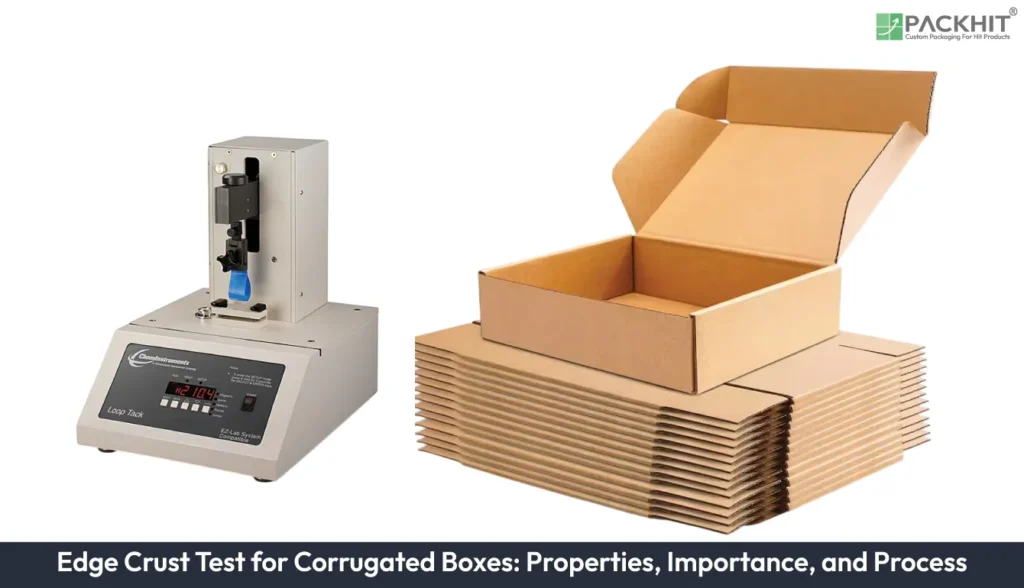
The Edge Crush Test (ECT) is a widely used evaluation method for measuring the edgewise compressive strength of corrugated board used in corrugated boxes. The test helps assess a board’s ability to resist stacking pressure during storage and transportation using standardized industry testing methods. The exact procedure starts from preparation of test samples to all the way until recording the values, and may vary depending on the applicable standard or testing requirements. ECT results are influenced by factors such as material composition, flute profile, board construction, environmental conditions, and manufacturing quality. When interpreted alongside other packaging performance data, ECT values help manufacturers develop cost-effective and reliable packaging solutions for specific product and shipping requirements.
What is the Edge Crush Test (ECT)?
The Edge Crush Test (ECT) measures the compressive force a corrugated board can resist along its edge under controlled laboratory conditions. The test reports an ECT value that manufacturers use as one indicator of edgewise compressive strength when evaluating corrugated board performance.
For custom packaging manufacturers, these properties help translate board-level test results into packaging decisions, such as selecting an appropriate corrugated grade and protective design features. However, actual package performance also depends on factors such as board construction, flute profile, environmental conditions, box design, and the intended shipping environment.
Why is the Edge Crush Test (ECT) Important for Corrugated Boxes?
The Edge Crush Test plays a pivotal role in the packaging industry by ensuring the durability and reliability of corrugated boxes. It provides manufacturers with critical data to optimize packaging design, reduce costs, and meet regulatory requirements.
Supporting Product Protection
ECT helps manufacturers determine whether a corrugated board can withstand expected stacking loads during storage and transportation, reducing the risk of box failure.
Guiding Material Selection
ECT results help manufacturers choose an appropriate board grade and flute profile based on product weight, shipping conditions, and cost requirements.
Verifying Packaging Performance
ECT can be used as one performance criterion to evaluate whether a packaging design is suitable for its intended application. Results should be considered alongside other package performance requirements.
How is the Edge Crush Test for Corrugated Boxes Conducted?
The Edge Crush Test is performed using specialized equipment and standardized test procedures to improve the consistency and repeatability of results. The exact procedure, sample preparation, conditioning, and reporting requirements should follow the applicable testing standard.
Below is a step-by-step overview of the testing process:
- Preparation of Test Samples: Corrugated board samples are prepared according to the applicable testing standard. Sample dimensions, conditioning requirements, and specimen preparation may vary depending on the selected standard and testing protocol. Clean, undamaged edges are important for obtaining reliable results.
- Testing Equipment: The test is conducted using an ECT machine equipped with compression platens. The machine applies a uniform compressive force to the sample’s edge.
- Execution of the Test: The sample is placed vertically between the platens, and force is applied until the sample crushes. The maximum force recorded during the test is the ECT value.
- Recording and Analysis: The ECT value is recorded and evaluated alongside other packaging performance data to assess material suitability for specific applications. While ECT is commonly used as one input when estimating box compression performance and optimizing packaging design, actual box strength also depends on factors such as box dimensions, board construction, flute type, manufacturing quality, and environmental conditions.
Applications of Edge Crush Test Data
The data obtained from the Edge Crush Test is used in various applications within the packaging industry. Below are some of the key uses of the Edge Crush Test:
- Designing Custom Packaging: Manufacturers use ECT data to design corrugated boxes that meet specific strength requirements while minimizing material usage and costs.
- Predicting Box Compression Strength: ECT values are used in conjunction with formulas to estimate the overall compression strength of corrugated boxes, ensuring they can withstand stacking loads.
- Quality Control: Regular ECT testing helps manufacturers maintain consistent quality in their corrugated board materials, ensuring reliable performance in packaging applications.
- Compliance with Standards: ECT data is often required to demonstrate compliance with industry standards and regulations, ensuring that packaging meets safety and performance criteria.
Note: Always follow the applicable testing standard for sample preparation, conditioning, equipment setup, and result reporting. ECT values should be interpreted together with board construction, flute profile, and intended service conditions, as laboratory results may not fully represent real-world shipping performance.
What are the Factors that Affect Edge Crush Test (ECT) Results?
Several factors can influence the results of the Edge Crush Test for corrugated boxes, such as material composition, flute profile, environmental conditions, and manufacturing process, making it essential to consider these variables during testing and analysis.
- Material Composition: The type of paper used in the corrugated board, including its weight and quality, significantly impacts ECT values. Boards with higher grammage or better-quality paper typically exhibit higher ECT values.
- Flute Profile: The flute profile (e.g., A, B, C, E) affects the board’s strength and stiffness. Larger flutes generally provide higher ECT values but may reduce flexibility.
- Environmental Conditions: Humidity and temperature can weaken corrugated board materials, leading to lower ECT values. Testing under controlled conditions is essential for accurate results.
- Manufacturing Process: The quality of adhesive bonding and the precision of the corrugation process can influence ECT results. Poor manufacturing practices may lead to weaker boards.
How Can Manufacturers Use ECT Results?
Use ECT results to set edge-crush acceptance limits, compare corrugator runs and moisture effects, and select the right box design and stacking performance before production.
- Interpreting ECT Results: Higher ECT values generally indicate greater resistance to stacking loads, while lower values may be suitable for lighter products. ECT should be considered alongside box design, product weight, and shipping conditions.
- Choosing the Right Board: Manufacturers use ECT results to balance packaging strength, material usage, and cost. Stronger boards are typically selected for heavier products or more demanding shipping environments.
- When to Consider a Higher ECT: A higher-strength corrugated board or additional packaging testing may be appropriate for products exposed to heavy stacking, long-distance transportation, or frequent handling.