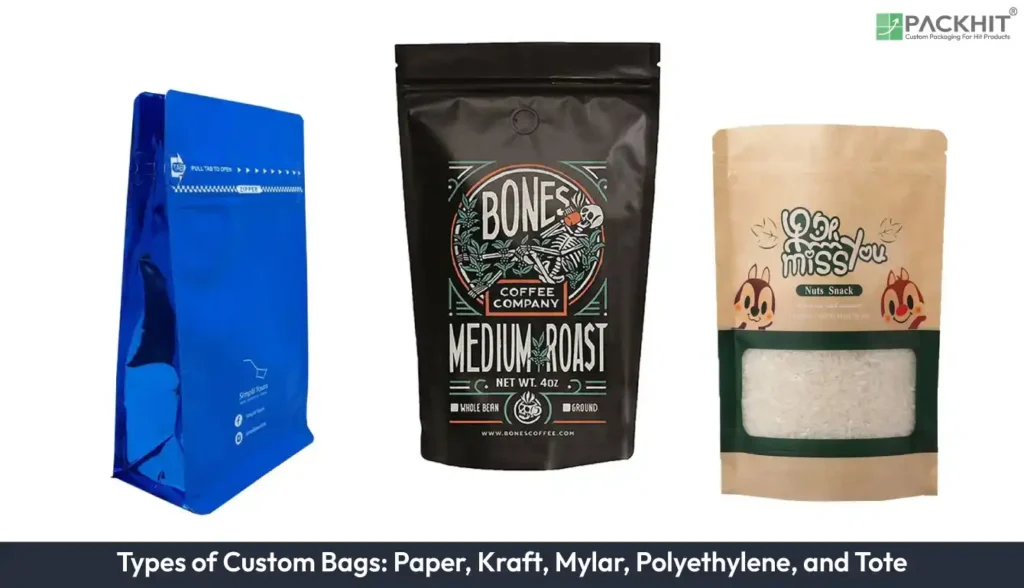
Custom bags provide businesses with packaging solutions that can be tailored to different products, branding requirements, and handling needs. They are available in materials such as paper, kraft paper, Mylar, polyethylene, and tote bags, with options for custom printing, handles, closures, and finishes. The choice of bag depends on factors such as product protection, durability, appearance, sustainability goals, and intended use.
The main types of custom bags include paper bags, kraft bags, Mylar bags, polyethylene bags, and tote bags. Each type differs in material, durability, appearance, and suitable applications.
Paper Bags
Custom paper bags are commonly used for retail, takeaway, gift, merchandise, and promotional packaging. They can use different paper grades and handle constructions, including rope handles, paper handles, and die-cut handles.
Paper bags are generally suited to dry products and applications where print appearance and fiber-based construction are important. Their practical limitations include reduced resistance to prolonged moisture exposure and potential tearing when overloaded or exposed to sharp product edges. Manufacturers should therefore match paper strength, bag dimensions, handle attachment, and bottom construction to the product weight and handling conditions.
Kraft Bags
Kraft bags are made from kraft paper and are valued for their sturdy fiber-based construction and natural appearance. They are commonly used for grocery, retail, takeaway, merchandise, and promotional packaging.
For kraft bags, useful selection attributes include paper strength, handle reinforcement, gusset construction, and resistance to tearing during carrying. Moisture can weaken untreated paper structures, so products exposed to wet conditions may require an appropriate inner layer or alternative bag material. Recycled or responsibly sourced kraft options can also be considered when fiber sourcing is part of the packaging specification.
Mylar Bags
Mylar bags use polyester-based film structures and can be combined with other layers to provide barrier protection against moisture, oxygen, light, and other environmental exposures. They are used for applications such as food, electronic components, and pharmaceutical packaging where protection requirements are more demanding.
The relevant technical considerations for mylar structures include film-layer construction, barrier requirements, puncture resistance, and seal integrity. A bag can have a suitable barrier film but still fail if the seal is damaged, contaminated, or improperly formed. Sharp products can also puncture flexible film structures. Manufacturers should therefore specify the required barrier function together with the sealing method and expected handling conditions. Kraft-layered mylar structures can combine a paper-based exterior with a barrier film interior when both presentation and product protection are required.
Polyethylene Bags
Polyethylene bags are plastic packaging formats used for general-purpose packaging, product containment, retail applications, and other applications requiring flexible film. They can be customized by size, film structure, printing, handles, and closure configuration.
Important practical attributes include film thickness or structure, tear resistance, puncture resistance, flexibility, and closure performance. Polyethylene bags may be unsuitable when a product requires a higher barrier against oxygen, light, or other environmental exposure unless the selected film structure provides that function. Manufacturers should also consider whether the bag will be exposed to sharp edges, heavy loads, repeated opening, or demanding transport conditions.
Tote Bags
Custom tote bags are reusable bags commonly produced from materials such as cotton or canvas. They are widely used for retail, grocery, apparel, promotional, and lifestyle applications.
For tote bags, important construction attributes include fabric weight, handle length, handle attachment, seam strength, bottom construction, and expected load. Reinforced handles and seams can reduce the risk of handle separation or seam failure during repeated carrying. Unlike single-use flexible packaging, tote bags should be evaluated according to expected reuse and washing or cleaning conditions where applicable.
- Functional Roles of Custom Bags in Business
- Common Failure Modes and Practical Constraints of Custom Bags
- Cost and Scalability Considerations of Custom Bags
- How do I Choose the Right Custom Bag Material?
- What Should Manufacturers Specify When Ordering Custom Bags?
- Which Custom Bags are Best for Moisture-Exposed Products?
- Add-Ons and Customization Options
Functional Roles of Custom Bags in Business
Custom bags can provide containment, carrying support, product protection, and branding. The appropriate function depends on the material and construction. Paper and kraft bags are often selected where print presentation, carrying convenience, and fiber-based construction are priorities. Mylar structures are more relevant when moisture, oxygen, or light protection is important. Polyethylene bags provide flexible containment and can be configured for different product sizes and closure requirements. Tote bags are better suited to repeated carrying and reusable promotional or retail applications.
Branding can include printed logos, colors, graphics, embossing, foil effects, or other finishing treatments. These options should be selected according to the surface material and required production process rather than treated as universally interchangeable across all bag types.
Common Failure Modes and Practical Constraints of Custom Bags
Manufacturers should consider how each bag could fail during filling, transport, storage, and use.
| Bag type | Potential failure mode | Practical consideration |
|---|---|---|
| Paper | Tearing, handle separation, moisture weakening | Match paper strength and handle reinforcement to product weight and handling |
| Kraft | Tear or bottom failure, moisture weakening | Consider gussets, bottom construction, reinforcement, and moisture exposure |
| Mylar | Puncture, seal failure, layer damage | Specify barrier structure, sealing method, and handling requirements |
| Polyethylene | Puncture, tearing, closure failure | Match film structure and closure to product weight and sharp edges |
| Tote | Handle or seam failure, fabric wear | Match fabric and reinforcement to expected load and number of uses |
These are practical selection considerations rather than universal failure limits. The appropriate specification depends on the product, bag construction, manufacturing process, and expected handling environment.
Cost and Scalability Considerations of Custom Bags
The cost of custom bags depends on material, dimensions, construction, printing, finishing, closures, tooling, order quantity, and shipping. Paper and kraft bags may require different handle, printing, and reinforcement processes. Mylar and polyethylene costs can vary with film structure, layer requirements, printing, sealing, and closure configuration. Tote-bag costs are affected by fabric type, fabric weight, stitching, handle construction, printing or embroidery, and reinforcement.
Larger production runs can reduce average unit cost by distributing setup and tooling costs across more units. Manufacturers should compare customization against expected order volume and determine which features are necessary for product protection rather than adding features that do not improve the intended packaging function.
How do I Choose the Right Custom Bag Material?
Start with the product and its handling conditions. Choose paper or kraft when fiber-based construction and printed presentation are priorities; consider Mylar when moisture, oxygen, or light protection is important; use polyethylene for flexible containment and general packaging requirements; and consider tote bags when repeated carrying and reuse are central requirements.
What Should Manufacturers Specify When Ordering Custom Bags?
Specify the material, bag dimensions, product weight, construction, handle or closure type, printing requirements, required protection, expected handling conditions, order quantity, and any sustainability requirements. For film structures, also specify the required barrier function and sealing method.
Which Custom Bags are Best for Moisture-Exposed Products?
The answer depends on the required level of protection. Mylar-based structures can be considered where stronger moisture and environmental barriers are required, while polyethylene can provide flexible moisture-resistant packaging depending on the selected film structure. Paper and kraft bags generally require additional consideration when prolonged moisture exposure is expected.
Add-Ons and Customization Options
Customization should be matched to the material and the intended use.
- Paper and kraft bags: Common options include rope or paper handles, die-cut handles, gussets, reinforced handle areas, custom printing, and selected surface finishes.
- Mylar bags: Useful options can include resealable zippers, heat-sealed closures, gussets, barrier-layer structures, high-barrier constructions, and selected printing or visual effects.
- Polyethylene bags: Customization can include printed graphics, different bag dimensions, gussets, handles, resealable closures, and film structures selected for the required containment and protection.
- Tote bags: Common options include reinforced handles, stitched seams, custom printing, embroidery, pockets, and different fabric constructions.
- Kraft-layered structures: These can combine a paper-based exterior with an internal film layer when appearance and barrier protection are both required.
Specialty features should not be added simply for appearance. For example, a resealable closure is useful when repeated opening is expected, while a barrier layer is more relevant when the product needs protection from moisture, oxygen, light, or other environmental exposure.