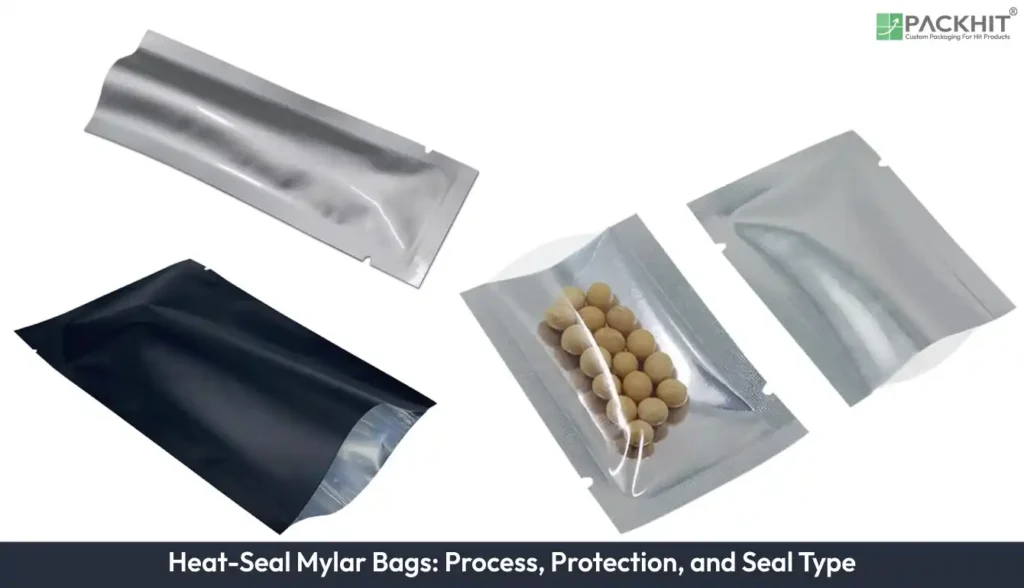
Heat-seal Mylar bags are versatile, laminated packaging solutions designed to combine durability, barrier protection, and efficient sealing mechanisms for industrial applications. They consist of multiple layers, including a PET outer layer for strength and graphics, an aluminum or metallized PET barrier layer for oxygen and moisture resistance, and a heat-seal inner layer for airtight closures. These bags protect contents from external contaminants, maintain freshness, and withstand mechanical stresses during handling and transport. Heat-sealing involves precise temperature, pressure, and dwell time to create strong bonds, supported by various equipment types such as impulse sealers or continuous band sealers.
Seal integrity testing ensures reliability, addressing issues like delamination or seal exclusion. Applications span industries like food, pharmaceuticals, electronics, and agriculture, where barrier properties and mechanical durability are critical. Additionally, advanced techniques like modified-atmosphere packaging, vacuum sealing, and desiccants extend shelf life for sensitive products. Proper storage conditions and adherence to regulatory standards ensure material stability and safety. Compared to alternatives, heat-seal Mylar bags offer better barrier performance, mechanical strength, and customization options.
- What are Heat-Seal Mylar Bags?
- How Does Heat Sealing Work for Mylar Bags?
- Step 1: Select a Heat-Sealable Mylar Structure
- Step 2: Place the Bag Between the Sealing Surfaces
- Step 3: Apply Heat to the Inner Sealant Layer
- Step 4: Maintain Pressure During Dwell Time
- Step 5: Cool the Joint Before Removing Pressure
- Step 6: Choose Equipment for the Production Rate
- Step 7: Inspect the Finished Heat Seal
- How Do Heat-Seal Mylar Bags Provide Mechanical Protection?
- Different Types of Seals Used in Heat-Seal Mylar Bags
- Three-Side Seal
- Four-Side Seal
- Center Seal or Fin Seal
- Lap Seal
- Gusseted Pouch Seal
- Heat-Sealed Tear Notch
- Resealable Zipper with a Heat Seal
- Tamper-Evident Heat Seal
- Best Sealing Equipment Options for Heat-Seal Mylar Bags
- Which Industries Use Heat-Seal Mylar Bags?
- What are the Recommended Storage Conditions for Heat-Seal Mylar Bags?
- How Do Regulatory Standards Impact Heat-Seal Mylar Bags Used for Food and Medical Products?
- Which Problems Cause Heat-Seal Mylar Bags to Fail?
- Comparison of Heat-Seal Mylar Bags with Alternative Flexible Packaging Options
- How Do Manufacturers Select a Seal Type to Heat-Seal Mylar Bags?
What are Heat-Seal Mylar Bags?
A heat-seal Mylar bag is a laminated flexible pouch whose layers protect contents and form a thermal seal. Its typical four-layer structure includes:
- Outer layer: Polyester (PET) adds tensile strength, gloss, and a printable surface.
- Barrier layer: Aluminum foil or vacuum-metallized PET limits oxygen and light penetration.
- Tie or adhesive layer: Maleic-anhydride-grafted polyolefins or acrylic adhesives bond the dissimilar films.
- Heat-seal layer: LDPE, LLDPE, EVA, or ionomer forms the welded seal during heat processing.
Layer thickness, barrier properties, and seal performance of heat-seal Mylar bags vary by bag construction, supplier, sealing method, and application. PET, aluminum foil, metallized PET, and heat-seal films can limit light, moisture, oxygen, abrasion, and contamination during handling and storage.
How Does Heat Sealing Work for Mylar Bags?
Heat sealing is a packaging process that bonds thermoplastic inner layers with controlled heat, pressure, dwell time, and cooling to create a closed, leak-resistant Mylar bag for protecting packaged products.
To heat seal a Mylar bag, follow the steps given below:
Step 1: Select a Heat-Sealable Mylar Structure
Heat sealing works when the bag contains a thermoplastic inner layer that softens under heat and bonds under pressure. Mylar, a polyester film commonly used as a structural and barrier layer, does not form a seal by itself. The bag construction also requires an inner sealant such as polyethylene or polypropylene.
Check the film specification before setting up the machine. Confirm the sealant material, total film thickness, seal width, and temperature range. A mismatch between the sealing equipment and the inner layer can produce weak, brittle, or uneven seals.
Step 2: Place the Bag Between the Sealing Surfaces
Position the open bag mouth between heated bars, jaws, or a continuous sealing belt. Keep the film flat and remove product, powder, liquid, or folded material from the seal area. Contamination or wrinkles create channels that reduce leak resistance.
Align the front and back layers before closing the sealer. A consistent overlap gives the sealant layers enough contact area to form a continuous bond across the bag width.
Step 3: Apply Heat to the Inner Sealant Layer
Heat passes through the outer film layers and softens the inner sealant surfaces. The set temperature must exceed the sealant layer’s softening or melting range while remaining below the temperature that damages the barrier film, printed layer, or bag structure.
Temperature settings vary with sealant type, film thickness, machine design, and production speed. A higher temperature does not automatically create a stronger seal. Excess heat can distort the film, burn the sealant, or narrow the usable seal window.
Step 4: Maintain Pressure During Dwell Time
Pressure presses the softened layers together and removes small gaps between them. Dwell time keeps the sealing surfaces closed long enough for heat to travel through the film and for the sealant layers to join.
- Temperature: Softens the inner sealant layer without damaging the bag structure.
- Pressure: Holds the layers in contact and reduces voids caused by wrinkles or trapped air.
- Dwell time: Allows heat transfer and polymer flow across the seal width.
Insufficient pressure or dwell time produces a narrow, discontinuous, or peelable seal. Excessive pressure can force molten sealant out of the joint and reduce the final seal thickness.
Step 5: Cool the Joint Before Removing Pressure
Keep the sealed area under pressure while the sealant cools and solidifies. Cooling fixes the polymer bond and limits movement between the film layers. Opening the jaws too soon can deform the joint or create a seal that appears closed but leaks under load.
Allow the seal to reach a stable temperature before folding, filling, or handling the bag. The required cooling period depends on film thickness, sealant composition, sealing temperature, and machine cycle time.
Step 6: Choose Equipment for the Production Rate
Select a sealer that matches the Mylar bag format, material thickness, and production volume. An impulse sealer heats the seal bars for a controlled pulse and fits short runs, samples, and manual packing. A continuous band sealer carries the bag through heated belts at a steady rate for repeated production. A rotary jaw sealer applies repeated heat and pressure with rotating jaws for automated or high-cycle packaging lines. Test the selected equipment with the actual bag material and filled product, then record the temperature, pressure, dwell time, cooling time, seal width, and test result for each production setup.
Step 7: Inspect the Finished Heat Seal
Inspect every setup change and sample the production seals at a defined frequency. Look for a continuous seal band, even width, clean edges, and freedom from wrinkles, burn marks, channels, and product contamination.
Use a peel test, burst test, or leak test that matches the package risk. A visually closed heat-seal Mylar bag is acceptable only when the joint also withstands the handling, storage, and transport conditions of the packaged product.
How Do Heat-Seal Mylar Bags Provide Mechanical Protection?
Heat-seal Mylar bags offer mechanical protection through their durable construction, particularly the PET outer layer and optional nylon (PA) reinforcement. These materials enhance tensile strength, puncture resistance, and abrasion resistance, ensuring safe handling and distribution.
PET Film Properties: PET exhibits high tensile strength, typically ranging between 50–100 MPa, and a Young’s modulus of 2–3 GPa. These properties make thinner PET suitable for lightweight applications and thicker PET ideal for heavy-duty transport. Nylon layers further improve impact and tear resistance, especially when packaging items with sharp or irregular shapes, such as jerky or dried produce.
Design Considerations: Increasing the total laminate thickness boosts puncture resistance and drop performance but also raises material costs, roll-stock weight, and sealing thermal mass. For high-abuse supply chains, thicker PET or a PET/PA/PE structure is recommended. Validation through ASTM puncture and tensile testing is essential to ensure performance reliability.
These design features make Heat-seal Mylar bags a dependable choice for products requiring robust protection throughout transportation and storage.
Different Types of Seals Used in Heat-Seal Mylar Bags
Heat-seal Mylar bags use five common seal geometries and three closure features. Each choice affects barrier continuity, pouch shape, filling speed, opening behavior, and compatibility with packaging equipment.
Three-Side Seal
A three-side seal joins the left, right, and bottom edges of a flat pouch, while the top edge remains open for filling and final sealing. This structure uses a simple pouch layout and fits lightweight products such as powders, samples, dry foods, and small components. The final top seal closes the package after filling.
Four-Side Seal
A four-side seal closes all four edges of the pouch and creates a flat, defined package perimeter. This geometry limits open edges that can admit oxygen, moisture, or contaminants. Manufacturers use it for medical products, pharmaceutical items, diagnostic materials, and other contents that require a controlled package barrier.
Center Seal or Fin Seal
A center seal, also called a fin seal, joins two film edges along the back or center of the pouch. The joined layers form an external fin that can be folded or left upright. Form-fill-seal equipment commonly makes this seal because the film forms around the product before longitudinal and transverse sealing.
Lap Seal
A lap seal overlaps one film edge over the other and bonds the layers across the overlap. The joint creates a flatter exterior than an exposed fin seal and can reduce the amount of folded material at the seam. Film construction and sealant-layer compatibility determine the bond strength.
Gusseted Pouch Seal
A gusseted pouch adds folded side or bottom panels to a sealed bag. These panels increase internal volume and let the package stand or accommodate products with irregular shapes, including coffee, pet food, hardware, and bulk dry goods. The gusset folds require consistent pressure and temperature across the seal area.
Heat-Sealed Tear Notch
A heat-sealed tear notch adds a small weakened point near the sealed edge for controlled opening. It keeps the package closed until the user tears the film and can leave visible evidence of opening. Single-use food packs, sample pouches, and small consumer products commonly use this feature.
Resealable Zipper with a Heat Seal
A resealable zipper combines a mechanical closure with heat-sealed pouch edges. The heat seals protect the perimeter during transport, while the zipper permits repeated opening and closing after the initial tear strip or header seal is removed. Coffee, pet food, snacks, and powders commonly use this arrangement.
Tamper-Evident Heat Seal
A tamper-evident heat seal shows visible damage or separation after someone opens the package. The feature can consist of a tear strip, a destructible seal layer, or a sealed header above a zipper. Medical products, sterile supplies, supplements, and regulated goods use tamper evidence to signal package interference.
Best Sealing Equipment Options for Heat-Seal Mylar Bags
Heat-seal Mylar bag equipment uses controlled heat and pressure to close the pouch opening, with machine selection based on production volume, pouch format, and seal-layer compatibility.
The best sealing equipment options for heat-seal Mylar bags are mentioned below:
- Impulse sealers: Apply heat in short cycles for bench-top, laboratory, and low-volume packaging.
- Continuous band sealers: Maintain a moving heated band for repeated seals in medium- and high-volume production.
- Rotary jaw sealers: Use rotating heated jaws for automated lines that seal formed pouches at high speed.
- Pouch fill-and-seal machines: Fill and close preformed or formed pouches within one automated packaging cycle.
Which Industries Use Heat-Seal Mylar Bags?
Heat-seal Mylar bags serve industries that require moisture, oxygen, light, puncture, or static protection during storage and transport. Multiple industries use heat-seal Mylar bags, such as food and beverage, pet food, or pharmaceuticals, which are explained below:
- Food and Beverage: Dry ingredients such as powdered milk, spices, grains, roasted coffee, and dried meals remain protected from moisture and oxygen, while coffee bags can include one-way valves for carbon dioxide release.
- Pet Food: Kibble, treats, and other animal foods retain flavor and aroma because the laminated film resists punctures from sharp product edges.
- Pharmaceuticals: Drug formulations, medical devices, and sterile components use heat-sealed pouches with validated seals and tamper-evident features.
- Electronics: Printed circuit boards, integrated circuits, and other moisture-sensitive devices use anti-static metallized bags with humidity-control requirements.
- Agriculture: Seeds, fertilizers, and other agricultural inputs remain protected from moisture and ultraviolet exposure, which helps preserve germination rates and chemical stability.
- Emergency Preparedness: Ration kits, dehydrated meals, and long-term storage goods use sealed bags to limit oxygen and moisture exposure during extended storage.
- Industrial Components: Metal parts, powdered materials, and precision items use heat-seal bags when barrier protection and resistance to handling damage are required.
What are the Recommended Storage Conditions for Heat-Seal Mylar Bags?
Store heat-seal Mylar bags in a clean, dry area because temperature, humidity, and light affect laminate stability and seal strength. A moderate, controlled temperature and low relative humidity suit many laminates, although the supplier’s specification, laminate construction, and packaged product can require different limits. Keep finished bags and roll-stock away from direct UV light and heat sources; prolonged exposure to elevated temperatures can affect inks, polymers, or adhesives depending on the structure. Inspect older material with a trial seal and use first-in, first-out inventory rotation to limit changes in adhesive tack and sealant crystallinity.
How Do Regulatory Standards Impact Heat-Seal Mylar Bags Used for Food and Medical Products?
Heat-Seal Mylar bags for food and medical products require close compliance with regulatory standards covering safety, material contact, and intended use.
Material Compliance: Food-contact laminates must follow applicable requirements, including FDA guidelines in the United States. Suppliers should provide migration-test records and declarations of compliance for PET, PE, and adhesive layers.
Traceability and Documentation: Manufacturers should retain batch records and material traceability, particularly for pharmaceutical and medical packaging. These records connect each finished bag to its approved films, adhesives, inks, and production controls.
Printing and Coating Considerations: Food-grade inks and coatings reduce contamination or migration risks near the seal area. Medical packaging may also require validated cleaning or sterilization processes, such as ethylene oxide or gamma irradiation.
Note: Applicable food and medical-packaging requirements vary by jurisdiction, product, product material, intended use, and supplier specification. Manufacturers may verify the current requirements and documentation with the relevant supplier and qualified regulatory professional before production.
Which Problems Cause Heat-Seal Mylar Bags to Fail?
Heat-seal Mylar bags commonly fail because of incomplete fusion, contamination, excessive heat, insufficient heat, uneven pressure, or incorrect dwell time. These conditions produce open seams, weak seals, channels, wrinkles, and pinholes that reduce package protection.
- Contamination: Product dust, oil, moisture, or film residue inside the seal area prevents the inner layers from bonding.
- Insufficient heat: A temperature below the film’s sealing range leaves the seam partially bonded and easy to peel.
- Excessive heat: A temperature above the sealing range can shrink, deform, or burn the sealant layer.
- Short dwell time: Limited contact time prevents heat from passing evenly through the bag layers.
- Uneven pressure: Misaligned jaws or irregular pressure create unsealed channels across the seam.
- Wrinkled film: Folds in the sealing area interrupt contact and create leak paths.
- Weak material structure: An unsuitable laminate, damaged film, or narrow seal width reduces seam strength.
Inspect the seal width, jaw alignment, temperature, pressure, and dwell time during production. Test filled bags rather than empty film alone, because product weight and particles can change the seam result. A consistent seal requires a clean sealing surface and process settings matched to the Mylar bag construction.
Comparison of Heat-Seal Mylar Bags with Alternative Flexible Packaging Options
Heat-seal Mylar bags distinguish themselves from other flexible packaging solutions through their multi-layer construction, superior barrier properties, and adaptability across diverse applications. While alternatives like polyethylene (PE) pouches, polypropylene (PP) bags, and co-extruded laminates offer varying benefits, heat-seal Mylar bags excel in specific areas that are critical for demanding industries.
Barrier Properties: Heat-seal Mylar bags can limit oxygen, moisture vapor, and light transmission more effectively than single-material PE or PP pouches when their structure includes aluminum foil or metallized PET. Barrier performance depends on foil continuity, metallized coating, seal integrity, and test conditions. Use measured OTR and WVTR data for products such as emergency rations, coffee, and pharmaceuticals.
Mechanical Attributes: A heat-seal Mylar bag gains tensile strength and puncture resistance from its PET, foil, or nylon layers, although the exact result depends on laminate thickness and construction. Compared with single-material PE or PP pouches, the laminate can better protect dried fruit, powders, and electronics from abrasion or sharp edges. Foil structures require careful handling because folds or pinholes can reduce barrier performance.
Sealing Performance: The inner heat-seal layer forms the closure after controlled heat, pressure, and dwell time. A properly sealed Mylar bag can retain vacuum or modified atmosphere contents more reliably than a zip closure, while seal strength still depends on temperature, jaw pressure, contamination, and seal width. Validate the seal using the intended pouch structure and test conditions.
Customization and Aesthetic Appeal: The outer PET layer accepts detailed printing, while foil or metallized PET changes opacity, reflectivity, and light protection. Compared with unprinted single-material PE or PP pouches, a printed laminate can carry batch codes, handling instructions, and brand graphics with greater surface control. Select the outer web after confirming ink adhesion, scuff resistance, and sealing compatibility.
Cost Considerations: Heat-seal Mylar bags generally cost more than single-material PE or PP pouches because they combine multiple films and may include foil or metallized PET. The added material cost can support longer shelf life, lower product loss, and stronger protection for high-value goods. Compare total package cost after testing barrier targets, seal strength, puncture resistance, and required storage duration.
Sustainability: Foil and metallized PET laminates are harder to recycle than mono-material PE or PP pouches because their bonded layers require separation or specialized processing. Mono-material structures can simplify recycling where collection systems accept them, but they may provide lower barrier protection. Choose the lightest structure that meets the product’s oxygen, moisture, light, and seal requirements, then confirm local recovery options.
How Do Manufacturers Select a Seal Type to Heat-Seal Mylar Bags?
Manufacturers select the seal type by matching the package barrier, product geometry, opening method, and filling equipment.
- Barrier performance: Use a continuous perimeter seal if the product requires protection from oxygen, moisture, light, dust, or external contaminants. The sealant layer must bond across the intended temperature range without channels or unsealed areas.
- Product geometry: Select a flat pouch for thin or lightweight contents, or use gussets if the product has greater volume or an irregular shape.
- Opening method: Add a tear notch for single-use access, or combine a zipper with a heat seal if the package requires repeated opening.
- Tamper evidence: Specify a destructible seal, tear strip, or sealed header if the user must identify package opening.
- Equipment compatibility: Match the pouch geometry with form-fill-seal machinery, continuous band sealers, impulse sealers, or pre-made pouch fillers. Jaw width, dwell time, pressure, and seal temperature affect the finished joint.
- Material compatibility: Confirm that the inner sealant layer bonds to itself under the selected process conditions. Mylar commonly describes a polyester film layer, while the heat-sealing surface may use polyethylene, polypropylene, or another sealant resin.
The correct seal type preserves the Mylar bag’s barrier across the closed perimeter while giving the production line and end user the required handling characteristics.
