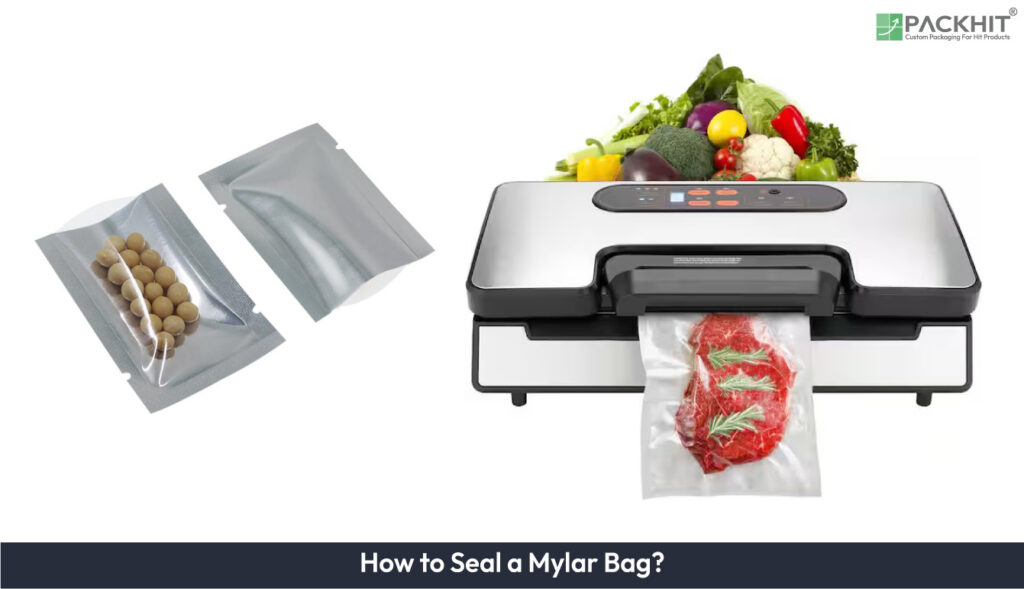
Seal a Mylar bag by selecting an appropriate sealing method. Then remove bulk air, place correctly sized oxygen absorbers or desiccants, make a validated primary weld with a redundant parallel seam, allow the seam to cool, and verify hermeticity with leak and O2 tests. Four primary methods exist: impulse/bar heat sealing (batch), chamber vacuum sealing with optional nitrogen flush, continuous/band sealing (high throughput), and household irons or hair straighteners (low volume). Follow a nine‑step sequence: verify pouch integrity; condition product moisture; add scavengers; leave 25–50 mm headspace for bar sealing or minimize headspace for chamber vacuum; expel gross air by rolling or vacuum; perform primary seal with validated dwell time, temperature and pressure; add a secondary seam 3–10 mm from the primary; cool 5–30 seconds before handling; and label and place pouches into rigid secondary containers. Validate seals using visual inspection, bubble (submersion) tests, destructive punch/peel checks, headspace O2 measurement (target <1% for sensitive loads), and pressure‑decay testing, and record calibration and lot data. Diagnose failures by adjusting heat/time/pressure, cleaning or replacing sealing elements, removing particulates, or discarding defective pouches; cut out and re‑seal failed seams with validated parameters and re‑test. For long‑term storage, pack sealed pouches with appropriately sized absorbers and desiccants into gasketed metal or heavy‑duty plastic containers, store at <25°C and <50% RH, and verify residual O2 and container integrity periodically.
- What Methods are Used to Seal a Mylar Bag?
- What is the Process of Sealing a Mylar Bag?
- 1. Verify materials
- 2. Condition the contents
- 3. Place oxygen absorber and desiccant
- 4. Allow headspace
- 5. Remove gross air
- 6. Perform the primary seal
- 7. Create a secondary (safety) seam
- 8. Cool and inspect
- 9. Label, then add secondary protection
- How is Leak Testing and Quality Control Performed?
- What Causes Common Seal Failures and How are They Corrected?
- How to Store Mylar Bags Long-Term with Oxygen Absorbers, Desiccants, and Secondary Protection?
What Methods are Used to Seal a Mylar Bag?
Four primary methods seal Mylar bags: impulse or bar heat sealing, chamber vacuum sealing with optional nitrogen flush, continuous or band sealing for higher throughput, and household irons or hair straighteners for low-volume work.
Choose based on the manufacturing constraint. Use chamber vacuum when minimal headspace and low residual oxygen matter for oxygen-sensitive products. Use continuous or band sealing when repeatable cycle time and high-volume consistency matter. Use irons or hair straighteners only as a contingency for small runs, because operator control of temperature and dwell time affects weld completeness.
Heat sealing (impulse or bar): Impulse sealers use a resistive element to generate a short heat pulse through a Teflon-coated sealing bar. The bar melts the inner sealant layer to form the seam, while the Teflon prevents the pouch from sticking to the tool. Use this method for batch sealing of filled pouches and for small-volume shop work because the dwell window stays short and controlled. Set dwell time in seconds, bar pressure, and cooling time. These settings change with the inner layer chemistry and total pouch gauge. Use a bar length equal to or slightly longer than the pouch width so the weld spans edge-to-edge without gaps.
Vacuum-chamber sealing: Chamber vacuum machines remove air from the entire pouch, collapse the headspace, and then apply heat to create the seam while the chamber remains under vacuum. This reduces trapped air and avoids mechanical compaction that can damage fragile goods. For moisture-sensitive or oxygen-sensitive loads, chamber vacuum combined with an oxygen absorber or an inert gas flush targets the starting oxygen level inside the headspace and within interstitial spaces of granular products. Add nitrogen flush when you expect high initial headspace oxygen and the package design depends on predictable absorber performance. For routine loads with effective absorbers, relying on vacuum plus absorber scavenging often provides sufficient control. Validate residual oxygen after sealing by measuring headspace oxygen or by running a production sampling test on sealed units.
Continuous / band sealing: Band or continuous heat sealers support mid- to high-throughput operations. A heated band contacts the seal area while the pouch advances on a conveyor. Weld quality depends on temperature at the band, belt or conveyor speed, and the timing and pressure of cooling rollers. Select this method when cycle time and repeatability drive throughput, and when you need integrated date or batch coding near the weld zone. Maintain stable process control because temperature drift changes seal strength, and belt pressure drift changes weld width.
Household alternatives (irons, hair straighteners): Domestic irons and hair straighteners can produce an acceptable seal for low-volume work if the operator prevents steam release and avoids scorching. Place a cloth or Teflon release sheet between the metal and the pouch, select a dry setting with a higher temperature range, and apply even pressure for several seconds. Test on scrap to confirm the weld holds and that the inner sealant melts without damaging the outer film. This method is a contingency approach. Results depend on operator temperature control and dwell time, and the risk of localized overheating or incomplete welds increases when testing is skipped.
What is the Process of Sealing a Mylar Bag?
Sealing a Mylar bag follows a controlled, testable sequence: verify the pouch and inner sealant, condition the product and target headspace, place scavengers sized to the load, remove bulk air, run a validated primary seal, add a redundant secondary seam, cool without disturbance, confirm hermeticity with leak tests, and pack the pouch in secondary protection.
1. Verify materials
Confirm the pouch laminate and the inner sealant chemistry where the supplier provides it. For example PET/foil/thermoplastic structures with a heat-sealable inner layer. Inspect each pouch for pinholes, delamination, wrinkles, edge separation, or foreign particles. Accept only pouches with intact, edge-to-edge lamination and no visible perforations. If defects exist, record the lot code and supplier, then quarantine the lot for supplier review.
2. Condition the contents
Dry and prepare the product to the moisture target stated in the product specification before packaging. Remove sharp fragments and oversized particulates that can puncture the film or create stress points. Portion product to leave planned headspace. For granular loads, level the fill surface to reduce point loading under the sealer jaw. For fragile items, add a cushioning layer or use a chamber vacuum that limits compression during evacuation.
3. Place oxygen absorber and desiccant
Add oxygen scavengers sized to the estimated headspace and residual oxygen in the load immediately before sealing. Keep absorbers sealed until placement to prevent premature activity. If direct product contact is restricted by your process, enclose absorbers or desiccants in a small polyethylene pouch inside the Mylar. If shelf life depends on oxygen control, size absorbers using absorber capacity rules (for example, ~300 cc as a starting point for a 1-gallon pouch) and confirm with headspace O2 measurements on representative packed samples.
4. Allow headspace
Keep a controlled headspace so the absorber functions and the seal stays consistent. Leave 25–50 mm (1–2 in) above the fill level for standard impulse or bar sealing. If using a chamber vacuum, reduce headspace to the minimum allowed by the machine for stable evacuation and to avoid pouch inversion during evacuation.
5. Remove gross air
Expel bulk air before making the primary seal so trapped oxygen and internal movement remain low. Roll the pouch from the bottom toward the mouth to collapse pockets, if the product tolerates mild compression. Use a short-straw manual express method when appropriate. If the product is fragile, porous, or oxygen-sensitive, use a chamber vacuum or a vacuum canister designed for film pouches rather than external clamp-style pumps.
6. Perform the primary seal
Apply a validated primary weld across the full pouch width using parameters matched to pouch gauge and the inner sealant. Confirm settings on scrap material, including dwell time, jaw pressure, seal width, and cooling delay. For chamber systems, apply heat under vacuum. Acceptance criteria require a continuous uniform weld, consistent embossing across the seam, no burn marks, and no visible melt-through.
7. Create a secondary (safety) seam
Add a redundant, parallel weld to protect against microchannels and handling damage. Place the second seam 3–10 mm from the primary seam. If spacing allows, position the secondary seam outside the primary band to preserve a margin for readable labeling. Verify redundancy by performing a bubble test between seams on sample pouches before releasing the lot.
8. Cool and inspect
Cool the sealed pouch undisturbed before mechanical stress or testing. Wait 5–30 seconds depending on pouch gauge and seal parameters before flexing or moving the pouch. Inspect each seal for wrinkles, voids, discoloration, and embossing irregularities. Run a bubble (submersion) test or manual compression test for leak screening. For production verification, perform a peel or punch destructive test on samples to confirm fusion-zone integrity.
9. Label, then add secondary protection
Mark each pouch with product name, lot number, and pack date. Place sealed pouches into rigid secondary containers that resist puncture and light exposure, such as a gasketed metal pail, heavy-duty plastic pail, or lined carton. Close secondary containers using the manufacturer’s torque or latch specification. Store in a cool, dark, low-humidity area to minimize barrier degradation and pest risk.
Harm-prevention boundary: If any pouch fails leak testing or headspace O2 targets for oxygen-sensitive storage, quarantine the affected lot. Do not use the pouches for oxygen-sensitive storage until parameters and sealing equipment receive corrective action and verification retesting confirms hermeticity.
How is Leak Testing and Quality Control Performed?
Leak testing combines non-destructive screening with destructive seam verification so process drift does not pass unnoticed. Perform visual inspection, bubble (submersion) tests, destructive seam punch or peel tests, headspace O2 measurement, and pressure-decay checks. Log results for traceability and start with non-destructive checks, then verify with destructive tests on samples. Keep calibration records and test logs to detect drift, and validate every sealer setup using both types of checks.
- Visual and tactile inspection: Look for a continuous weld bead, uniform embossing, and no wrinkles or burn marks. Use a fingernail trace along the seam to detect delamination. Example: confirm edge-to-edge melt and a smooth seal profile across the full width.
- Bubble (submersion) test: Submerge the sealed pouch in water and compress gently. Watch for continuous or fine bubble streams that indicate leaks. Use this as a quick non-destructive screening step.
- Punch/peel test (destructive): Cut a sacrificial seam sample and inspect the fusion zone. A full weld shows integrated polymers across the seal width with no layer separation. Record bond width and failure mode.
- Headspace oxygen measurement (instrument): Measure residual O2 with an oxygen analyzer for critical loads. Common operational targets are under 1% O2 for sensitive products. Record instrument ID, reading, and sample ID.
- Pressure hold/vacuum decay (industrial): Apply calibrated pressure or vacuum and monitor decay rate over a defined interval. Use this for statistical process control and lot acceptance testing. Record setpoint, decay curve, and pass or fail result.
Numeric target limitation: Oxygen and timing targets act as operational starting points. Results depend on laminate structure, inner-seal chemistry, pouch gauge, product matrix, and absorber performance. Validate parameters for each critical product family and lot using the stated leak and headspace checks.
Verification cadence: Perform routine seal-parameter checks at each lot change and after equipment maintenance. Inspect at least monthly or per lot for sealing elements and container integrity, and run additional verification if pack weight, formulation, or headspace plan changes.
What Causes Common Seal Failures and How are They Corrected?
Most seal failures come from four causes: insufficient heat or pressure, excessive heat, contamination or particulates, and poor laminate adhesion. Correct by adjusting dwell time or jaw pressure, lowering temperature, cleaning or replacing sealing elements, or discarding defective pouches. Identify the symptom first, then apply the corrective action in the table below.
| Symptom | Probable cause | Corrective action |
| Incomplete / cold seam | Insufficient dwell time or pressure; dirty or worn wire | Increase dwell time in small steps; raise jaw pressure; clean or replace the sealing element; test on scrap material. |
| Burnt or discolored seam | Excessive heat or dwell; overheating outer PET/foil | Lower temperature or shorten dwell; lengthen cooling interval; inspect for adhesive charring and remove affected pouches. |
| Wrinkled seam or puckering | Uneven pressure or too-high temperature | Reduce jaw pressure; slow feed speed on band sealers; smooth the pouch before sealing; realign bars if needed. |
| Pinhole leaks | Contamination, particulates, or tool damage | Clean product and seal area; remove sharp particles; inspect and repair tools; run a bubble test and re-seal if required. |
How to Store Mylar Bags Long-Term with Oxygen Absorbers, Desiccants, and Secondary Protection?
Store sealed Mylar pouches with correctly sized oxygen absorbers and desiccants inside rigid secondary containers. Keep containers closed, cool, dark, and at low relative humidity.
Use a repeatable packing sequence and record verification data for traceability. Validate residual O2 on representative samples after packing.
- Absorber sizing: Common sizes: 100 cc, 300 cc, 1,000 cc. Use ~300 cc for a 1-gallon pouch of dry grains. Use 1,000 cc or multiples for 5-gallon pails. Increase capacity for oily seeds and highly porous products.
- Desiccant selection: Packet sizes: 2 g, 5 g, 10 g, 25 g. Choose silica gel for higher water uptake or molecular-sieve/clay where appropriate. Place desiccants inside the pouch or inside the secondary container according to product contact rules.
- Placement and containment: Place absorbers and desiccants immediately before sealing to avoid premature activation. If direct product contact is restricted, enclose scavengers in small polyethylene sachets inside the Mylar.
- Air management: Remove bulk air by rolling the pouch toward the mouth or by using a chamber vacuum. Use nitrogen flush to displace bulk O2 before sealing, then rely on absorbers for residual oxygen in porous matrices.
- Sealing procedure: Seal with validated parameters matched to laminate and gauge. Add a redundant parallel seam 3–10 mm from the primary weld. Allow 5–30 seconds of undisturbed cooling before handling. Inspect each seal visually and with a bubble test.
- Secondary containers: Examples: metal pail with gasketed lid, heavy-duty plastic pail, lined carton. Place sealed pouches into rigid containers to protect against puncture, rodents, and light. Tighten lids to manufacturer torque or latch settings.
- Storage environment: Target temperature <25°C and relative humidity <50% RH. Avoid direct sunlight, heated rooms, and attics where temperature and RH cycle widely.
- Verification & monitoring: Measure headspace O2 on representative samples; target <1% O2 for oxygen-sensitive loads. Record instrument ID, reading, sample ID, and date. Inspect seals and container integrity periodically (monthly or per lot).
- Shelf-life expectations: Multi-year storage is possible when seals remain hermetic, absorbers have sufficient capacity, and pouches are protected from puncture and light. Validate shelf life with real-time or accelerated testing for critical products.
- Cautions: Do not use damaged pouches. Replace absorbers exposed to air. Do not patch oxygen-sensitive packages with adhesive tape; cut out failed seams and re-seal with validated parameters.
How Long Should a Seal Cool Before Testing?
Allow a freshly made seal to cool undisturbed for 5–30 seconds, depending on pouch gauge. Start leak testing only after the seam reaches near-ambient temperature. Warm polymer can give false positives because it stays flexible and has not crystallized. For thin pouches (3 mil) use the lower end. For thicker pouches (5–7 mil) allow longer cooling before flex or submersion tests.
Can I Vacuum‑seal Mylar Bags with a Standard External Vacuum Sealer?
A chamber vacuum sealer produces the most reliable results. External (in-line) vacuum machines pull air through the bag mouth and often crush granular goods. They also fail to remove interstitial air from porous loads. If you only have an external sealer, place the pouch inside a rigid canister or use a heat-resistant, low-fill pouch and perform a quick external vacuum prior to sealing. Always validate residual O2 for critical loads.
How Many Oxygen Absorbers do I Need for a 1‑gallon Bag?
Start with one 300 cc absorber for a typical 1‑gallon (3.8 L) pouch of dry goods. Increase absorber capacity for oily seeds or highly porous materials. Absorber sizes include 100 cc, 300 cc, and 1,000 cc as common examples. Validate your choice with headspace O2 measurements when shelf life is critical.
What Gauge is Sufficient to Resist Punctures and Rodents?
Use thicker laminates (5–7 mil) for greater puncture resistance; no flexible pouch is rodent‑proof. Thin pouches (around 3 mil) tear more easily. Combine a thicker Mylar pouch with a rigid metal or heavy‑duty plastic secondary container to reduce puncture and gnawing risk. Test puncture resistance on representative samples when protection matters.
How do I Repair a Failed or Leaky Seal?
Cut the compromised seam off, leaving at least 10–15 mm of intact material, clean the cut edge, and re‑seal with the validated parameter set. Do not patch oxygen‑sensitive packages with adhesive tape. After re‑sealing, run a bubble (submersion) test or headspace O2 check to confirm hermeticity. Record the repair action and re-check a sample from the lot.