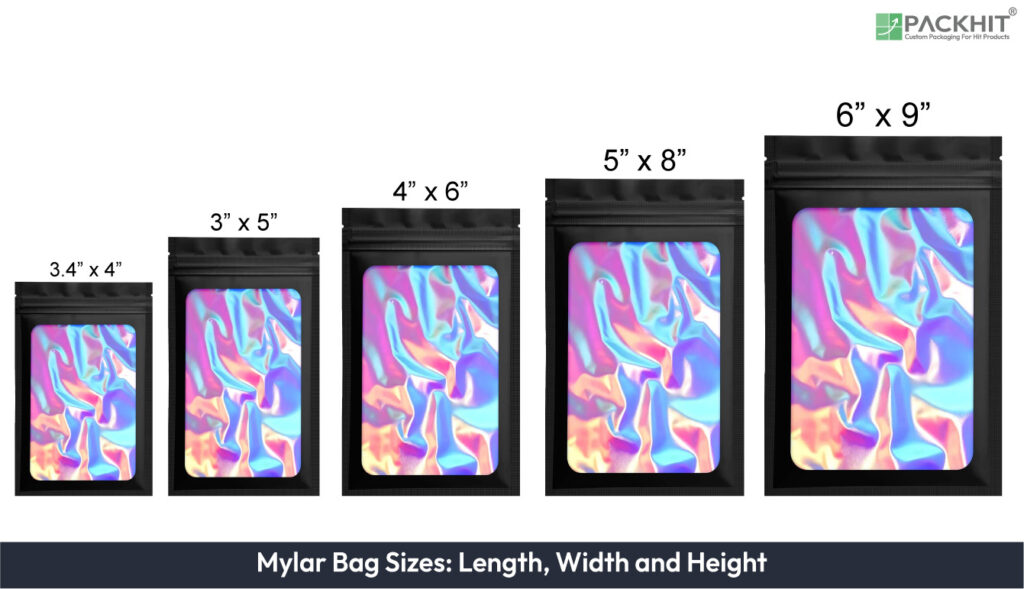
Mylar bags come in various sizes defined by their length, width, and height, which are essential for determining their suitability for different packaging needs. Standard Mylar bag dimensions include length (longer side), width (shorter side), and height (gusset, for expandable depth). Common sizes range from small 4″ x 6″ pouches to large 20″ x 30″ storage bags, accommodating everything from spices to bulkier items like grains or industrial materials. Selecting the appropriate size ensures optimal use of space, product protection, and ease of storage or transportation. Customization allows manufacturers to tailor Mylar bags for specific product dimensions, storage conditions, and branding requirements. Dimensional tolerances and manufacturing constraints are considered to ensure consistency and functionality. Properly chosen Mylar bag sizes improve storage efficiency, reduce waste, and support product presentation in retail and industrial settings.
- Standard Dimensions of Mylar Bags
- How are Mylar Bag Sizes Determined for Specific Applications?
- What Factors Influence the Customization of Mylar Bag Sizes?
- Dimensional Tolerances and Manufacturing Constraints
- Product-Specific Considerations
- Branding and Labeling Requirements
- Storage and Transportation Efficiency
- Cost Implications of Customization
- How Do Mylar Bag Sizes Affect Storage and Transportation?
- How to Choose the Right Mylar Bag Size (Decision Criteria)?
Standard Dimensions of Mylar Bags
Mylar bags use three main dimensions: length, width, and height (gusset). Sizes are stated in inches or millimeters, depending on the supplier’s size chart. Length refers to the longer side of the flat bag, width refers to the shorter side, and height describes the bag depth when expanded.
Common size examples include 4″ x 6″ pouches for small items and 20″ x 30″ storage bags for bulk packaging. Bag dimensions vary by manufacturer and by the product’s fill level, so dimension selection focuses on the packed product footprint and the required headspace for a reliable seal.
Length and Width
Measure length and width with the bag laid flat. These two dimensions determine the bag’s surface area for labeling and the flat sealing area for airtight closure. Use length and width together when calculating whether the packaged product fits without excessive compression, shifting, or air pockets.
Illustrative examples include a 10″ x 14″ bag for medium-size dry goods and a 6″ x 9″ bag for compact contents such as spices or seeds. Larger flat dimensions also increase the sealing contact length, so sealing performance depends on the heat-seal settings and the bag’s seal finish.
Height (Gusset)
Height, often called the gusset, defines the depth of the bag when it expands. This dimension matters for stand-up storage because it sets the usable fill volume and influences how the product stands vertically on the shelf or in a container stack. Height also affects package stiffness around the filled corners.
Illustrative gusseted examples include a 12″ x 16″ x 4″ configuration, where the 4-inch gusset adds depth for higher-fill items such as coffee beans or pet food. Gusset height also changes the bag’s filled height tolerance, which impacts label placement and whether secondary packaging fits over the filled bag.
Mylar bags are available in a wide range of sizes to accommodate products from small samples to large-volume storage. Dimensions are expressed as length × width. Gusseted bags add a third measurement that represents gusset height, which sets the bag’s usable depth.
The table below lists common reference sizes and typical uses. Use each reference as a starting point: match the length and width to the packed product footprint, then set gusset height based on the fill depth you need plus headspace for your filling and heat-seal method. Capacity changes with product density and fill level, and sealing requirements affect the final usable volume.
| Mylar Bag Size | Length | Width | Gusset/Height | Example Application |
|---|---|---|---|---|
| 4″ × 6″ | 6″ | 4″ | – | Spices, seeds, samples, and small accessories |
| 6″ × 9″ | 9″ | 6″ | – | Coffee, spices, dried foods, and small parts |
| 8″ × 12″ | 12″ | 8″ | – | Snacks, grains, dried foods, and pet treats |
| 10″ × 14″ | 14″ | 10″ | – | Medium-size dry goods, grains, and food products |
| 12″ × 16″ × 4″ | 16″ | 12″ | 4″ | Coffee beans, pet food, and higher-volume products |
| 14″ × 20″ × 4″ | 20″ | 14″ | 4″ | Bulk food products and larger storage applications |
| 20″ × 30″ | 30″ | 20″ | – | Bulk packaging, large dry goods, and long-term storage |
If a size is referenced by a “gallon style,” treat it as a label-level reference rather than a direct height spec. For example, a “1-gallon style” bag is often listed around 10″ × 14″, and a “5-gallon style” bag is often listed around 18″ × 28″. These dimensions describe the typical footprint, so map them to your packed product: set the bag’s length and width to the product’s measured footprint at fill, then derive gusset height from the required fill depth and the headspace needed for consistent sealing.
Custom sizing lists dimensional tolerances, typically within a range of ±1–2 mm. In practice, this affects three checkpoints: first, measurement margin between the product and the bag opening; second, label placement clearance if the label prints near the seal zone; third, seal-area consistency when bags from different production batches vary slightly in size. Add a small buffer in your product measurement so the bag still seals consistently when batch dimensions stay within that tolerance range.
When choosing a Mylar bag size, measure the product’s length, width, and depth and compare them to the bag’s length × width and gusset/height. Leave additional space for comfortable filling and for the heat-seal zone, not only for storage comfort. Products with greater volume, layered fills, or irregular shapes frequently need a gusseted design to maintain usable capacity.
The appropriate Mylar bag size depends on the product’s density, fill volume, required headspace, and sealing method. If storage clearance is tight, prioritize a bag footprint that fits first, then adjust height (gusset) only up to what your sealing setup can handle; excessive fill with insufficient headspace reduces seal reliability even when the footprint matches.
Using manufacturer capacity guidance together with your packed dimensions helps secure a repeatable fit and a reliable closure, especially for US manufacturing runs where label position and seal settings are consistent line-to-line.
How are Mylar Bag Sizes Determined for Specific Applications?
Mylar bag sizes follow three linked drivers: product footprint (length and width), fill depth (height or gusset), and sealing limits from the packaging method. Manufacturers set bag length and width to match the storage footprint, then set height to reach the target fill volume with controlled headspace for the seal.
Volume and Capacity Considerations
Internal capacity depends on length, width, and height. A “1-gallon style” bag is often listed around 10″ x 14,” and a “5-gallon style” bag is often listed around 18″ x 28″. These numbers describe typical references. Usable volume changes with gusset geometry, fill level, and the headspace left for sealing.
Capacity choices also control how the bag behaves during storage. Taller bags (more gusset height) increase volume without expanding the floor footprint. Bulk programs often select higher height to reduce the number of units per pallet lane while keeping shelf or pallet layer limits.
Product-Specific Requirements
Some categories require tighter dimensional consistency. Pharmaceutical packs often use smaller pouches with controlled length and width to support dosing schedules and reduce variation across filling runs. Agricultural items such as seeds and fertilizers often use larger gusseted bags to support higher fill volumes while maintaining shape during distribution.
For specialized applications, manufacturers tailor Mylar dimensions (length, width, and gusset/height) to match product footprint and target fill depth while preserving headspace for sealing.
What Factors Influence the Customization of Mylar Bag Sizes?
Customization of Mylar bag sizes depends on the required Length, Width, and Height ranges, plus how the film is formed and sealed for the filling line and storage conditions. The factors that influence mylar bag size customization are given below:
Dimensional Tolerances and Manufacturing Constraints
Customized Mylar bags account for dimensional tolerances, typically within a range of ±1-2 mm. These tolerances help keep batches consistent even when minor material or process variations occur. Larger bags require stronger constructions, such as wider seal zones or additional gusset depth, to hold shape under load.
The feasible size range also depends on equipment limits. Film handling constrains maximum web width, and the sealer constrains workable bag length and seal pattern repeatability on the production run.
Product-Specific Considerations
Different products impose distinct dimensional requirements. Pharmaceutical pouches often need dimensions matched to dose count and a defined headspace volume. Extra empty volume increases air exposure, which changes how the contents behave over shelf time.
Agricultural products such as seeds or fertilizers typically use larger gusseted bags to hold higher fill volumes. Gusset height supports resistance to bulging during vibration and stacking in distribution. Length, width, and gusset depth then align with the product’s physical form, fill weight, and the handling method used in receiving and storage.
Branding and Labeling Requirements
Bag dimensions control where label surfaces land on curved film. Larger bags provide more usable panel length and height for printed graphics, batch codes, and barcodes. The label can sit on a flatter region of the front panel, so label placement can follow a consistent height reference across batches.
Smaller bags concentrate branding into less panel area. Print placement often shifts toward a narrow label zone near the seal line, where the surface is more stable. Choosing Length, Width, and Height therefore balances readable print area with the storage footprint for the retail shelf or warehouse bin.
Storage and Transportation Efficiency
Customized dimensions also affect logistics. Bag length and width determine how units fit shelving systems, bin sizes, and pallet layer patterns. Precise Height supports tighter stacking height control, which reduces slide and shifting risks when multiple bags stack within the same layer.
For palletized transport, uniform dimensions help keep load geometry consistent even when product weight varies by lot. Consistent gusset depth supports a stable vertical profile, which reduces corner collapse when stretch-wrap tension and corner protection are applied.
Cost Implications of Customization
Customized Mylar bags can add cost through specialized production steps or material choices. Unique dimensions may increase changeover time for cutting and sealing setups. If the gusset geometry changes with height, manufacturers also revise seal width and forming parameters to preserve a uniform seal.
Manufacturers balance setup and material costs against measurable outcomes. These outcomes include reduced wasted space in cartons, improved stacking stability, and fewer void adjustments during warehouse handling. Repeating the same custom size on bulk or scheduled runs spreads changeover time across larger production volumes.
How Do Mylar Bag Sizes Affect Storage and Transportation?
Mylar bag dimensions shape storage efficiency and transport logistics by changing how bags stack, occupy bin volume, and align to pallet patterns. Smaller bags stack with less height per unit, which fits compact shelves and retail cases. Larger bags increase capacity, but they require tighter control of bag stability during palletization to prevent deformation and seal stress.
Stacking and Palletization
Stacking and palletization depend on uniformity across Length, Width, and Height. Bags with consistent dimensions form predictable layers, which reduces shift risk during transit. For bulk storage, larger bags use palletizing equipment that supports even weight distribution, including stretch-wrap patterns and corner protection to limit corner collapse.
Consistent gusset depth also supports a stable vertical profile across mixed fill weights. That stability reduces uneven compression between layers, which can otherwise stress seals at the bag ends.
Space Optimization in Warehousing
In warehouses, bag dimensions influence space utilization and inventory management. Smaller bags fit fixed-height bin positions and shelf locations, so inventory planning can group products into a single storage configuration.
Larger bags often require dedicated racks or pallet lanes because their Height and Width change effective clearance. Selecting dimensions that match the storage condition reduces wasted space between units and lowers the need for overstock buffers created by uneven layer geometry.
How to Choose the Right Mylar Bag Size (Decision Criteria)?
Use the following criteria to select dimensions for a specific application, then re-check the final filled height against storage and sealing constraints.
- Fit vs. capacity: Select length and width for the product footprint, then match height to the required fill depth while leaving headspace for sealing.
- Storage constraints: Choose a flat footprint that fits shelves, bins, or pallet patterns, then confirm the filled height clears stacking limits and any protective sleeves.
- Sealing equipment limits: Match bag width and seal area to the available sealing bars and the machine’s maximum and minimum bag dimensions.
- Re-evaluation trigger: Re-check sizing if the required gusset height exceeds equipment capability, if sealing contact becomes inconsistent, or if product shifting creates gaps that affect airtight closure.
Practical Dimension Checks Before Ordering
Measure the packed product footprint, estimate the fill depth needed for the target quantity, and verify the headspace required by the closure method. If your packaging line uses formed gusset support or a specific sealing cycle, confirm that the selected bag dimensions align with machine setup tolerances.