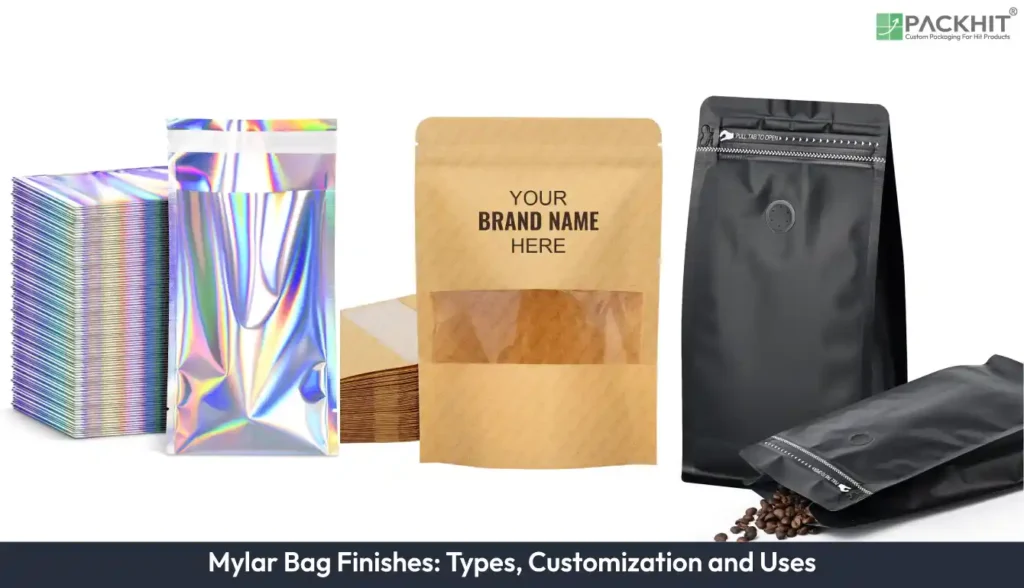
Mylar bag finishes define a package’s appearance, tactile feel, barrier performance, sealing behavior, and print protection. Gloss, matte, soft-touch, metallized, foil-laminated, polymeric, functional, and decorative finishes serve different oxygen, moisture, light, static-control, opening, and branding requirements. Manufacturers specify the laminate, sealant, coating, printing method, closures, compliance criteria, minimum order quantity, and lead time according to the product and shelf-life target. Applications include coffee, snacks, frozen meals, pharmaceutical doses, and electronics, with final selection confirmed through seal-strength, barrier, migration, handling, and recycling checks.
Mylar bag finish selection affects recyclability, food-contact compliance, barrier performance, and manufacturing controls. Specify the finish, material structure, shelf-life target, required features, regulatory requirements, testing limits, run size, and prototype needs so the converter can verify adhesion, curing, seal integrity, leakage, and permeation before production. A quote should state the product, pack size, shelf life, storage conditions, gloss or matte finish, required features, oxygen and water-vapor barrier targets, seal strength, regulatory requirements, annual volume, sample quantity, and prototype deadline.
- What are Mylar Bag Finishes?
- What are the Main Finish Types for Mylar Bags?
- Surface/Optical Finishes (Gloss, Matte, Soft‑touch)
- Barrier Finishes (Metallization, Foil Laminates, Barrier Coatings)
- Functional Coatings (Sealants, Anti‑fog, Anti‑static, Release)
- Decorative and Printing Finishes (Varnish, Hot Stamping, Embossing)
- How to Specify Customization Parameters and a Specification Checklist for Mylar Bag Finishes?
- How are Mylar Bag Finishes Used in Common Packaging Applications?
- How Do Sustainability, Recyclability, and Regulatory Considerations Affect Mylar Bag Finishes?
- How Do the Manufacturing Workflow Control Points for Mylar Bag Finishes?
- How to Specify a Mylar Bag Finish for Quoting
- Frequently Asked Questions (FAQs)
- Which Finish Provides the Highest Barrier Performance?
- Can I Get a Recyclable Mylar Pouch With a Good Barrier?
- How Does Soft‑touch Affect Print Vibrance?
- How to Choose the Best Mylar Bag Finish?
What are Mylar Bag Finishes?
Mylar bag finishes are surface treatments or laminated layers that define a pouch’s tactile, optical, barrier, and sealing properties. They specify material identity, for example, BOPET, aluminum foil, and PE sealant; surface treatment, for example, aqueous varnish, UV-cured coating, and soft-touch lacquer; and functional additives, for example, anti-fog agents and antistatic compounds. Each finish affects at least one performance axis: optical (sheen and gloss), barrier (oxygen and water vapor permeation), mechanical (scratch and puncture resistance), and processability (print adhesion and heat-seal windowing). Designers translate product needs, for example, target shelf life, storage temperature, regulatory status, and filling method, into a finish specification. Converters validate that specification by measuring seal strength and permeation rates.
What are the Main Finish Types for Mylar Bags?
Finish types for mylar bags are split into four groups: surface/optical treatments (gloss, matte, soft-touch), barrier layers (vacuum metallization, aluminum foil laminates, high-barrier coatings), functional coatings (sealants, anti-fog, anti-static), and decorative/printing finishes (varnish, hot stamping, embossing).
Surface/Optical Finishes (Gloss, Matte, Soft‑touch)
Gloss, matte, and soft‑touch finishes for mylar bags define how the pouch looks and feels; each finish is described by its method of application and resulting attributes.
- Gloss varnish: A clear polymer coating applied over print (aqueous or UV-cured). It increases specular reflectance, improves abrasion resistance, and raises perceived colour density. It fingerprints easily and can block under elevated temperature and pressure. Examples: aqueous gloss varnish, UV gloss varnish.
- Matte varnish: A low‑sheen coating that diffuses light to reduce glare. It reduces specular reflection, creates a flat tactile feel, and mutes colour appearance. It lowers apparent contrast compared with gloss and can increase scratch visibility. Examples: aqueous matte varnish, soft matte lacquers.
- Soft‑touch (velvet) coating: A micro‑textured polymer layer that produces a low‑friction, velvet feel, reduces slip, and shifts the print gamut. Its appearance may be used to convey a higher-end look, depending on the packaging design. It incurs higher cost, requires longer cure times, and can reduce the effect of adjacent high‑gloss elements.
- Textured embossing: A mechanical surface alteration applied during converting. It adds grip, provides visual differentiation, and helps mask micro-scratches. It increases complexity in slit and rewind stages.
Barrier Finishes (Metallization, Foil Laminates, Barrier Coatings)
Barrier finishes control mass transfer of oxygen and water vapour and therefore determine shelf life for oxygen‑sensitive or moisture‑sensitive products. The principal technologies and their defining specifications follow.
- Vacuum metallized PET: A thin vapor‑deposited aluminium layer on PET. It produces very low optical transmission, improves oxygen barrier relative to bare PET, and adds little weight or cost. It has limited pinhole resistance and a lower moisture barrier than foil, so use it where high visual opacity and moderate barrier are needed.
- Aluminum foil lamination: A continuous aluminium foil layer laminated between printable facestock and a sealant. It can provide good oxygen exclusion, WVTR control, and puncture resistance when the foil is supported. It reduces transparency and complicates recycling unless replaced by monomaterial alternatives; use it where extended shelf life or light exclusion is required.
- Polymeric high‑barrier coatings (SiOx/AlOx, PVDC): Inorganic oxide layers or chlorinated polyvinylidene coatings applied to polymer films. They deliver ultra‑low OTR and WVTR while retaining flexibility at thin gauges. The coating process is complex, and coatings are sensitive to flex fatigue and scoring, so control handling and conversion parameters.
- Multilayer laminated structures: Stacked films (e.g., PET / metallized PET / PE) bonded with adhesives or extrusion laminates. They combine optical and barrier performance by layer composition. They increase lamination complexity and can hinder recyclability, so assess end‑of‑life requirements during design.
Functional Coatings (Sealants, Anti‑fog, Anti‑static, Release)
Functional coatings for mylar bags impart process or end‑use properties rather than primarily aesthetic ones.
- Sealant layers (PE, LDPE, LLDPE, CPP): Sealant layers are extruded or co‑extruded thermoplastic films that form heat seals. They vary in melting point, seal window, and peel behaviour. Thicker sealants increase hermeticity and reduce recyclability. Examples: LDPE for pillow‑pack seals; CPP for deep‑draw thermoforming.
- Anti‑fog coatings: Anti‑fog coatings are surfactant‑based formulations applied to the inside of clear windows. They maintain optical clarity when condensate forms. These coatings can present migration risks for food contact unless the formulation is qualified for the intended use.
- Anti‑static or conductive coatings: Anti‑static and conductive coatings dissipate electrostatic charge on film surfaces. They reduce dust attraction and lower electrostatic discharge risk. Some formulations affect the adhesion of certain inks and adhesives; test adhesion during qualification runs.
- Release coatings: Release coatings create a low surface‑energy layer for easy opening and peelable seals. They provide controlled peel force and enable tamper evidence by producing consistent peel values. Achieve repeatable peel by controlling formulation and process parameters during converting.
Decorative and Printing Finishes (Varnish, Hot Stamping, Embossing)
Printing‑related finishing technologies provide brand signals and functional protection for inks.
- UV/aqueous varnish: UV and aqueous varnishes are clear coatings applied after printing to alter sheen and protect inks. UV varnish cures by ultraviolet lamps; aqueous varnish dries by solvent evaporation. Varnish increases abrasion resistance and reduces ink rub. UV curing requires lamp systems, ventilation, and operator safety controls; aqueous varnish requires adequate drying time to avoid blocking.
- Hot stamping and cold foil: Hot stamping and cold foil transfer metallized foil to the printed surface to create metallic accents. Hot stamping uses a heated die; cold foil transfers foil on-press using adhesive and impression rollers. Both methods produce durable metallic finishes that resist normal handling. They require extra press stations and tooling, which raise setup cost and per-unit cost for short runs.
- High‑resolution digital printing: High-resolution digital inkjet prints directly on film or paper facestock and supports variable data and short runs. Digital printing enables rapid proofing and on-demand changes. Ink cost per square metre is higher than conventional processes for long runs. For food-contact packaging, select low-migration ink systems and run migration testing under intended storage conditions.
How to Specify Customization Parameters and a Specification Checklist for Mylar Bag Finishes?
To specify customization for mylar bags, translate product needs into measurable parameters. The checklist below lists required data points and practical choices.Essential specification elements:
- Product and shelf‑life: declare commodity, desired ambient shelf life, and storage temperature. Example: roasted coffee, 6–12 months at ambient.
- Barrier targets: state target OTR and WVTR, or give a comparative requirement (e.g., “high barrier for >6 months”). Example metrics: numeric OTR/WVTR or “comparable to aluminum foil laminate”.
- Optical/tactile finish: choose gloss, matte, or soft‑touch, and note locations (front, back, windows).
- Sealing behaviour: select sealant polymer (LDPE, LLDPE, CPP), target seal strength, and preferred seal type (fin seal, lap seal, pinch‑seal). Provide sealing equipment details, if available.
- Printing: identify process (flexo, gravure, digital), colour spec (CMYK, spot Pantone), and expected print run length. Specify proof requirements.
- Closures and features: list zippers, spouts, one‑way valves, tear notches, and windows. Provide positional coordinates if critical.
- Compliance: list food‑contact approvals, sterilization compatibility, or antistatic ratings, and relevant market destination.
- MOQ and lead time indicate expected run length and sample needs.
How are Mylar Bag Finishes Used in Common Packaging Applications?
Mylar bag finishes match the product’s barrier, sealing, handling, and presentation requirements. Aluminum foil laminates generally provide the highest barrier against oxygen, moisture, and light, but actual barrier performance depends on the complete structure, foil integrity, seals, and test conditions. Vacuum-metallized PET provides moderate barrier performance with low weight and an opaque appearance. Polyethylene monomaterial structures prioritize a simpler material stream and recyclability, subject to local collection and recycling capabilities.
The table compares common uses of Mylar bag finishes with the structure and finish selected for each application. Actual specifications depend on fill temperature, storage conditions, seal strength, shelf-life targets, and applicable food, pharmaceutical, or electronics requirements.
Application | Typical finish or structure | Primary rationale |
| Roasted coffee for retail sale | Aluminum foil laminate with a one-way valve and matte or soft-touch varnish | Blocks oxygen and light to protect flavor during storage; the matte or soft-touch surface changes the bag’s tactile and visual finish |
| Snack chips | Metallized BOPP with a polyethylene sealant layer and gloss varnish | Controls water-vapor transmission to preserve crispness while the gloss surface supports strong color and image reproduction |
| Frozen meals | PET outer web with a CPP sealant, high-temperature sealing properties, and a matte finish | Supports forming and heat-sealing processes and maintains package performance during frozen storage |
| Pharmaceutical unit doses | Foil laminate or coated polymer with a tamper-evident finish | Supports light and moisture protection, low-migration requirements, and controlled peel behavior |
| Electronics components | Metallized PET with an antistatic finish | Limits moisture exposure and static charge during handling, shipping, and storage |
How Do Sustainability, Recyclability, and Regulatory Considerations Affect Mylar Bag Finishes?
Finish choice directly affects end-of-life options and regulatory compliance. Multilayer laminates (e.g., PET/Al/PE) that combine different polymers and metal layers often block mechanical recycling streams. Monomaterial pouches (e.g., polyethylene-based structures) simplify recycling where local systems accept them. For food-contact packaging, identify the intended market and use, then have the packaging supplier verify applicable food-contact and migration requirements for the inks, coatings, adhesives, and finished structure. Specify monomaterial constructions and low-migration ink systems up front, if a recyclable solution is required.
How Do the Manufacturing Workflow Control Points for Mylar Bag Finishes?
Converters execute a sequence of operations that transform raw web materials into finished pouches; each step imposes constraints on finish selection and acceptance criteria. The sequence and its causal checkpoints are described below.
- Substrate selection and incoming inspection: converters verify film identity, gauge, and surface energy. If surface energy is not confirmed, ink wetting and varnish adhesion fail.
- Printing and ink curing/dry‑off: the press operator prints by flexographic, gravure, or digital methods. Curing or solvent removal must be complete before lamination to prevent blistering.
- Surface finishing: apply varnish, lamination, or metallization. For thermal lamination, nip pressure and temperature set the bond strength. Improper adhesive formulation causes delamination during fill or distribution.
- Lamination and extrusion coating: films are bonded. Adhesive cure and web tension control laminate flatness and shrinkage behaviour.
- Slitting and pouch converting: slit width tolerance and seal jaw alignment control pouch geometry and seal integrity. Spout or zipper insertion introduces local mechanical stress; layer composition must manage it.
- Quality control and testing: finished pouches undergo visual inspection, leak tests, seal strength tests, and permeation checks. Failing lots are quarantined and root‑cause analysed.
How to Specify a Mylar Bag Finish for Quoting
The minimum specification packet should include the following entries:
- Commodity and intended pack size: e.g., roasted coffee, 250 g pouch.
- Target shelf life and conditions: e.g., 9 months at 25 °C, ambient humidity 40–60%.
- Finish aesthetic: gloss/matte/soft‑touch; include artwork proof or sample if available.
- Required features: zipper, tear notch, degassing valve, window (position and size).
- Barrier and mechanical targets: state desired OTR/WVTR, and minimum seal strength in N/15 mm.
- Regulatory needs: food contact approvals, migration limits, sterilization requirements.
- Run size and sample needs: target annual volume, initial sample quantity, and lead time for prototypes.
Frequently Asked Questions (FAQs)
Which Finish Provides the Highest Barrier Performance?
Aluminum foil lamination or continuous metallized foil supported by polymeric layers can provide light and oxygen protection, although barrier performance varies with material grade, layer thickness, seals, and package construction.
Can I Get a Recyclable Mylar Pouch With a Good Barrier?
Recyclable pouches exist in monomaterial constructions (polyethylene‑based) that improve mechanical recycling compatibility; however, monomaterial formats typically require thicker gauges or dedicated high‑barrier coatings to approach foil‑level performance, so tradeoffs between recyclability and absolute barrier should be evaluated.
How Does Soft‑touch Affect Print Vibrance?
Soft‑touch coatings reduce specular reflection and therefore lower apparent print contrast compared with gloss varnish; colour management via ink density adjustment compensates for this shift but must be validated with press proofs.
How to Choose the Best Mylar Bag Finish?
Choose the best mylar bag finish by matching the surface treatment to product protection, package construction, filling equipment, brand graphics, and end-use handling. A finish that looks correct but reduces seal strength or barrier performance does not meet the package requirement.
- Product requirement: Set OTR, WVTR, light-blocking, odor, and chemical-resistance targets according to the product’s sensitivity and shelf-life specification.
- Visual requirement: Select a matte, gloss, transparent, or metallized treatment according to the required gloss level, haze, opacity, color appearance, and print-reading conditions.
- Process requirement: Confirm ink adhesion, lamination bond, seal compatibility, coefficient of friction, and heat resistance on the filling and sealing equipment.
- Mechanical requirement: Check puncture, tear, flex-crack, zipper, spout, and transport performance on the completed pouch, not only on a flat film sample.
- Compliance requirement: Confirm that inks, coatings, adhesives, and films meet applicable food-contact or pharmaceutical packaging requirements for the intended market.
- Approval requirement: Record the layer structure, finish location, coating or adhesive specification, test methods, acceptance limits, and approved physical sample before production.
Manufacturers can apply this checklist to compare mylar bag finishes by measurable function. The selected finish must protect the product, retain its appearance, run through the filling line, and meet documented seal, barrier, mechanical, optical, and compliance limits.
