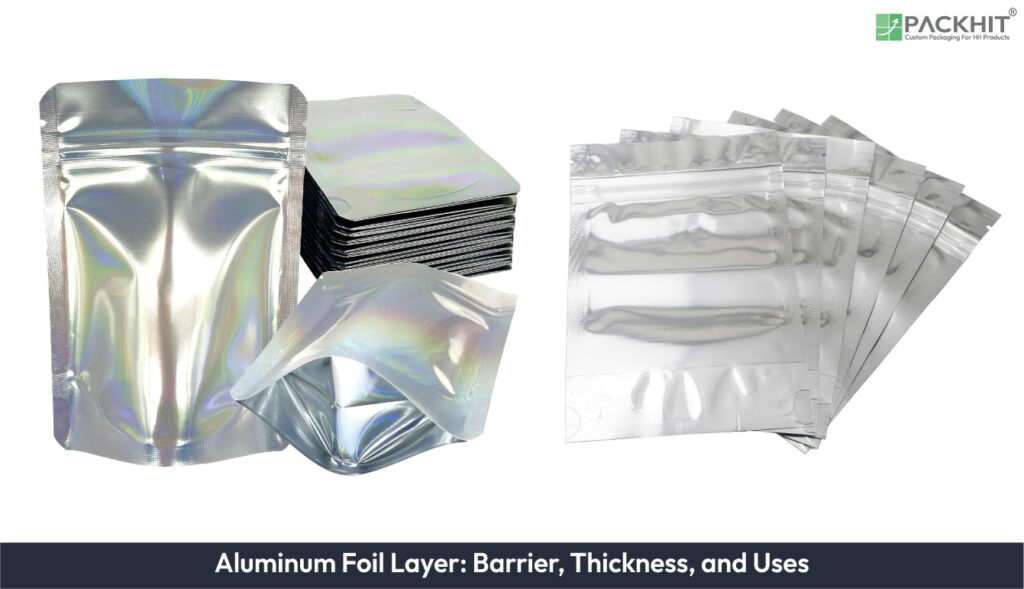
An aluminum foil layer is a thin, solid-metal film (6-200 µm) laminated within flexible packaging to block oxygen, moisture, and light while offering thermal reflectivity and mechanical protection. Its barrier performance stems from its dense, pore-free structure, making it nearly impermeable to gases and vapors, with excellent OTR and MVTR values, especially in thicker gauges. The foil also reflects up to 98% of radiant heat and light, resists corrosion due to surface passivation, and maintains stable performance across storage conditions. Thickness influences barrier strength; thicker foil improves puncture resistance and reduces transmission rates but adds weight and cost, while thinner foil is more flexible but vulnerable to pinholes unless laminated. Primary uses include food packaging, pharmaceutical packaging, and industrial applications, where protection from environmental factors is critical. In mylar bags, the foil is sandwiched between PET and polymers to combine barrier and mechanical properties via lamination. However, limitations include vulnerability to damage in thin forms and environmental concerns due to recyclability challenges, especially in multi-material structures.
- What is an Aluminum Foil Layer?
- What Makes Aluminum Foil an Effective Barrier Material?
- Physical Structure and Impermeability
- Thermal and Optical Reflectivity
- Chemical Stability and Surface Passivation
- Mechanical Behavior and Manufacturing Considerations
- Performance Across Storage and Transport Conditions
- How Does the Thickness of the Aluminum Foil Influence Barrier Performance?
- Barrier Effect (OTR and MVTR)
- Mechanical Protection (Puncture, Tear, and Handling)
- Cost, Weight, and Process Trade-Offs
- Primary Uses of Aluminum Foil Layers
- How Is Aluminum Foil Integrated into Mylar Bags?
- What Are the Limitations of Aluminum Foil Layers?
What is an Aluminum Foil Layer?
An aluminum foil layer is a continuous, solid-metal barrier film (typically 6-200 µm) laminated inside flexible packaging to block oxygen, moisture, and light, provide thermal reflectivity, and supply tamper and puncture resistance when combined with polymer films (e.g., PET, PE).
What Makes Aluminum Foil an Effective Barrier Material?
Aluminum foil is an effective barrier material because it provides near-total impermeability to gases, liquids, and light, which makes it the primary barrier layer in many flexible packaging constructions.
Physical Structure and Impermeability
The physical structure and impermeability of aluminum foil are derived from its dense metallic lattice, which contains no continuous pores, so gas and liquid molecules cannot pass through under normal service conditions. Barrier performance depends on alloy, laminate construction, defects, test method, and application conditions, and should be verified via product-specific OTR/MVTR testing to ensure the material meets required shelf-life extensions for sensitive goods.
Thermal and Optical Reflectivity
Thermal and optical reflectivity performance in aluminum foil allows it to reflect incident radiant heat and visible light, reducing radiative transfer and limiting light-induced degradation of light-sensitive products. Performance varies significantly based on the specific alloy and surface finish rather than fixed percentage benchmarks. This reflectivity reduces photochemical reactions that affect color, aroma, and potency.
Chemical Stability and Surface Passivation
Chemical stability and surface passivation are maintained by a thin oxide layer (Al2O3) that forms immediately on exposed aluminum and reduces further corrosion, improving resistance to atmospheric moisture and common contaminants. The metal remains chemically stable in contact with many packaged goods, but it can react with strong alkaline or acidic formulations if not isolated by polymer layers.
Mechanical Behavior and Manufacturing Considerations
Mechanical behavior and manufacturing considerations are critical because thin gauges are vulnerable to pinholes and tearing during processing. Manufacturers use lamination or protective films to add puncture resistance and to preserve barrier integrity during filling and sealing operations.
Performance Across Storage and Transport Conditions
Performance across storage and transport conditions is consistent due to the stable nature of the foil’s impermeability, so packaged products retain low moisture and oxygen exposure through distribution. The foil’s impermeability does not depend on tight temperature control if the package remains intact and undamaged.
How Does the Thickness of the Aluminum Foil Influence Barrier Performance?
The thickness of aluminum foil influences barrier performance through barrier transmission, mechanical protection, cost, weight, and process trade-offs.
Barrier Effect (OTR and MVTR)
The barrier effect (OTR and MVTR) involves increasing foil thickness to reduce transmission rates. Barrier performance and suitable foil gauges vary by alloy, laminate construction, defect level, test method, and application. Use measured OTR/MVTR targets and product-specific testing rather than treating the figures above as broadly applicable. Metallized PET mimics foil optical barrier at much lower metal mass but does not match solid-foil impermeability for long-term storage.
Mechanical Protection (Puncture, Tear, and Handling)
Mechanical protection (puncture, tear, and handling) is influenced by alloy and lamination and should be qualified for the specific application rather than relying on standard thickness thresholds. Lamination with PET or foil-to-foil bonding is used to reduce pinhole formation during filling and sealing, ensuring barrier integrity is maintained throughout the supply chain.
Cost, Weight, and Process Trade-Offs
Cost, weight, and process trade-offs result from material cost and package weight rising linearly with foil thickness; thicker foil also reduces pack conformability and may complicate heat-seal settings. Use thicker foil if the product faces abrasive handling or prolonged storage; use thinner foil if flexibility, low cost, and machine speed are priorities.
Selection Guidelines by Application
- Food: Lower gauge foils are typically used for snack pouches and coffee bags where high-speed runnability is a priority alongside shelf-life requirements.
- Pharmaceuticals: Mid-range gauges are standard for blister backings and foil pouches to ensure total light exclusion and moisture protection.
- Industrial: Higher gauge foils are preferred for heavy-duty sacks and thermal wraps where mechanical durability and maximum heat reflection are required.
- Metallized films: Vapor-deposited aluminum on polymer substrates is used for retail pouches needing printability and moderate barrier at lower cost.
Testing and specification tips
Testing and specification tips for aluminum foil involve specifying target OTR and MVTR values, not just foil gauge, and verifying them by laboratory tests (ASTM D3985 for OTR, ASTM F1249 for MVTR). Add pinhole inspection and seal-integrity checks during pilot runs to detect handling-induced defects early.
Primary Uses of Aluminum Foil Layers
The primary uses of aluminum foil layers are food packaging, pharmaceutical packaging, and industrial applications.
1. Food Packaging
In food packaging, aluminum foil acts as a barrier to oxygen, moisture, and light, all of which can compromise the freshness and safety of food products. It is commonly used in the production of mylar bags for items such as coffee, snacks, and dehydrated foods. The foil layer prevents the absorption of external odors and flavors, ensuring the product retains its intended taste and aroma.
2. Pharmaceutical Packaging
Pharmaceutical packaging requires materials that protect against contamination and degradation. Aluminum foil is widely used in blister packs and strip packs for tablets and capsules, where its impermeability to moisture and light is critical. The foil layer also provides tamper-evidence, enhancing the security of the packaged product.
3. Industrial Applications
Industrial applications utilize aluminum foil for insulation and shielding purposes. Its ability to reflect heat and resist chemical corrosion makes it suitable for applications such as HVAC ducting, thermal insulation, and electromagnetic shielding. The foil layer is often combined with other materials, such as fiberglass or polymer films, to enhance its mechanical properties.
How Is Aluminum Foil Integrated into Mylar Bags?
In mylar bags, the aluminum foil layer is typically laminated between layers of polyethylene terephthalate (PET) and other polymers. This multi-layer structure combines the barrier properties of aluminum with the mechanical strength and flexibility of plastic films. The foil layer acts as the primary barrier, while the outer PET layer provides durability and printability.
The lamination process involves bonding the aluminum foil to the polymer layers using adhesives or extrusion techniques. This ensures a uniform and defect-free structure, which is essential for maintaining the integrity of the barrier. Mylar bags with aluminum foil layers are commonly used for long-term food storage, medical supplies, and high-value industrial products.
What Are the Limitations of Aluminum Foil Layers?
Despite its numerous advantages, aluminum foil has certain limitations. Its susceptibility to pinholes and cracks, particularly in thinner gauges, can compromise its barrier properties. These defects often arise during manufacturing or handling and may require additional layers or coatings to mitigate.
Furthermore, aluminum foil is not biodegradable, raising environmental concerns. While it is recyclable, the recycling process can be energy-intensive, particularly when the foil is laminated with other materials. Manufacturers are exploring alternatives, such as thinner foils and bio-based laminates, to address these challenges without compromising performance.