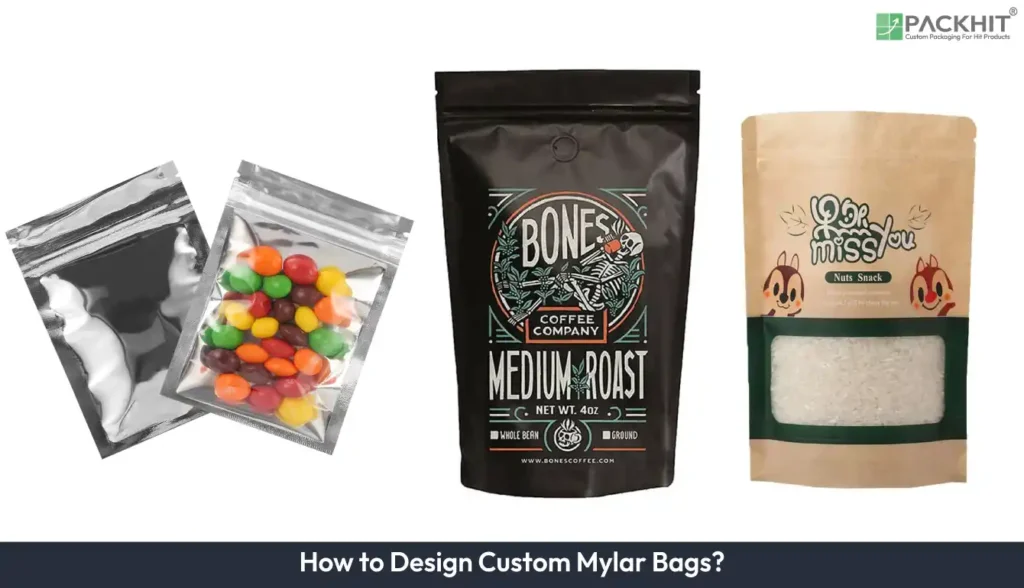
To design Mylar bags, begin by defining product-specific requirements such as barrier protection, durability, and shelf life. Suitable materials such as BoPET, aluminum foil, or polyethylene are selected based on functional needs. Next, determine the bag’s dimensions, structure, and added features such as zippers or valves. Branding elements are then incorporated, and high-quality printing is applied to support the branding. Prototypes are tested for performance and regulatory compliance before the design moves to full-scale production, with strict quality control to ensure consistency and effectiveness.
Key material considerations for Mylar bag design include selecting appropriate material compositions, such as BoPET laminated with aluminum foil, polyethylene, or polypropylene, to achieve the required barrier performance and flexibility. Thickness affects durability and cost, while laminate layer properties influence functions such as moisture resistance and structural integrity. Barrier properties, including low OTR and WVTR, are critical for food and electronics packaging. Regulatory compliance with applicable FDA, EU, or GMP requirements is also essential, as are effective sealing mechanisms such as heat or hermetic sealing to maintain product integrity. Printing and branding can enhance consumer appeal through techniques such as flexographic or digital printing, while sustainability can be addressed through recyclable materials, reduced material thickness, and the use of post-consumer recycled content.
Designing custom Mylar bags follows a sequence of decisions that connect product needs to the final bag format. Each step locks in inputs for the next stage, so barrier performance, sealing behavior, and printed layout match the intended filling and storage conditions.
- 1. Define Product Requirements
- 2. Select Materials
- 3. Determine Dimensions and Structure
- 4. Incorporate Functional Features
- 5. Plan Branding and Visual Elements
- 6. Build From Mylar Bag Templates
- 7. Develop Prototype and Test
- 8. Create and Review Mockups
- 9. Validate Compliance
- 10. Scale Production
- Key Material Considerations for Mylar Bag Design
- Material Composition
- Thickness and Durability
- Laminate Layer Properties
- How Do Barrier Properties Influence Material Selection?
- What are the Regulatory Requirements for Mylar Bag Design?
- What Role Does Sealing Mechanism Play in Design?
- How is Printing and Branding Incorporated?
- How Does Mylar Bag Design Support Sustainability?
1. Define Product Requirements
Start with the product’s required barrier performance and the storage conditions that drive it. Food products often prioritize oxygen and moisture barriers to slow oxidation and moisture uptake. Electronics packaging often targets static control and UV resistance to reduce damage during storage and display. Record target shelf life, expected storage temperature range, and whether the bag content is dry, moist, or contains oils.
2. Select Materials
Pick film structures based on the requirement list. Use BoPET laminated with aluminum foil for high barrier performance against oxygen and moisture. Use polyethylene layers when the process needs flexibility and reseal behavior. Match laminate thickness to handling risk: higher thickness and more layers improve puncture resistance and tear resistance, while thinner composites reduce material cost when product sharpness and transport stress stay low.
3. Determine Dimensions and Structure
Calculate bag dimensions from the filled product size, headspace, and target pack-out method. Choose a structure that matches bulk and retail display needs, such as flat pouches for compact items, gusseted bags for higher fill volume, or stand-up pouches for shelf visibility. Confirm that the chosen width and gusset geometry fit the filling equipment and do not force excessive compression of the laminate during transport.
4. Incorporate Functional Features
Add features based on handling and end-use. Use a zipper when repeated opening and resealing matters. Add a tear notch when clean opening reduces contamination risk. For coffee packaging, select valve or degassing provisions that align with the batch’s gas release behavior. For liquids, use a compatible spout opening that does not conflict with the bag’s seal zones.
5. Plan Branding and Visual Elements
Map branding art to usable print areas and to the bag’s barrier cutouts. Place product names, regulatory text, and symbol panels where the artwork does not interfere with seals, zipper paths, or gusset folds. For print reproduction, use layout files that reflect the dielines and safe zones. If you add a transparent window, define the window size as a starting range (5–25% of the front panel), then validate that the cutout does not weaken overall integrity for the specific laminate and sealing method.
Printing steps can also affect cost and lead time. Specify metallic accents by choosing hot-foil or cold-foil. Match surface finish to readability targets by selecting matte or gloss varnishes for contrast. Note that large windows and foil applications add manufacturing steps, which influence production scheduling.
Mylar bag design software supports this stage by automating dielines, bleeds, safe zones, and export of print-ready files. Use its color simulation and file export settings to keep proofs consistent across revisions, including CMYK and spot-metallic ink handling.
6. Build From Mylar Bag Templates
Start from Mylar bag templates to standardize dielines and print specifications across SKUs. Template sets typically include trim and bleed lines, safe zones, zipper and gusset placement, window cutout positions, and barcode or nutrition panel areas. Keeping these elements consistent reduces rework when you change only product graphics, not the packaging structure.
7. Develop Prototype and Test
Create prototypes for the exact bag structure, not a close alternative. Test sealing behavior with your target sealing temperature and pressure settings, and measure whether seal strength stays consistent across full-run conditions. Confirm barrier integrity targets after sealing and after simulated handling. Run trials for temperature shifts and transportation vibration to check whether seal edges maintain integrity under stress.
8. Create and Review Mockups
Generate a Mylar bag mockup to review front and side layouts before production. Mockups help confirm the visual relationship between product art, window size, zipper placement, and fold behavior on gusseted or stand-up formats. Use digital proofs to spot alignment issues caused by metallic finishes or transparent areas, so approvals match the real print outputs.
9. Validate Compliance
Verify that the selected film, inks, adhesives, and labeling placement meet the applicable food-contact or packaging standards for your market. For food packaging, confirm requirements such as FDA or EU food contact expectations based on the product category and intended contact conditions. Label content should include required ingredient or nutrition fields where applicable, along with recycling symbols and certifications demanded by the channel.
10. Scale Production
Move into full-scale manufacturing only after the design passes seal and barrier checks, and the packaging artwork matches the approved dielines. Apply quality control to the full workflow: incoming film inspection, print registration checks, seal continuity checks, and batch consistency review. Maintain the specified parameters so the finished bag performance matches the prototype results.
Following these stages helps manufacturers design custom Mylar bags that protect the product, meet required barrier and seal behavior, and keep branding readable across practical manufacturing and retail conditions.
Key Material Considerations for Mylar Bag Design
The material choices in Mylar bag design determine barrier performance, seal behavior, and run-to-run consistency. The points below cover composition, film thickness, laminate construction, and how barrier targets connect to product selection.
Material Composition
Mylar bags are commonly formed from biaxially oriented polyethylene terephthalate (BoPET). Manufacturers often laminate BoPET with layers such as aluminum foil, polyethylene (PE), or polypropylene (PP). Aluminum foil adds resistance to oxygen and water vapor. PE and PP add heat-sealable behavior, which controls seal strength and the tamper-evident outcome when bags are closed.
Thickness and Durability
Film thickness affects puncture resistance, wrinkle behavior, and stiffness during filling. Common thickness targets range from 2 mils (0.002 inches) to 7 mils (0.007 inches). Thinner films usually reduce material cost, while thicker laminates improve handling tolerance for heavier fills, retail displays, and repeated storage cycles. Seal performance can also shift with thickness because heat transfer changes across the laminate.
Laminate Layer Properties
Laminate selection sets barrier level and mechanical stability. Aluminum foil laminates reduce oxygen transmission and moisture ingress to extend shelf life. PP can improve structural stability in some constructions, while PE often supports heat-sealing where the sealing layer must soften and bond reliably. Multi-layer builds combine those functions, for example a foil-containing barrier layer paired with a heat-seal layer for consistent closure.
How Do Barrier Properties Influence Material Selection?
Barrier properties include oxygen transmission, water vapor transmission, light transmission, and odor transfer. For food packaging, oxygen and moisture control are the key inputs for freshness retention. Example target specifications used in packaging selection include OTR under 0.1 cc/m²/day and WVTR under 0.05 g/m²/day for long-term storage, but the correct threshold depends on the product’s formulation, headspace conditions, and the test method in the packaging specification. Electronics packaging often prioritizes anti-static behavior and UV resistance instead of oxygen and moisture targets alone.How to Choose the Right Mylar Bag Specs
- Food solids: prioritize low OTR and low WVTR, then match the seal layer to the filling line temperature range.
- Electronics: prioritize anti-static control and UV-blocking performance, then confirm that the laminate does not shed contaminants during heat sealing.
- Moisture-sensitive goods: prioritize WVTR targets and check seam integrity after thermal cycling, then adjust dwell time if seal gaps appear.
Escalate after prototype runs if results miss your barrier or seal targets. Use the test outcomes to change either the laminate layer selection (for barrier shortfalls) or the sealing parameters (for seam failures such as weak bonds, channeling, or edge wrinkling).
What are the Regulatory Requirements for Mylar Bag Design?
Regulatory compliance supports safe food-contact and product labeling practices, but compliance must follow applicable rules and product-specific use conditions. For food packaging, manufacturers commonly select materials that meet applicable FDA or EU food-contact requirements as part of ensuring suitability for use. If a product is intended for pharmaceuticals, GMP-aligned processes and USP Class VI considerations can apply based on the market and product claims. Label content also follows category rules, including ingredient or nutrition information, traceability needs, and recycling or disposal markings required by the destination market.
What Role Does Sealing Mechanism Play in Design?
Sealing mechanisms control seam integrity, closure leak risk, and tamper-evident outcomes. Heat sealing is a common approach because it forms an airtight closure when the heat-seal layer softens and bonds. Seal strength depends on the sealing layer chemistry, sealing temperature, pressure, and dwell time. For higher-barrier use cases, double-sealing or hermetic sealing can reduce leakage paths, but the closure design still depends on the bag geometry and the tested seam performance.
How is Printing and Branding Incorporated?
Custom printing places logos and product information onto Mylar bag surfaces for identification during retail and storage. Common printing methods include flexographic, rotogravure, and digital printing. Flexographic printing is used for larger production runs. Digital printing supports smaller batches and variable graphics, because artwork can change without a full plate workflow.
Design placement affects readability and compliance. Position regulatory symbols and required product text where the bag is likely to remain flat and unobstructed. Some finishes can affect perceived contrast on metallized or matte films, including metallic inks for high visibility and matte coatings to reduce glare. Transparent windows can also be incorporated when the product view is part of the packaging requirements.
How Does Mylar Bag Design Support Sustainability?
Sustainability is increasingly influencing Mylar bag design. Manufacturers are exploring recyclable or biodegradable alternatives to traditional laminates. Mono-material structures, such as 100% polyethylene, are gaining traction due to their recyclability. Additionally, reducing material thickness without compromising barrier properties can minimize environmental impact.
Post-consumer recycled (PCR) content is another avenue for sustainable design. Incorporating PCR materials reduces reliance on virgin plastics and supports circular economy initiatives. However, achieving the desired performance characteristics with recycled content remains a technical challenge.