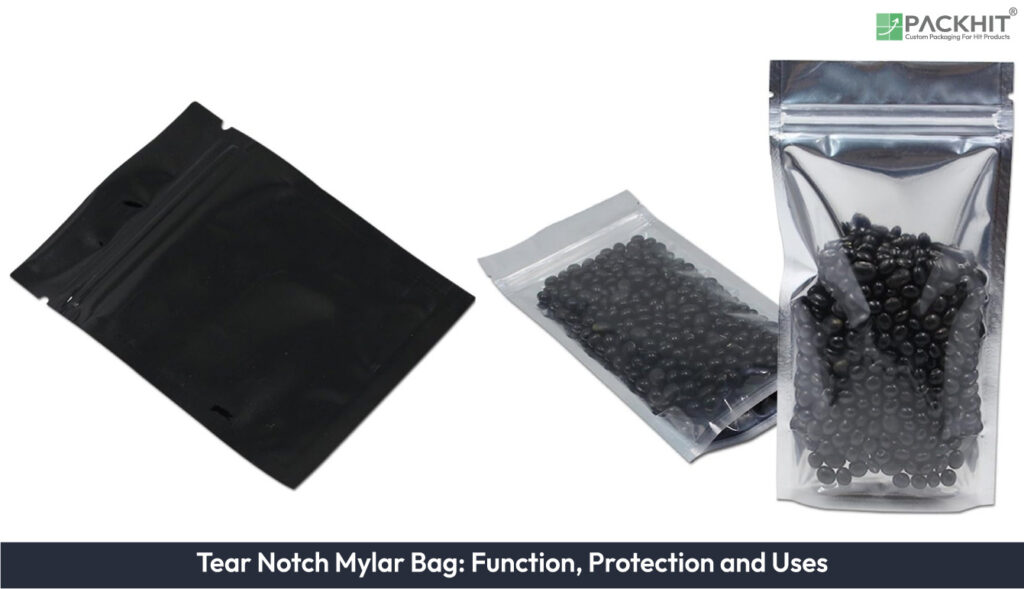
A tear-notch mylar bag uses a defined opening point in a multilayer laminate, allowing controlled access while the unopened package blocks moisture, oxygen, light, and contaminants. Manufacturers typically add the notch after printing and lamination, then form, seal, trim, and inspect each pouch for alignment and damage. The intact laminate supports barrier performance and shelf life, but air and moisture enter after opening, so sensitive products may require a zipper, single-use fill size, desiccant, or oxygen absorber. Food, pharmaceutical, electronics, seed, grain, emergency, and survival products use different film structures, sealants, storage conditions, and validation tests. Product specifications should define pouch dimensions, barrier targets, notch position, seal strength, opening force, lot identification, and shelf-life requirements before production.
Tear-notch mylar bag laminate selection depends on the required oxygen barrier, moisture barrier, seal strength, shelf life, and end use. Foil provides the strongest protection, EVOH controls oxygen when humidity is managed, and mono-PET/PE supports lower-barrier packaging with a simpler material structure.
- What Is a Tear-Notch Mylar Bag?
- How Are Tear Notches Formed During Mylar Bag Manufacturing?
- 1. Unwind the Roll Stock
- 2. Prepare the Pouch Blank
- 3. Form the Pouch
- 4. Apply the Tear Notch
- 5. Seal the Pouch
- 6. Cut and Trim the Pouch
- How Does a Tear Notch Mylar Bag Affect Protection, Barrier Performance, and Shelf Life?
- Primary Industry Uses for Tear Notch Mylar Bags
- Food Products
- Pharmaceuticals
- Electronics
- Agricultural Seed and Grain Samples
- Emergency and Survival Kits
- What Laminate Structures and Thickness Ranges Are Typical for Tear-notch Mylar Bags?
- When Should Manufacturers Choose a Tear Notch Over Other Mylar Bag Opening Solutions?
What Is a Tear-Notch Mylar Bag?
A tear-notch mylar bag is a multilayer flexible pouch with a precision-cut opening point that lets the user start a controlled tear while the laminate protects the packaged product from moisture, oxygen, light, and contaminants. The notch supports convenient access without replacing the heat-sealed barrier that protects shelf life.
Tear-Notch Properties and Function
The notch concentrates pulling force at one defined location. Its geometry, depth, position, and forming method determine how the bag opens and how well the seal remains intact.
- Opening control: V-shaped, U-shaped, or corner notches start a one-hand tear; opening force requires product-specific testing or qualified review.
- Laminate protection: BoPET, aluminum foil or EVOH, and PE or LLDPE layers combine print strength, barrier protection, and heat sealing; thickness and barrier performance require product-specific testing.
- Seal placement: Position the notch outside the primary heat-seal flange to avoid seal damage and leakage; dimensions require product-specific testing or qualified review.
- Manufacturing position: Converters form the notch after printing and lamination with a mechanical punch or laser score before final sealing or trimming; process validation confirms tear quality.
- Resealable access: A zipper pouch places the notch above the closure so the first tear exposes the zipper without severing it; storage period and temperature limits require product-specific review.
How Are Tear Notches Formed During Mylar Bag Manufacturing?
Tear notches are usually added after printing and lamination but before final sealing and trimming. The exact point depends on whether the package starts as roll stock or a pre-made pouch.
1. Unwind the Roll Stock
Unwind the printed or laminated film from the supply roll. Keep the web aligned so the notch reaches the planned position on each pouch.
2. Prepare the Pouch Blank
Prepare a pre-cut blank if the process uses pre-made pouches. Roll-fed HFFS and VFFS lines usually form the pouch directly from continuous film.
3. Form the Pouch
Shape the film around the forming equipment. Keep the front and back panels aligned before the tear notch is applied.
4. Apply the Tear Notch
Cut the notch with a mechanical die or score it with a laser head. Place the notch at the opening edge and keep it clear of the seal area.
5. Seal the Pouch
Make the fin seal or lap seal after notch placement. Control heat, pressure, and dwell time so the seal remains closed during transport.
6. Cut and Trim the Pouch
Separate each pouch from the web and trim it to the specified dimensions. Check that the notch remains visible, accessible, and free from excess film.
How Does a Tear Notch Mylar Bag Affect Protection, Barrier Performance, and Shelf Life?
A tear notch preserves the sealed bag’s protection and barrier performance, but exposure begins once the notch opens the package.
Protection
A tear notch affects protection only at the opening edge. The notch creates a controlled initiation point for tearing, while the sealed laminate protects the product from handling damage, moisture, oxygen, light, and contamination. Keep the notch above the product fill line and away from the heat seal to preserve package strength during shipping and storage.
Barrier Performance
A tear notch does not reduce barrier performance across the intact bag material. The moisture, oxygen, aroma, and light barrier comes from the laminate structure, such as polyester combined with foil or a metallized film and a heat-sealable inner layer. Barrier loss occurs if the notch reaches the seal, the tear extends into the product area, or the package develops a puncture or incomplete seal.
Shelf Life
A tear notch preserves shelf life until the bag is opened. After opening, air and moisture enter through the tear, so the remaining shelf life depends on product sensitivity, storage conditions, and resealing performance. For products that oxidize or absorb moisture, specify a resealable closure or single-use fill size, and verify shelf life with seal-strength, leak, and package-barrier testing.
Primary Industry Uses for Tear Notch Mylar Bags
Tear-notch mylar bags combine a sealed barrier with a controlled opening for products that require protection during storage and direct access at use. The notch concentrates tearing force at a defined point while the heat seal remains closed until opening. This format supports food, pharmaceutical, electronics, agricultural, and emergency packaging applications.
Food Products
Food-grade tear-notch mylar bags limit oxygen and moisture exposure while supporting single-handed opening. Coffee, roasted nuts, powdered beverages, and dehydrated meals commonly use BoPET/foil/PE or BoPET/EVOH/PE laminates. Foil layers often measure 6-9 µm, while EVOH layers commonly measure 3-12 µm; ranges vary by product and barrier target. LDPE or LLDPE sealants commonly measure 30-80 µm, with food-contact status varying by material and market. Shelf-life targets, OTR, WVTR, storage temperatures, modified-atmosphere packaging, oxygen scavengers, and desiccants differ for products stored beyond 12 months.
Pharmaceuticals
For pharmaceutical, sterile-medical, food-contact, or emergency-use packaging, the information here is general only. The final laminate, seal, opening design, sterilization process, shelf-life period, and test plan must be validated for the specific product and use by qualified packaging and regulatory professionals before production or use.
Electronics
Electronics tear-notch pouches combine electrostatic control with moisture and light shielding for sensitive parts. ESD-sensitive ICs, connectors, and small PCBs can use antistatic or static-dissipative film with a surface resistivity of 106 to 1011 Ω/sq. Metallized PET or foil adds Faraday shielding, while a desiccant and humidity indicator card support moisture-sensitive devices. Place the notch away from the shield layer, use laser scoring when partial-layer integrity matters, and verify surface resistivity, shield continuity, notch condition, humidity status, RH, and temperature limits during acceptance.
Agricultural Seed and Grain Samples
Seed and grain tear-notch pouches control moisture while preserving germination data and lot identity. Breeder seed packets and test-sample sachets can use foil-backed or EVOH laminates, with WVTR set against the required viability period. Specify sample mass or seed count, pouch dimensions, storage temperature, relative humidity, and retention time, then print the lot number, germination percentage, moisture content, and test date. Oxygen absorbers or hermetic seams support long-term storage in humid shipping conditions, while retained samples can undergo weight, seal, and random germination checks.
Emergency and Survival Kits
Emergency tear-notch pouches protect rations and medical contents during extended storage while allowing rapid opening. Long-shelf-life foods, sterile medical kits, and first-aid bandage packs require a defined storage period, such as a multi-year term, supported by accelerated-aging validation. Foil laminates, desiccants, and oxygen scavengers limit oxidative and moisture damage across qualification cycles covering subzero and elevated temperatures. Set notch depth and mouth width for wet or gloved hands, place a zipper below the notch when staged access is required, and print storage instructions, manufacture date, expiry date, and lot code.
What Laminate Structures and Thickness Ranges Are Typical for Tear-notch Mylar Bags?
Typical laminate stacks meet barrier and seal targets. Common stacks include BoPET/Metallized PET/LLDPE, BoPET/EVOH/PE, BoPET/Al foil/PE, and Mono-PET/PE.
Specify the outer BoPET thickness, the continuous barrier layer, and the PE sealant. Foil: 6-9 µm. EVOH: 3-12 µm. PE sealant: 30–100 µm. Include target OTR (cm³/m²·day), WVTR (g/m²·day), and opening force (N) when you order.
- Barrier examples: aluminum foil (very high barrier), EVOH (high oxygen barrier but moisture-sensitive).
- Sealant examples: LDPE or LLDPE 30-100 µm; list required peel strength in N/15 mm.
- Application examples: food (shelf life months or years), pharmaceutical (sterility and seal tests), electronics (ESD shielding).
The table below aligns protection targets with converter capabilities. It lists representative stacks, typical layer thickness ranges (µm), primary functions, and relative barrier performance.
| Laminate stack (outer → inner) | Typical layer thickness (µm) | Primary function | Relative barrier |
| Printed BoPET / Metallized PET / LLDPE | 12-36 / metallized ~0.02-0.1 / 30–80 | Print surface; visible and moisture barrier; heat-sealant | Moderate oxygen barrier; low to moderate moisture barrier |
| BoPET / EVOH / PE sealant | 23-36 / 3-12 / 30-80 | Structure: high oxygen barrier from EVOH; seal | High oxygen barrier; moisture-sensitive at high relative humidity |
| BoPET / Aluminum foil / PE | 23-48 / 6-9 / 30-100 | Structure; metal foil barrier; seal | Very high oxygen and moisture barrier (near zero) |
| Mono-PET / PE lamination | 36-75 / 30-100 | Simplified stack to ease recycling | Lower oxygen barrier; adequate for short shelf-life snacks |
Match the laminate choice to the product need. Choose foil stacks for maximum moisture and oxygen protection. Choose EVOH stacks for oxygen control if humidity is managed. Choose mono-PET/PE for simple, lower-barrier applications and easier recycling.
When Should Manufacturers Choose a Tear Notch Over Other Mylar Bag Opening Solutions?
Manufacturers should choose a tear notch when a product requires single-use, low-cost, single-handed access with controlled initiation, typically 18-42 N, depending on laminate, seal, and notch geometry. Place the notch 2-8 mm outside the primary seal, with placement varying by seal width and barrier structure.
Select a tear notch when high-throughput die punching or laser scoring keeps unit cost low and resealability is unnecessary. Choose another opening method when the package requires resealing, 4-8 N opening force, or liquid dispensing; force varies with film thickness, seal strength, and contents.
- Cost: Lower tooling cost and faster cycle times than integrated zippers, reducing per-unit cost in high-volume production; savings vary with order size and equipment.
- Barrier protection: Maintain laminate integrity by placing the notch 2-8 mm outside the seal; foil and EVOH structures retain perimeter protection when the seal remains intact, subject to seal width and material thickness.
- User access: Support single-handed opening and gloved handling with a 3-6 mm mouth; emergency kits commonly use 4-7 mm, depending on glove thickness and notch depth.
- Production method: Use die punching for high volumes and laser scoring for precise partial-layer removal, such as electronics packaging requiring continuous shielding; throughput varies with material and line speed.
- Post-use protection: Select an integrated zipper or spout for repeated access or controlled dispensing, as used in reclosable food pouches and liquid containers; performance depends on closure design and product viscosity.