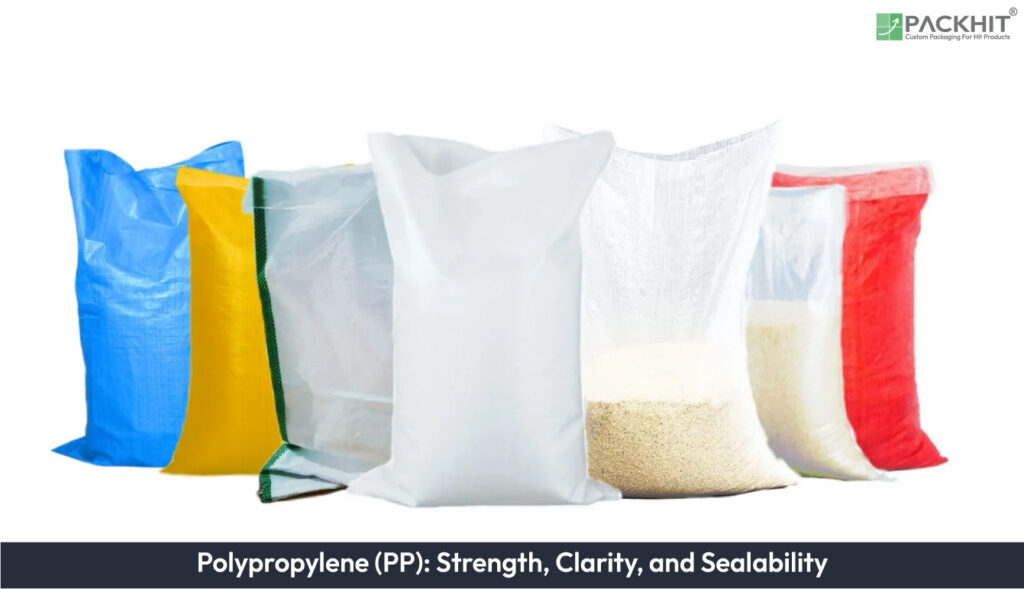
Polypropylene (PP) is a thermoplastic polymer used in packaging because it combines mechanical strength, optical clarity, and sealability. Its structure, low moisture absorption, and chemical inertness support packaging applications where durability, visibility, and airtight sealing are needed. In applications where durability, visibility, and sealing matter, manufacturers may consider PP as one option.
- What is Polypropylene?
- How Does Polypropylene Achieve Strength?
- What Contributes to Polypropylene’s Optical Clarity?
- How Does Polypropylene Enable Sealability?
- Key Applications of Polypropylene in Packaging
- How Does Polypropylene Perform Under Environmental Stress?
- How Does Polypropylene Compare to Other Packaging Materials?
What is Polypropylene?
Polypropylene is a polymer synthesized through the polymerization of propylene monomers, belonging to the polyolefin family. Its chemical structure consists of a repeating chain of carbon and hydrogen atoms, with methyl groups attached to alternating carbon atoms. This arrangement forms the basis of its semi-crystalline nature, which contributes to the material’s rigidity and thermal stability. Polypropylene can be categorized into different grades, such as homopolymer and copolymer, each designed for specific applications based on their unique structural characteristics.
How is Polypropylene Structured?
The semi-crystalline structure of polypropylene results from its isotactic molecular configuration, where methyl groups are uniformly aligned along the polymer chain. Polypropylene properties vary by grade and processing conditions. Grade and processing differences allow polypropylene to serve packaging applications that require durability or performance under stress. These properties make polypropylene highly adaptable for packaging applications, particularly where durability and performance under stress are required.
How Does Polypropylene Achieve Strength?
The strength of polypropylene is primarily attributed to its semi-crystalline structure, which provides a balance between rigidity and flexibility. Tensile strength and melting point vary based on the specific grade and processing conditions. The semi-crystalline structure provides dimensional stability and durability under thermal and mechanical stress, though performance varies by grade, processing, package design, and use conditions. Furthermore, the polymer’s resistance to fatigue and stress cracking can enhance its longevity in demanding conditions, such as repeated mechanical loading or exposure to harsh chemicals.
What Contributes to Polypropylene’s Optical Clarity?
Polypropylene’s optical clarity is a result of its low haze and high light transmittance properties. The polymer’s amorphous regions allow light to pass through with minimal scattering, creating a transparent appearance. Clarifying agents, such as sorbitol-based nucleating agents, are often added during processing to further enhance transparency by reducing the size of crystalline domains. This makes polypropylene a common material choice for applications requiring visual inspection or aesthetic appeal, such as food packaging and retail displays.
How Does Polypropylene Enable Sealability?
Sealability in polypropylene is achieved through its ability to form strong, airtight bonds under heat and pressure. The polymer’s low melting point relative to other thermoplastics facilitates efficient heat sealing, while its chemical inertness means it is generally compatible with many adhesives and sealants, depending on the specific grade and application requirements. Polypropylene’s seal integrity is particularly valuable in applications requiring moisture and oxygen barriers, such as vacuum-sealed food packaging. Additionally, its resistance to punctures and tears further enhances its suitability for protective packaging solutions.
Key Applications of Polypropylene in Packaging
Polypropylene is extensively used in packaging due to its versatile properties. In the context of custom paper-based packaging, PP is often employed as a laminate or coating to enhance durability, moisture resistance, and sealability. Key applications include:
Food Packaging
Polypropylene films or containers may support moisture control, sealing, and product protection when the specific packaging design, sterilization or hygiene process, seal integrity, and storage conditions are appropriately validated.
Medical Packaging
Sterile polypropylene containers and films are widely used for storing medical supplies. Their chemical inertness and moisture resistance can support product integrity during transport and storage. Transparent polypropylene films are commonly used for wrapping perishable goods and can support product presentation in retail settings.
Industrial Packaging
Polypropylene-coated paper bags are designed to offer superior strength and moisture resistance, making them suitable for packaging bulk materials like fertilizers, cement, and grains. These coatings enhance the durability of paper-based packaging, ensuring that the contents remain intact even in demanding industrial conditions.
Retail Packaging
Clear polypropylene boxes and pouches are widely used in the retail sector for presenting consumer goods. Their transparency highlights product features, while their structural integrity ensures protection against physical damage. These packaging solutions are particularly popular for electronics, cosmetics, and gift items.
How Does Polypropylene Perform Under Environmental Stress?
Polypropylene exhibits excellent resistance to environmental stressors, including UV radiation, moisture, and chemical exposure. Its water absorption, chemical resistance, and recyclability vary by grade, formulation, use conditions, and available recycling systems. Confirm the relevant values and end-of-life pathway for the intended packaging design. The material’s recyclability further enhances its environmental profile, aligning with sustainability goals in packaging design.
How Does Polypropylene Compare to Other Packaging Materials?
Polypropylene offers distinct advantages over other packaging materials, such as polyethylene and polyester, in terms of strength, clarity, and sealability. Compared with polyethylene and polyester, polypropylene can offer a different balance of strength, clarity, sealability, processing, and cost. The appropriate choice depends on the grade, package design, production volume, and supplier conditions. These comparative features enable manufacturers to select polypropylene for applications where a balance of performance and cost-efficiency is required.