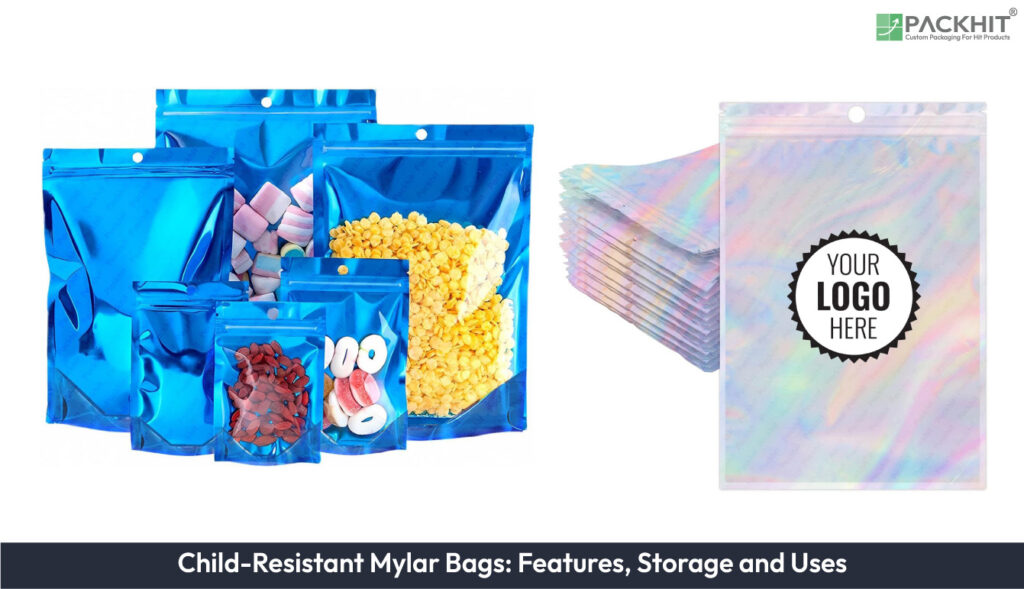
Child-resistant mylar bags are protective packaging designed to restrict access by young children while safeguarding sensitive contents. Their key features include durable multilayer films, secure closures, odor control, customization, and temperature tolerance. Child-resistant mechanisms work through closure systems that require coordinated actions that are difficult for young children to perform. For storage, these bags help protect contents from moisture, oxygen, light, odors, and physical damage. They are used across pharmaceuticals, cannabis, household chemicals, and selected food applications. Compared with rigid containers and blister packs, mylar bags can offer greater flexibility, lower weight, easier customization, and potential cost advantages. Manufacturers must also account for applicable testing, labeling, material-safety, and jurisdiction-specific regulatory requirements.
- What are Child-Resistant Mylar Bags?
- Key Features of Child-Resistant Mylar Bags
- Child-Resistant Closures
- Multilayered Barrier Films
- Durability
- Odor Containment
- Customizable Design
- Temperature Resistance
- How Do Child-Resistant Mechanisms in Mylar Bags Work?
- What are the Storage Capabilities of Child-Resistant Mylar Bags?
- What are the Primary Uses of Child-Resistant Mylar Bags?
- How Do Child-Resistant Mylar Bags Compare to Alternative Packaging?
- What are the Regulatory Considerations for Manufacturers?
What are Child-Resistant Mylar Bags?
Child-resistant mylar bags are flexible packaging designed to help restrict access by young children while protecting sensitive contents. Their construction may include biaxially oriented polyethylene terephthalate (BoPET) and child-resistant closure systems such as specialized zippers or sliding mechanisms. Actual child-resistant performance depends on the specific bag-and-closure configuration and whether that configuration has been tested for the intended application.
Key Features of Child-Resistant Mylar Bags
The performance of child-resistant mylar bags depends on their film structure, closure design, thickness, and intended use. Common features may include:
Child-Resistant Closures
Some bags use press-to-close zippers, sliding locks, or other specialized closure systems intended to make opening more difficult for young children. A closure should be described as certified or compliant only when the specific package configuration has been tested against the applicable standard.
Multilayered Barrier Films
Mylar-based packaging can incorporate multilayer structures designed to reduce exposure to moisture, oxygen, and light. Barrier performance varies by film composition, thickness, coatings, seals, and test conditions.
Durability
Depending on the construction, these bags may provide resistance to punctures, tears, and routine handling stresses. Actual durability should be confirmed using specifications or testing for the selected package.
Odor Containment
Some constructions include foil or other high-barrier layers that can help reduce odor transmission. Performance varies with material structure, seal quality, and the product being packaged.
Customizable Design
Manufacturers can vary dimensions, printing, graphics, closure types, and other design elements to suit product and branding requirements. Any modification that affects the package structure or closure may need to be reviewed for its effect on tested performance or compliance.
Temperature Resistance
Temperature tolerance is product-dependent and should be verified for the specific film laminate, adhesive, seal, and closure system. Broad ranges such as -80°C to 150°C should not be treated as universal specifications unless they are supported by manufacturer data and appropriate test conditions.
How Do Child-Resistant Mechanisms in Mylar Bags Work?
Child-resistant closures are generally designed to require coordinated actions that are more difficult for young children to perform than for adults. These may include specific pressing, sliding, alignment, or multi-step opening motions.
Whether a closure qualifies as child-resistant depends on the complete package design and the applicable test protocol. Performance should therefore be verified for the exact bag, closure, contents, and intended market rather than inferred from the closure type alone.
What are the Storage Capabilities of Child-Resistant Mylar Bags?
Storage performance varies according to the laminate structure, seal quality, closure design, contents, and environmental conditions.
- Barrier Properties: Some multilayer constructions can provide low oxygen and moisture transmission, but OTR and MVTR values are specific to the tested material and conditions. Figures such as 0.1 cc/m²/day or 0.1 g/m²/day should only be used when supported by product-specific test data.
- Temperature Resistance: Suitable storage temperatures depend on the exact materials and package construction. Refrigeration or high-temperature use should be confirmed against the manufacturer’s specifications.
- Odor Containment: Foil and other barrier layers may help reduce odor transmission, although effectiveness depends on the package structure and seal integrity.
- Long-Term Durability: Resistance to puncture, tearing, and storage stress varies by film thickness, laminate design, handling, and storage environment.
What are the Primary Uses of Child-Resistant Mylar Bags?
Child-resistant mylar bags may be used where flexible packaging, environmental protection, and restricted access are required, subject to product-specific and jurisdiction-specific requirements.
Pharmaceuticals
For pharmaceutical products, these bags may be used where the selected package meets the applicable requirements for the medication, closure system, barrier properties, and market.
Cannabis Products
In cannabis packaging, child-resistant mylar bags are commonly considered for products such as flower, edibles, and concentrates. Required child resistance, resealability, opacity, labeling, and barrier performance vary by jurisdiction and product type.
Household Chemicals
For household chemicals, suitable child-resistant packaging depends on the contents, hazard classification, closure design, and applicable packaging rules. The package should be evaluated for compatibility with the chemical as well as child-resistant performance.
Food and Beverages
Some food products may use high-barrier mylar-style packaging where moisture, oxygen, or light protection is useful. Child-resistant features are only relevant where required by the product, use case, or applicable regulation.
Verification note: Technical performance claims, including barrier values, temperature ranges, durability, child-resistant certification, and regulatory compliance, should be supported by specifications or test data for the exact bag construction and closure being used. Compliance also depends on the packaged product, intended use, and jurisdiction.
How Do Child-Resistant Mylar Bags Compare to Alternative Packaging?
Compared to other child-resistant packaging options, such as rigid plastic containers or blister packs, mylar bags offer several advantages:
- Flexibility: Mylar bags are lightweight and flexible, reducing shipping and storage costs compared to rigid containers.
- Customizability: The ability to print directly on the bag surface allows for high-quality branding and labeling, which is more challenging with rigid packaging.
- Environmental Impact: Many mylar bags are recyclable or made from partially recycled materials, offering a more sustainable option than single-use plastics.
- Cost-Effectiveness: Mylar bags are generally more affordable to produce in bulk, making them a cost-efficient choice for manufacturers.
Note: Mylar bags can be a practical choice when flexibility, lower package weight, and printable surface area are priorities, while rigid containers or blister packs may be better suited to products that require greater structural protection, unit-dose organization, or a different dispensing format.
What are the Regulatory Considerations for Manufacturers?
Regulatory requirements for child-resistant mylar bags vary according to the product, package design, intended use, and jurisdiction. Manufacturers should evaluate the rules that apply to the specific packaging configuration and market. Key considerations may include:
- Testing Protocols: Depending on the product and jurisdiction, child-resistant packaging may need to meet applicable CPSC requirements, ASTM classifications, or other recognized testing criteria.
- Labeling Requirements: Required warnings, opening instructions, symbols, and other label elements can vary by product category and governing authority.
- State-Specific Regulations: Cannabis packaging requirements in the United States vary by state and may impose additional requirements for child resistance, labeling, opacity, or resealability.
- Material Safety: Material requirements depend on the packaged product and intended use, including any applicable food-contact, pharmaceutical, or chemical-packaging standards.
Meeting one testing standard or packaging criterion does not by itself establish compliance for every product or market. Manufacturers should confirm all applicable requirements for the specific package and jurisdiction before release.
Note: Child-resistant packaging is intended to make access more difficult for young children, but it is not childproof. This information is general in nature and does not establish that a particular package is legally compliant. Applicable testing, labeling, material, and product-specific requirements should be verified with a qualified compliance professional.