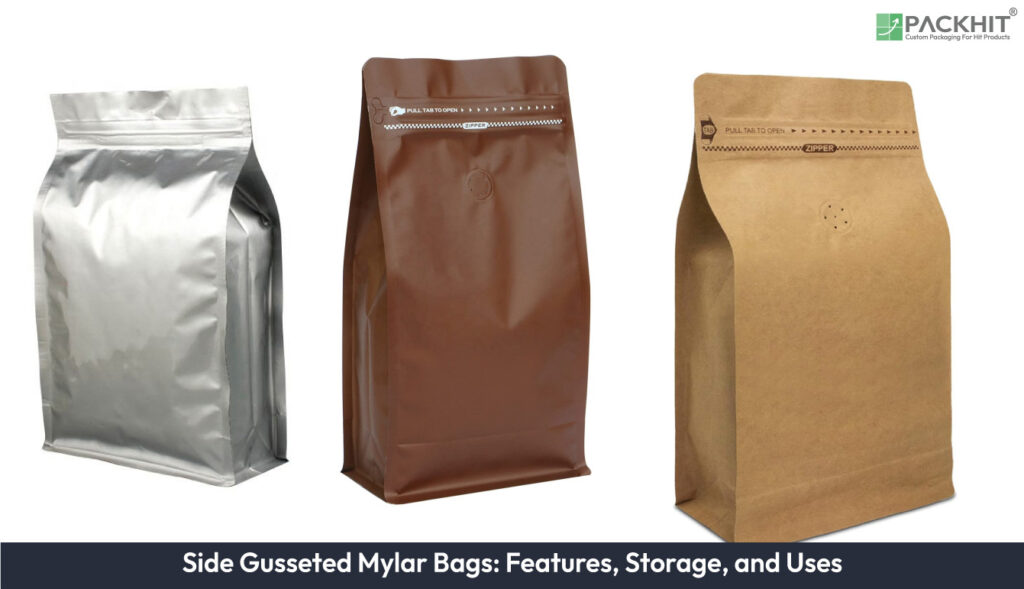
Side-gusseted mylar bags combine expandable pouch geometry with application-specific laminate structures, closure options, barrier properties, and storage requirements. Their suitability varies by product, with considerations including food-contact compliance, printing and labeling, recyclability, comparison with other pouch formats, vacuum sealing, freezing, liquid compatibility, shelf-life validation, and storage after opening. They are used across food, nutraceutical, pet food, agricultural, electronics, chemical-powder, and other selected packaging applications.
- What are Side Gusseted Mylar Bags?
- Features of Side Gusseted Mylar Bags
- Expandable Capacity
- High Barrier Properties
- Mechanical Durability
- Closure Flexibility
- Customizable Dimensions
- How Should Side-Gusseted Mylar Bags Be Stored?
- Which Industries Use Side Gusseted Mylar Bags?
- Food Packaging
- Nutraceuticals and Health Products
- Pet Food and Agricultural Products
- Non-Food Applications
- What are the Regulatory and Food-Contact Considerations for Side Gusseted Mylar Bags?
- How are Printing, Labeling, and Aesthetic Choices Implemented in Mylar Packaging?
- What are the Environmental Impacts and End-of-Life Options for Mylar Bags?
- How do Side-Gusseted Mylar Bags Compare to Stand-up and Flat Bags?
- Can Side-Gusseted Mylar Bags be Vacuum Sealed?
- Are Side-Gusseted Mylar Bags Suitable for Freezing?
- Can Side-Gusseted Mylar Bags Be Used for Liquids?
What are Side Gusseted Mylar Bags?
Side-gusseted mylar bags are flexible pouches whose side panels are folded inward as gussets so the bag expands laterally when filled, producing a block-shaped profile suitable for packing in cartons or on pallets.
They constitute a subclass of pre-made flexible packaging used where a rectangular form factor, efficient shelf stacking, or box packing is required; common configurations include zipper-reseal, heat-seal-only, and versions with tear notches or slider zippers.
Material and Laminate Structure of Side-Gusseted Mylar Bags
Side-gusseted mylar bags are commonly made from multilayer flexible laminates in which each layer serves a different packaging function. The exact materials, layer thicknesses, and total laminate gauge vary by supplier, intended product, filling process, barrier requirement, and mechanical-performance needs.
A typical construction may include:
- Outer PET or BoPET layer: Commonly used to provide printability, dimensional stability, abrasion resistance, and mechanical strength.
- Barrier layer: May consist of aluminium foil, metallized PET, or another barrier material selected according to the required resistance to oxygen, moisture, light, or aroma transmission. Barrier performance depends on the complete laminate structure and should be verified from supplier test data.
- Inner sealant layer: Often based on PE, LLDPE, or another heat-sealable polymer selected for the intended sealing process and product-contact application. Food-contact suitability should not be assumed from the polymer type alone and should be confirmed through applicable supplier declarations and regulatory documentation.
Layers may be bonded with adhesives or tie layers. Overall laminate thickness and individual layer gauges are specification-dependent rather than universal and should be confirmed with the packaging supplier.
When selecting a laminate, evaluate the product’s sensitivity, required barrier properties, sealing conditions, filling method, distribution environment, and applicable regulatory requirements.
| Layer | Function | Typical Thickness (μm) |
|---|---|---|
| PET (Outer) | Printability, tensile strength, and abrasion resistance | 12-50 |
| Aluminium Foil / Metallized PET | Oxygen and moisture barrier | 6-20 (foil) / Varies (metallized PET) |
| PE (Sealant) | Heat sealing and food contact | 40-150 |
The multi-layered design ensures the bags meet diverse packaging demands, including mechanical durability, extended shelf life, and compatibility with food and non-food applications. When selecting a laminate structure, consider factors like product sensitivity, storage conditions, and filling processes to ensure optimal performance.
Features of Side Gusseted Mylar Bags
Side gusseted mylar bags are distinguished by their combination of structural versatility, barrier performance, and suitability for automated packaging processes. The following features make them a preferred choice across multiple industries:
Expandable Capacity
The gusseted design allows the bag to expand laterally, creating a rectangular profile ideal for efficient stacking, filling, and storage. This feature is particularly useful for products requiring high-volume packaging while maintaining a compact footprint.
High Barrier Properties
The multi-layered laminate structure ensures superior resistance to oxygen, moisture, and light, preserving the quality and shelf life of sensitive products such as coffee, dried foods, and electronics. Aluminium foil laminates provide the lowest permeation rates, while metallized PET offers a cost-effective alternative.
Mechanical Durability
These bags are designed for strength, with excellent puncture resistance, tensile strength, and seal reliability. This durability ensures the integrity of the packaging during handling, transport, and storage.
Closure Flexibility
Available with options such as resealable zippers, slider closures, heat-seal-only designs, and tamper-evident seals, side-gusseted mylar bags can be tailored to meet various product and consumer needs.
Customizable Dimensions
The width, height, and gusset depth can be adjusted to accommodate specific fill volumes and bulk densities, making these bags adaptable to a wide range of product types and packaging configurations.
These distinct features make side gusseted mylar bags a versatile and efficient choice for manufacturers seeking reliable, high-performance packaging solutions.
How Should Side-Gusseted Mylar Bags Be Stored?
Side-gusseted mylar bags require proper storage to preserve their quality and functionality. They can be stored either empty or filled, with specific conditions tailored to their state and usage.
Storage of Empty Side-Gusseted Mylar Bags
Unused side-gusseted pouches should be stored in accordance with the supplier’s specified handling and storage conditions. In general, they should be kept clean, dry, protected from direct sunlight and excessive heat, and retained in suitable packaging to minimize deformation, contamination, or damage.
Acceptable temperature and relative-humidity limits vary according to the laminate, adhesives, zipper or closure system, inks, coatings, and other components. Exposure to conditions that may adversely affect these materials, including excessive heat, moisture, UV radiation, ozone, solvents, or incompatible chemicals, should be avoided where relevant.
A first-in-first-out inventory system can help manage stored packaging materials. The recommended storage life of unused pouches is supplier- and construction-specific and should be confirmed from technical data sheets, certificates of conformity, or other applicable supplier documentation.
Storage of Filled Side-Gusseted Mylar Bags
Storage requirements for filled pouches should be determined primarily by the packaged product and the validated package system. Appropriate temperature, humidity, stacking, freezing, and handling limits depend on the product, laminate construction, seal performance, and distribution conditions.
Where desiccants, oxygen absorbers, refrigeration, or freezing are used, their suitability should be established for the specific product and packaging system. Any storage-life or performance claim should be supported by relevant product-specific testing or supplier documentation.
Which Industries Use Side Gusseted Mylar Bags?
Side gusseted mylar bags are used in food packaging, nutraceuticals and health products, pet food and agricultural products, and selected non-food applications.
Food Packaging
In the food industry, side-gusseted mylar bags are used for products such as coffee, nuts, dried fruits, and confectionery. Depending on the laminate structure and seal performance, their barrier properties can help protect products from oxygen, moisture, and other environmental factors during storage and transport.
For coffee packaging, some pouch configurations may also incorporate degassing valves where required by the product and packaging process.
Nutraceuticals and Health Products
Side-gusseted pouches may be used for products such as powders, tablets, and other dry health-related goods where protection from moisture and contamination is required. Suitability depends on the product, laminate construction, sealing system, and applicable regulatory requirements.
Pet Food and Agricultural Products
These pouches may be used for pet food and agricultural products such as seeds and certain dry or powdered materials. Package construction should be selected according to product sensitivity, bulk density, storage conditions, and handling requirements.
Non-Food Applications
Side-gusseted pouches are also used for non-food products, including certain electronics, chemical powders, and small hardware components. Applications that require moisture control, static protection, or other specialized performance may require additional materials or package features.
These applications show that side-gusseted mylar bags can be used for food, health-product, agricultural, electronics, chemical-powder, and hardware packaging when the laminate structure and closure system are selected to suit the product and intended use.
What are the Regulatory and Food-Contact Considerations for Side Gusseted Mylar Bags?
Food-contact layers and adhesives in mylar bags must comply with relevant regulations, such as national food-contact rules. Reverse printing is only acceptable when the printed layer is outside the food-contact area or separated by a complete barrier to prevent ink migration into the product.
Manufacturers should request declarations of conformity and migration test data from suppliers. For regulated markets, verify allergen cross-contact controls and traceability data within the supplier’s quality system to ensure compliance and product safety.
How are Printing, Labeling, and Aesthetic Choices Implemented in Mylar Packaging?
Reverse printing on PET outer layers allows for durable graphics and protects inks from abrasion. Common printing methods include flexographic and rotogravure styles, with options for glossy varnishes or matte finishes to control perceived quality and scuff resistance.
Variable data, such as QR codes and batch/lot numbers, can be applied to most laminates. However, inks and varnishes must be compatible with barrier seals and recycling processes to avoid compromising packaging functionality or environmental goals.
What are the Environmental Impacts and End-of-Life Options for Mylar Bags?
Multilayer laminated mylar bags are challenging to recycle via standard curbside collection due to their combination of metal, PET, and polyolefin layers. Specialized recycling programs, including chemical or mechanical methods, are geographically limited.
For improved recyclability, consider mono-material alternatives, such as mono-PE pouches with barrier coatings, or implement supplier take-back programs. Manufacturers should include recyclability statements in procurement evaluations and provide end-of-life handling instructions on product specifications.
How do Side-Gusseted Mylar Bags Compare to Stand-up and Flat Bags?
Side-gusseted mylar bags expand laterally, creating a rectangular profile that is optimal for box packing and space-efficient stacking. In contrast, stand-up pouches feature a bottom gusset for shelf stability and better consumer-facing display, while flat bags are simpler but less suitable for high-volume bulk products.
Choose side-gusseted designs for cartonization, block stacking, and rectangular filling geometry, while stand-up pouches are better suited for retail presence and visual appeal.
Can Side-Gusseted Mylar Bags be Vacuum Sealed?
Yes, vacuum sealing is feasible if the chosen laminate and closure are compatible with the vacuum process and the sealing system produces consistent, contaminant-free seals; for best results, use bag geometries and materials specified for vacuum packaging and confirm vacuum levels acceptable for the product to avoid crushing fragile contents.
Are Side-Gusseted Mylar Bags Suitable for Freezing?
Freezing is suitable for many side-gusseted mylar bags provided the laminate maintains integrity at target temperatures (typical commercial freezing ≤ −18 °C) and the sealant layer remains ductile to resist brittle failure; consult the supplier for low-temperature performance data and perform freeze‑thaw cycle tests when necessary.
Can Side-Gusseted Mylar Bags Be Used for Liquids?
Use with liquids is possible but requires specific design choices: strong seals (often triple-seal), appropriate closure systems, and laminate stiffness to resist deformation during handling; continuous liquid-fill applications commonly prefer stand-up or spout-equipped pouches designed for wet fill.
