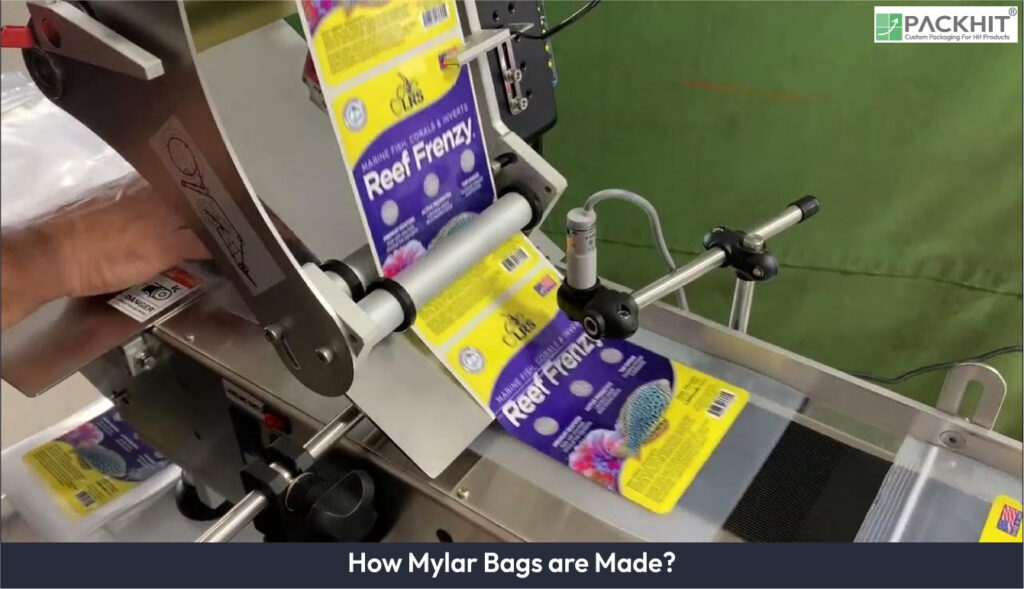
Mylar bags are flexible laminated packaging structures commonly based on biaxially oriented polyethylene terephthalate (BoPET) combined with barrier and heat-sealable layers. Depending on the construction, the laminate can help limit exposure to oxygen, moisture, and light while providing the strength and flexibility needed for converting and handling.
The manufacturing route generally includes material selection, BoPET film production or sourcing, barrier-layer preparation, lamination, printing, slitting, bag forming, feature installation, sealing, trimming, inspection, and final packaging where critical controls include laminate compatibility, seal consistency, and verification of barrier integrity before release. The exact materials and process controls vary with the intended product, required barrier performance, sealing method, food-contact requirements, and expected storage conditions.
For manufacturers, the important point is that mylar is not a single universal construction. A foil-laminated pouch, a clear polymer-based pouch, and a pouch with a resealable zipper can have materially different barrier, sealing, and durability characteristics. Specifications should therefore be based on the complete laminate and finished package rather than the word “mylar” alone.
What are Mylar Bags Made Of?
Mylar bags are commonly constructed around BoPET film. Additional layers are selected to provide specific functions such as light protection, reduced gas or moisture transmission, heat sealing, printability, or mechanical protection.
Typical components include:
- BoPET film: Provides tensile strength, dimensional stability, and a stable film substrate for further processing.
- Aluminum foil or metallized layer: Can provide a high barrier to light and substantially reduce oxygen and moisture transmission when incorporated correctly into the laminate.
- Heat-sealable inner layer: A compatible polymer layer provides the surface needed to form the package seal.
- Adhesive or bonding layer: Used in some laminated constructions to join different substrates.
- Optional functional layers: Depending on the application, additional films, coatings, printing layers, zippers, valves, windows, or other features may be incorporated.
The practical performance of the finished bag depends on how these layers work together. For example, a high-barrier layer does not by itself guarantee package integrity if the laminate is damaged or the finished seal is defective.
How is BoPET Film Produced?
BoPET is produced from PET resin through film-forming and orientation processes. The general sequence is:
- Resin preparation: PET resin is prepared for film processing according to the required material specification.
- Extrusion: The resin is melted and formed into a continuous film.
- Casting: The molten film is cooled and solidified into a stable web.
- Machine-direction orientation: The film is stretched in one direction.
- Transverse orientation: The film is stretched in the perpendicular direction.
- Heat setting: The oriented film may undergo controlled thermal treatment to stabilize its dimensions and processing characteristics.
- Inspection and winding: The finished film is inspected and wound for subsequent converting or lamination.
The orientation step is important because it changes the polymer structure and contributes to the strength and dimensional stability needed during subsequent converting. Manufacturers should not, however, treat orientation alone as proof of a particular barrier or shelf-life performance; those properties depend on the complete film and laminate specification.
What is the Laminating Process in Mylar Bag Manufacturing?
Lamination combines BoPET with other films or barrier materials to create the required multilayer structure. The chosen method affects bonding, processing, material compatibility, and manufacturing economics.
Adhesive Lamination
Adhesive lamination uses an adhesive to bond two or more substrates. The adhesive is applied to one layer, and the substrates are brought together under controlled processing conditions.
This approach can be useful when a particular combination of films or foils is required. For food-contact packaging, however, the adhesive and other food-contact components must be suitable for the intended application; simply describing an adhesive as “food grade” is not sufficient to establish regulatory compliance.
Extrusion Lamination
Extrusion lamination uses a molten polymer as the bonding layer between substrates. The polymer is extruded between the materials and solidifies as the laminate is formed. It can be attractive for continuous industrial production, but the correct choice depends on the substrates, required bond performance, processing equipment, and final-package requirements.
How Should Manufacturers Choose Between Lamination Methods?
Choose a lamination method by matching the barrier target to the film chemistry, then verify the result with package-level tests. Manufacturers balance several measurable factors:
- Oxygen barrier: Target OTR performance for the expected shelf life (example: low-OTR use for dry foods).
- Moisture barrier: Target WVTR performance for the humidity load (example: lower WVTR use for powders).
- Light protection: Confirm the finished bag blocks harmful exposure (example: UV-sensitive contents).
- Substrate compatibility: Match adhesive and tie-layer chemistry to the chosen film types (example: polyester, nylon, or metallized films).
- Sealant requirements: Align lamination surfaces with the selected heat-seal film or sealant system (example: bag closure heat seal).
- Bond strength: Verify peel strength after conditioning (example: peel after 24 h at room temperature).
- Processing conditions: Confirm lamination temperature and dwell time fit the web speed and equipment limits (example: high-speed line with controlled tension).
- Food-contact or other regulatory requirements: Confirm the full material set meets the intended use category (example: direct food contact packaging).
- Production speed and material efficiency: Track throughput and scrap rate from web breaks and misalignment (example: fewer wrinkles reduce rework).
- Storage and handling conditions: Match bond performance to temperature swings and flexing (example: transport vibration).
If the application requires a particular food-contact formulation or a specific laminate structure, regulatory suitability checks happen before production runs. A simpler construction fits lower-risk uses when performance gaps stay inside the acceptance limits, and no regulatory constraints apply.
Selection checkpoints: record the target barrier numbers, then run a small pilot to confirm bond strength and seal integrity on the exact films and sealant surfaces used for production.
When to escalate: escalate to food-contact or regulatory review when the intended contents change from non-food to direct food contact, when migration risk is unclear, or when customer documentation requires a defined material declaration.
How are Mylar Bags Converted and Formed?
After lamination, the finished web is converted into individual bags or pouches. Conversion typically includes:
Slitting and Cutting
Large rolls are slit into appropriate widths and converted into panels or webs for the selected bag format. Dimensional control matters because inaccurate cuts can affect gusset formation, zipper placement, seal width, and final bag dimensions.
Folding and Bag Formation
The laminated material is folded or formed into the required geometry. Common formats include flat pouches, gusseted bags, stand-up pouches, and other custom structures. The bag geometry should match the filling process and product characteristics. For example, a gusseted structure can provide additional capacity, while a flat pouch may be more appropriate where compact storage is the priority.
Feature Installation
Features such as zippers, tear notches, valves, windows, and other components may be added during conversion. These features introduce additional interfaces that need to be controlled. A zipper or valve, for example, can create a potential weak point if its placement, sealing, or compatibility with the laminate is not properly controlled.
Heat Sealing
The sealing layer is activated using controlled heat and pressure, with dwell time and equipment settings selected for the specific structure. Some applications may use other sealing technologies. A good seal should provide the required package integrity without damaging the laminate. In practice, manufacturers should monitor seal consistency and inspect for channels, incomplete seals, wrinkles, contamination, or other defects that could compromise package performance.
Seal strength can be quantitatively evaluated using recognized methods such as ASTM F88/F88M, which measures the force required to separate a sealed specimen and can also identify the mode of failure.
Testing and Quality-Control Approach for Mylar Bags for Manufacturers
Testing should be selected according to the package specification rather than presented as a universal test package for every mylar bag. Depending on the application, manufacturers may evaluate:
| Attribute | What it helps verify |
|---|---|
| Film thickness | Material consistency and dimensional specification |
| Laminate bond strength | Integrity between layers |
| Seal strength | Consistency and strength of the finished seal |
| Leak or package-integrity testing | Whether the finished package has detectable leakage |
| Puncture resistance | Resistance to damage during handling |
| OTR | Oxygen transmission performance of the specified structure |
| MVTR | Moisture-vapor transmission performance of the specified structure |
| Dimensional inspection | Bag size, seal location, and feature placement |
| Print inspection | Artwork, registration, legibility, and surface quality |
ASTM maintains methods for several flexible-packaging measurements, including seal strength, heat-seal behavior, thickness, laminate bond-related measurements, and penetration resistance. The applicable method and acceptance criteria should be selected for the actual package and application rather than assumed from a general industry description.
What Matters Most for Manufacturing Quality of Mylar Bags?
The most important controls are not necessarily the most complicated process steps. For a manufacturer, several areas deserve particular attention:
- Layer compatibility: The materials must bond and process correctly as a complete laminate.
- Barrier continuity: Foil, metallized layers, and other barrier components need to remain intact through lamination and conversion.
- Seal consistency: Seal temperature, pressure, dwell time, seal width, and material cleanliness can affect package integrity.
- Feature placement: Zippers, valves, windows, and notches should not create unintended weak points.
- Dimensional accuracy: Bag dimensions affect filling, product fit, stacking, and sealing.
- Material suitability: The selected materials must match the product and intended conditions of use.
- Regulatory suitability: Food-contact and other regulated applications require verification for the actual formulation and intended use.
This is why thickness alone is not an adequate specification for a mylar bag. Two bags with similar overall thickness can have different barrier layers, sealants, adhesives, and resulting performance.
What Makes Mylar Bags Suitable for Packaging?
Mylar bags use multilayer mylar laminates that combine base film strength (BoPET) with barrier and sealing layers for product protection during storage and handling. Barrier performance comes from the full layer stack, not the word “Mylar” alone.
Mylar-based laminates can include several construction choices, each changing light blocking, moisture transfer, oxygen transfer, and how the bag seals during filling. The same filling equipment can produce different results if the sealing layer changes.
The benefit depends on the construction:
- Foil-containing structures can provide strong light and oxygen-barrier protection for light-sensitive contents.
- Metallized structures can provide substantial barrier performance while keeping a different look and different processing behavior than foil.
- Clear structures prioritize product visibility during inspection, if the application tolerates a lower light barrier than foil-based constructions.
- Resealable structures can support repeated access using a closure feature, if the manufacturer verifies that the reseal method matches the needed barrier after each opening.
- Vacuum-oriented structures can support vacuum use if the bag geometry and sealing layers match the vacuum process and load.
For manufacturers, the best configuration follows the product’s sensitivity to oxygen, moisture, and light, plus the required storage period and the real-world handling environment (temperature swings, repeated opening, and transit vibration).
Environmental and Regulatory Considerations of Mylar Bags
Environmental performance depends on the complete laminate design. Layer count, layer weights, coatings, adhesives, and the practical availability of local recycling or recovery routes affect end-of-life outcomes more than the base film name.
A multilayer package can provide useful barrier performance if the supplier and the manufacturer document how the laminate fraction is recovered in the target region. A simpler single-material structure often sorts more easily if recycling infrastructure exists for that material stream.
Sustainability claims should tie back to the specific mylar bag construction and its stated recovery pathway. Use construction facts, such as closure type, layer structure, and compatible recovery programs, rather than relying on generic material labels.
Food-Contact Safety of Mylar Bags
Food-contact safety is application-specific for the specific laminate and components used in the manufacturer’s mylar bag construction. In the United States, FDA regulates substances that come into contact with food, and the regulatory status depends on each component and its intended conditions of use.
For the manufacturer’s exact formulation, FDA identifies regulatory pathways, including applicable regulations in Title 21 CFR, effective Food Contact Substance Notifications, and other authorized pathways. Therefore, the phrase “FDA compliant mylar bag” does not automatically cover every mylar laminate configuration, sealant, adhesive, ink, or closure feature.
Verify the actual laminate, adhesive system, printing inks, sealant chemistry, and closure components against the intended food type and conditions of use, such as refrigerated, frozen, room-temperature, hot-filled, or heat-sterilized applications.
Depending on the specific components in the laminate, migration testing and food-contact safety assessments can support the evaluation. FDA’s framework can consider migration data and toxicological information tied to the particular use conditions.
Note: This is all general educational information, not a regulatory determination. Before direct food contact use, request the supplier’s applicable compliance documentation for the specific construction and verify that it covers the manufacturer’s planned conditions. When the use is regulated or uncertain, consult a qualified food-safety or regulatory professional before approving the packaging.