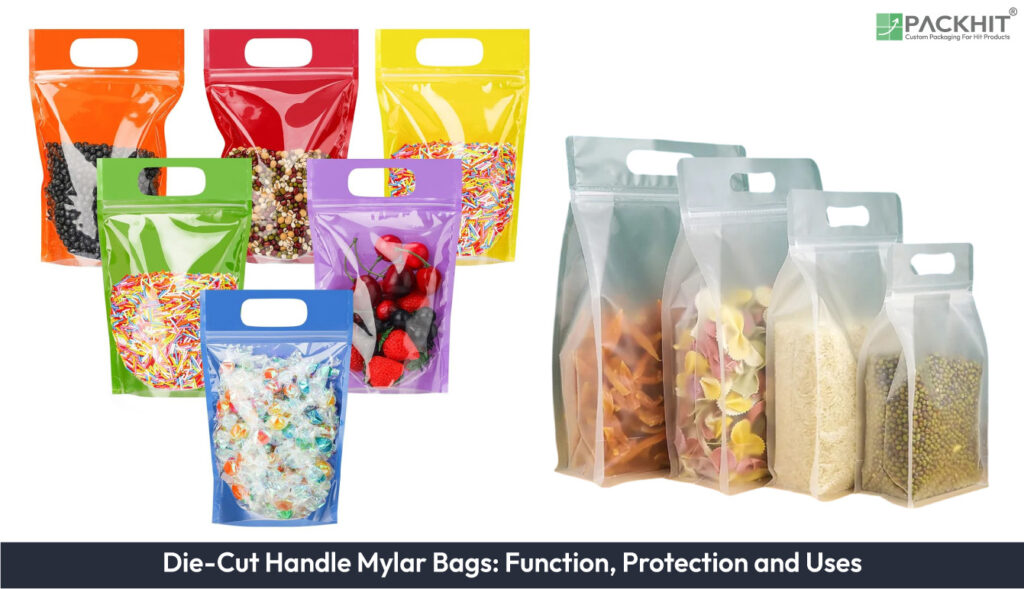
Die-cut Mylar bags combine an integrated carry aperture with multilayer BoPET-based laminates and a heat-seal layer to provide defined barrier performance, print-ready graphics, and carry function. Typical construction of die-cut Mylar bags uses a printable PET face, metallized PET or aluminium foil for low OTR, PA for puncture resistance, and PE/CPP for sealability. Manufacturing follows surface treatment, printing, metallization/foil, lamination, slitting, pouch forming, die-cutting, reinforcement application, and packing, while process controls monitor web tension, optical registration, nip force, and seal temperature. Industries that use die-cut Mylar bags include retail, food, cosmetics, electronics, agriculture, and industrial components. Select die-cut Mylar when barrier, branding, and carry outweigh higher per-unit cost and recycling complexity; add laminated patches or grommets if load >10 kg.
- What is a Die-Cut Handle Mylar Bag?
- What Materials and Laminate Structures Compose Die-cut Mylar Bags?
- How Do Die-cut Mylar Bags Protect Contents (barrier metrics)?
- How are Die-cut Mylar Bags Manufactured?
- Which Industries Commonly Use Die-cut Mylar Bags?
- Retail and Promotional
- Food and Snacks
- Personal Care and Cosmetics
- Electronics
- Agriculture and Horticulture
- Industrial Components
- How Should Die-Cut Mylar Bag Testing Be Sampled and Documented?
- How Do Die-cut Mylar Bags Compare with Alternative Packaging Formats?
What is a Die-Cut Handle Mylar Bag?
A die-cut mylar bag is a laminated flexible pouch that incorporates a mechanically cut hand aperture into a mylar (BoPET) laminate to combine carryability, controlled-barrier protection, and retail presentation.
These packages are specified by layer function, handle geometry, and finishing details. Typical layer roles include a printable PET face for graphics, a barrier layer (metallized PET or aluminium foil) for oxygen/light control, a puncture-resistant layer (nylon) for mechanical protection, and an inner heat-seal layer (PE or CPP) for closure integrity.
For procurement and validation, request per-layer thickness, seal-strength method (ASTM F88 or equivalent), handle-placement tolerances (±1–2 mm), and sample packs for production trials. Match laminate choice to shelf-life, mechanical load, and recyclability targets when selecting a final construction.
What Materials and Laminate Structures Compose Die-cut Mylar Bags?
A die-cut mylar bag uses layered films: printable BoPET (mylar), a barrier layer (metallized PET or aluminium foil), a puncture layer (PA/nylon), and an inner heat-seal layer (PE or CPP) to meet barrier, print, and seal requirements.
- PET / PE: Printable face and basic seal; examples: PET 12–25 µm + PE 40–120 µm; typical total thickness ≈ 60–150 µm.
- PET / AL / PE: Light and oxygen barrier; examples: printable PET + metallized PET or Al foil + PE; typical total thickness ≈ 80–200 µm.
- PET / PA / PE: Puncture resistance and sealability; examples: PET + nylon (12–40 µm) + PE; typical total thickness ≈ 100–250 µm.
Select a construction by quantified targets: OTR and MVTR for shelf life, force‑to‑puncture for sharp items, and per-layer recyclability for end‑of‑life trade-offs.
How Do Die-cut Mylar Bags Protect Contents (barrier metrics)?
Die-cut mylar bags protect contents by limiting oxygen, moisture, and light ingress and by resisting puncture; protection is reported as OTR, MVTR, percent visible transmission, and force-to-puncture.
- Oxygen (OTR): measured by ASTM D3985; metallized PET or aluminium-foil laminates typically reach <1 cc·m−2·day−1 (examples: metallized PET, Al foil); PE-only builds commonly measure ≥10 cc·m−2·day−1.
- Moisture (MVTR): measured by ASTM F1249; high-barrier laminates often show <0.1 g·m−2·day−1 (examples: foil laminates); PE‑heavy constructions often exceed 1 g·m−2·day−1.
- Light (transmission): measured by spectrophotometer; aluminium or opaque metallized films give <1% visible transmission (examples: foil-backed laminates); clear PET can allow >50% transmission.
- Mechanical (puncture/abrasion): puncture force measured in newtons (N) and abrasion by cycles (Taber); specify minimum force (example: 30–50 N for small sharp items) when sharp‑edge protection is required.
Design mapping: select metallized or foil laminates for low OTR/MVTR and opaque light protection; add a PA (nylon) layer for higher puncture resistance; use clear PET faces when display visibility is the priority.
Note: Barrier results depend on film grade, layer thickness, construction, and test conditions. Use supplier test data for the specific laminate rather than treating example OTR, MVTR, transmission, puncture, or thickness values as typical for every die-cut bag.
How are Die-cut Mylar Bags Manufactured?
Die-cut mylar bags manufacturing follows a linear web-conversion sequence from film supply to pouch forming, die-cutting, inspection, and packing. Below are typical high-level steps with concrete examples and numeric targets.
- Film supply and unwind: Load BoPET webs (12–50 µm) and PE sealant webs (40–120 µm) onto shafts. Set web tension to a stable band; typical running tension ranges by material and line, but is monitored by dancer or load‑cell systems. Use clean cores and leader tapes to prevent edge damage and contamination.
- Surface treatment: Apply corona or plasma to the PET face to raise surface energy for printing. Target contact angle <40° for common flexo ink systems. Verify treatment level with a tensiometer before printing.
- Printing: Use flexo or gravure for long runs and digital for short runs or variable data. Control color register to ±0.5–1.0 mm for multi‑color layouts. Cure or oven settings follow the ink supplier guidelines.
- Metallization/foil: Apply vacuum metallizing or dry‑laminated foil when a low OTR or a metallic finish is required. Metallized PET reduces visible transmission; aluminium foil achieves OTR often <1 cc·m−2·day−1 for high-barrier needs.
- Lamination: Bond barrier and sealant layers using solventless adhesive or extrusion lamination. Control nip force, temperature, and web speed per adhesive datasheet. Validate the bond with routine peel‑strength spot checks.
- Slitting and web handling: Set slit widths to the final pouch web width. Remove edge trim and inspect rewind rolls for wrinkles, dust, or contamination. Use edge guides and vacuum-assisted rewind to maintain web quality.
- Pouch forming and heat sealing: Route the web to formers and seal bars or continuous sealers. Use seal widths of 4–10 mm depending on expected load. Typical PE seal process window: 120–170°C and dwell 0.3–2 s; adjust pressure per sealant grade.
- Die-cutting or aperture cutting: Perform rotary die-cutting inline for high throughput. Use flatbed or reciprocating dies off‑line for short runs or thicker laminates. Produce handle geometries (D‑cut, oval, euro‑slot) per die profile. Maintain a handle‑to‑seal margin of 10–25 mm and fillet radii of 3–8 mm to reduce tear initiation.
- Finishing and packing: Apply reinforcement patches, zippers, or tear strips as specified. Inspect units for print defects, seal integrity, and handle quality. Pack and palletize according to the packing schedule and incoming logistics instructions.
Which Industries Commonly Use Die-cut Mylar Bags?
Die-cut mylar bags serve six primary sectors: retail and promotional, food and snacks, personal care and cosmetics, electronics, agriculture and horticulture, and industrial components.
Retail and Promotional
Custom die-cut mylar bags provide carry capability and high-impact graphics for retail and promotional distribution. Formats: shopper-style pouches, tote-style promotional bags, event swag packs (examples: apparel carry bags, branded gift kits, trade-show giveaways). Typical requirements: full-color print on PET face, handle ergonomics for 0.5–5 kg loads, optional laminated reinforcement patches or folded-strap welds for repeated use. Production notes: common run sizes 500–50,000 units; verify print-to-cut registration ±1 mm.
Food and Snacks
Die-cut mylar bags combine food-contact-compliant surfaces with controllable barrier and reseal features for retail food packaging. Formats: flat pouches, stand-up pouches, deli carry bags (examples: baked-goods take-away, snack multipacks, deli market pouches). Typical requirements for die-cut handle myalr bags include inks and adhesives, barrier targets for MAP (example: OTR <1 cc·m−2·day−1 for long shelf life), zipper or press-seal located below the handle for reseal, and tear-notches for tamper evidence. Process notes: specify seal strength (ASTM F88) and perform batch leak testing for MAP lots.
Personal Care and Cosmetics
Die-cut shaped mylar bags serve as kit and sample carriers that protect formulations while presenting high-quality graphics. Formats: kit pouches and sample packs (examples: travel toiletry packs, boxed gift sets, sample kits). Typical requirements: migration-tested layers for fragrance and oil contact, reverse or glossy PET print for photographic images, small-run customization economics (typical quantities 500–10,000 units). Regulatory note: include migration data and material declarations with sample approvals.
Electronics
Die-cut mylar bags provide ESD-control and particulate-minimum laminates for sensitive components while adding carry features. Formats: metallized shield pouches and multi-compartment kits (examples: accessory pouches, antistatic component bags, replacement-part kits). Typical requirements: antistatic or conductive metallized PET for ESD mitigation, low-particulate laminates for clean handling, handle reinforcement when bags carry connectors or tools (example: handle pull >30 N for loaded kits). Test guidance: require ESD surface-resistivity or charge‑decay criteria and incoming particulate checks.
Agriculture and Horticulture
Die-cut mylar bags protect seeds and bulbs from moisture and UV while providing a retail carry option. Formats: sealed sample sachets and small carry bags (examples: premium seed packs, bulb sample bags, specialty fertilizer samples). Typical requirements: UV-stable PET face, moisture-barrier laminates for seed viability, clear or opaque choices depending on light sensitivity, economical run sizes (example: 1,000–50,000 units per SKU). Supply note: include accelerated-aging targets and storage-humidity recommendations with orders.
Industrial Components
Die-cut mylar bags act as parts kits and service pouches that resist puncture and survive distribution. Formats: parts kits and maintenance packs (examples: fastener kits, on-site service packs, tool accessory pouches). Typical requirements: puncture-resistant PA layers when sharp parts are enclosed, reinforced handles or grommet assemblies for loads above 10 kg, and ISTA-style distribution testing for assembled shipments. Quality checklist: specify puncture-force minima, handle pull factor (3×–5× working load), and required distribution-test protocol.
How Should Die-Cut Mylar Bag Testing Be Sampled and Documented?
A testing sample is a documented subset of die-cut mylar packaging bags taken from one production batch to represent that batch during inspection. The record identifies the bag construction, production lot, sampling method, test conditions, measured results, and disposition.
- Batch sampling: Select 10–30 die-cut mylar bags from each production batch. Record the batch number, production quantity, bag dimensions, material structure, sampling date, and inspector.
- Acceptance criteria: State the AQL level, inspection level, pass/fail limits, test methods, and rejection conditions on the purchase order before production. Define separate limits for seal strength, handle tear resistance, puncture resistance, laminate adhesion, dimensions, and visual defects.
- Parameter recording: Record temperature, relative humidity, crosshead speed, specimen orientation, gauge length, test equipment identification, calibration status, and measured results for each test. Keep units consistent across the inspection record.
- Specimen identification: Mark each tested bag or cut specimen with its batch number and sample number. Link handle, seal, film, and closure results to the original bag rather than recording them as untraceable averages.
- Failure handling: Photograph failed seals, torn handles, pinholes, delamination, and dimensional defects. Record the failure location, failure mode, measured value, and retest decision without replacing the original result.
- Post-test documentation: Attach signed inspection records, batch certificates, laboratory reports, failed-sample findings, photographs, and corrective-action records to the shipment file. Record the final release, hold, rework, or rejection decision.
- Record retention: Store the inspection file with the purchase order, production lot, test equipment records, and shipment documents for the period required by the manufacturer’s quality system or customer specification.
How Do Die-cut Mylar Bags Compare with Alternative Packaging Formats?
Die-cut mylar bags combine integrated carry, measured barrier performance, and high print fidelity while incurring higher per-unit cost and more complex end-of-life handling. Use them if barrier performance, brand presentation, and carry function outweigh cost and recyclability.
Comparison points and practical guidance:
| Format | Strengths (examples) | Limitations (examples) |
| Die-cut mylar bag | Integrated carry, high barrier options, high print quality | Complex recycling, higher cost than single-polymer paper |
| Paper bag with handle | Low cost, recyclability in paper streams | Poor moisture/oxygen barrier, limited print vibrancy |
| Reusable textile tote | High re-use potential, strong consumer perception | Higher per-unit cost, bulkier storage, limited barrier |
| Rigid plastic or cardboard | Excellent mechanical protection and stackability | Higher material weight and cost, reduced flexibility |
Choose a paper mylar bag for lower cost, a reusable textile tote for lower cost, and rigid packaging for easier recycling and superior mechanical protection.