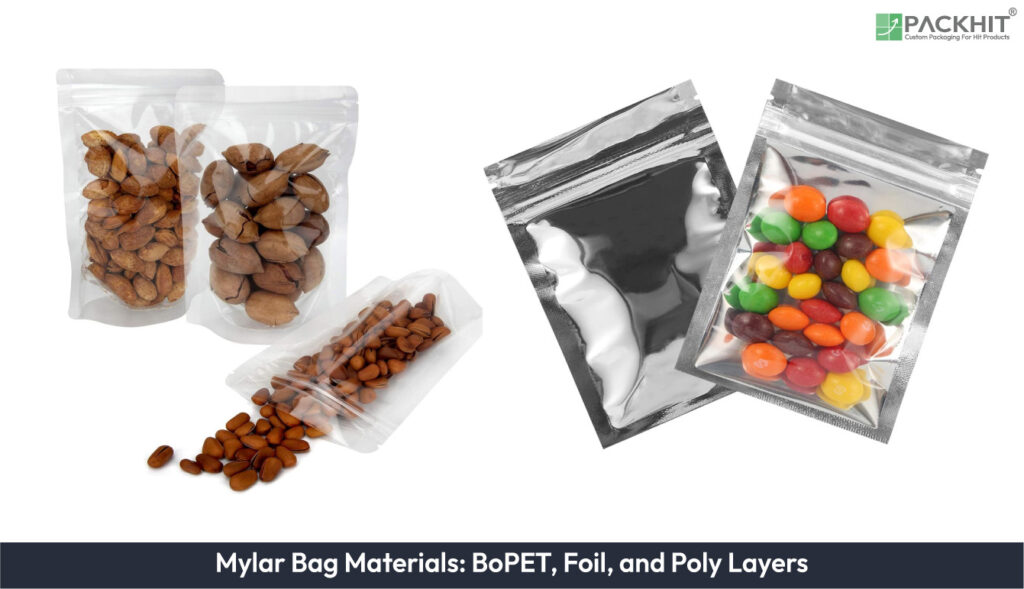
Mylar bags are constructed using a layered combination of BoPET (biaxially-oriented polyethylene terephthalate), aluminum foil, and polymer layers, each selected for its specific role in providing barrier protection, durability, and sealing efficiency. BoPET serves as the structural foundation, offering tensile strength, dimensional stability, and low permeability to gases and moisture, which contributes to extended shelf life. Aluminum foil enhances the barrier properties by blocking light, moisture, and odors, while its reflective surface aids in thermal insulation, making it suitable for temperature-sensitive applications. Polymer layers, typically polyethylene or polypropylene, ensure airtight seals and tear resistance while adding flexibility for efficient storage and transport. Together, these materials are laminated or co-extruded to form a composite structure that balances performance, cost-efficiency, and usability, catering to manufacturers’ diverse packaging needs.
- What Materials Are Mylar Bags Made Of?
- BoPET (biaxially-oriented polyethylene terephthalate)
- Aluminum Foil Layer
- Polyethylene (PE) sealant
- Polypropylene (PP) sealant or structural layer
- Function of BoPET in Mylar Bags
- How Does Aluminum Foil Enhance Mylar Bag Performance?
- What Role Do Poly Layers Play in Mylar Bag Construction?
- How are Mylar Bag Materials Combined in Mylar Bag Manufacturing?
What Materials Are Mylar Bags Made Of?
Mylar bags are primarily made of three material layers: BoPET (biaxially-oriented polyethylene terephthalate), an aluminum foil layer (or metallized aluminum), and one or more polymer sealant layers, commonly polyethylene (PE) or polypropylene (PP).
BoPET (biaxially-oriented polyethylene terephthalate)
As the primary structural component, BoPET forms the structural backbone and controls gas and moisture transmission. Typical film thickness may range from 12-50 µm. Treated or metallized BoPET can potentially reach oxygen transmission rates near 0.5 cc/m²/day. BoPET accepts vacuum metallization, adhesive lamination, and extrusion lamination. Surface treatments such as corona or plasma increase wetting and adhesion for inks, adhesives, and tie layers. Heat tolerance up to ~150°C may keep dimensions stable during sealing and thermal processing.
Aluminum Foil Layer
Aluminum foil layer, also known as metallized aluminum, provides a high optical and vapor barrier. Foil laminates commonly use 6-12 µm foil. Vacuum-deposited aluminum on BoPET is applied at the nanometer scale. The metal layer may block light, water vapor, and odors. To prevent pinholes and flex-cracking, manufacturers laminate foil between polymer layers or add protective coatings. Adding foil raises package cost and complicates mechanical recycling because metal-polymer bonds resist separation.
Polyethylene (PE) sealant
The polyethylene (PE) sealant serves as the inner heat-seal layer and gives moisture sealing plus film flexibility. Typical sealant thickness may be 20-100 µm. LDPE formulations may seal at about 110-130°C and give good foldability. MDPE or HDPE blends increase puncture resistance and reduce cut propagation. PE bonds well to many adhesives and co-extrusions. If laminating to nonpolar layers, include a compatibilizing tie layer for reliable adhesion.
Polypropylene (PP) sealant or structural layer
A polypropylene (PP) sealant adds stiffness, higher potential sealing temperatures, and improved tear resistance for machine-runner performance. PP sealant or structural layers typically range from 25-100 µm and may seal commonly at 140-170°C. Oriented PP increases stiffness and hot-tack for high-speed form-fill-seal lines and resists blocking. Co-extruded PP improves temperature stability compared with PE. Using PP requires adjusted sealing jaw dwell time and temperature profiles to achieve consistent seals.
Manufacturers combine these materials by lamination (adhesive or heat) or by co-extruding polymer layers onto BoPET or foil. Choices such as film thickness, metallization versus foil, and PE versus PP sealant depend on required barrier level, heat-seal method, mechanical handling, and cost.
Function of BoPET in Mylar Bags
BoPET forms the strong polyester layer that adds tensile strength, puncture and tear resistance, dimensional stability, and a printable surface to Mylar bags. Its molecular structure, characterized by high crystallinity, ensures low permeability to gases and moisture, making it ideal for applications requiring extended shelf life.
The optical clarity of BoPET is often modified through metallization or lamination processes, which improve its light-blocking capabilities. Additionally, BoPET exhibits excellent thermal resistance, withstanding temperatures up to 150°C without deformation, making it suitable for heat-sealing operations during bag manufacturing.
Why is BoPET Essential for Barrier Properties?
BoPET is essential for barrier properties because its dense polymer matrix restricts the diffusion of oxygen, carbon dioxide, and water vapor. This characteristic is critical for preserving the freshness and quality of perishable goods, such as food and pharmaceuticals. According to industry standards, BoPET films can achieve oxygen transmission rates (OTR) as low as 0.5 cc/m²/day, depending on thickness and surface treatments.
How Does Aluminum Foil Enhance Mylar Bag Performance?
Aluminum foil enhances mylar bag performance because when laminated onto the BoPET layer, aluminum foil provides a high barrier to gases and liquids. This helps offer significant protection against environmental factors that could degrade the contents. Its reflective surface also contributes to thermal insulation, reducing heat transfer and maintaining internal temperature stability.
The thickness of the aluminum foil layer typically ranges from 6 to 12 microns, depending on the application requirements. Thinner foil layers are used for lightweight packaging, while thicker layers are preferred for heavy-duty applications, such as industrial storage or long-term food preservation.
Limitations of Aluminum Foil in Mylar Bags
Despite the advantages, what are the limitations of aluminum foil in mylar bags include the fact that, while aluminum foil offers unparalleled barrier properties, it is prone to mechanical damage, such as pinholes or tears, which can compromise its effectiveness. To mitigate this, manufacturers often combine foil with polymer coatings or laminates that enhance its durability without sacrificing flexibility. Additionally, the foil layer can increase the overall cost of the packaging, making it less suitable for low-margin products.
What Role Do Poly Layers Play in Mylar Bag Construction?
Poly layers can play an important role in mylar bag construction because they are integrated to provide sealing capabilities and additional mechanical strength, often co-extruded or laminated onto the BoPET and foil layers, creating a multi-layered structure that balances barrier performance with ease of use.
Poly layers are particularly important for heat-sealing, as they exhibit low melting points and excellent adhesion properties. This ensures airtight seals that prevent contamination and leakage, even under high-pressure conditions. Furthermore, poly layers contribute to the bag’s tear resistance, allowing it to withstand rough handling during transportation and storage.
Note: Performance of mylar bag varies by film grade, layer structure, thickness, coating, and test method. Typical ranges may include 12-50 µm for some BoPET films, 20-100 µm for some PE sealant layers, 25-100 µm for some PP layers, and 6-12 µm for some foil laminates; sealing temperatures and barrier values should be confirmed for the selected construction. Aluminum foil can provide a very high barrier when the laminate remains intact, while poly layers can support sealing and handling performance; neither guarantees protection in every use condition.
How Do Poly Layers Affect the Overall Cost and Sustainability of Mylar Bags?
Poly layers are relatively inexpensive compared to BoPET and aluminum foil, making them a cost-effective addition to mylar bag construction. However, their environmental impact is a concern, as polyethylene and polypropylene are derived from non-renewable petroleum resources. To address this, some manufacturers are exploring bio-based polymers or recyclable alternatives that maintain performance while reducing ecological footprint.
How are Mylar Bag Materials Combined in Mylar Bag Manufacturing?
The manufacturing process of mylar bags involves the lamination or co-extrusion of BoPET, aluminum foil, and poly layers to create a composite structure. Lamination uses adhesives or heat to bond the layers, ensuring uniform thickness and adhesion. Co-extrusion, on the other hand, involves the simultaneous extrusion of multiple polymer layers, resulting in a seamless and durable film.
After the layers are selected for the required barrier, sealing, handling, and cost profile, quality checks such as tensile testing and permeability analysis verify the composite’s integrity, barrier performance, mechanical strength, and thermal resistance.