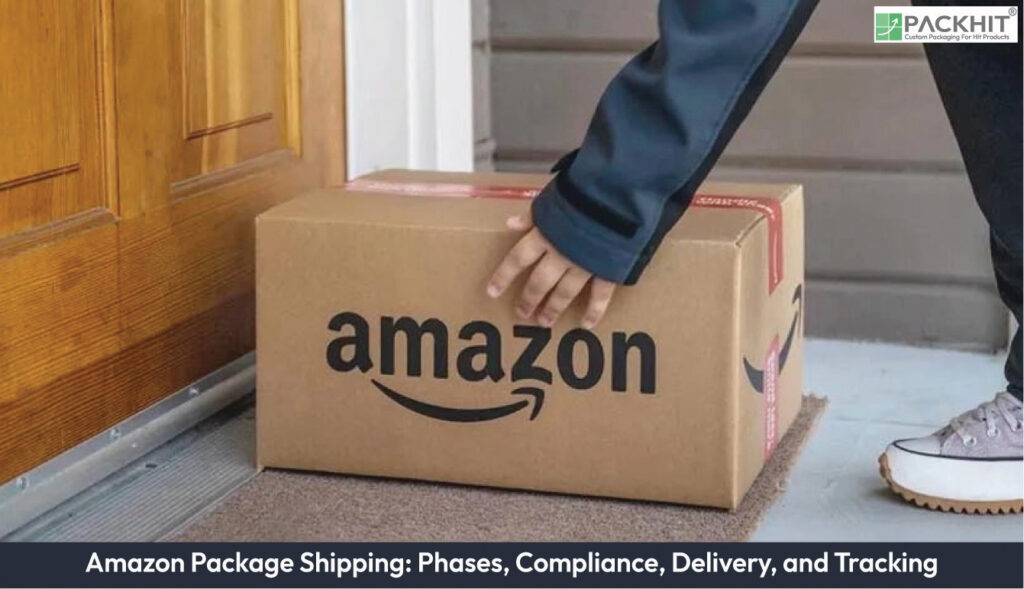
Amazon package shipping combines four stages: preparation, shipment initiation, transit, and delivery confirmation. Packaging compliance, carrier coordination, and shipment tracking connect these stages. The sections below explain how each stage affects manufacturers and their packaging operations.
For a product packed in paper-based materials, preparation includes selecting a carton that protects the item, applying readable shipment labels, and checking package dimensions and weight. Shipment records then connect the package to its carrier movement and delivery status. Manufacturers can use those records to review late deliveries, damaged cartons, labeling errors, and packaging changes without repeating the full shipping process in each order.
- Key Phases in Amazon Package Shipping
- 1. Preparation Phase
- 2. Shipment Initiation
- 3. Transit Phase
- 4. Delivery Confirmation
- 5. Amazon Package Shipping Timeline
- How Does Amazon Ensure Packaging Compliance for Shipping?
- Delivery Mechanisms Amazon Uses for Package Shipping
- How Does Amazon’s Tracking System Work for Package Shipping?
- Why is Understanding Amazon Package Shipping Critical for Manufacturers?
- What Should Manufacturers Check Before Amazon Package Shipping?
Key Phases in Amazon Package Shipping
Amazon package shipping follows the applicable program, carrier, destination, and shipment-date requirements. The preparation phase begins with product and package checks.
1. Preparation Phase
Release the product and package for production only after the required preparation checks are defined. This phase covers product protection, package construction, labeling, and shipment inspection. Requirements vary between Fulfillment by Amazon (FBA), Seller Fulfilled Prime, merchant-fulfilled orders, and special product programs. Check the applicable Amazon packaging and prep guidance in Seller Central because carton limits, product restrictions, barcode rules, and certification requirements can change.
For paper-based custom packaging, select a carton grade that matches the product weight, stacking load, and handling conditions. Use internal protection that limits movement and separates fragile surfaces from the carton walls. Test the assembled pack in its shipping configuration, rather than testing the empty carton alone. A manufacturer can record compression, drop, vibration, seal, and barcode-readability results for each package configuration. Amazon can apply different testing or certification requirements to specific categories, so a general packaging test does not establish compliance for every program.
Preparation ends when the finished cartons pass the applicable inspection and the shipment is ready for release. The duration depends on production lead time, packaging-material availability, test failures, label corrections, product inspection, and Amazon approval requirements. Do not assign a standard preparation duration without shipment-specific records. Apply the required product and shipment labels to clean, flat surfaces. Keep barcodes visible, scannable, and separate from seams, folds, tape, and other markings. Inspect each carton before handoff. Retain the package specification, test record, label proof, inspection date, and lot or production reference for manual review if a shipment is questioned.
2. Shipment Initiation
Create the shipment workflow and shipping labels in the applicable Amazon account tools to begin shipment initiation. The resulting documents can identify the fulfillment center, shipment ID, carton count, product quantities, carrier, and routing instructions. These fields depend on the program and shipment configuration. Compare the label data with the physical cartons before pickup.
Shipment initiation is complete only when the shipment record is created and the physical cartons receive a recorded carrier or Amazon handoff, unless the applicable workflow defines another milestone. Shipment creation alone does not establish transit or final delivery. Timing depends on label correction, carton reconciliation, carrier scheduling, pickup capacity, fulfillment-center routing, and any appointment or approval step. Place each label where warehouse scanning equipment can read it without removing or opening the carton. Do not cover a barcode with opaque tape, place competing scannable codes nearby, or attach a label to a corner or seam. A mismatch between the shipment record and carton contents can cause receiving exceptions, inventory delays, or routing corrections. The specific consequence depends on Amazon’s current terms and the facts of the shipment. Check the applicable notice before treating a fee, rejection, or delay as a confirmed outcome.
3. Transit Phase
After the carrier records acceptance, cartons move through a carrier network to an Amazon fulfillment center, delivery station, or customer address, depending on the fulfillment method. Amazon uses contracted carriers, postal services, and Amazon-operated or independently contracted transportation services. Carrier availability, service level, origin, destination, package size, and seasonal capacity affect the route and estimated timing.
Transit time runs from the first accepted pickup or carrier scan to the receiving or delivery endpoint recorded for the shipment. The tracking page may show an estimated date, but that estimate is not a fixed duration. Compare the estimated date with the latest scan and exception notice. A weekend, holiday, remote destination, weather event, address correction, missed appointment, oversize handling requirement, or network disruption can change the interval. Tracking events usually come from scans or electronic status messages at selected handoff points. They do not establish continuous physical location, and a time gap between events does not by itself prove that a package is lost. Compare the carrier record, Amazon shipment record, pickup receipt, carton count, and exception notice when investigating a delay. Keep the shipment ID and proof of handoff with the packaging records.
4. Delivery Confirmation
The package reaches its final phase when Amazon or the carrier records an accepted delivery or fulfillment-center receiving event, depending on the shipment type. The confirmation date is the date shown in the relevant Amazon or carrier record, not the date on which the seller expects the package to arrive. Customer orders can use doorstep delivery, pickup lockers, access-point collection, or scheduled handling for large or restricted items. Availability depends on the address, product, carrier, and local service rules at the time of the order.
A status such as “Delivered” records a carrier or Amazon system event. It does not prove that the intended person inspected the contents or that no package damage occurred. For a customer claim, compare the delivery timestamp, location note, image or signature where available, carton condition, and product inspection record. Status definitions and evidence fields vary, so confirm them in the relevant order or carrier record. For an FBA shipment, distinguish the carrier’s delivery to the fulfillment center from Amazon’s later receiving and inventory-record update. Those events can occur at different times, and carton receipt does not by itself confirm that every unit entered available inventory.
5. Amazon Package Shipping Timeline
Amazon does not publish one fixed duration for every package-shipping phase. Preparation time depends on product readiness, packaging tests, label production, inventory availability, and any required approval. Shipment initiation depends on shipment-plan creation, carton data, appointment or routing instructions, carrier pickup capacity, and the handoff date. Transit time depends on the selected service, origin, destination, package characteristics, carrier network, weather, holidays, and operational capacity. Delivery confirmation follows the carrier or Amazon scan that records receipt at the fulfillment center or delivery at the customer address.
Treat the shipment record as the timeline baseline. Record the packaging-release date, label-generation date, pickup or carrier-acceptance date, each material tracking event, the estimated delivery date, and the final receiving or delivery-confirmation event. A shipment can show a created or confirmed status before physical movement begins. That status does not confirm final delivery. An estimated date also remains subject to later scans and service conditions.
| Phase | Timing criterion | Confirmation record |
|---|---|---|
| Preparation | Starts when the product and package enter production release and ends when the cartons pass inspection and are ready for handoff. | Package specification, test record, label proof, inspection record, and lot reference. |
| Shipment initiation | Starts when the seller creates the shipment workflow and ends at carrier pickup or another recorded handoff. | Shipment ID, carton count, label data, routing instructions, and pickup receipt. |
| Transit | Runs from recorded carrier acceptance or pickup through movement between the origin, fulfillment facility, delivery station, or customer address. | Carrier scans, Amazon shipment events, exception notices, and estimated delivery updates. |
| Delivery confirmation | Occurs when the system records fulfillment-center receipt, customer delivery, pickup readiness, or another accepted endpoint for the shipment type. | Receiving event, delivery timestamp, location note, image, signature, or pickup record, where available. |
Use the actual recorded dates rather than a generic number of days when measuring performance. A missing scan, weekend or holiday closure, inventory discrepancy, address issue, appointment requirement, weather event, or carrier exception can extend the interval between milestones. Separate shipment confirmation, which records creation or acceptance of a shipment, from final delivery confirmation, which records receipt at the applicable endpoint.
How Does Amazon Ensure Packaging Compliance for Shipping?
Amazon applies program-specific packaging and prep requirements to products entering its fulfillment process. The requirements can address materials, carton construction, product protection, labeling, barcode readability, and waste reduction. They can also change by product category, fulfillment route, seller program, destination, and time. Review the current Amazon Packaging Compliance Standards and the applicable Amazon instructions before production or shipment release.
Packaging compliance depends on the specific program and shipment, not on a single universal Amazon standard. Frustration-Free Packaging (FFP) is one Amazon packaging program, but FFP participation does not represent every Amazon packaging requirement. A package can meet a general material or strength specification and still require additional prep for a particular product. A stated consequence can include a receiving exception, corrective action, a fee, a repackaging request, or shipment rejection under the terms that apply to that shipment. Verify the current Amazon notice before relying on any one consequence.
Amazon does not apply one universal recyclable-material rule or one universal corrugated-board rating to every product shipment. Material selection and board performance depend on the product, package dimensions, gross weight, stacking conditions, fulfillment route, and applicable program. Manufacturers can reduce compliance risk by documenting the requirement source, package revision, test result, and approval date for each configuration.
Packaging Material Requirements
Material requirements depend on product risk, package configuration, program rules, and the destination process. Recyclable paperboard can reduce mixed-material content, but recyclability alone does not establish compliance. Cartons also require adequate edge crush strength, burst strength, closure performance, and moisture resistance for their intended load. The relevant test value depends on carton dimensions, gross weight, stacking pattern, and distribution conditions.
Protective materials include molded fiber, corrugated inserts, paper pads, bubble wrap, and air pillows. Choose the material by checking movement, impact exposure, abrasion, and surface sensitivity. Record the test method, sample configuration, conditioning, acceptance criteria, result, and test date. Supplier data can support material selection, but it does not replace a review of the finished package when the product, carton, or shipping route changes.
Labeling and Barcode Standards
Each carton and product requires the barcode type specified by the applicable Amazon workflow. A barcode can identify a product, seller inventory, shipment, or carrier handling unit, so one readable code does not prove that every labeling requirement is satisfied. Confirm the required code, size, contrast, placement, and quantity in the current shipment instructions.
Print labels with sufficient contrast and attach them to a flat, clean area. Keep the code unobstructed by tape, folds, seams, straps, or competing labels. Test representative cartons with the same printer, substrate, adhesive, and application process used in production. Record the scan result and inspect cartons after sealing because abrasion, condensation, and label lift can change readability during handling.
Delivery Mechanisms Amazon Uses for Package Shipping
Amazon package shipping uses different last-mile and middle-mile arrangements according to order type, service area, carrier capacity, product characteristics, and fulfillment program. Public descriptions do not establish the route for every order. Amazon Logistics, third-party carriers, pickup lockers, scheduled handling, and limited pilot services can vary by program, location, product, and time. Use the tracking record and shipment documents for shipment-specific verification.
Amazon Logistics Network
Amazon Logistics includes delivery stations, contracted delivery businesses, and other transportation arrangements that support selected customer orders. The proportion of orders handled through these arrangements varies by location, service, capacity, and date, so a manufacturer cannot treat Amazon Logistics as the carrier for every shipment. Amazon Flex is a separate contractor-based arrangement in which approved drivers use personal vehicles for assigned routes. Coverage, driver assignment, route sequence, and status detail vary by location and date.
Third-Party Carrier Integration
Amazon also uses third-party carriers, including UPS, FedEx, and the United States Postal Service, for selected shipments. Carrier choice depends on the service purchased, package characteristics, origin, destination, and operational conditions. Check the carrier name and tracking number in the shipment record instead of assuming that one carrier handles all Amazon orders.
Locker and Special Delivery Methods
Some orders use Amazon Locker or another designated pickup location when the address and product qualify. Scheduled handling can apply to large, heavy, restricted, or appointment-based shipments. Availability changes by location, product, account, carrier, and current service rules. Prime Air drone delivery and other pilot services have limited geographic, regulatory, and product scope when available; they do not represent a general method for manufacturer shipments. Confirm eligibility and current availability before describing a method as part of an order’s route.
How Does Amazon’s Tracking System Work for Package Shipping?
Amazon Tracking for Package Shipping combines shipment records, barcode events, carrier updates, and customer notifications. It can show the latest recorded status, but it does not guarantee continuous real-time location or a fixed delivery time. Data timing depends on scan frequency, carrier transmission, system processing, service interruptions, and shipment type.
Barcode Scanning at Checkpoints
At selected checkpoints, workers or automated equipment scan packages during pickup, carrier acceptance, fulfillment-center receipt, sorting, and delivery. Each event can change the displayed status. Some handoffs are recorded in batches, and some physical movements occur without a customer-visible scan. Investigate an exception by comparing the Amazon record with the carrier record, shipment ID, carton count, and handoff receipt.
Location Data for Delivery Vehicles
Some delivery operations use vehicle location data to estimate route progress and arrival time. The displayed estimate is a system calculation, not a guarantee of the vehicle’s exact position or arrival sequence. Traffic, weather, access restrictions, address corrections, route changes, and unplanned stops can alter the estimate. GPS availability and the level of location detail depend on the operating system, carrier, device, service, and account view.
Automated Notifications
Amazon or the carrier can send notifications for events such as shipment creation, carrier acceptance, out-for-delivery status, attempted delivery, pickup readiness, and delivery confirmation. Notification timing and channel depend on account settings, order type, carrier data, and local service conditions. Treat the notification as a recorded status update, then verify the underlying tracking record if the package is delayed, missing, or damaged.
Packaging requirements, delivery methods, and tracking details can change by product, program, shipment, location, and current Amazon guidance. Manufacturers can verify the applicable instructions before finalizing materials, labels, carrier assumptions, or customer-facing delivery statements.
Why is Understanding Amazon Package Shipping Critical for Manufacturers?
Amazon package shipping affects packaging design, warehouse handling, carrier acceptance, delivery records, and customer returns. Manufacturers can reduce avoidable shipping problems by treating the package as part of the fulfillment process rather than as a separate production step.
- Packaging compliance: Follow the applicable Amazon packaging, labeling, and preparation requirements before inventory enters the fulfillment network. Select paper-based cartons, inserts, and protective materials that match the product’s weight, dimensions, fragility, and moisture exposure. Accurate product identifiers and shipping labels reduce receiving errors.
- Fulfillment coordination: Match carton dimensions, case quantities, pallet patterns, and shipment appointments to the requirements of the selected fulfillment route. Early coordination helps prevent repacking, split shipments, receiving delays, and extra handling at fulfillment centers.
- Shipment visibility: Record the shipment identification number, carrier, tracking number, carton count, and dispatch date for each outbound shipment. Tracking records help manufacturers compare the expected delivery date with carrier scans and investigate missing or delayed cartons.
- Cost control: Reduce dimensional weight, excess void fill, material waste, and avoidable rework through package testing and accurate carton specifications. A smaller paper-based package can lower shipping charges when it still protects the product during sorting and transport.
- Product protection: Test the package against compression, vibration, abrasion, and handling conditions that apply to the product. Proper closure, cushioning, and moisture protection can reduce damage claims and support a more reliable customer experience.
- Regulatory alignment: Check the package against applicable product, transport, labeling, and environmental rules in the markets served. Keep material specifications, test records, supplier declarations, and label versions with the shipment documentation.
What Should Manufacturers Check Before Amazon Package Shipping?
Before each shipment, confirm the current program requirements, package and label records, shipment data, and carrier handoff evidence. Recheck the package if the product, carton, label process, carrier, route, or Amazon program changes.
Amazon package shipping requirements vary by product category, fulfillment method, carton configuration, and destination. A package specification that fits one shipment may not fit another, so manufacturers must verify the applicable requirements for each shipment.
This review connects packaging construction with identification, documentation, and carrier acceptance. It also gives manufacturers a defined record for investigating receiving discrepancies, delivery delays, damaged goods, and customer returns.