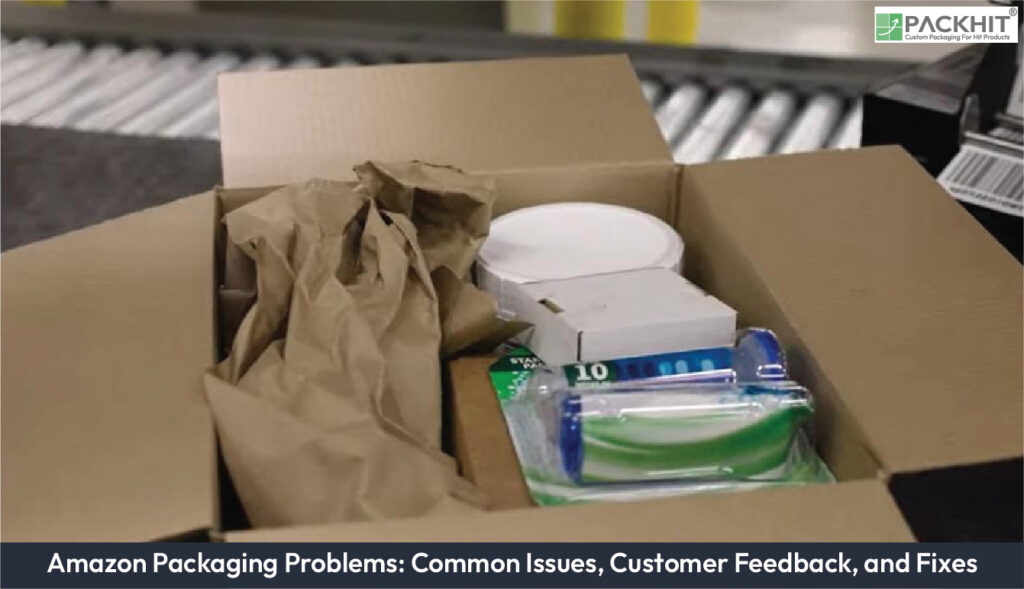
Amazon’s packaging challenges encompass oversized boxes that waste materials, insufficient protection leading to damaged goods, environmental concerns from non-recyclable components, and security vulnerabilities such as tampered shipments. Customer feedback reveals dissatisfaction with these issues, emphasizing the need for adaptive box-sizing systems, enhanced cushioning for fragile items, eco-friendly designs, and tamper-evident features. As potential solutions, Amazon could implement AI-driven packaging technologies, expand sustainable initiatives like biodegradable materials, and strengthen shipment security measures, with the aim of improving customer satisfaction, supporting product protection, and reducing unnecessary environmental impact.
- Most Common Issues with Amazon Packaging
- Oversized Packaging
- Insufficient Product Protection
- Environmental Concerns
- Packaging Tampering and Security Issues
- How Does Customer Feedback Reflect Issues with Amazon Packaging?
- Dissatisfaction with Packaging Size
- Complaints About Damaged Goods
- Calls for Sustainable Practices
- Security Concerns
- Potential Fixes for Amazon’s Packaging Problems
- Implementing Adaptive Packaging Systems
- Enhancing Protective Measures
- Expanding Sustainable Packaging Initiatives
- Strengthening Security Features
- How Can Manufacturers Prioritize Amazon Packaging Fixes?
Most Common Issues with Amazon Packaging
Commonly discussed Amazon packaging concerns include oversized boxes, inadequate protection for fragile items, difficult-to-recycle materials, and weak shipment security. These concerns correspond to four manufacturer decisions: carton dimensions, cushioning, material selection, and closure design. The supplied customer-feedback examples do not establish how prevalent any one issue is because they do not define a review sample, date range, or reporting method.
Oversized Packaging
Oversized packaging can increase shipping costs, leave products exposed to movement, and consume additional paperboard and filler. Customers have reported receiving small items, such as USB drives and phone cases, in large boxes with excess void fill. Automated packaging systems can create this mismatch if recorded item dimensions are inaccurate or if standard cartons take priority over precise sizing.
Manufacturers can reduce this risk by recording the product’s packed length, width, and height, then testing the smallest carton that preserves clearance around the item. The test should account for product tolerances, protective inserts, carton compression, and carrier handling. A carton that fits the product closely but leaves no room for cushioning can create a separate damage risk.
Insufficient Product Protection
Inadequate cushioning can cause fragile or high-value products to arrive damaged. Glassware can break, electronics can receive dents or screen damage, and other items can shift inside a carton during handling. A standard Amazon carton does not account for every product shape, weight, or breakage risk. Manufacturers can assess the product itself, including sharp edges, compressible parts, projecting components, and empty areas that require an insert.
Protection depends on the contact points between the product, insert, and carton walls. Paperboard partitions, molded-pulp supports, folded inserts, and die-cut retainers can separate components and restrict movement without adding loose filler. Package testing should include compression, vibration, drop, and edge-impact checks that reflect the product’s weight and distribution route.
Environmental Concerns
Amazon packaging raises environmental concerns when non-recyclable materials, excess plastic, and single-use components increase landfill waste. Customers also report packaging that is difficult to separate or recycle, despite programs such as Frustration-Free Packaging. Paper-based manufacturers can reduce material complexity by limiting unnecessary layers and checking whether the carton, insert, adhesive, and protective filler enter the intended recycling stream together.
Material selection also affects sorting and preparation after delivery. A paperboard carton with a plastic window, foam pad, or permanently bonded mixed-material insert may require separate handling or disposal. Manufacturers can document each package component, identify its material, and verify local recycling instructions before printing disposal guidance on the package.
Packaging Tampering and Security Issues
Weak adhesive seals and easily damaged cartons can expose shipments to tampering, theft, or missing contents. High-value goods require a closure that shows visible evidence of opening while remaining practical for fulfillment and customer unboxing. A security feature must match the product risk. A reinforced carton and tamper-evident seal can matter more than extra cushioning for a compact, valuable item.
Manufacturers can review seal placement, flap overlap, carton board strength, and access points before production. Tear strips, security labels, locking tabs, and reinforced seams each create different opening signals and handling requirements. Testing should confirm that the package remains closed during transport and that a customer can identify a disturbed seal after delivery.
How Does Customer Feedback Reflect Issues with Amazon Packaging?
Customer feedback can reveal four packaging concerns: oversized parcels, damaged goods, excess material, and opened shipments. These examples connect packaging specifications with customer-visible failures, but they do not establish how common each problem is without a defined review sample, date range, or reporting method. Manufacturers can treat the concerns as inspection points and compare them with fulfillment, return, and damage data.
Dissatisfaction with Packaging Size
An oversized parcel can place a small product inside a large box with unused space. A customer may interpret that space as material waste or inefficient transport. For manufacturers, this concern calls for two checks: verify the product dimensions recorded in fulfillment data, then measure the void space after the product, insert, and closure are placed in the carton. Carton dimensions, product orientation, and pack-out tolerances all affect the result. Reducing box size requires a compression and handling test, because a smaller carton can also leave less clearance around fragile surfaces.
Complaints About Damaged Goods
A report of shattered glassware, dented electronics, or torn clothing can indicate movement, compression, abrasion, or inadequate padding during handling. A single complaint does not identify the failure point, so manufacturers should record the damage location, product orientation, carton condition, and protective components. Edge damage calls for corner or edge protection. Impact marks call for cushioning around the affected zone. Surface abrasion calls for separation from the carton or insert. Product movement calls for an insert that holds the item in place. Return and replacement records can then show whether the packaging change reduced repeat damage.
Calls for Sustainable Practices
Requests for recyclable materials, less plastic, or fewer packaging components identify material-use concerns rather than a complete performance specification. Removing cushioning reduces material quantity only if the product remains protected during shipment. Manufacturers can test the smallest material set that limits movement, contact, and impact, then verify the recycling status of each remaining component. The review should cover paperboard, corrugated fiberboard, molded fiber, plastic film, tape, labels, and mixed-material inserts. Material reduction is acceptable only when the revised pack still meets the product’s damage and compression requirements.
Security Concerns
A report of an opened box or a missing item can indicate closure failure, handling damage, or an order-packing error. Without shipment records or a defined incident sample, the report does not prove a broad tampering pattern. Manufacturers can inspect seal adhesion, flap engagement, carton tear resistance, and visible evidence of opening after normal shipment handling. High-value products call for stronger closure and reinforcement when the failure review shows unauthorized access or carton separation. A lighter closure can remain appropriate for low-risk goods if it stays intact during vibration, compression, and drop testing.
Customer feedback is most useful when each concern is paired with a measurable packaging check. Track carton size, void space, component materials, damage location, closure condition, return reason, and shipment batch. This record separates an isolated complaint from a repeatable packaging defect and gives manufacturers a basis for revising paper-based packaging.
Potential Fixes for Amazon’s Packaging Problems
The appropriate fix depends on the failure recorded in customer feedback. Adaptive sizing addresses excess space, cushioning addresses impact, material reduction addresses waste, and tamper-evident construction addresses unauthorized opening. Manufacturers can test these changes separately before combining them in one Amazon-ready package.
Implementing Adaptive Packaging Systems
Adaptive packaging systems match carton dimensions to the product’s measured size and shape. Automated box-sizing machines and AI-driven packaging algorithms can reduce unused space when fulfillment data is accurate. Manufacturers should first verify the dimensions supplied for the product, because incorrect data can reproduce oversized packaging even with an automated system.
Enhancing Protective Measures
Protective packaging reduces breakage and impact damage when its material and placement match the product’s weak points. Air pillows, molded pulp inserts, and product-specific supports can limit movement inside the carton. Use the smallest protective arrangement that keeps the product away from carton walls and preserves enough clearance for normal handling.
Expanding Sustainable Packaging Initiatives
Sustainable packaging removes unnecessary components and uses recyclable or biodegradable materials where product protection remains adequate. Programs such as Frustration-Free Packaging support reduced packaging complexity, but the final package still requires a material and damage check. A paperboard carton with a molded pulp insert can reduce plastic use, if the combined package protects the product and fits the intended recycling stream.
Strengthening Security Features
Tamper-evident seals, reinforced carton designs, and shipment tracking address different parts of shipment security. The seal shows whether a package was opened, the carton resists damage, and tracking records movement through shipment. Manufacturers should select the combination according to product value and test whether the package remains closed while opening attempts leave visible evidence.
How Can Manufacturers Prioritize Amazon Packaging Fixes?
Manufacturers can prioritize packaging changes by matching the observed failure to one design response and one validation check. The following framework separates dimensional efficiency, product protection, material recovery, and shipment security without applying the same fix to every product.
| Packaging problem | Design response | Manufacturer consideration | Validation step |
|---|---|---|---|
| Oversized carton for a small item | Reduce carton dimensions or use adaptive box sizing. | Balance lower material and shipping use against enough clearance for the product, insert, and closure. | Compare recorded product dimensions with the packed product and measure remaining void space. |
| Fragile product damage | Add air pillows, molded pulp inserts, or product-specific cushioning. | Place protection at impact points without creating an unnecessarily large carton. | Inspect the product and insert after shipment handling, focusing on breakage, dents, and movement. |
| Non-recyclable or excessive packaging | Remove unnecessary layers and select recyclable or biodegradable components. | Check the carton, adhesive, insert, and filler as a complete material set, not as separate claims. | Confirm that the final package can enter the intended recycling process and still protects the product. |
| Tampered or missing shipment contents | Use tamper-evident seals, reinforced carton construction, and shipment tracking. | Match closure strength and carton resistance to product value and theft risk. | Check whether opening leaves visible evidence and whether the contents remain enclosed after handling |
This framework helps manufacturers connect each packaging problem with a specific design response and a corresponding validation step. Prioritizing changes this way allows packaging teams to evaluate dimensional efficiency, product protection, material recovery, and shipment security according to the product’s actual requirements rather than applying a single solution across all packaging formats. Validation should be completed on the finished package before production to identify design weaknesses and confirm that the selected changes meet the intended packaging requirements.