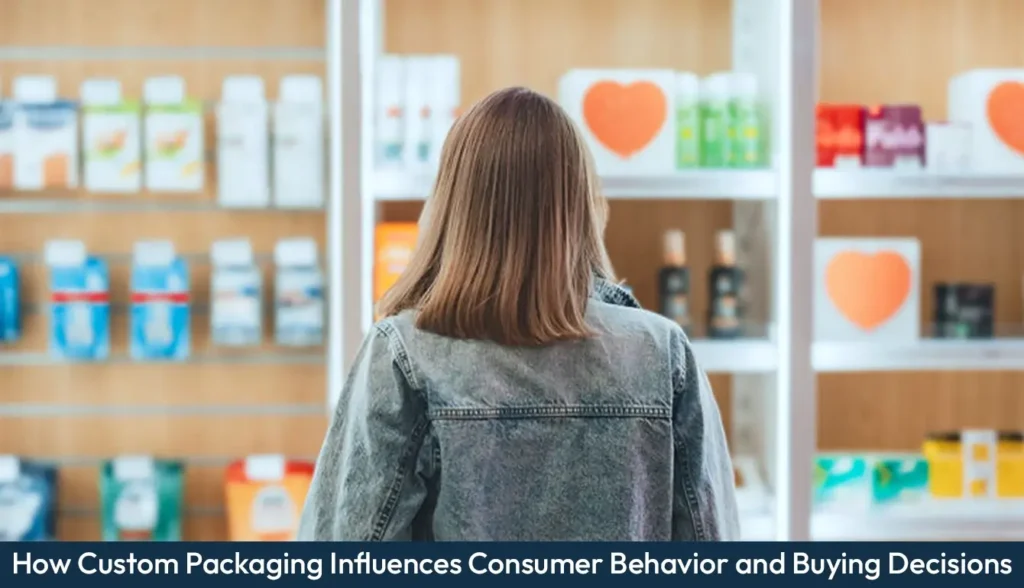
Custom packaging has a significant impact on customers’ buying decisions and behavior through visual, structural, and tactile elements. A distinct color palette, artwork, typography, material finishes, and structure help customers recognize and compare an item quickly, serving as a first interaction between a business and its consumer. Emotive packaging also helps businesses in increasing consumer’s willingness to buy a product via elements including humor, nostalgia, or mission-related messages. Businesses can turn consumer insight into packaging choices by studying the buying setting, matching package cues to the product promise, and testing noticeability, comprehension, usability, material interpretation, and production consistency. A successful package attracts attention without obscuring essential details, and its physical performance must support the expectations created by its visual and structural design.
- How Does Custom Packaging Influence the Buying Decision?
- Which Visual and Material Cues Shape Attention and Perceived Quality?
- How Do Emotion and Relevance Influence Packaging Purchase Decisions?
- How Does Packaging Functionality Affect Product Use and Buying Decisions?
- How to Convert Consumer Insight Into a Packaging Decision?
- Does Packaging Attention Guarantee a Completed Purchase?
- Why Do Claims About Sustainable Packaging Materials Need Evidence?
- Packaging Decision Specifications
- How Does Custom Packaging Influence Consumer Behavior?
- What Packaging Features Affect Buying Decisions?
- How Do Manufacturers Align Packaging With the Customer’s Needs?
How Does Custom Packaging Influence the Buying Decision?
Custom packaging influences a buying decision by attracting attention, identifying the product, setting quality and use expectations, and reducing uncertainty before purchase. At a shelf or on a product page, readable typography, strong contrast, clear branding, and a concise product description help shoppers recognize and compare an item quickly. The package structure adds practical signals: a rigid box suggests protection, a window shows the contents, and a resealable pouch indicates repeated use. Materials, color, graphics, and finishes also communicate product category and brand character, while accurate labels support trust. After purchase, secure closures, orderly inserts, and useful formats such as reusable trays or storage-ready boxes can strengthen brand recall, provided the package remains easy to open, carry, store, and discard.
Which Visual and Material Cues Shape Attention and Perceived Quality?
Visual and material cues shape attention and perceived quality through contrast, legibility, physical form, surface treatment, and handling. Each element contributes a different signal, so the package must keep product identification, required information, protection, and brand recognition clear.
Color
Color attracts initial attention and supports brand recognition. Contrast separates the package from nearby products, while a consistent palette helps shoppers connect the package with a brand, product category, flavor, or use case.
Typography
Typography helps shoppers identify the product and scan essential information. Legible type distinguishes the brand and product name from ingredients, instructions, quantity statements, and other required details.
Graphics
Graphics establish product expectations before the package is opened. Product images, patterns, and illustrations can indicate the product form, flavor, quantity, or intended use while giving the package a recognizable shelf presence.
Structure
Structure communicates protection and controls how shoppers handle the package. A stable carton, fitted insert, or carefully proportioned container can protect the contents, support storage, and make opening and closing more predictable.
Finish
Finish creates visual and tactile differences across the package surface. Matte coatings reduce reflection, gloss areas draw attention to selected graphics, and embossing or foil accents separate specific details from the surrounding print.
Texture
Texture gives shoppers a physical cue about the package material and handling. Smooth, grainy, soft-touch, and paper-like surfaces produce different hand sensations and can reinforce expectations about product positioning and construction.
Material
Material affects expectations about durability, protection, handling, and sustainability. Paperboard, corrugated fiber, glass, metal, and recycled substrates communicate different physical properties, while weight and rigidity affect how shoppers judge the package before opening it.
In a reported 2018 survey, 67% of Americans said the materials used to package a product often influence their purchasing decisions. Rigid paperboard, molded inserts, smooth coatings, foil details, and precise folds can indicate careful construction, while uncoated fiber, recycled content, minimal ink coverage, and visible natural texture communicate a different product position. These signals must match the package’s actual construction and labeling.
How Do Emotion and Relevance Influence Packaging Purchase Decisions?
Packaging can make a product feel relevant before the customer has tested its performance. Consumer psychology operates through both interpretation and emotion: the pack may explain what the item is for, connect it to a problem, and create a memorable moment that keeps the brand available for consideration.
Storytelling, humor, nostalgia, joy, and excitement can make inspection more enjoyable and strengthen an emotional bond. Their effect depends on audience and context. A familiar reference may create warmth for one group but feel dated or irrelevant to another. Mission-related communication, such as a health-focused or eco-friendly initiative, is more persuasive when it identifies a real commitment and remains subordinate to the product identity.
A customer may be more convinced when the brand is presented as a solution to a recognizable problem, but emotional resonance does not prove safety, durability, taste, quality, or performance. Those expectations still require accurate product information and an experience that matches the promise. Company information, event participation, and special offers can provide reasons for attention when they are timely and easy to interpret.
How Does Packaging Functionality Affect Product Use and Buying Decisions?
Packaging functionality is the package’s ability to support product use through opening, dispensing, measuring, storing, protecting, or tracking. Functional packaging affects buying decisions when customers can identify its purpose quickly and judge whether it will make routine use safer, cleaner, or easier.
- Product use: Packaging becomes part of the product when it helps customers complete a defined task, such as opening a sealed pouch, measuring a dose, dispensing a liquid, resealing food, storing leftovers, or tracking consumption.
- Practical feature: A built-in hydration tracker can support a health or fitness routine by marking intake on the bottle or closure while connecting the package with the product’s stated purpose.
- User friction: Participatory features belong in the structure only when they solve a clear use problem without making opening, handling, cleaning, refilling, or storage harder. A difficult closure can outweigh the benefit of a tracking mark.
- Design sequence: Define the customer’s task first, then fit the feature into the package structure and preserve the visual hierarchy needed to identify the product, read instructions, and understand the intended use.
- Brand communication: Use graphics, instructions, measurements, and physical cues that explain the feature quickly. A useful function does not replace clear product information, such as the product name, quantity, directions, warnings, or storage guidance.
- Design collaboration: In-house designers and packaging partners can test whether a product idea fits the available surface area, material thickness, closure type, assembly method, filling process, and manufacturing limits.
- Trade-off: Give priority to safe handling and clear use instructions if a decorative treatment competes with a functional feature for space, contrast, or legibility. Customers must understand how to use the package before they can judge its added feature.
How to Convert Consumer Insight Into a Packaging Decision?
Begin with the typical customer, the current market, the buying setting, nearby alternatives, and the task the person is trying to complete. Aligning business strategy with customer pain points is essential yet challenging because the package must both express the strategy and market it in a way the audience can understand.
Then match the cues to the product promise. A convenience-led item may foreground portability and use; a product built around a quality attribute or brand mission needs a legible, supportable distinction. Custom labels and packaging can act as strategic assets for consumer packaged goods brands by creating identity across a range, but coherence should invite evaluation rather than imply performance that the product cannot deliver.
Finally, test the proposed design in the real buying environment. Check noticeability, brand recognition, comprehension of the offer, material interpretation, usability, and production consistency. A package that attracts attention but obscures flavor, quantity, function, or price-related context needs refinement before scale. Packaging can influence an unplanned purchase or trial when the situation already permits discovery, but product fit, price, availability, and prior experience remain active constraints.
Does Packaging Attention Guarantee a Completed Purchase?
Packaging can open an interaction, support evaluation, create emotional relevance, and extend use, yet each stage is distinct from a sale. A person may notice a custom-printed design and still reject the product because its price, availability, performance expectation, or immediate usefulness does not fit the need.
The strongest role is cumulative: recognition earns consideration, organized claims reduce interpretation effort, material and structural choices shape expectations, and useful functionality can continue the brand relationship after purchase. The design should support a credible product promise instead of compensating for weak product-market fit.
Why Do Claims About Sustainable Packaging Materials Need Evidence?
Material selection affects both physical handling and the meaning customers attach to the product. The reported 67% figure indicates that packaging materials can enter the buying judgment, but it does not establish a universal preference or prove that a material is environmentally better in every application. State the relevant material fact, avoid vague ecological language, and validate whether the chosen format protects the product and remains usable.
Packaging Decision Specifications
The following specifications given in the table are to connect packaging choices with customer recognition, product expectations, purchase decisions, and the practical constraints of production and use.
| Area | Specification to Review | Behavioral Relevance and Constraint |
|---|---|---|
| Customer and context | Define the typical customer, market setting, competing offers, and task at the buying moment. | Relevance depends on need and context; a design cannot be judged apart from the situation. |
| Recognition | Assign a readable order to brand, product type, variant, quantity, and primary benefit. | Hierarchy and cognitive fluency support rapid identification and evaluation. |
| Visual system | Test color, typography, imagery, contrast, custom printing, and distinctive shape at the intended viewing distance. | These attributes can distinguish the item, but visual novelty that obscures meaning creates friction. |
| Physical materials | Review substrate, texture, finish, weight, structural form, handling, storage, and protection. | Material cues influence tactile interpretation and, in a reported 2018 survey, 67% said packaging materials often influenced purchasing decisions. |
| Design influence evidence | Interpret the reported 72% figure as Americans reporting that packaging design often influences purchasing decisions. | The statistic indicates reported influence, not a guaranteed conversion rate or universal response. |
| Functional feature | Define the customer task for any added feature, such as a built-in hydration tracker, and test opening, use, and storage. | Function can extend the product experience only when it solves a real problem without adding complexity. |
| Message credibility | Check storytelling, humor, nostalgia, health, environmental, company, event, and offer messaging for relevance and support. | Emotion can aid recall or consideration; it cannot substantiate unsupported product-performance claims. |
| Production validation | Use continuous validation tests and packaging data to check graphic colors, structural details, functionality, and specification consistency. | The physical result must match the approved design and the expectations it creates. |
These checks keep visual recognition, material interpretation, functional use, message credibility, and production accuracy aligned with the customer’s buying context.
How Does Custom Packaging Influence Consumer Behavior?
Custom packaging influences behavior by attracting attention, making the product easier to identify and evaluate, shaping perceived value and trust, and creating emotional or functional reasons for consideration. It works alongside product quality, price, availability, and customer need rather than guaranteeing a purchase.
What Packaging Features Affect Buying Decisions?
Color, visual hierarchy, typography, imagery, texture, shape, materials, structural usability, brand cues, storytelling, and relevant offers can affect how a product is noticed and interpreted. The useful feature depends on the audience and buying setting, so recognition and comprehension should be tested rather than assumed.
How Do Manufacturers Align Packaging With the Customer’s Needs?
Manufacturers align packaging with customer needs by matching its structure, materials, visuals, and instructions to the product’s use and buyer expectations. Define the customer and purchase context, choose credible visual and material cues, and add functionality only when it solves a practical problem. Test the finished structure, colors, messages, and materials before production so the package makes the product easy to recognize and evaluate without overstating its performance.