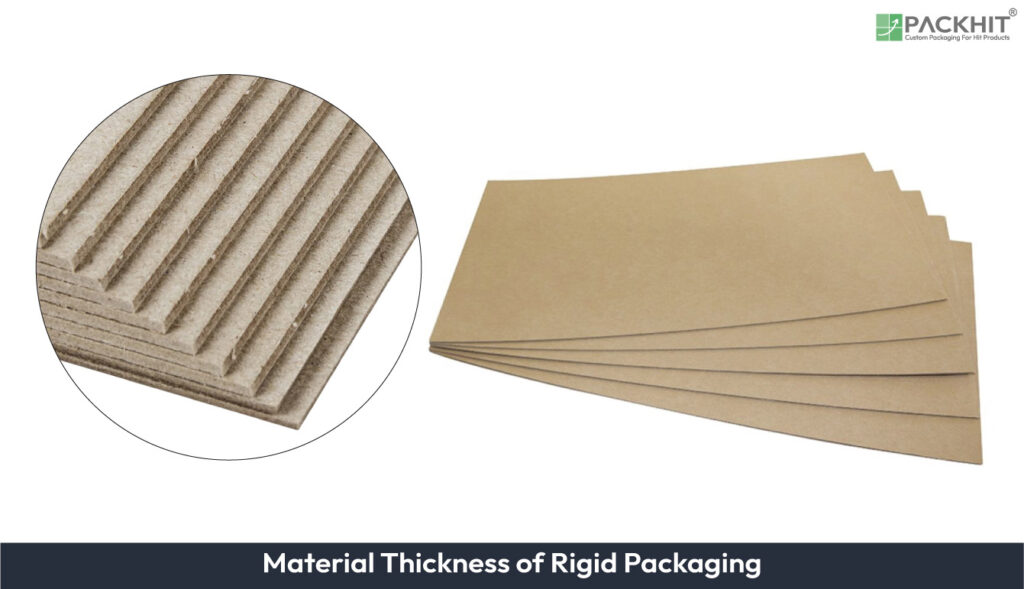
Material thickness in rigid packaging refers to the distance between the outer surfaces of a packaging material and is commonly measured in millimeters (mm) or micrometers (µm). It is an important design parameter because it can influence stiffness, dimensional stability, puncture resistance, compression performance, and package weight. The optimal thickness depends on factors such as product characteristics, transportation and storage conditions, environmental exposure, cost, sustainability, printing requirements, and required performance. Thickness can be measured using tools such as micrometers, calipers, or thickness gauges, with the measurement method selected according to the material and required accuracy. Although greater thickness can improve stiffness and resistance to certain mechanical stresses, it does not determine durability or load-bearing capacity on its own. Material grade, density, construction, package geometry, and application-specific testing must also be considered when selecting and validating the thickness of rigid packaging.
- What is Material Thickness in Rigid Packaging?
- What Factors Determine the Optimal Thickness Selection in Rigid Packaging?
- Product Characteristics
- Transportation and Storage Conditions
- Environmental Exposure
- Cost and Sustainability
- Printing and Branding Requirements
- Performance Testing
- How is Thickness Measured in Rigid Packaging?
- How Does Material Thickness Impact the Durability of Rigid Packaging?
- How Does Thickness Affect the Load-Bearing Capacity of Rigid Packaging?
- How Does Material Composition Affect Thickness Requirements in Rigid Packaging?
What is Material Thickness in Rigid Packaging?
Material thickness is the measured distance between the outer surfaces of a packaging material, typically expressed in millimeters (mm) or micrometers (µm). In rigid packaging, it can influence stiffness, dimensional stability, puncture resistance, compression behavior, and package weight, but the effect depends on the material grade, density, construction, geometry, and environmental conditions.
Paperboard, corrugated fiberboard, molded fiber, and other rigid or semi-rigid materials can have different thickness requirements for the same application. Manufacturers should therefore specify thickness together with the relevant material grade and construction rather than treating thickness as a standalone performance specification.
What Factors Determine the Optimal Thickness Selection in Rigid Packaging?
The appropriate material thickness is determined by the product, package geometry, expected loads and handling conditions, environmental exposure, manufacturing requirements, and required protection level. Key factors include:
Product Characteristics
Product weight, dimensions, fragility, shape, and contact points influence the structural requirements of the package. Heavier or more fragile products may require greater stiffness, reinforcement, or cushioning, but the required thickness depends on the material and package design.
Transportation and Storage Conditions
Packaging can experience stacking, compression, vibration, impact, and repeated handling during distribution. Humidity and temperature can also affect some paper-based materials, coatings, and adhesives. Thickness should therefore be selected as part of a construction designed for the expected distribution environment.
Environmental Exposure
Moisture, temperature fluctuations, grease, and other environmental conditions can alter the performance of some packaging materials. Coatings, laminates, or other treatments may be considered when additional resistance is required, but these changes can also affect thickness, weight, recyclability, adhesion, and converting requirements.
Cost and Sustainability
Increasing thickness can increase material consumption, package weight, and production cost. The objective is therefore generally to achieve the required protection and structural performance with an efficient material specification rather than simply selecting the thickest available material.
Printing and Branding Requirements
Thickness and surface construction can affect printing, folding, embossing, foil application, coating, and other finishing processes. The selected construction should be compatible with the intended converting process while maintaining the required structural properties.
Performance Testing
Thickness selection can be supported by application-specific testing such as compression, drop, vibration, stacking, moisture, or environmental evaluations, depending on the package’s intended use.
Test results are valid only within their defined test scope. Material grade, thickness, package dimensions, loading configuration, conditioning, environmental conditions, test duration, test method, and acceptance criteria can all affect the observed result. Any measured load, stacking limit, or durability result should therefore be treated as a test-specific performance value, not as a universal design rule.
Where a formal industry or internal test standard applies, the specification should identify the test method and relevant conditioning requirements. If no standardized method is specified, the test procedure and conditions should still be documented sufficiently to support repeatable comparison.
How is Thickness Measured in Rigid Packaging?
Thickness in rigid packaging is commonly measured with a suitable thickness gauge, micrometer, or caliper, depending on the material, surface characteristics, compressibility, and required measurement accuracy. Automated or non-contact systems may also be used for continuous production monitoring.
The measurement procedure should define the measurement location, equipment, contact pressure where applicable, number of readings, sampling frequency, and acceptable tolerance. Surface texture, coatings, compressibility, and multilayer construction can affect the measured value, so measurements should be made using a consistent documented procedure.
For quality control, measured thickness should be compared with the specified material tolerance rather than treated as an independent indicator of package performance. Results obtained with different instruments or measurement conditions may not be directly comparable.
How Does Material Thickness Impact the Durability of Rigid Packaging?
Material thickness can improve stiffness and resistance to some forms of mechanical damage, but its effect on durability depends on the specified material, package construction, and conditions of use.
For example, increasing the thickness of a particular board construction may improve resistance to bending or compression under defined test conditions. The magnitude of that improvement must be established for the specific material grade, construction, package geometry, and test configuration; it should not be assumed that the same thickness increase will produce the same result across different materials.
Durability can also be affected by density, layer construction, scoring, bonding, edge geometry, moisture, temperature, and manufacturing consistency. Thickness should therefore be evaluated alongside these factors rather than used as the sole durability criterion.
How Does Thickness Affect the Load-Bearing Capacity of Rigid Packaging?
Material thickness can contribute to load-bearing capacity by affecting structural stiffness and resistance to deformation, but the load a package can safely support must be established for the defined material and package configuration. Load-bearing performance can vary with board grade, density, package dimensions, panel geometry, corner construction, closure design, loading direction, stacking arrangement, conditioning, and environmental exposure. A reported load value is therefore meaningful only when it is tied to a defined material specification, package configuration, test method, and acceptance criterion.
For manufacturer decision-making, the expected load and stacking conditions should first be established, followed by validation of the selected construction under representative conditions. The test record should identify, as applicable:
- material grade and thickness
- package dimensions and construction
- loading and stacking configuration
- conditioning and environmental conditions
- test procedure and duration
- acceptance or failure criteria
A result from one package configuration should not automatically be treated as the capacity of another. Changes to material grade, dimensions, moisture condition, stacking arrangement, or geometry can materially change performance.
How Does Material Composition Affect Thickness Requirements in Rigid Packaging?
Material composition affects the thickness needed to achieve a particular level of stiffness, strength, or protection because different materials can have different densities, fiber structures, stiffness characteristics, and moisture responses.
For example, two boards with the same nominal thickness may perform differently if their density, fiber composition, or layer construction differs. Multi-layer constructions can also combine materials with different functions, such as structural support, surface protection, printability, or barrier performance.
Thickness should therefore be specified together with material grade, density or construction where relevant, and the intended package geometry. Directly comparing thickness values across different materials without accounting for these variables can produce misleading performance conclusions.
Limitations of Thickness-Based Performance Claims
Thickness is a measurable material attribute, but it is not a universal predictor of package durability, load-bearing capacity, or protection. Quantitative performance results should always be interpreted within the material specification and test conditions under which they were obtained.
Accordingly, the thickness and performance relationships described here are general engineering guidance rather than guaranteed capacity values or universal design rules. Final specifications should be based on current supplier material data and, where performance is critical, testing of the finished package under representative loading, handling, transportation, and environmental conditions.
Where a numerical capacity, durability result, or design limit is required, the value should be reported together with its material grade, package configuration, test method, conditioning, and other conditions necessary to interpret the result.
