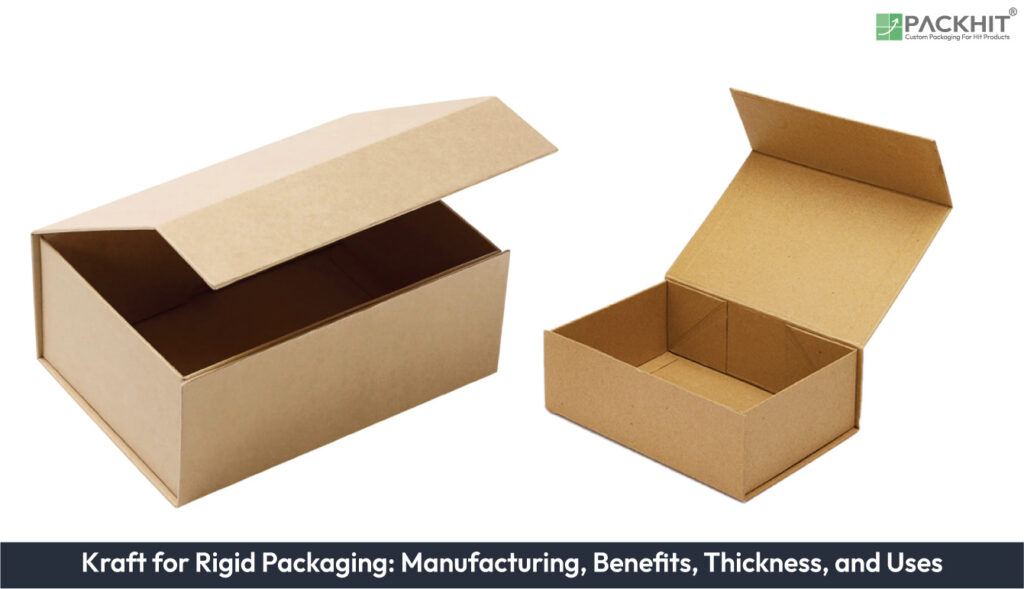
Kraft paper is a durable, eco-friendly material widely used in rigid packaging applications due to its high tensile strength, adaptability, and cost-efficiency. Manufactured through the Kraft process, which involves pulping, washing, screening, and drying wood chips, kraft paper offers customizable properties like thickness and coatings to meet various industry needs. Kraft paper’s sustainability aligns with growing environmental demands, and its applications span food and beverage packaging, electronics protection, retail branding, and logistics. With GSM-based thickness options ranging from lightweight wrapping to heavy-duty inserts, Kraft paper supports diverse uses while enabling businesses to integrate eco-conscious branding into their packaging strategies.
- What is Kraft Paper?
- How is Kraft Paper Manufactured for Rigid Packaging?
- What are the Benefits of Kraft Paper in Rigid Packaging?
- How Does Thickness Impact Kraft Paper’s Performance in Rigid Packaging?
- What are the Industrial Uses of Kraft Paper in Rigid Packaging?
- Key Factors to Consider When Selecting Kraft Paper
- Comparison of Kraft Paper to Other Packaging Materials
What is Kraft Paper?
Kraft paper is a strong paper-based material produced through the Kraft chemical-pulping process, which separates lignin and other components from wood fibers. It is widely used in packaging because its strength, surface characteristics, basis weight, and finish can be adapted to different applications.
Kraft paper is available in grades such as natural brown Kraft, bleached Kraft, and recycled Kraft. Their properties can differ substantially depending on fiber source, recycled content, basis weight, refining, coating, and manufacturing process.
Kraft paper is generally known for good tensile and tear performance relative to many paper grades, but the actual performance of a particular product depends on its grade and specification. For rigid packaging, manufacturers should validate the selected grade under the expected moisture, handling, stacking, and transportation conditions and assess the complete construction, such as whether the Kraft paper is used as a liner, insert, wrap, or part of a composite structure. Higher tensile or tear values alone do not establish suitability for the finished package.
Kraft paper can also have a relatively porous or textured surface. This can be useful for certain converting and lamination applications, but surface treatment may be needed when a package requires specific print quality, barrier performance, or adhesion characteristics. The appropriate treatment should therefore be selected according to the required surface finish, moisture or grease exposure, and compatibility with the intended coating, adhesive, or printing process.
How is Kraft Paper Manufactured for Rigid Packaging?
The manufacturing process of Kraft paper involves cooking wood chips in a mixture of sodium hydroxide and sodium sulfide under pressure to extract cellulose fibers. This workflow includes pulping, washing, screening, and drying, followed by optional treatments such as coating or laminating. Each stage can influence the consistency, strength, surface characteristics, and moisture behavior of the finished paper. Below, the key stages are outlined in detail:
1. Pulping
Wood chips are cooked in a mixture of sodium hydroxide and sodium sulfide under pressure to extract cellulose fibers. This process, known as the Kraft process, separates lignin and other components from the fibers, producing pulp that can be processed into packaging paper.
2. Washing
The pulp undergoes washing to remove residual chemicals and impurities. Consistent washing and subsequent processing help prepare the fiber for controlled sheet formation and finishing.
3. Screening
Screening filters out oversized particles and contaminants. This supports more consistent fiber distribution and sheet formation, which can be important when the finished paper must meet defined basis-weight, surface, or converting requirements.
4. Drying
The washed and screened pulp is formed into sheets or rolls and dried to the required moisture condition. Drying is important because moisture content can affect the paper’s handling characteristics and mechanical performance.
5. Optional Treatments
After or during paper production, Kraft paper can receive coatings, laminations, or other surface treatments depending on its intended use. These treatments can modify moisture or grease resistance, printability, surface texture, or adhesion. The treatment should be evaluated as part of the complete packaging construction rather than as an isolated material upgrade.
What are the Benefits of Kraft Paper in Rigid Packaging?
Kraft paper can provide a useful combination of strength, adaptability, and fiber-based material characteristics, but the actual benefit depends on the selected grade, construction, coating, and packaging application.
- Durability: Kraft paper grades can provide good tensile and tear resistance, helping packaging components withstand handling and some mechanical stresses. Actual compression, puncture, and transit performance depends on basis weight, fiber structure, package geometry, moisture conditions, and the complete package design.
- Environmental considerations: Kraft paper is fiber-based and may contain virgin or recycled fibers. Some grades can be recycled through appropriate collection systems, but recyclability depends on the complete construction, including coatings, laminations, adhesives, contamination, and local recycling infrastructure.
- Customizability: Kraft paper can be produced with different basis weights, surface treatments, and coatings. These options allow manufacturers to adapt the material for applications such as liners, wraps, inserts, bags, and composite packaging.
- Cost considerations: Kraft paper can be cost-effective for applications where its performance meets the required specification. Actual cost depends on grade, basis weight, fiber source, coating, converting requirements, production volume, and market conditions.
- Versatility: Kraft paper is used in a range of packaging structures, including corrugated components, protective inserts, cushioning materials, wraps, and branded packaging. Its suitability depends on the mechanical and environmental requirements of the finished package.
- Branding: The natural brown appearance and visible fiber texture of unbleached Kraft can support a natural or minimal packaging aesthetic. However, an environmental message should be based on the actual material and end-of-life characteristics rather than appearance alone.
How Does Thickness Impact Kraft Paper’s Performance in Rigid Packaging?
GSM, or grams per square metre, describes the mass of paper per unit area. A higher GSM generally indicates greater material mass per unit area, but GSM does not by itself establish a specific thickness, stiffness, compression strength, or load-bearing capacity. The relationship between GSM and these properties depends on the paper grade, density, fiber structure, manufacturing process, moisture condition, and construction.
For rigid packaging, material selection should therefore begin with the performance requirements of the finished package. Relevant criteria may include stiffness, compression resistance, tear resistance, dimensional stability, forming behavior, moisture exposure, and transportation conditions.
A range such as approximately 120-300 GSM may occur among packaging papers used for different purposes, but this should be treated only as an illustrative range, not as a universal industry specification or recommended range for all rigid packaging. Actual requirements can fall below or above this range.
For preliminary material discussions, the following categories may be useful:
- Around 120-150 GSM: May be considered for relatively light wraps, liners, or other components where flexibility and lower material weight are important. The finished construction should be checked for the required tear, handling, and dimensional performance.
- Around 180-250 GSM: May be considered where greater sheet substance or handling resistance is required. Selection should be checked against the stiffness, forming, converting, and structural requirements of the finished package.
- Around 260-300 GSM and above: May be considered where a heavier paper sheet is required. However, increasing GSM should not automatically be interpreted as proportional improvement in structural performance. Thickness, density, stiffness, compression behavior, package geometry, moisture exposure, and construction should be evaluated together.
These ranges don’t represent guaranteed performance grades. They are illustrative selection categories rather than a substitute for a supplier’s technical specification.
Before specifying a grade, manufacturers should obtain relevant supplier data and, where performance is critical, test the finished package under representative handling, stacking, moisture, and transportation conditions. If a package does not meet a stiffness, compression, moisture, or dimensional-stability requirement, increasing GSM may not be the most appropriate solution. A different grade, construction, coating, geometry, or additional structural layer may provide a more suitable result.
What are the Industrial Uses of Kraft Paper in Rigid Packaging?
Kraft paper plays a critical role in rigid packaging across a variety of industries, offering strength, adaptability, and sustainability. Its unique combination of durability and eco-friendly properties makes it a preferred choice for manufacturers seeking reliable and environmentally conscious packaging solutions. Below are key industrial applications of Kraft paper in rigid packaging:
Food and Beverage Industry
Kraft paper is used for applications such as dry-goods packaging, takeaway containers, wraps, liners, and protective packaging components. Its fiber structure and any applied coating or barrier can contribute to the package’s functional performance.
Kraft paper’s barrier properties can help address moisture, grease, or other exposure when the specific grade and treatment are designed for that purpose. However, food-safety suitability depends on the product, packaging construction, intended use, and applicable regulations. A paper grade should not be assumed to be suitable for direct food contact simply because it is described as Kraft paper.
For food-contact packaging, manufacturers should verify the complete packaging construction against the applicable food-contact requirements in the target market, including requirements relating to coatings, adhesives, inks, and recycled fiber where applicable.
Electronics Industry
The electronics industry uses Kraft paper for protective components such as die-cut inserts, wraps, and cushioning structures. These components can help limit product movement and provide separation from other package elements. For fragile electronics, the selected construction should be assessed against expected shock, vibration, and handling conditions rather than assuming the paper’s tensile strength alone provides sufficient protection.
Retail Packaging
Retail packaging often incorporates Kraft paper for its aesthetic appeal and customizability. It is used for gift boxes, branded paper bags, inserts, wraps, and other presentation-oriented structures. Where the package must support premium graphics or surface finishes, the paper grade and any coating should be checked for compatibility with the selected printing and converting processes.
Logistics and Consumer Goods
In logistics, Kraft paper is used to line corrugated boxes, add protective layers, and create cushioning for goods during handling and transit. Its suitability depends on the required level of cushioning, abrasion protection, stiffness, and moisture resistance. Where exposure to humidity or liquid is expected, manufacturers should evaluate whether the untreated paper provides sufficient performance or whether a suitable barrier construction is required.
Key Factors to Consider When Selecting Kraft Paper
Because Kraft paper covers a broad range of grades and constructions, selection should be based on the actual requirements of the finished package rather than on generic claims about Kraft paper. Before final specification, manufacturers should consider:
- Required GSM and thickness
- Tensile and tear requirements
- Stiffness and compression requirements
- Moisture and grease exposure
- Surface and print requirements
- Coating, adhesive, or lamination compatibility
- Forming and converting requirements
- Expected handling, stacking, shock, and vibration
- Food-contact or other regulatory requirements, where applicable
- Recyclability or end-of-life requirements for the complete construction
- Supplier technical specifications and available test data
Where reliable product-specific evidence is unavailable, these factors should be treated as evaluation criteria rather than assumed performance characteristics. Final suitability should be confirmed using the supplier’s current specification and, for performance-critical applications, testing of the finished packaging under representative conditions.
Comparison of Kraft Paper to Other Packaging Materials
Kraft paper can offer advantages in weight, fiber-based construction, customization, and appearance, but it is not universally superior to plastic, metal, glass, or composite materials. Material selection should be based on the performance requirements and environmental conditions of the application.
Plastic: Plastic commonly provides stronger moisture and water barriers. Kraft paper can be combined with coatings or barrier structures when additional resistance is required, but these treatments can affect cost, converting, and end-of-life options.
Metal: Metal can provide high strength and strong barrier performance but is generally heavier than paper-based packaging components. Kraft paper may be preferable where lower weight and fiber-based construction meet the application’s requirements.
Composite materials: Composite structures can combine several functional properties but may introduce additional material and end-of-life considerations. Kraft paper can be laminated or coated when a specific combination of properties is needed, although the resulting construction should be evaluated as a whole.
Glass: Glass provides strong barrier properties and a rigid structure but is relatively heavy and fragile. Kraft paper can be used for protective wraps, inserts, cushioning, and secondary packaging around glass products, although it does not replace glass’s barrier function.
Synthetic fabrics: Kraft paper can provide a fiber-based alternative for certain protective or packaging applications. However, synthetic materials may provide better resistance to repeated moisture exposure, abrasion, or tensile loading in applications where those properties are critical.