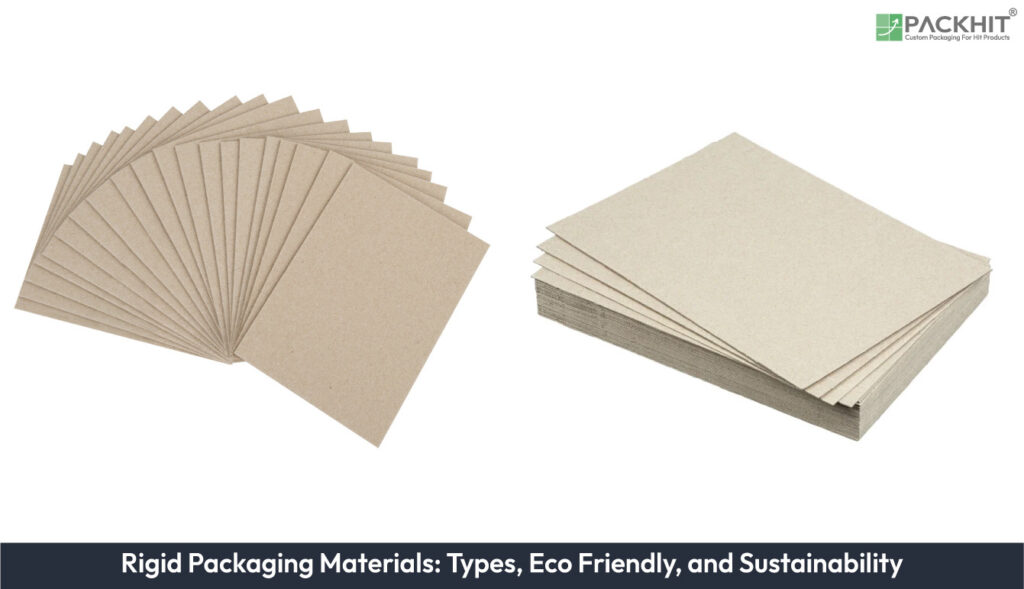
Rigid packaging materials are used to provide structural support, product protection, and dimensional stability across a wide range of packaging applications. The main types include paper-based materials, plastics, metals, and glass, with each offering different combinations of strength, weight, barrier performance, durability, processing requirements, cost, and end-of-life options. Their environmental impact also varies according to factors such as raw-material sourcing, manufacturing, material efficiency, transportation, reuse, recycling, and disposal. Manufacturers therefore need to evaluate the product requirements, environmental conditions, performance needs, sustainability objectives, cost, logistics, and available recovery systems when selecting the most suitable rigid packaging material. Material thickness can further influence stiffness, protection, weight, and resource consumption, making it an important consideration during packaging design.
Types of Rigid Packaging Materials
Rigid packaging materials can be grouped into paper-based materials, plastics, metals, and glass. Each category offers different combinations of stiffness, weight, barrier performance, impact resistance, recyclability, processing requirements, and cost. The appropriate choice depends on the product and the conditions the package must withstand rather than on material category alone.
Paper-Based Materials
Paper-based materials can provide relatively low weight and useful structural performance, with end-of-life options depending on fiber composition, coatings, adhesives, contamination, and local recycling infrastructure.
- Paperboard Packaging: Paperboard can provide a lightweight structural option for consumer goods, food, cosmetics, and pharmaceutical packaging. Its recyclability and fiber content can support sustainability objectives where suitable collection and recycling systems are available. Moisture resistance and structural performance depend on the grade and any applied coating or laminate.
- Corrugated Fiberboard: Corrugated fiberboard uses fluted paper between liner layers to provide structural support and cushioning. Its construction can be useful for shipping and storage, where stacking, compression, and impact requirements must be considered. Moisture exposure can affect performance, particularly where the construction is not designed for humid or wet conditions.
- Chipboard Packaging: Chipboard can provide a relatively economical option for lighter-duty packaging such as cartons and retail displays. Its suitability depends on basis weight, density, construction, and surface treatment, so it may be less appropriate where high moisture resistance or demanding structural loads are required.
- Kraft Packaging: Kraft paper and Kraft-based constructions can provide useful tear and tensile characteristics and a natural visual appearance. Their environmental profile depends on fiber source, manufacturing, coatings, and end-of-life conditions; the term “Kraft” alone does not establish biodegradability or recyclability.
- Recycled Paperboard Packaging: Recycled paperboard incorporates recovered fiber and can support material-recovery objectives where appropriate recycling systems exist. Recycled content can affect characteristics such as strength, surface quality, and moisture behavior, so the selected grade should be matched to the package requirements.
- Molded Pulp Packaging: Molded pulp can be formed into product-specific inserts, trays, and protective structures. Its protective performance depends on wall thickness, fiber formulation, density, mold geometry, and finishing. Moisture sensitivity and dimensional stability should be considered where the package may encounter humidity, condensation, or liquid exposure. Claims such as recyclable, biodegradable, or compostable should be verified for the complete construction and applicable local conditions.
Plastics
Rigid plastics such as polyethylene terephthalate (PET), polypropylene (PP), and high-density polyethylene (HDPE) can provide combinations of impact resistance, moisture resistance, clarity, chemical resistance, and processability.
- PET: PET is commonly used for beverage bottles and food containers where clarity, dimensional stability, and barrier performance are relevant. Its end-of-life performance depends on the grade, additives, collection system, and recycling infrastructure available in the target market.
- PP: PP can be used where low weight, chemical resistance, and impact performance are important. It is found in containers, closures, trays, and other rigid packaging formats. The appropriate grade depends on the required mechanical and thermal properties.
- HDPE: HDPE can provide impact resistance and moisture protection and is used for containers, bottles, and other rigid formats. As with other plastics, recycling outcomes depend on local collection and processing systems and on the specific package construction.
Plastics can offer functional advantages, but their environmental assessment should consider material production, package weight, additives, reuse potential, collection, recycling, and end-of-life pathways rather than biodegradability alone.
Metals
Aluminum and steel can provide high structural strength and useful barrier characteristics.
- Aluminum: Aluminum is lightweight relative to many other metals and can provide strong protection against light, oxygen, moisture, and other exposures when used in appropriate packaging constructions. Aluminum can be recycled, and recycling processes can return recovered metal to material streams, but actual recovery depends on collection, sorting, contamination, and processing infrastructure.
- Steel: Steel provides high strength and is used in cans, industrial containers, and other demanding packaging applications. It is recyclable, while its production and processing require substantial energy and resources. Lightweighting and efficient recovery can influence the overall environmental performance of a steel package.
Glass
Glass is a rigid, non-porous material valued for chemical stability, product visibility, and barrier properties. Glass can be recycled and reused in suitable systems, but the practical environmental outcome depends on collection, processing, transport distances, manufacturing energy, and whether the package is actually reused.
Glass also has important logistical trade-offs. Its weight can increase transportation requirements, while its brittleness can create breakage risks during handling and distribution. These factors should be considered alongside its barrier and product-preservation characteristics.
How Eco-Friendly are Rigid Packaging Materials?
The environmental profile of rigid packaging depends on the full lifecycle, including raw-material sourcing, manufacturing energy and emissions, material quantity, transportation, use or reuse, collection, recycling, and final disposal. There is no single material that is automatically the most environmentally friendly across every application or market.
- Paper-based materials: Renewable or recovered fiber content and established paper-recycling systems can support favorable end-of-life outcomes in suitable applications. However, coatings, laminations, additives, contamination, and local collection systems can change recyclability.
- Plastics: PET, PP, and HDPE can provide lightweighting, durability, and moisture or barrier performance, potentially reducing material use or transportation weight in some applications. Their environmental challenges include fossil-resource use for conventional feedstocks and dependence on effective collection and recycling systems.
- Metals: Aluminum and steel can be recovered and recycled through established metal-recycling systems in many markets. At the same time, primary metal production can be energy-intensive, so the environmental outcome depends on factors such as recycled content, production route, package weight, and recovery rate.
- Glass: Glass can provide durable barrier performance and can be recycled or reused through suitable systems. Its relatively high mass can increase transportation impacts, and manufacturing requires significant thermal energy. The overall result therefore depends on production, transport, reuse, recycling, and package design.
For a meaningful comparison, manufacturers should define the metric being optimized, such as material consumption, greenhouse-gas emissions, recycled content, recyclability, transport weight, or reuse potential—and compare materials using consistent lifecycle assumptions.
How do Rigid Packaging Materials Support Sustainability?
Rigid packaging materials can support sustainability by reducing material use, incorporating recycled or renewable feedstocks, improving packaging efficiency, and enabling recovery or recycling at the end of life. Materials such as paperboard, molded pulp, recycled plastics, and other fiber-based materials can offer different environmental advantages depending on how they are sourced, manufactured, used, and disposed of. Material selection should therefore consider the complete packaging system, including material efficiency, recycled content, durability, recyclability, coatings and additives, transportation requirements, and end-of-life options. No single material is universally the most sustainable, so the appropriate choice depends on the product, packaging requirements, supply chain, and available waste-management infrastructure.
How Does Material Thickness Impact Rigid Packaging?
The material thickness of rigid packaging significantly influences its performance, durability, and sustainability. Thicker materials generally provide enhanced structural integrity and protection, making them ideal for heavy-duty applications such as industrial packaging or long-distance shipping. Conversely, thinner materials may offer cost savings and reduce environmental impact by using fewer resources, but they are better suited for lightweight products and short-term use. Manufacturers must carefully balance thickness with functional requirements, cost efficiency, and sustainability goals to ensure optimal packaging performance.
How Do Manufacturers Choose Rigid Packaging Materials?
Manufacturers should select rigid packaging materials by matching product requirements, environmental conditions, performance needs, cost, logistics, and end-of-life objectives. A practical decision path is:
- If moisture or barrier protection is the primary constraint, consider materials or constructions designed for the required moisture, oxygen, light, grease, or chemical barrier. Plastics, metals, glass, or coated paper-based structures may be appropriate depending on the product. Coatings and multilayer constructions can complicate recycling, while heavier barrier materials can increase transport impacts.
- If impact, vibration, or stacking protection is the primary constraint, consider corrugated fiberboard, molded pulp, suitable rigid plastics, or engineered multi-component structures according to the product’s fragility and transport conditions. Increasing thickness or adding protective features can increase material use and package volume.
- If low shipping weight is a major constraint, consider lightweight paper-based structures, molded pulp, or lightweight plastic and metal designs where they meet the required performance. Lightweighting can reduce stiffness or protection if material reduction is taken beyond the package’s validated performance requirement.
- If recyclability is a major objective: Favor a construction that is compatible with the collection and recycling system in the target market, and minimize unnecessary materials or treatments that interfere with recovery. The most recyclable construction may not provide every required barrier, moisture, or durability characteristic without additional design work.
- If product visibility and inert barrier performance are priorities, glass may be appropriate for applications where its properties justify the additional weight and breakage considerations. Greater mass and fragility can increase handling and transportation requirements.
- If high strength with established metal-recovery pathways is required, aluminum or steel may be appropriate depending on the package function. Primary metal production can be energy-intensive, while package weight and recycled content affect the overall lifecycle profile.
- If a natural fiber-based presentation is important, paperboard, Kraft, recycled paperboard, or molded pulp may provide suitable aesthetic and structural options. Moisture resistance, surface finish, and dimensional stability may require specific grades or treatments.
The decision should escalate to a different material or construction when the selected option cannot meet a critical requirement such as required barrier performance, impact protection, stacking strength, dimensional stability, food-contact compliance, or validated end-of-life compatibility without excessive material use or unsuitable finishing.