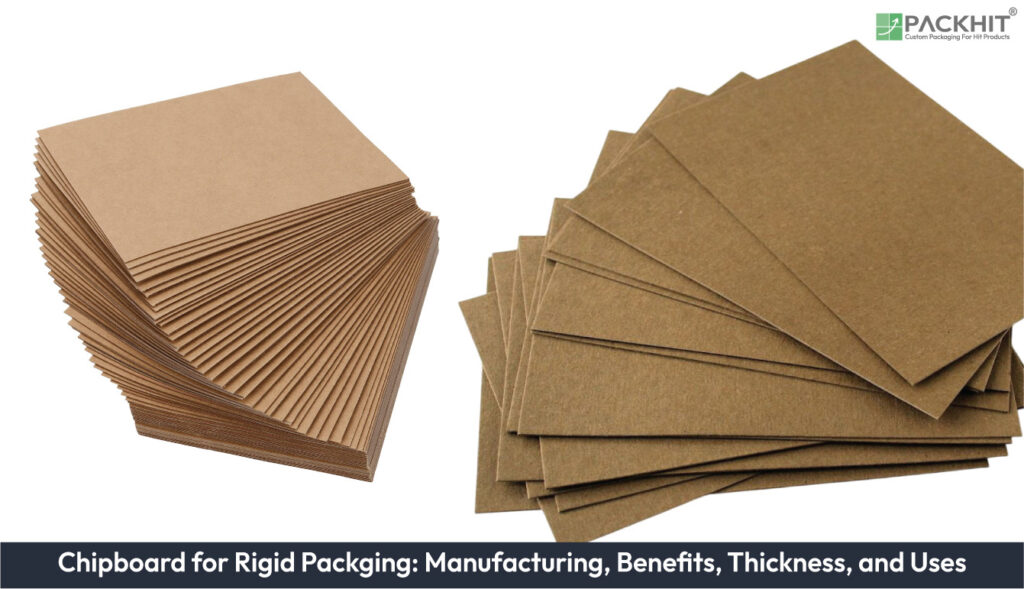
Chipboard, a dense material made from recycled paper fibers, is widely used for rigid packaging due to its eco-friendly nature, structural integrity, and cost-effectiveness. The manufacturing process involves pulping recycled fibers, drying them into dense sheets, and finishing them with calendaring for smoothness and customizability. Benefits of chipboard include high compressive strength, excellent printability, lightweight design, and full recyclability, making it ideal for rigid packaging uses such as food cartons, retail packaging, and industrial containers. Thickness options of chipboard, ranging from 10 to 40+ points, determine its suitability for applications such as food cartons, retail packaging, and industrial containers. Chipboard is extensively used across industries, from consumer goods and food packaging to specialty applications like gift boxes and e-commerce solutions, balancing functionality, sustainability, and branding versatility.
- What is Chipboard Packaging?
- How is Chipboard for Rigid Packaging Made?
- 1. Pressing and Drying for Rigidity
- 2. Surface Finishing for Customization
- 3. Cutting and Shaping for Specific Applications
- Benefits of Chipboard in Rigid Packaging
- How Does Thickness Affect Chipboard Performance in Rigid Packaging?
- Practical Uses of Chipboard in Rigid Packaging
- How Does Chipboard Compare to Other Packaging Materials?
What is Chipboard Packaging?
Chipboard is widely used for rigid packaging due to its eco-friendly nature, structural integrity, and cost-effectiveness. It is a dense material made from recycled paper fibers. Commonly used in industries such as consumer goods, electronics, and food packaging, chipboard provides structural integrity and a customizable surface for branding and design purposes.
How is Chipboard for Rigid Packaging Made?
The manufacturing process of chipboard packaging starts with the collection and sorting of recycled paper fibers, which serve as the primary raw material. These fibers are pulped and cleaned to remove contaminants, ensuring a high-quality base material. The cleaned fibers are then processed into a slurry, which is spread evenly onto a wire mesh screen. Here, water is drained through the mesh, leaving behind a dense mat of interwoven fibers.
1. Pressing and Drying for Rigidity
Once the dense mat is formed, it undergoes pressing to remove additional moisture and achieve the desired density. The pressed mat is then dried under controlled heat conditions. This drying process not only solidifies the chipboard but also adjusts its rigidity to meet specific packaging requirements. The thickness of the chipboard is determined at this stage, depending on its intended application.
2. Surface Finishing for Customization
After drying, the chipboard sheets are fed through a calendaring process, where they are compressed between heated rollers to create a smooth, uniform surface. This step is critical for applications requiring high-quality printing, as it ensures the material is suitable for vibrant branding and product information. Depending on the end use, additional treatments like lamination or coating may be applied to enhance moisture resistance, durability, or visual appeal.
3. Cutting and Shaping for Specific Applications
The final stage involves cutting or die-cutting the chipboard sheets into specific shapes and dimensions. This customization process ensures the material aligns perfectly with the functional and branding needs of the product it will encase. Whether for food cartons, retail packaging, or industrial containers, the precision cutting allows manufacturers to create tailored designs that meet both structural and aesthetic requirements.
Benefits of Chipboard in Rigid Packaging
Chipboard offers several advantages that make it a preferred choice for rigid packaging applications. Below is a detailed list of its key benefits:
- Structural Integrity: Chipboard provides robust support for packaging heavy or fragile items, ensuring their safety during transit and storage. Its high compressive strength makes it a reliable choice for maintaining the shape and integrity of packaged goods.
- Customizability: The material can be easily die-cut, folded, or laminated, offering endless possibilities for unique packaging solutions. This adaptability is particularly useful for creating tailored designs that meet specific branding and functional requirements.
- Cost Efficiency: Chipboard is economical to produce, especially in large volumes. Its affordability allows manufacturers to achieve high-quality packaging without significantly increasing production costs, making it ideal for budget-conscious projects.
- Eco-Friendliness: Made from recycled paper fibers, chipboard is fully recyclable and aligns with sustainability goals. Its production process minimizes waste, offering an environmentally responsible option for businesses aiming to reduce their ecological footprint.
- Printability: The smooth surface of chipboard ensures excellent print quality, making it suitable for vibrant, high-resolution branding and product information. This feature is critical for industries where visual appeal and clear communication are essential.
- Lightweight Design: Despite its rigidity, chipboard remains lightweight. This lightweight property helps reduce shipping costs.
How Does Thickness Affect Chipboard Performance in Rigid Packaging?
Chipboard thickness directly affects its rigidity, strength, weight, and suitability for different rigid packaging applications. Thicker chipboard generally provides greater structural support and resistance to bending, making it suitable for boxes, rigid cartons, dividers, and protective inserts that require higher stiffness. Thinner grades are typically better suited to lightweight packaging where lower material usage and flexibility are more important. However, thickness alone does not determine packaging performance; factors such as fiber composition, density, moisture exposure, package geometry, converting process, and manufacturing quality also influence the final strength and durability. Therefore, chipboard thickness should be selected according to the product weight, required protection, stacking conditions, and overall package design.
Practical Uses of Chipboard in Rigid Packaging
Chipboard is used across a range of rigid packaging applications because of its rigidity, printability, lightweight construction, and ease of customization. Common practical uses include:
- Consumer Goods: Chipboard is extensively used for packaging electronics, such as smartphones and accessories, where precision and protection are crucial. It is also ideal for toy boxes and household item containers, ensuring durability and branding consistency.
- Food Packaging: As a primary material for cereal boxes, frozen food containers, and bakery packaging, chipboard offers excellent printability for nutritional information and branding while maintaining the necessary structural integrity to protect perishable items.
- Specialty Packaging: High-end gift boxes, wine carriers, and custom promotional displays leverage chipboard for its ability to balance aesthetics with functionality. These applications often include custom finishes like embossing or foil stamping to enhance visual appeal.
- Retail and E-commerce: Chipboard is increasingly adopted in retail and e-commerce for packaging small to medium-sized products, such as cosmetics, apparel, and subscription boxes. Its lightweight nature reduces shipping costs while ensuring a professional presentation.
- Industrial Applications: For heavy-duty use, chipboard is employed in protective layers or as dividers in bulk packaging. Its rigidity and customizable dimensions make it suitable for industrial containers and equipment storage solutions.
How Does Chipboard Compare to Other Packaging Materials?
Choose chipboard when you need a smooth, printable surface and cost-effective rigidity; if you need maximum cushioning, prioritize corrugated. If you need premium whiteness/appearance, SBS may be better but typically costs more. Rigid packaging materials differ in terms of cost, protection, appearance, printability, and sustainability. Chipboard, corrugated cardboard, and SBS board each offer specific advantages and limitations, making them suitable for different packaging applications. The table below compares their key strengths and weaknesses.
| Material | Strengths | Weaknesses |
|---|---|---|
| Chipboard | Cost-effective, recyclable, smooth surface | Limited cushioning, lower moisture resistance |
| Corrugated Cardboard | Excellent cushioning, high durability | Bulky, less suitable for high-quality printing |
| SBS Board | Premium appearance, high whiteness | Expensive, less eco-friendly |
The choice of material should be based on the specific requirements of the finished package. Chipboard may be preferred for cost-effective and recyclable packaging, corrugated cardboard for cushioning and durability, and SBS board for premium appearance and high-quality printing.