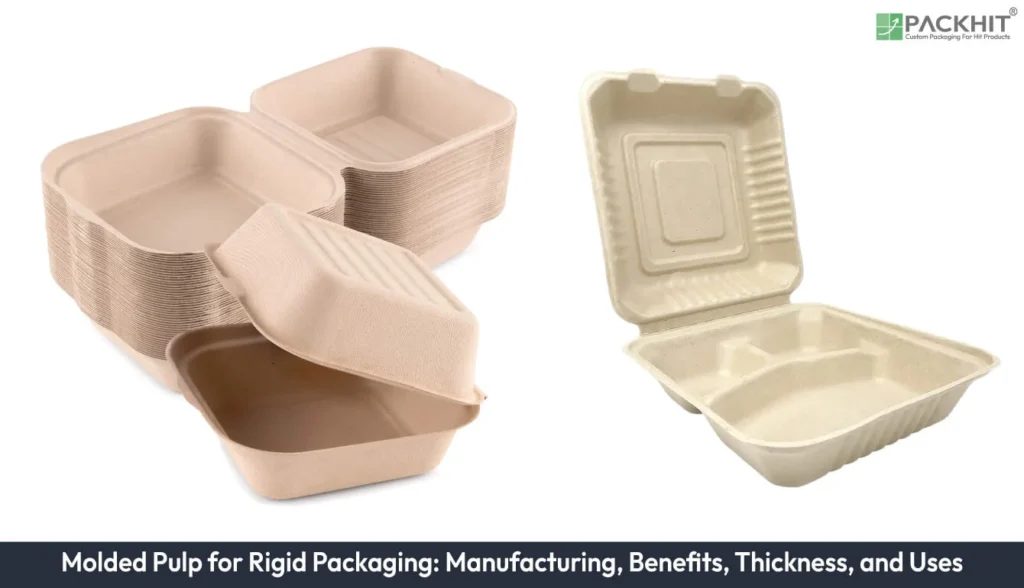
Molded pulp for rigid packaging is a fiber-based packaging material made by forming recycled paper, cardboard, or other cellulose fibers into firm, product-specific structures. Its rigidity and dimensional stability depend in part on fiber composition and molding density, while impact absorption and protective performance can change with thickness and finishing treatments that influence bonding and surface strength. The manufacturing process generally involves pulp preparation, formation, controlled drying, and trimming to achieve the required shape and structural properties. Molded pulp can offer benefits such as the use of recycled or renewable fibers, product protection, customization, and potential sustainability advantages. Its thickness is selected according to the product’s weight, fragility, and protection requirements, while common applications include consumer electronics, food and beverage packaging, industrial and automotive components, retail packaging, and e-commerce inserts.
- What is Molded Pulp for Rigid Packaging?
- How is Molded Pulp for Rigid Packaging Manufactured?
- Benefits of Molded Pulp for Rigid Packaging
- What Molded Pulp Thickness is Best for Rigid Packaging?
- Common Uses of Rigid Molded Pulp Packaging
- What are the Limitations of Molded Pulp for Rigid Packaging?
- Moisture Exposure
- Cracking and Edge Failure
- Deformation and Loss of Rigidity
- Shock and Vibration
- Dimensional Variation
- Is Molded Pulp Always the Right Choice for Rigid Packaging?
What is Molded Pulp for Rigid Packaging?
Molded pulp for rigid packaging applications refers to packaging made from fibrous pulp, typically sourced from recycled paper, cardboard, or other cellulose-based materials. Depending on the manufacturing process and application, molded pulp can be engineered to provide different levels of thickness, density, rigidity, and surface finish.
Key properties of molded pulp for rigid packaging include structural strength, resistance to deformation, impact absorption, and dimensional stability. These characteristics can be influenced by processes such as thermoforming, wet pressing, and other compression-based forming techniques. The resulting packaging can combine relatively low weight with structural support and can serve as an alternative to certain conventional rigid packaging materials.
How is Molded Pulp for Rigid Packaging Manufactured?
Molded pulp for rigid packaging is manufactured through a series of controlled processes that transform recycled paper, cardboard, or other cellulose fibers into packaging components with the required shape and structural properties. The main stages include pulp preparation and refinement, molding and forming, drying, and finishing. Each stage can affect specific outcomes such as fiber bonding, density, rigidity, dimensional accuracy, moisture resistance, and surface quality. Detailed steps are outlined below:
1. Pulp Preparation and Refinement
The process begins with preparing the raw fiber material, such as recycled paper or cardboard. The material is broken down and mixed with water to create a pulp slurry. The slurry is then refined to achieve an appropriate fiber length, consistency, and bonding behavior. Depending on the packaging requirements, additives may be incorporated to improve strength, moisture resistance, surface quality, or fiber bonding.
2. Molding and Forming
The prepared pulp slurry is transferred into molds designed according to the required shape and dimensions of the packaging. Vacuum forming can draw pulp fibers evenly onto the mold surface to create a consistent structure. For rigid packaging applications, pressure and heated molding techniques may also be used to increase fiber density, improve dimensional stability, and produce a stronger, more precise form.
3. Drying
After molding, the formed packaging contains a significant amount of moisture and therefore undergoes controlled drying. Industrial drying systems may use heated air, convection, infrared heating, or other methods to remove moisture. Proper drying helps develop rigidity and allows the packaging to retain its intended shape and dimensions.
4. Trimming and Finishing
Once dried, the molded pulp components are trimmed to remove excess material and create clean, uniform edges. Additional finishing processes may include surface smoothing, coating, printing, embossing, or lamination, depending on the product and packaging requirements. These treatments can improve appearance, moisture resistance, printability, and surface functionality.
Rather than simply adding structural support, these manufacturing stages determine how the finished package performs: fiber preparation influences bonding, compression can increase density and dimensional stability, drying helps preserve shape and rigidity, and finishing can modify surface protection and appearance.
Benefits of Molded Pulp for Rigid Packaging
Molded pulp for rigid packaging can offer environmental sustainability, cost efficiency, protective performance, and customizability, making it a packaging solution for a wide range of applications.
Environmental Sustainability
Molded pulp for rigid packaging can be produced using recycled and renewable fiber materials, helping reduce reliance on petroleum-based packaging materials. Depending on its composition, coatings, and additives, molded pulp packaging may also be recyclable, biodegradable, or compostable. Its fiber-based construction makes it an attractive option for brands seeking more sustainable packaging solutions, although the end-of-life characteristics depend on the specific formulation and treatment.
Cost Efficiency
The use of recycled fiber materials and efficient manufacturing processes can contribute to the cost-effectiveness of molded pulp packaging. Its lightweight nature can also help reduce transportation and handling costs, particularly when packaging is designed for efficient stacking and space utilization. Actual cost performance depends on tooling, production volume, material formulation, finishing requirements, and manufacturing process.
Protective Performance
Molded pulp for rigid packaging provides structural support and can help absorb shocks and vibrations during transportation and handling. Its ability to be formed into product-specific shapes allows it to hold products securely while helping minimize movement inside the package. Protection requirements should be evaluated against the product’s weight, fragility, expected handling conditions, and likely impact or vibration exposure.
Customizability
Molded pulp packaging can be customized to meet specific product and design requirements. Manufacturers can create custom molds that conform to the shape of a product, allowing for efficient space utilization and improved product presentation. Different thicknesses, shapes, textures, and surface finishes can also be incorporated depending on the application.
What Molded Pulp Thickness is Best for Rigid Packaging?
The appropriate molded pulp thickness depends on product weight, fragility, geometry, required protection, molding process, material density, and expected environmental and transportation conditions. A nominal thickness range should therefore be treated as preliminary design guidance rather than a universal specification. An approximate 1.5-6 mm range may occur across some rigid molded-pulp applications, but actual requirements can fall outside this range.
Approximately 1.5-3 mm
This range may be considered for relatively lightweight products or components where moderate structural support is sufficient, and material or package volume needs to be controlled.
It is more appropriate when:
- Product weight is relatively low
- Handling and vibration loads are moderate
- The component has adequate supporting geometry
- Moisture exposure is limited or controlled
- The package does not depend on the molded pulp wall alone for substantial cushioning
If testing shows cracking, edge damage, excessive deformation, or inadequate protection, the solution may require thicker sections, stronger geometry, different fiber density, or additional protective features.
Approximately 3-6 mm
This range may be considered where greater wall substance, rigidity, or protection is required, including some heavier or more fragile products.
It may be appropriate when:
- Product weight creates greater structural loads
- Stacking or compression loads are higher
- The package requires greater separation between the product and outer packaging
- The geometry benefits from thicker structural sections
- Additional resistance to handling deformation is required
Even within this range, thickness alone does not establish a safe stacking or load-bearing capacity. The finished design should be evaluated under its expected load and environmental conditions.
Factors to Consider When Selecting Molded Pulp Thickness
If the package must withstand substantial shock, vibration, stacking loads, or moisture exposure, simply increasing wall thickness may produce an unnecessarily heavy or bulky design without solving the underlying failure mode. Consider changing the geometry, adding ribs or cushioning features, modifying density or fiber formulation, applying an appropriate coating, or using multilayer or supplemental protective construction when:
- The component buckles or deforms under load
- Edges or corners crack or chip
- The product moves excessively during transport
- Moisture causes unacceptable softening or dimensional change
- The required protection cannot be achieved within the available package space
Final thickness should be selected from supplier specifications and package-level testing rather than from a generic thickness table.
Common Uses of Rigid Molded Pulp Packaging
Molded pulp for rigid packaging is commonly used in consumer electronics, food and beverage, industrial components, automotive applications, retail, and e-commerce because of its protective, customizable, and sustainability-related properties.
- Consumer Electronics: Used for packaging smartphones, laptops, headphones, and other electronic products. Its cushioning and structural support help protect delicate components during shipping and handling.
- Food and Beverage: Commonly used for egg cartons, drink carriers, food trays, and other food packaging applications. Its fiber-based composition and potential recyclability make it suitable for brands focusing on more sustainable packaging solutions.
- Industrial and Automotive Components: Used to package gears, bearings, mechanical parts, and other precision components. Its structural properties help hold components securely and reduce the risk of damage during transportation and handling.
- Retail and E-Commerce: Used for custom inserts, product trays, and protective packaging. Its customizable design, attractive appearance, and fiber-based construction can enhance product presentation while protecting shipping.
What are the Limitations of Molded Pulp for Rigid Packaging?
Molded pulp should not be treated as a universally rigid or moisture-resistant material. Its failure behavior depends on fiber formulation, density, wall thickness, geometry, drying, finishing, and environmental conditions.
Moisture Exposure
Uncoated molded pulp can absorb moisture, which may reduce stiffness, alter dimensions, soften edges, or contribute to deformation under sustained exposure. Coatings or laminations may improve resistance, but their effectiveness depends on the specific treatment and exposure conditions.
There is no single moisture-exposure limit that applies to all molded pulp products. Where humidity, condensation, liquid contact, refrigeration, or wet handling is expected, the selected construction should be tested under representative conditions rather than relying on a generic moisture-resistance claim.
Cracking and Edge Failure
Thin sections, sharp corners, narrow ribs, and poorly supported transitions can be more susceptible to cracking, chipping, or edge damage during demolding, assembly, or handling. Increasing thickness can help in some designs, but geometry, fiber distribution, density, and mold design also affect failure behavior.
Where edge integrity is critical, manufacturers should evaluate trimmed edges, corners, apertures, and other stress-concentration areas rather than assessing only the average wall thickness.
Deformation and Loss of Rigidity
Molded pulp can deform when exposed to loads or environmental conditions beyond the design basis. Sustained stacking loads, localized compression, high humidity, temperature variation, or insufficient structural support can contribute to creep, buckling, or dimensional change.
A thickness value should therefore not be interpreted as a guaranteed load-bearing capacity. Stacking and compression requirements should be established from the finished package geometry, product weight, stacking configuration, environmental conditions, and required safety margin, then validated through appropriate testing.
Shock and Vibration
Molded pulp can help restrain products and absorb or distribute some impact energy, but protection depends on the complete package design. A component that is sufficiently rigid for static loading may not provide adequate protection against drops, shock, or vibration.
For fragile products, package validation should consider representative transportation hazards rather than relying only on material thickness or nominal strength.
Dimensional Variation
Drying conditions, fiber distribution, molding pressure, material formulation, and geometry can influence final dimensions. Tight-fitting inserts or components with precise product-location requirements may therefore require tighter process control and dimensional verification.
Is Molded Pulp Always the Right Choice for Rigid Packaging?
Molded pulp can be a suitable option when a package requires shaped fiber-based protection, product-specific positioning, or a balance of structural support and material efficiency. Selection should be based on measurable requirements rather than material type alone.
Before finalizing a molded pulp specification, manufacturers should evaluate:
- Product weight and fragility
- Wall thickness and fiber density
- Mold geometry and structural features
- Shock and vibration exposure
- Stacking and compression loads
- Moisture, humidity, condensation, or liquid exposure
- Dimensional tolerances
- Surface and finishing requirements
- Food-contact or other regulatory requirements, where applicable
- Expected production volume and tooling requirements
- End-of-life requirements for the complete construction
Supplier specifications should be used to establish material properties, while package-level testing should be used to determine whether the finished design performs adequately under representative handling, stacking, transportation, and environmental conditions. Where a specific safety or performance threshold is required, it should be established from the product and packaging design requirements rather than inferred from molded pulp thickness alone.