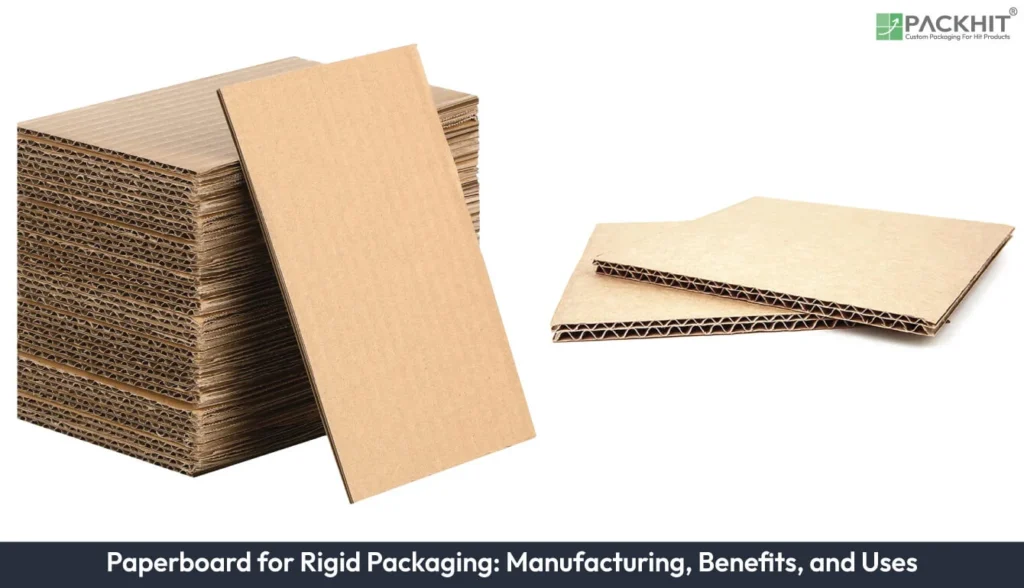
Paperboard is a thick, stiff paper-based material used in packaging applications that require greater structure and support than ordinary paper. Its fiber composition, ply structure, thickness, density, and surface treatments influence properties such as stiffness, strength, printability, moisture resistance, and converting performance. Paperboard is available in grades such as solid bleached sulfate (SBS), coated unbleached kraft (CUK), and recycled paperboard, with each offering different characteristics for specific packaging requirements. Its manufacturing involves fiber preparation, sheet formation, drying, and, where required, coating or finishing. Paperboard is widely used for food and beverage cartons, electronics packaging, consumer goods, and luxury and gift packaging because it combines structural support, printability, customization, and relatively low weight.
What is Paperboard?
Paperboard is a relatively thick, stiff paper-based sheet material designed for applications that require more structure than ordinary paper. Industry definitions commonly distinguish paperboard from paper by basis weight and thickness, but the exact classification threshold can vary by standard, manufacturer, and product type; therefore, a value such as 224 GSM should be treated as a general reference rather than a universal cutoff.
Paperboard can be engineered with different fiber compositions, ply structures, thicknesses, and surface treatments. These characteristics influence stiffness, surface smoothness, print performance, moisture resistance, and converting behavior.
Its main packaging function is to provide a combination of structural support, product presentation, and handling protection. For example, a board with sufficient stiffness can help a carton maintain its shape during stacking and transportation, while a suitable coated surface can support detailed graphics and finishing.
Grades of Paperboard in Rigid Packaging
Paperboard is available in several grades, including solid bleached sulfate (SBS), coated unbleached kraft (CUK), and recycled paperboard. Their properties vary by manufacturer and specification, so the grade name alone should not be treated as a guarantee of a particular performance level.
- SBS: Often selected when a smooth, bright surface and high-quality graphics or premium finishing are important. Its surface characteristics can make it suitable for applications involving detailed printing, foil stamping, or embossing. The trade-off is that the specific board’s cost, stiffness, and moisture performance still depend on its construction and coating.
- CUK: Often selected when a natural kraft appearance, packaging durability, and a fiber-based visual identity are priorities. The brown or natural surface can influence color reproduction and may require different print treatment than a bright SBS surface. Moisture or grease exposure may also require an appropriate coating or barrier.
- Recycled paperboard: Can be selected when recycled fiber content and cost considerations are important. Surface appearance, stiffness, color, and print characteristics can differ according to the recycled fiber content and manufacturing process, so the specification should be checked against the requirements of the finished package.
How is Paperboard Manufactured for Rigid Packaging?
Paperboard for rigid packaging is produced by preparing fibers, forming and consolidating the sheet, drying it, and applying surface treatments or finishing processes when required. The exact process varies by grade and manufacturer, and these process differences can affect strength, smoothness, printability, and barrier performance.
1. Pulping and Fiber Sourcing
Paperboard production generally begins with virgin wood fibers, recovered fibers, or a combination of fiber sources. Mechanical and chemical processing can be used to prepare the fibers for sheet formation.
Fiber type and processing influence characteristics such as strength, brightness, surface quality, and recyclability. For manufacturers, this means that two boards with similar GSM can still behave differently during folding, printing, or transportation.
2. Sheet Formation and Layering
Prepared fibers are formed into a wet sheet and consolidated through pressing and drying. Some paperboards use multiple plies, allowing different layers to contribute different functions, such as surface quality, bulk, stiffness, or internal strength.
Board thickness and stiffness are affected by the combination of basis weight, fiber properties, density, and construction. Consequently, GSM should not be used by itself to predict how rigid a finished package will be.
3. Coating and Finishing
Paperboard may receive coatings, laminations, or other surface treatments to modify properties such as print appearance, moisture resistance, grease resistance, or surface smoothness. Common coating systems and barrier structures vary according to the intended application.
In practice, the coating or barrier should match the product’s exposure conditions. A package exposed to moisture or grease may require a suitable barrier, while a package designed primarily for premium graphics may place greater emphasis on surface smoothness and print quality. Adding a coating can also affect recyclability, converting behavior, cost, and the package’s end-of-life options, so the performance benefit should be weighed against these considerations.
What are the Benefits of Using Paperboard in Rigid Packaging?
Paperboard can combine structural support, relatively low weight, printability, and design flexibility in a single packaging material, but its performance depends on the selected grade and construction.
- Lightweight: Paperboard is lighter than many rigid packaging materials, helping reduce shipping and handling costs.
- Strong and durable: Provides good structural strength and protects products during storage and transportation.
- Eco-friendly: Often made from renewable fibers and can be recyclable, depending on the coating and composition.
- Customizable: Can be easily cut, folded, printed, embossed, and shaped into attractive packaging designs.
- Excellent printability: Offers a smooth surface for high-quality graphics, branding, product information, and promotional messages.
- Cost-effective: Generally more affordable to produce and customize than many alternative rigid packaging materials.
- Good product protection: Helps protect products from dust, light, minor impacts, and handling damage.
- Space-efficient: Can be designed to stack efficiently, saving storage and transportation space.
- Supports sustainability goals: Recyclable paperboard packaging can help brands reduce reliance on plastic and improve their environmental image.
For this reason, manufacturers should evaluate the actual material construction and the recycling requirements of the target market rather than making a blanket claim that every paperboard package is recyclable. Where applicable, recycled or responsibly sourced fiber content can also form part of a broader material-sourcing strategy.
What are the Common Uses of Paperboard in Rigid Packaging?
Paperboard is commonly used in rigid packaging for food and beverage containers, electronics boxes, and luxury gift packaging due to its strength, versatility, and eco-friendly attributes.
Food and Beverage Packaging
Paperboard is used for applications such as cereal cartons, frozen-food cartons, and beverage carriers. Where the package encounters moisture, condensation, or grease, the board and barrier system should be selected for those conditions rather than relying on the base paperboard alone.
For food-contact applications, manufacturers must also verify that the complete packaging construction meets the applicable food-contact requirements for the intended market and use.
Electronics and Consumer Goods
Paperboard can be converted into cartons and boxes for electronics, accessories, and other consumer products. Die-cut structures can accommodate inserts and compartments, helping position products during handling and transportation.
For fragile or high-value electronics, however, the board should be evaluated together with the inserts and overall package design because paperboard thickness alone does not determine impact protection.
Luxury and Gift Packaging
Premium packaging often emphasizes surface appearance, color reproduction, tactile quality, and finishing. SBS and other smooth-surface grades may be suitable where detailed graphics, embossing, or foil effects are required.
The practical trade-off is that premium finishes can increase cost and introduce additional production steps. The board, coating, ink, and finishing process should therefore be tested together before large-scale production.
How Should Manufacturers Choose Between Paperboard Grades?
The best paperboard grade depends on the balance between print and finish requirements, structural performance, product exposure, appearance, cost, and end-of-life requirements.
| Requirement | Selection Consideration | Practical Trade-off |
|---|---|---|
| High-detail graphics and premium finishes | Consider a smooth, bright grade such as SBS | May involve higher material or finishing costs |
| Natural kraft appearance and durability | Consider CUK or another kraft-based grade | Natural color can affect printed color reproduction |
| Recycled-fiber objectives | Consider recycled paperboard with a suitable specification | Surface uniformity, color, stiffness, and printability may differ by grade |
| Moisture exposure | Specify an appropriate coating or barrier | Barrier systems can affect cost, converting, and recyclability |
| Grease exposure | Select a board and barrier system designed for the expected contact | Not every paperboard coating provides the same grease resistance |
| High stacking or transit loads | Evaluate thickness, stiffness, compression performance, and package geometry | Increasing GSM alone may not deliver the required structural performance |
| Premium tactile presentation | Prioritize surface quality and compatible finishing processes | Foil, embossing, lamination, and other finishes add process requirements |
For manufacturers, the key decision is not simply choosing the highest GSM or thickest board. The board should be specified according to the actual failure risk: loss of shape during stacking, moisture or grease penetration, poor print reproduction, cracking during creasing, surface damage, or inadequate protection during transit.